BLOG
Best air quality monitors for home
 By Nangyal Khan··Updated
 16 min read

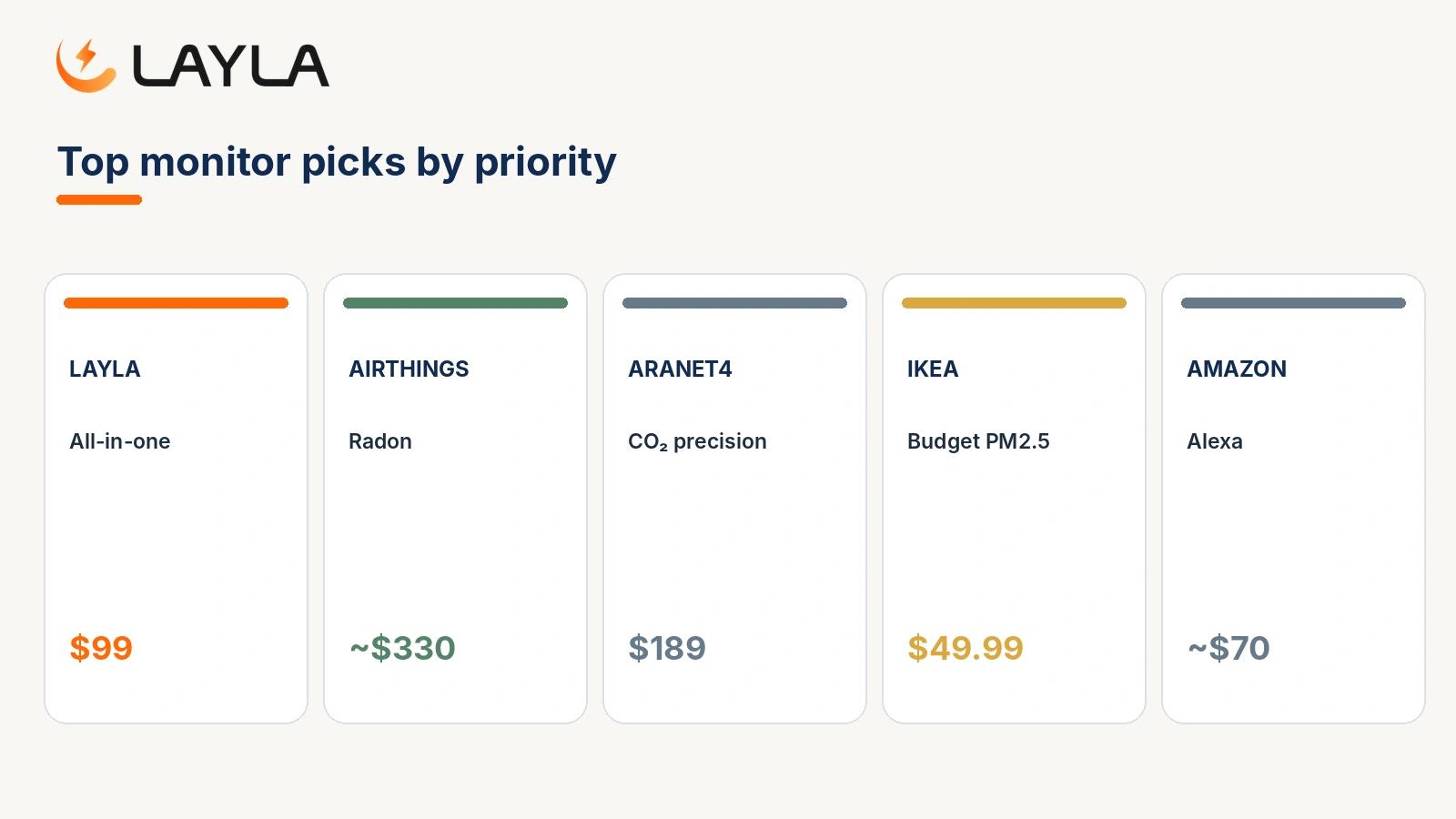
The best air quality monitors for home give you an honest, real-time picture of what you're breathing indoors without locking you into a subscription or a hub you don't want. For most people, the best all-around pick is Layla, which rolls CO2, particulates, VOCs, humidity and smoke type-ID into one device for a one-time $99. If your main worry is radon, Airthings is the stronger choice. For a reference-grade CO2 reading, Aranet4 wins. And if you just want a cheap glanceable readout, IKEA's Vindstyrka or Amazon's monitor cover specific needs well.
Below, we start with what actually matters when you compare the best indoor air quality monitors, then go device by device. No single monitor wins on everything, so each pick gets a plain "best for" and an honest note on where it falls short.
How we picked and what to look for
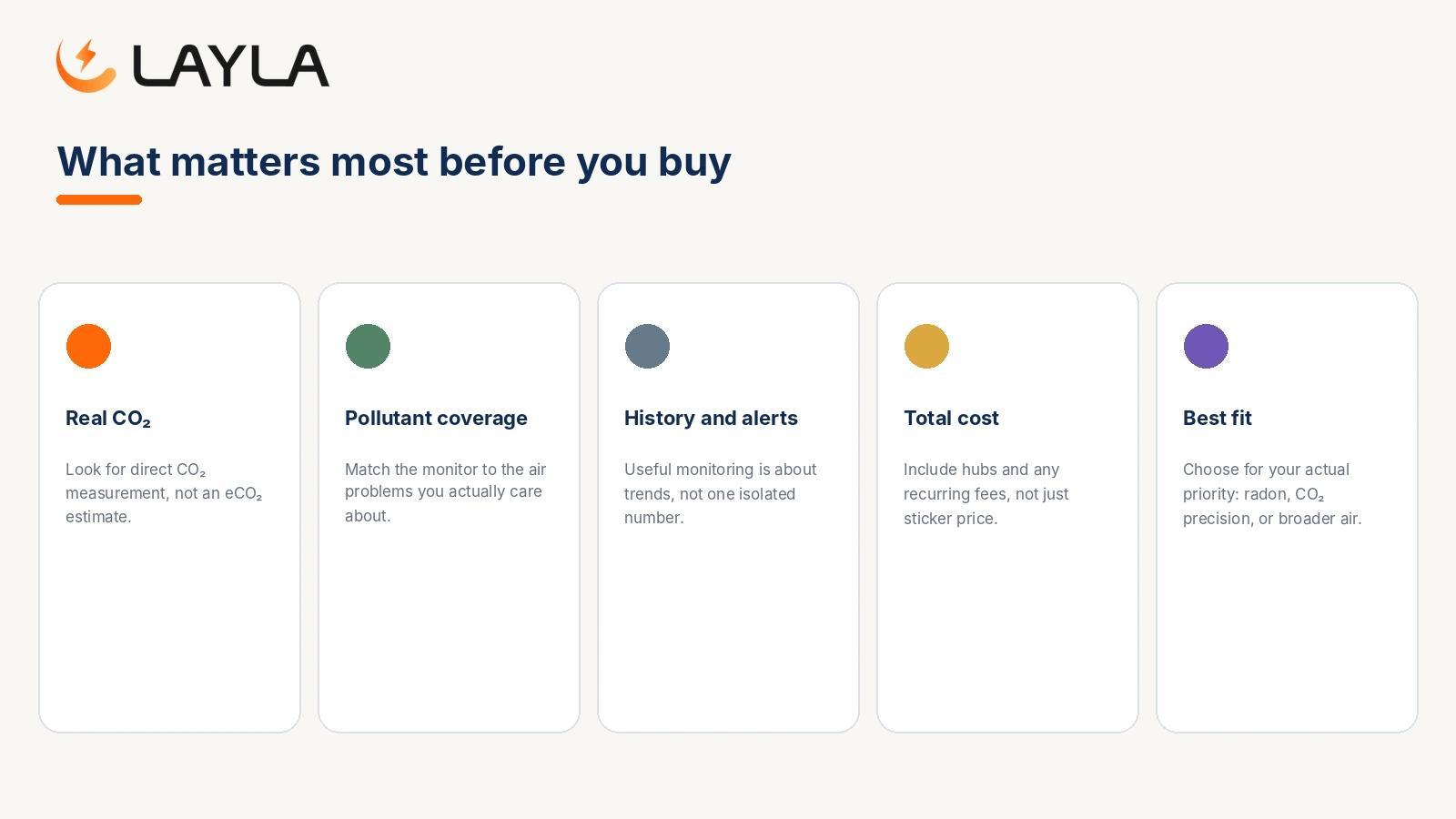
A good home air quality monitor should measure the things that actually shift how a room feels and how well you sleep, and it should report them in a way you can act on. Here's what separates a genuinely useful monitor from a gadget — and what we weighted when ranking the picks below.
Start with how it measures CO2. The gold standard is a true NDIR sensor, which reads carbon dioxide directly by measuring how much infrared light the gas absorbs. Cheaper devices often skip the real sensor and estimate "eCO2" from VOC readings instead, which is a modelled guess rather than a measurement. It drifts over time, reacts to things that have nothing to do with how many people are in the room, and can land hundreds of parts per million off the truth. A smaller group of monitors don't report CO2 at all, so stuffiness never shows up no matter how closed the room gets. If sleep quality, focus and ventilation are what you care about, insist on real NDIR and treat "eCO2 only" or "no CO2" as a hard limitation. Our CO2 monitor for home guide explains the difference in plain terms, and CO2 levels in your home covers what the numbers mean once you have them.
Next, check particulate and VOC coverage. PM2.5 is the fine-dust reading that matters most for day-to-day air, because those particles are small enough to stay suspended and reach deep into the lungs. What drives PM2.5 in a normal home is predictable once you know to watch for it: frying and searing on the stove, toast and candles, dust stirred up by cleaning or pets, and wildfire smoke drifting in through windows and gaps during fire season. A monitor that surfaces those spikes turns an invisible problem into something you can manage, which matters a lot if anyone in the house has allergies or asthma, as covered in our air quality monitor for allergies guide. VOC sensors cover the other half of the picture, flagging the off-gassing from fresh paint, cleaning sprays and new furniture, and good monitors report these as a single total VOC (TVOC) figure rather than naming individual compounds. A device that tracks both PM2.5 and TVOC, explained further in dust and PM2.5 in your home and what VOCs are in your home, gives you the fullest view of everyday air.
Humidity deserves its own mention, because it's your earliest warning for mold risk. No consumer home monitor detects mold spores, and you should be wary of any product that claims it does. What a monitor can do is track the humidity conditions that let mold take hold: mold needs sustained damp to establish, so a reading that keeps creeping above the mid-60s percent in a bathroom, basement or behind furniture is a warning you can get days or weeks before anything becomes visible. Catching that trend lets you ventilate, run a dehumidifier or fix the source before it turns into a cleanup job. See what humidity level prevents mold for the target range and the honest explainer on whether an air monitor can detect mold for what the hardware can and can't tell you.
Then there's the ongoing-cost trap, and it's the one that catches people out most often. Some monitors show a live reading for free but lock history, trend charts, alerts and remote access behind a paid hub or a monthly subscription. A $50 device that needs a $140 hub to do anything useful is really a $190 device — and a cheap monitor on a monthly plan quietly becomes the most expensive option over a few years. The sticker price isn't the whole price, so decide up front whether paying monthly suits you or a one-time purchase with no running cost fits better.
A few smaller things round it out, and they matter more in daily life than the spec sheet suggests. A built-in screen lets you glance at a reading on your way past without digging out your phone, which is the difference between a monitor you actually check and one you forget about; app-only devices keep the hardware cheaper but lean on you opening an app. Privacy is worth a hard look too. An air quality monitor has no business carrying a camera or a microphone, so confirm there's neither before you put one in a bedroom or child's room. And watch the CO2-versus-CO distinction closely, because many products badged "air monitor" measure one and not the other, and the two letters hide a serious safety difference. CO2 is the stuffiness gas you exhale, which builds up in closed rooms and dulls sleep and concentration; carbon monoxide (CO) is the poisonous combustion gas from faulty heaters, stoves and flues that needs its own certified alarm. Our CO2 detector vs CO detector piece untangles the two. Whichever you buy, no air quality monitor replaces a certified CO or fire alarm.
Layla 3.0 — best all-in-one monitor
Layla is the best all-in-one home air quality monitor and the best value, because one device covers your whole air picture plus smoke type-ID with no subscription. It reads CO2, total VOCs, PM2.5 and an overall air-quality index, along with temperature and humidity, so the stuffiness, dust, off-gassing and mold-risk conditions all land on a single screen and in one app.
The smoke sensing is where it pulls away from the field. Layla can tell cigarette, vape and cannabis smoke apart rather than just noticing "something," which is genuinely unusual at this price. The humidity tracking doubles as an early mold-risk warning, flagging the damp conditions that let mold start, and you can read more on handling that in how to prevent mold in your home. There's no camera and no microphone, so the privacy story is clean, and on higher tiers the wider Layla system adds noise sensing, radar-based occupancy detection and AC automation with an Eco Mode.
Price is the clincher. The air quality tier is a one-time $99, down from $189, with nothing to pay monthly, and the full all-in-one setup runs $299. You can see the sensor at layla.eco/air-quality and the tiers at layla.eco/pricing.
Where it stops: Layla doesn't measure radon, and it reports total VOCs rather than naming individual compounds. If radon is your specific concern, read on to the next pick. For most households wanting broad, everyday coverage without a running bill, it's the one to beat.
Airthings View Plus — best for radon monitoring
Airthings View Plus is the best choice for homes that want radon monitoring alongside core air quality. It's a seven-sensor device that tracks radon, PM2.5, CO2, VOCs, temperature, humidity and barometric pressure, which makes it unusually comprehensive on the radon front where most monitors simply don't go.
Radon is a colourless, odourless gas that seeps up from the ground, and it's a real concern in a lot of regions, especially in basements and lower floors. If you live somewhere with known radon issues, a monitor that watches it continuously is worth the premium. The View Plus runs around $330, and there's no consumer subscription required to use it.
One caveat for home buyers: noise and light monitoring are reserved for a business plan, so you won't get those here. For radon plus solid all-round air tracking, though, it's the specialist pick. We go deeper in Layla vs Airthings if you're weighing the two directly.
Aranet4 Home — best for a trusted CO2 reading
Aranet4 Home is the best monitor if you want the most trusted dedicated CO2 reading plus real portability. It uses a true NDIR sensor for reference-grade carbon dioxide accuracy, alongside temperature, humidity and pressure, and it's become the device a lot of researchers and ventilation nerds reach for.
The design leans into that single-minded focus. A crisp e-ink display shows the reading at a glance along with a simple green-amber-red indicator, so even someone who never opens the app can tell when a room needs airing out. It talks to your phone over local Bluetooth with no cloud account required, and the battery life is genuinely remarkable: up to four years on alkaline cells and as long as nine on lithium. Because it runs on batteries and weighs almost nothing, it's easy to carry from the bedroom at night to a stuffy home office by day. It sells for $189 with no subscription.
What you give up is breadth. Aranet4 measures CO2 and nothing in the way of PM2.5, VOCs or radon, so it's a specialist, not an all-rounder. If CO2 is the one number you care about most, it's the specialist to beat for that one reading. See Layla vs Aranet4 for the trade-off against a broader device, and best CO2 monitors for more dedicated options.
IKEA Vindstyrka — best cheap glanceable PM2.5 readout
IKEA's Vindstyrka is the best cheap glanceable PM2.5 readout, and a natural fit for households already living in the IKEA smart-home world. At $49.99 it's remarkably affordable, and it uses a well-regarded Sensirion sensor to track PM2.5, total VOCs, temperature and humidity on a simple front display you can read from across the room.
For a bedroom, a kitchen or a kid's room where you just want to see whether the air is clean right now, it does the job cheaply and cheerfully. The Sensirion particulate sensor is the same class of component found in far pricier devices, so the PM2.5 readout is more trustworthy than the price tag suggests. If you're already building out IKEA's smart-home ecosystem, it slots in neatly alongside the rest.
The catches are worth knowing before you buy. It doesn't measure CO2 at all, so stuffiness won't show up. And while the live readout works standalone, history, alerts and remote access require IKEA's DIRIGERA hub at $139.99, which more than quadruples the real cost if you want those features. As a standalone glance-and-go dust gauge, though, nothing beats the entry price. More detail in Layla vs IKEA Vindstyrka.
Amazon Smart Air Quality Monitor — best cheap pick for Alexa homes
The Amazon Smart Air Quality Monitor is the best cheap option for Alexa households that also want a carbon monoxide reading. It tracks PM2.5, VOCs, carbon monoxide, humidity and temperature, and it typically sells for around $70, often dropping to $45 to $50 on the street, which is about as low as a multi-sensor monitor goes.
The CO reading is the quietly useful part here, since it's an actual carbon monoxide sensor rather than CO2, giving you a basic combustion-gas heads-up as a supplement to your alarms (though it still isn't a replacement for a certified CO alarm). If you've already built your home around Alexa, the integration is seamless: alerts route straight through your Echo, you can ask for the current reading by voice, and a smart plug can kick on an air purifier when particulates spike. For anyone living an Alexa-first routine, that hands-free loop is the real draw.
The compromises keep it firmly in budget territory. There's no screen, so you lean on the app and voice; it won't work without Alexa; you can't export your data; and the alert thresholds are fixed rather than customisable. For a cheap, voice-first monitor with a CO reading in an Alexa home, it fits. See Layla vs Amazon Smart Air Quality Monitor for the fuller comparison.
A note on Awair Element
Awair Element was long a top pick, measuring PM2.5, VOCs, CO2, temperature and humidity in a well-liked package, but it's now effectively discontinued. It disappeared from Amazon around April 2026, the price roughly doubled to about $299 wherever it's still listed, and the company appears to be winding down. We don't recommend it as a current buy. If you were eyeing one, our Awair Element alternative guide covers what to get instead.
How to place and use a home air quality monitor
Where you put a monitor changes what it tells you, so a few placement habits are worth getting right. Keep it at roughly breathing height, somewhere between a tabletop and head level, rather than on the floor or a high shelf where readings stop reflecting the air you're actually in. Give it a little clearance from walls and corners so air can move around the sensor freely. And keep it away from spots that will skew the numbers: next to the stove, directly under a vent, beside an open window or in the path of a humidifier will all push readings in misleading directions.
Think about which room matters most to you. The bedroom is the usual priority, since CO2 climbs overnight behind a closed door and poor air shows up as restless sleep and morning grogginess; our guide to indoor air quality and your health covers why that matters. The kitchen is the place to watch PM2.5, since cooking is the biggest everyday source of indoor particulates, while basements and bathrooms are where humidity and mold risk deserve attention. If you only have one monitor, start where you spend the most hours, and if your pick is portable, like the Aranet4, move it around over a week to build a picture of the whole home before settling it in one spot.
Once it's running, give the numbers a few days before you react, so you learn what normal looks like rather than chasing a single spike. From there the pattern is simple. When CO2 rises, open a door or window; when PM2.5 jumps as you cook, switch on the extractor fan; when humidity drifts high, ventilate or run a dehumidifier. A monitor that logs history and sends alerts, which the Layla app does, makes those trends easy to spot. And the monitor's job is to inform you, not to clean the air or stand in for a certified CO or fire alarm.
At a glance
| Monitor | Price | What it measures | CO2? | Subscription / hub | Best for |
|---|---|---|---|---|---|
| Layla 3.0 | From $99 one-time, no subscription | CO2, TVOC, PM2.5, AQI, temp, humidity, smoke type-ID | Yes (NDIR) | None | Best all-in-one and best value |
| Airthings View Plus | ~$330 | Radon, PM2.5, CO2, VOC, temp, humidity, pressure | Yes | None (consumer) | Radon plus core air quality |
| Aranet4 Home | $189, no subscription | CO2, temp, humidity, pressure | Yes (NDIR) | None | Trusted CO2 reading and portability |
| IKEA Vindstyrka | $49.99 (hub $139.99 for history) | PM2.5, TVOC, temp, humidity | No | DIRIGERA hub for alerts/history | Cheap glanceable PM2.5 readout |
| Amazon Smart Air Quality Monitor | ~$70 (street ~$45–50) | PM2.5, VOC, CO, temp, humidity | No (measures CO) | Alexa required | Cheap pick for Alexa homes |
| Awair Element | ~$299 (discontinued) | PM2.5, VOC, CO2, temp, humidity | Yes | None | Formerly a top pick, now discontinued |
Frequently asked questions
What is the best air quality monitor for home overall?
For most households, Layla is the best all-around home air quality monitor. It covers CO2, PM2.5, VOCs, humidity and an overall air-quality index in one device, adds smoke type-ID that tells cigarette, vape and cannabis apart, and carries no subscription at a one-time $99. Pick a specialist instead if radon or reference-grade CO2 is your single priority.
Do I need a monitor that measures CO2 or CO?
Both matter, but they're different. CO2 is the stuffiness gas that builds up in closed rooms and affects sleep and focus; CO is poisonous combustion gas that needs a dedicated certified alarm. Layla, Airthings and Aranet4 read CO2, while the Amazon monitor reads CO. No air quality monitor replaces a certified CO or fire alarm.
Can an air quality monitor detect mold?
No consumer monitor detects mold spores. What good monitors like Layla do is track the humidity conditions that let mold grow, giving you an early warning before it starts. Keeping indoor humidity in the right range is the real lever, as covered in our humidity and mold guides.
Which monitor is best for radon?
Airthings View Plus is the clear radon pick. It's one of the few home monitors with a built-in radon sensor, which matters most in basements and lower floors in radon-prone regions. Layla and the other monitors here do not measure radon.
Is a subscription or hub required?
It depends on the device. Layla, Aranet4 and Airthings work without a consumer subscription. IKEA's Vindstyrka needs the DIRIGERA hub for history and alerts, and the Amazon monitor needs Alexa to function. Factor the ongoing or add-on cost in before you compare sticker prices.
Which is the best value?
Layla is the best value because a single one-time $99 buys CO2, particulates, VOCs, humidity and smoke type-ID with nothing to pay monthly. Vindstyrka is cheaper up front at $49.99 but lacks CO2 and needs a $139.99 hub for its full feature set.
Where should I place a home air quality monitor?
Put it at breathing height, around tabletop to head level, with a little space from walls and away from the stove, vents, open windows and humidifiers so the readings reflect the real air. The bedroom is the most common choice because CO2 builds up overnight, while the kitchen is the place to watch PM2.5 from cooking. If your monitor is portable you can move it room to room over a week first; Layla is designed to sit in one spot and track the whole picture continuously.
Can an air quality monitor tell different types of smoke apart?
Most can't, but Layla can. Its smoke sensing distinguishes cigarette, vape and cannabis smoke rather than simply noticing that something is in the air, which is unusual at any price and especially at a one-time $99. That type-ID is useful when you want to know not just that there's smoke but what kind. It is a smoke-awareness feature, not a replacement for a certified smoke or fire alarm.
Related reading

Best for: health-conscious homes
Smoke & Air Quality
Air quality, mold and smoke monitoring for healthy homes and smoke-free rentals.
Included forever — no subscription
- Mold-risk early warning
- Smoke & cigarette detection
- Air quality score (IAQ) with alerts
- CO₂ & bVOC monitoring
- AI air insights & recommendations
- Allergy-comfort monitoring
No monthly fees. Ever.
30-day money back guarantee