BLOG
Best CO2 monitors for your home, honestly compared
 By Nangyal Khan··Updated
 16 min read

If you want the most accurate dedicated carbon dioxide reading, the Aranet4 Home is the benchmark the whole category is measured against. If you want real CO2 plus the rest of your air picture in one device at a lower price, Layla 3.0 is the best all-in-one. And if you want CO2 alongside radon, the Airthings View Plus covers both. That is the short version of the best CO2 monitors in 2026, and the rest of this guide explains why, including a warning most roundups skip: several popular "air quality monitors" don't measure CO2 at all.
That last point matters more than price. Carbon dioxide is the clearest indoor signal you have for ventilation, sleep quality, and afternoon focus, yet a surprising number of well-reviewed devices either estimate it from something else or track a different gas entirely. Two of the most popular budget picks, the IKEA Vindstyrka and the Amazon Smart Air Quality Monitor, don't read CO2 at all. So before you compare features, it helps to understand what separates a real CO2 monitor from a lookalike. If you only remember one thing, make it this — the three letters NDIR on a product page are worth more than any star rating.
How to choose a CO2 monitor
A real CO2 monitor uses an NDIR sensor, measures the gas directly, and does not confuse carbon dioxide with carbon monoxide. Get those straight and most of the marketing fog in this category clears. Here is what each one means when you're staring at a spec sheet.
NDIR vs eCO2, the one spec that decides everything
Sensor type is the thing that quietly sorts real monitors from the imposters. A true CO2 sensor uses NDIR, short for nondispersive infrared, which measures the gas directly by how much infrared light it absorbs. CO2 soaks up a specific wavelength, so the sensor shines a tiny light through a sample of air and converts the shortfall into a parts-per-million reading. It is a physical measurement of the actual gas, which is why it's accurate and why it costs more.
Cheaper devices advertise "eCO2" or "equivalent CO2," and the word to notice is equivalent. It is not a CO2 measurement at all. An eCO2 number is a guess, derived from volatile organic compounds by a metal-oxide sensor that reacts to a broad soup of chemicals and then assumes those chemicals rose in step with CO2. Often they don't. Cook dinner, wipe a counter with cleaning spray, or spritz deodorant near an eCO2 meter and the number rockets to 2,000 or 3,000 ppm even though the real carbon dioxide hasn't moved an inch; the sensor is reacting to the fumes, not to your breathing. The moments when you most want a trustworthy reading, like cooking in a closed kitchen, are exactly when an eCO2 sensor is least trustworthy.
How do you spot it on a spec sheet before you buy? Look for the literal letters NDIR and a stated accuracy figure in ppm, something like ±50 ppm; a genuine CO2 sensor is a selling point, so manufacturers name it. If the page says "eCO2," "equivalent CO2," "estimated CO2," or just lists an "air quality index" with no sensor named, treat it as an estimate and move on. Our guide to choosing a CO2 monitor for home goes deeper, and because eCO2 is really a VOC reading wearing a CO2 label, it helps to understand what VOCs actually are before you shop.
CO2 is not CO, the gas mix-up that trips up buyers
CO2 is not CO, and a CO2 monitor is not a CO detector. The single-letter difference trips up more shoppers than any other thing in this category. Carbon dioxide (CO2) is a comfort and ventilation signal; it builds up as people breathe in a closed room and tells you, long before you consciously notice, when the air has gone stale. Carbon monoxide (CO) is something else entirely, a poisonous, odorless combustion gas from furnaces, gas stoves, fireplaces, and car engines. It can be dangerous at concentrations a CO2 monitor would never flag, and it needs its own separate, certified CO alarm, full stop.
A device that measures one of these gases does not measure the other, and no air-quality monitor replaces a proper CO alarm on your wall. We break the distinction down in CO2 detector vs CO detector, and it's the exact trap behind one of the budget monitors below, which measures CO and is very easy to mistake for a CO2 reader at a glance.
What the numbers mean, and where to watch them
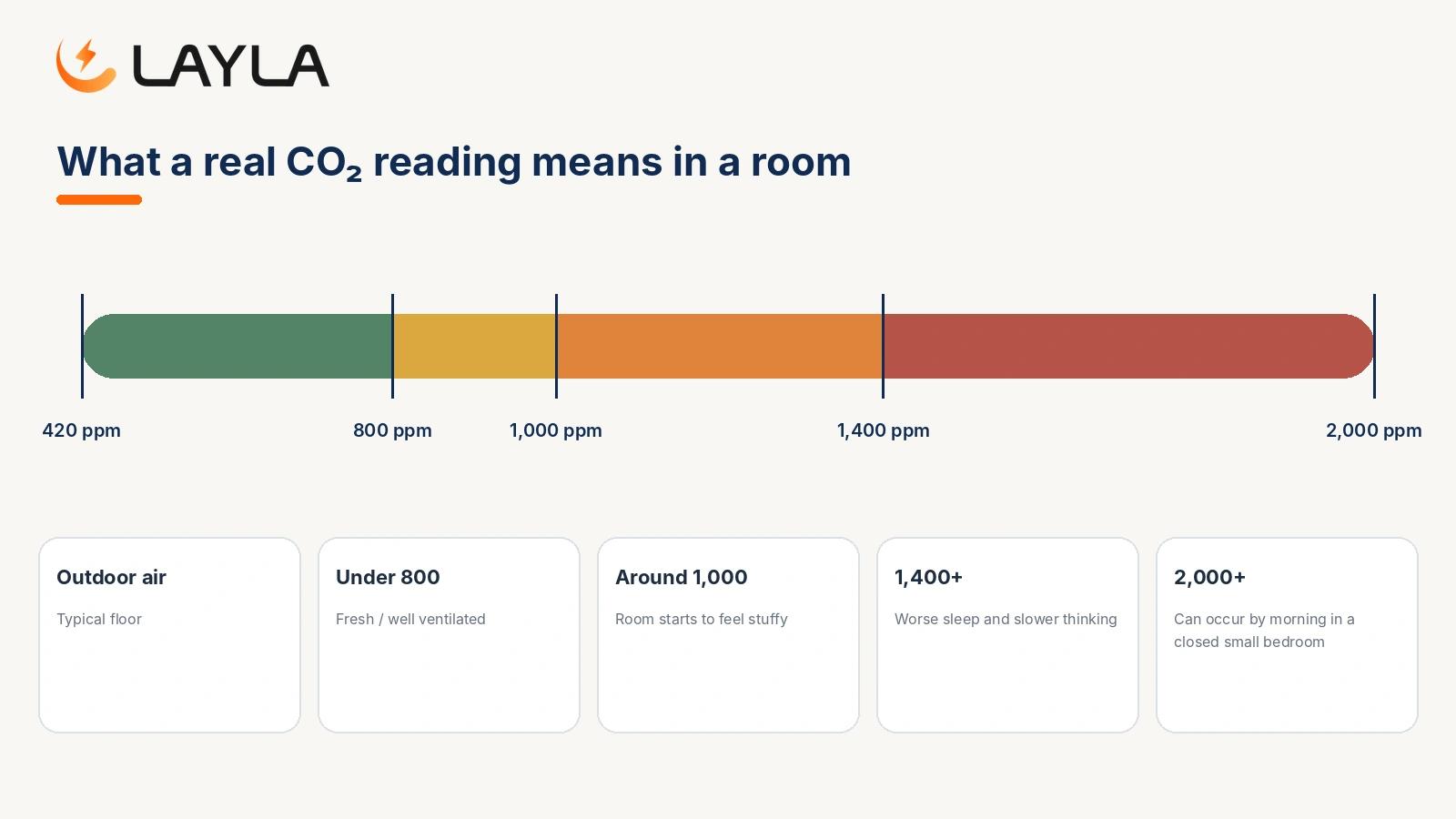
Once you have a real NDIR reading, the numbers are easy to interpret. Outdoor air sits around 420 ppm, and that's your floor; indoor air is almost always higher. Under 800 ppm indoors is fresh and well ventilated. Around 1,000 ppm is where most people start to feel the room is stuffy and attention begins to slip. Sustained levels of 1,400 ppm and up are linked in research to worse sleep and measurably slower thinking, which is why bedrooms and home offices are the two rooms worth watching above all others.
The bedroom is the sleeper case, literally — close the door overnight in a small room with no ventilation and CO2 can climb past 2,000 ppm by morning without anyone noticing, because the buildup is gradual and you're asleep through it. A cracked window or a trickle vent fixes it cheaply. There's more detail in what healthy CO2 levels look like at home and in how CO2 affects sleep in the bedroom.
Placement, sampling, and calibration
A few practical habits make any monitor more honest. Keep the sensor at roughly seated or sleeping head height, away from open windows, HVAC vents, and doorways where moving air reads falsely low, and well away from your own face, since breathing on it spikes the number. A desk corner or a nightstand works well; a windowsill does not. CO2 drifts over minutes rather than seconds, so a device that logs every minute or two captures the real trend while sipping battery. Calibration mostly takes care of itself: quality NDIR monitors run automatic baseline correction, treating their lowest reading over a week or two as fresh outdoor air near 420 ppm, so you just let the device breathe real fresh air now and then, which happens on its own in any normal home.
With the fundamentals settled, here are the monitors that genuinely measure CO2, and after them, the two popular picks that don't.
Aranet4 Home: the most trusted dedicated CO2 reading
The Aranet4 Home is the most accurate and most trusted single-purpose CO2 monitor you can buy, and it deserves that reputation plainly. It uses a true NDIR sensor rated to roughly ±(30 ppm + 3%), which is the figure other monitors get held up against. Alongside CO2 it tracks temperature, humidity, and barometric pressure — and that's the full list, by design.
What makes it a classic is the hardware around that sensor. The e-ink screen is readable across a room, there's no subscription, readings sync locally over Bluetooth, and the battery runs for years rather than weeks on two AAs. It's genuinely pocketable, so people carry it between the bedroom, the office, and the classroom to spot-check ventilation, which is half of why it became the device researchers and ventilation nerds quote.
If a dedicated, reference-grade CO2 number is the only thing you care about, this is the one to beat, and we'll say it plainly: nothing here out-measures it on carbon dioxide alone. The trade-off is scope. It reads CO2, temperature, humidity, and pressure, and nothing else — no particulate matter, no VOCs, no radon, no smoke. So it tells you the room is stuffy, but not whether cooking smoke or wildfire particulates are the reason, and at roughly $189 it isn't cheap for a deliberately single-purpose instrument. For a lot of households that focus is exactly the appeal, and if you're weighing it against an all-in-one, Layla vs Aranet4 lays out the choice in full.
Layla 3.0: the best all-in-one that includes real CO2
Layla 3.0 is the best all-in-one monitor that includes real CO2, measuring it as part of a full air picture instead of on its own. In one device you get carbon dioxide along with PM2.5, total VOCs, humidity, temperature, mold-forming conditions, and smoke that it can type-identify by source — distinguishing cigarette from vape from cannabis rather than just flagging "smoke." That smoke type-ID is something no other device here attempts. The wider Layla system layers in noise, radar-based occupancy sensing, and AC control on higher tiers, with no camera or microphone involved. It starts at a one-time $99, down from $189, with no subscription, and the full All-in-One package is $299.
The honest part, which is really the whole reason to consider it, goes like this. Layla's CO2 is real, direct, and reliable for the same ventilation and sleep decisions you'd make with any monitor, but it is not trying to out-measure a dedicated NDIR specialist on raw carbon dioxide accuracy. If a single, lab-grade CO2 figure is your only goal, the Aranet4 is the sharper instrument and we won't pretend otherwise. Layla's win is a different, more practical one. You get real CO2 plus particulates, VOCs, humidity, mold risk, and smoke in one unit, for less than several single-sensor gadgets cost stacked on a shelf. Worth stating plainly: Layla reports total VOCs rather than naming individual compounds, it isn't a certified alarm or an air purifier, and its mold reading reflects the conditions that invite mold rather than counting spores. Within those lines, it's the strongest value here if you want to see your whole room, not just one gas. You can see the sensor on the Layla air quality page and the tiers on the pricing page.
Airthings View Plus: CO2 plus radon in one device
The Airthings View Plus is the pick when you want CO2 and radon measured together, a combination almost nothing else offers at home. It carries a real CO2 sensor alongside a radon sensor, PM2.5, VOCs, humidity, temperature, and barometric pressure, so it's genuinely broad. At around $330 it's the priciest device on this list, with no subscription required.
Radon is the reason to choose it, and really the only reason to pay its premium. Radon is a naturally occurring radioactive gas that seeps up from soil and rock into basements and ground floors in certain regions, and prolonged exposure is a genuine long-term health risk — a running radon reading is something a pure CO2 specialist simply can't give you. If you live in a known radon area or a basement, this one device covers both that worry and your everyday ventilation. A couple of caveats keep it honest: its noise and light sensing are reserved for the business models, not the home unit, and like every device here except one, it does not measure carbon monoxide. If radon isn't on your list, you're paying roughly $330 for a sensor you may never need.
IKEA Vindstyrka, a good cheap particulate readout with no CO2
The IKEA Vindstyrka does not measure CO2, so despite the low price it doesn't belong on a CO2 shortlist. At $49.99 it reads PM2.5, total VOCs, temperature, and humidity on a clear little display, and for spotting cooking smoke or dust it's a reasonable budget buy — but there's no carbon dioxide sensor inside, NDIR or otherwise.
Two things to know before it tempts you. First, its VOC reading is exactly the kind of signal cheap devices sometimes dress up as "eCO2," so don't mistake a VOC number for a CO2 one. Second, to log history and see trends you need IKEA's hub, which runs another $139.99, so the real cost is higher than the sticker. As a cheap particulate check it's fine; as a CO2 monitor it's the wrong tool. If you're comparing it head to head, Layla vs IKEA Vindstyrka spells out the gap.
Amazon Smart Air Quality Monitor, which measures CO, not CO2
The Amazon Smart Air Quality Monitor does not measure CO2 either, and the reason it ends up on CO2 shortlists is a naming mix-up worth clearing up. At around $70 it tracks PM2.5, VOCs, humidity, temperature, and carbon monoxide. That last one, CO, is not carbon dioxide. They're one letter apart and completely different gases, and as we covered above, a CO reading tells you nothing about ventilation or stuffiness.
It also leans hard on the Amazon ecosystem: it needs Alexa, has no screen of its own, and surfaces readings through the app and your Echo devices. If you already live in that world and want a cheap CO and particulate sensor, it does a job. Just don't buy it expecting carbon dioxide, because it isn't in there. Layla vs the Amazon Smart Air Quality Monitor walks through what you gain and give up.
Do you need a dedicated CO2 monitor, or an all-in-one?
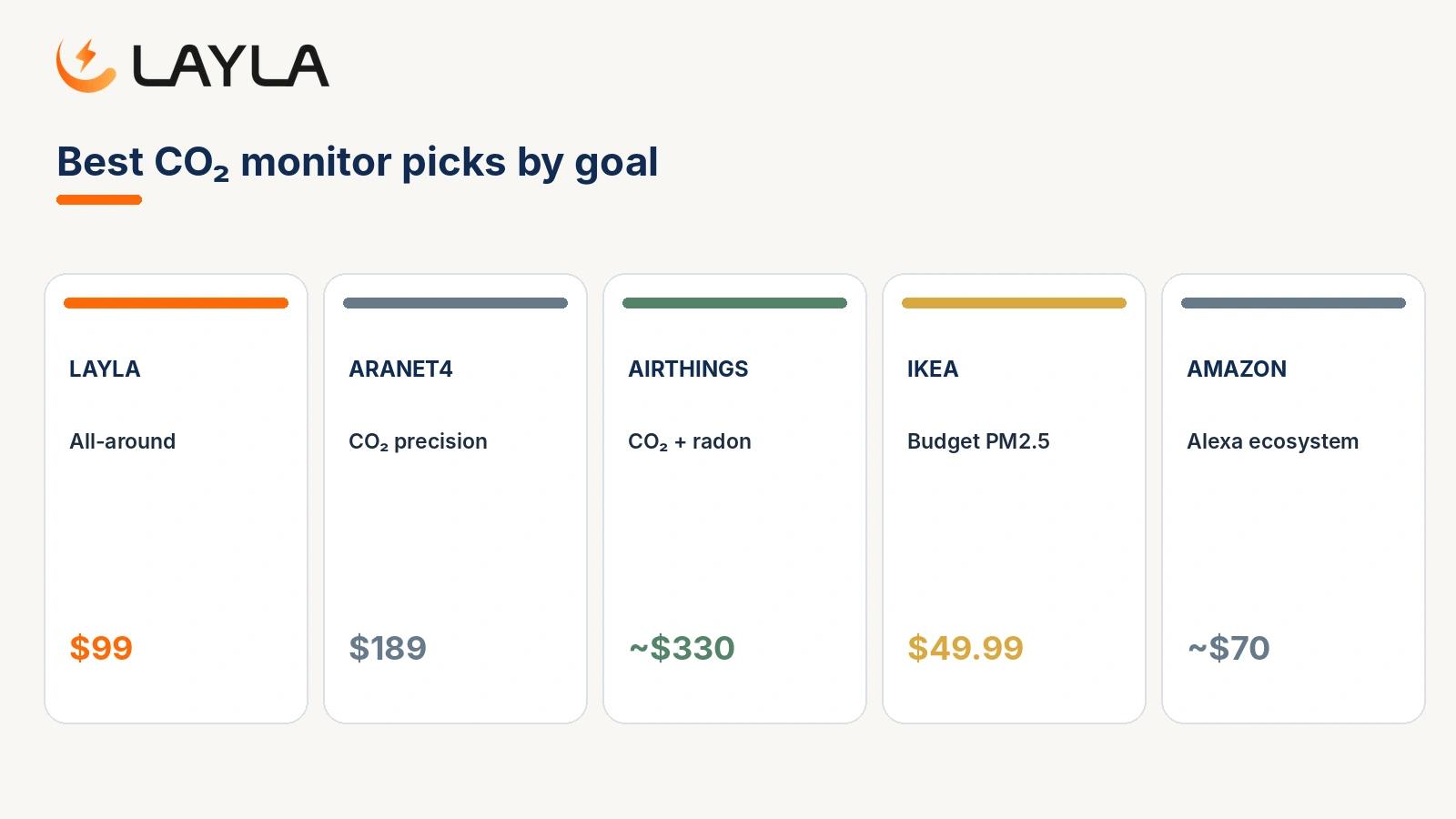
The real decision comes down to one question. Is carbon dioxide the only thing you care about, or is it one worry among several?
Reach for a dedicated CO2 monitor when the answer is genuinely just CO2, like tracking ventilation in one room, checking a classroom or meeting space, or wanting the single most trustworthy number and carrying the device around to get it. There the extra sensors in an all-in-one are weight and cost you won't use, and a focused NDIR instrument like the Aranet4 gives you a tighter reading and a longer battery. Nothing beats a specialist at its one task.
Reach for an all-in-one when CO2 is part of a bigger picture, which for most homes it is. If you also wonder about cooking particulates, wildfire smoke, VOCs from cleaning and new furniture, humidity creeping toward mold, or vaping in the house, buying five single-purpose gadgets for those questions gets expensive fast and clutters your shelf with screens and apps. One device that covers CO2 alongside all of that, on a single dashboard, is simpler and usually cheaper overall, which is the case for Layla at a one-time $99, or the $299 All-in-One if you also want the wider noise and occupancy sensing. The honest trade is accuracy for breadth, a hair of lab-grade CO2 precision given up in exchange for seeing your whole room instead of one gas. For a household rather than a lab, that's almost always the better deal. One tie-breaker remains: if radon is a live concern where you live, the Airthings View Plus is the only all-in-one here that reads it.
At a glance
| Device | Measures CO2? | NDIR? | Price | Subscription / hub | Best for |
|---|---|---|---|---|---|
| Aranet4 Home | Yes | Yes | $189 | None | Most trusted dedicated CO2 reading |
| Layla 3.0 | Yes | Yes | From $99 one-time, no subscription | None | Best all-in-one with real CO2 / best value |
| Airthings View Plus | Yes | Yes | ~$330 | None | CO2 plus radon in one device |
| IKEA Vindstyrka | No | — | $49.99 | Hub $139.99 for history | Cheap PM2.5 readout (not CO2) |
| Amazon Smart AQ Monitor | No | — | ~$70 | Alexa required | Cheap CO + PM sensor (not CO2) |
Frequently asked questions
Is Layla a good CO2 monitor?
Yes, if you want real CO2 as part of a complete air picture rather than a single number. Layla 3.0 measures carbon dioxide directly alongside PM2.5, VOCs, humidity, temperature, mold conditions, and smoke type, in one device starting at a one-time $99 with no subscription. It's the best value here for seeing your whole room instead of just one gas.
What's the most accurate CO2 monitor?
For a dedicated, reference-grade CO2 reading, the Aranet4 Home is the benchmark, with an NDIR sensor rated around ±(30 ppm + 3%). It's the sharpest instrument if a single carbon dioxide figure is all you need.
Does Layla measure CO2 as accurately as the Aranet4?
Layla reads real, direct CO2 as part of a full all-in-one picture, which is plenty for everyday ventilation and sleep decisions. A dedicated NDIR specialist like the Aranet4 is a touch more accurate on that single number, but Layla pairs real CO2 with particulates, VOCs, humidity, mold risk, and smoke in one unit.
What is an NDIR CO2 monitor, and why does it matter?
An NDIR (nondispersive infrared) monitor measures carbon dioxide directly by how much infrared light the gas absorbs, which is the accurate way to read CO2. Devices that list "eCO2" or "equivalent CO2" instead estimate it from VOCs and drift when you cook or clean. If the spec sheet doesn't say NDIR, treat it as an estimate.
Is a CO2 monitor the same as a CO detector?
No. A CO2 monitor tracks carbon dioxide for ventilation and comfort. A CO detector tracks carbon monoxide, a poisonous combustion gas, and it needs to be a separate certified alarm. One does not substitute for the other, so if you want both you need two devices.
Which popular monitors don't actually measure CO2?
The IKEA Vindstyrka ($49.99) and the Amazon Smart Air Quality Monitor (~$70) are the common surprises. The Vindstyrka reads PM2.5 and VOCs but has no CO2 sensor, and the Amazon monitor measures carbon monoxide (CO), not carbon dioxide (CO2).
Where should I put a CO2 monitor, and do I need to calibrate it?
Place it at seated or sleeping head height, away from windows, vents, doorways, and your own breath, all of which skew the reading. Most quality NDIR monitors self-calibrate through automatic baseline correction, so you don't normally do anything; if the numbers ever look oddly high, leaving the device in fresh air for a few hours resets its baseline.
What CO2 level should worry me at home?
Under 800 ppm is fresh and well ventilated, around 1,000 ppm the room feels stuffy and focus slips, and sustained levels of 1,400 ppm and above are linked to worse sleep and slower thinking. That's the line to act on, and bedrooms are the usual culprit.
Related reading

Best for: health-conscious homes
Smoke & Air Quality
Air quality, mold and smoke monitoring for healthy homes and smoke-free rentals.
Included forever — no subscription
- Mold-risk early warning
- Smoke & cigarette detection
- Air quality score (IAQ) with alerts
- CO₂ & bVOC monitoring
- AI air insights & recommendations
- Allergy-comfort monitoring
No monthly fees. Ever.
30-day money back guarantee