BLOG
Layla vs Amazon smart air quality monitor: which one actually tells you what you're breathing?
 By Nangyal Khan··Updated
 12 min read
If you're weighing Layla vs Amazon smart air quality monitor options for your home, the two solve slightly different problems. The Amazon air quality monitor is cheap, plugs neatly into an Alexa setup, and includes a carbon monoxide reading that a lot of home monitors leave out. Layla costs more but works as a standalone device, measures carbon dioxide (CO2), identifies smoke type, and never asks you to open a phone app or own a speaker to read your own air. Which one fits comes down to whether you want the cheapest sensor inside an ecosystem or a complete readout you can glance at on the wall.
What follows lays out the real differences and concedes where Amazon genuinely wins, but one technical point runs underneath all of it: the two devices don't measure the same gas. Both boxes say "air quality," yet the gap between what they track is wide enough to change which device belongs in your home, and most shoppers never notice it until the unit is already on the shelf. If you're new to the readings that matter, our guide to CO2 levels in your home is a useful primer before you spend anything.
At a glance
| Layla | Amazon smart air quality monitor | |
|---|---|---|
| Price | From $99 one-time, no subscription | $69.99 (often ~$45–50) |
| CO2 (carbon dioxide) | Yes | No — measures CO instead |
| CO (carbon monoxide) | No | Yes |
| PM2.5 | Yes | Yes |
| VOCs | Yes (total VOC) | Yes (0–500 index) |
| Temperature + humidity | Yes | Yes |
| Smoke type ID (cigarette / vape / cannabis) | Yes | No |
| On-device screen | Yes | No (LED ring only) |
| Needs Alexa / an app to read values | No | Yes |
| Camera or microphone | None | None (voice via paired Echo) |
| Subscription | None | None |
Does the Amazon air quality monitor measure CO2?
No. The Amazon smart air quality monitor measures carbon monoxide (CO), not carbon dioxide (CO2), and the two are not interchangeable. This is the single most misread spec on the box. CO is the combustion gas from furnaces, stoves and cars that a dedicated alarm watches for. CO2 is the gas you and everyone else in the room breathe out, and it's the number that tells you whether a space is stuffy and under-ventilated. The names sit one letter apart, but what they tell you about your home has almost nothing in common.
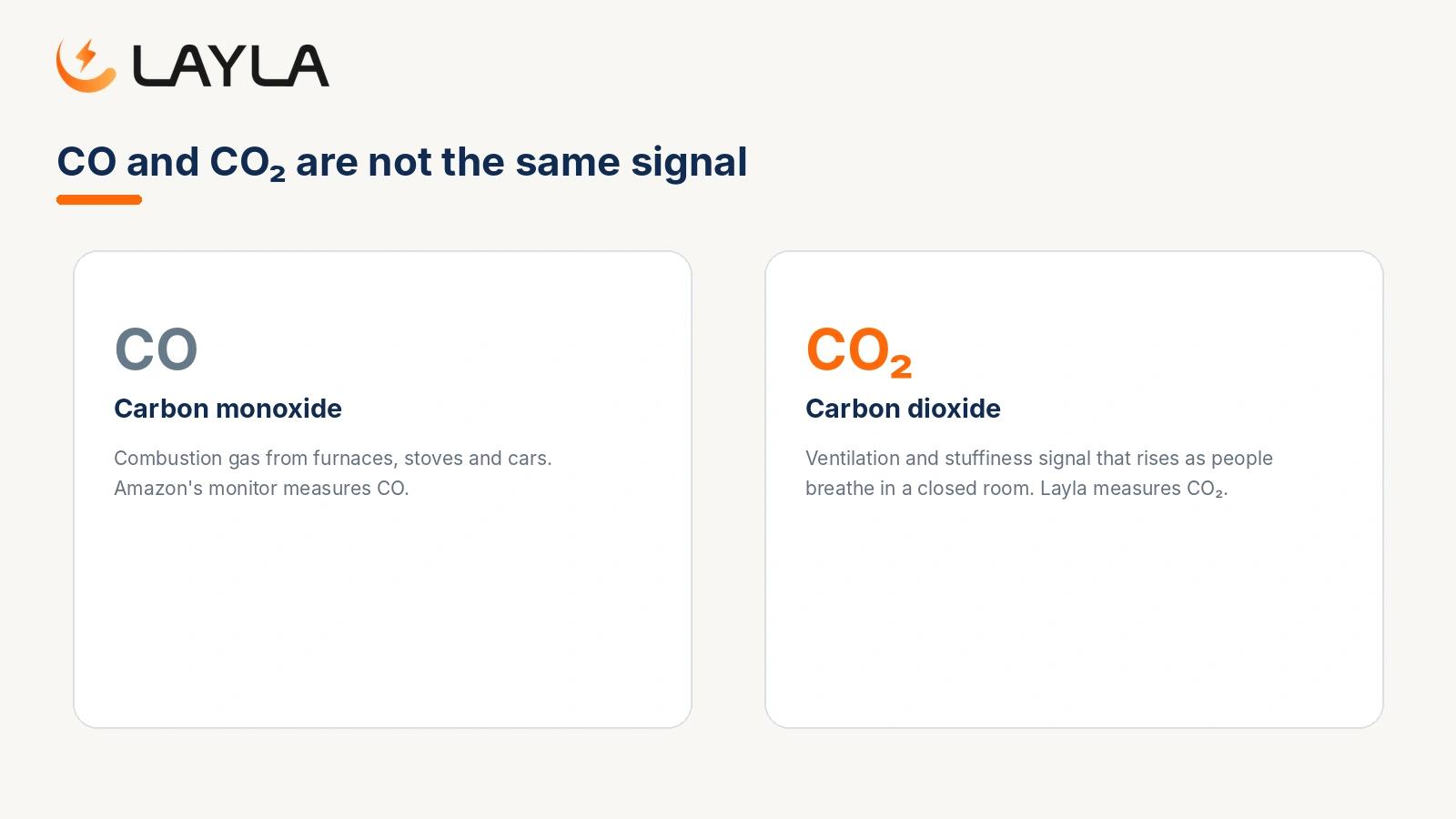
That distinction matters for everyday living. Rising CO2 is what makes a closed bedroom feel heavy by morning, or a home office feel foggy by mid-afternoon. It's a direct proxy for how much fresh air is reaching you, and it's the reading most people are really chasing when they say a room feels "stuffy." Outdoor air sits around 400 ppm. A shut bedroom with two sleepers can climb past 1,000 or even 2,000 ppm overnight, the range where people report grogginess, headaches and poorer sleep. See that curve and you know what to do, whether that's cracking a window, running the HVAC fan or opening the door. Without it, you're left guessing why the room feels off in the first place.
The Amazon monitor simply doesn't track CO2. Layla does, which is why it can flag ventilation problems that a CO-only device will never see. That's the heart of the mismatch: a device that measures CO is built around the rare, dangerous combustion event, while a device that measures CO2 is built around the everyday question of whether the air in the room is fresh. Only one of them changes based on how many people are in the room and whether the window is open. If this trips you up, you're in good company, and our explainer on CO2 vs CO detectors walks through why you often want both. So the practical takeaway is simple. If your main complaint is stuffiness, drowsiness or a room that never feels fresh, CO2 is the number you want, and the Amazon unit does not report it.
What does the Amazon smart air quality monitor do well?
The Amazon smart air quality monitor is a genuinely good value pick if you already live inside the Alexa ecosystem. It's inexpensive, at $69.99 list and frequently closer to $45–50 on the street, which makes it one of the cheapest ways to start watching PM2.5, VOCs, temperature and humidity at home. For a lot of people, that low barrier is the whole appeal, and on raw price nothing here comes close to beating it.
Its tightest advantage is automation. Because it's built around Alexa, it slots straight into Routines, so a VOC or particulate spike can automatically kick on an air purifier, nudge up a fan, or trigger whatever smart plugs you've got wired in. If your house already runs on Echo devices and smart plugs, that hands-off reaction is legitimately useful and genuinely hard to replicate without an ecosystem behind it. For someone already invested in Alexa hardware, the monitor becomes one more trigger in a system that reacts to everything else in the house. On top of that, it includes a carbon monoxide reading that many home air-quality monitors omit entirely, a nice extra awareness layer worth understanding for what it is rather than what it replaces.
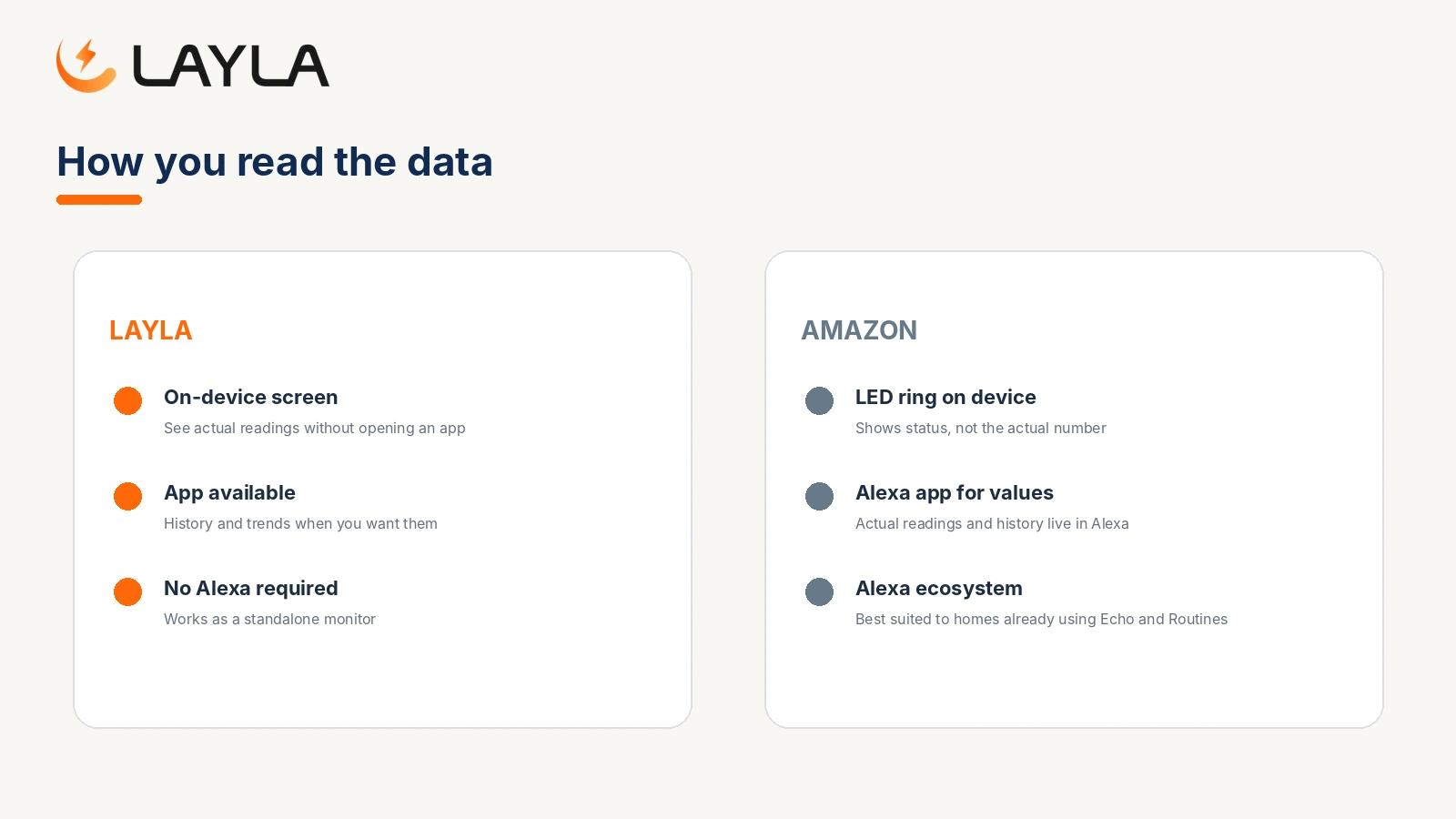
Where it gets limiting is everything downstream of Alexa. There's no screen on the device, just an LED ring that glows a color, so to see an actual number, any history, or the trend charts, you have to open the Alexa app on your phone. History comes as hourly, daily and weekly charts that show peaks rather than averages, alert thresholds aren't customizable, and there's no way to export your data. The device is effectively unusable without Alexa in the loop, so if you ever leave the ecosystem, or simply don't want to build your home around it, the hardware loses most of its usefulness overnight. That's the trade you're making for the low price and the tight integration.
How is Layla different?
Layla is a standalone all-in-one monitor, which means the biggest practical difference is that you don't need an app, an account, or a voice assistant just to read your air. There's a screen on the device. You walk past, you glance at it, you see your CO2, total VOCs, PM2.5, overall air-quality index, temperature and humidity right there. Nothing to unlock, nothing listening in the corner of the room. For anyone who'd rather not route their home's air data through an always-on speaker, that alone is the deciding factor. With the Amazon unit you open a phone app to decode what an LED color means; with Layla the number is already on the wall when you walk past. One device you have to consult, the other you just glance at a dozen times a day without thinking about it.
Beyond the readout, Layla measures more of what shapes indoor air. It tracks CO2 for ventilation and stuffiness, the gap we covered above, and it watches total VOCs from cleaning products, paints, furniture and cooking. It keeps an eye on humidity and the mold conditions that follow when damp air lingers, giving you an early warning before a problem takes hold rather than after. And it can identify smoke by type — telling cigarette from vape from cannabis, along with intensity — which is something the Amazon monitor doesn't attempt at all. A generic air-quality sensor might register a particulate bump and leave you to guess the cause; Layla tells you what kind of smoke it's seeing. If you care about indoor air quality and your health as a whole picture, that breadth is the point.
Then there's privacy, quietly one of the clearest dividing lines between these two devices. The Amazon monitor has no camera and no microphone of its own, which is good, but it only becomes useful paired into an Alexa setup, and voice control runs through an always-listening Echo speaker somewhere in the house. Layla keeps nothing like that in the loop: no microphone and no camera at the hardware level, and no always-on speaker required to make it work. Where the wider Layla system does sense presence, it does so with radar rather than audio or video, so no conversation and no image ever needs to leave the room. For a lot of households, especially in bedrooms and nurseries, that's not a nice-to-have — it's the whole reason to pick one device over the other.
There's no ecosystem lock-in either. Layla isn't tied to Alexa, Google or any single platform to function, so it works the same whether your home is full of smart devices or has none at all. There's no subscription: the air-quality tier is a one-time $99 (down from $189), and that single payment covers the full standalone readout, CO2, VOCs, PM2.5, humidity and mold conditions, and smoke type ID, with nothing gated behind a recurring fee. You own the device and the view, full stop.
Which one should you buy?
Two kinds of buyer walk away happy here, and they're not the same person.
The first is deep in Alexa already and wants to spend as little as possible. Their home runs on Echo speakers and smart plugs, they're comfortable glancing at a phone to check a reading, and what they really want is for the house to react on its own when something spikes. For that person the Amazon monitor is the right call. It's the cheapest way in, it drops straight into the Routines they've already built, and the bundled CO reading is a genuine bonus. They should just go in knowing they'll live in the Alexa app to use it, and that it won't tell them anything about CO2 or stuffiness.
The second buyer wants to understand the air itself, see it without reaching for a phone, and keep one more always-listening device out of the house. They care about why the bedroom feels heavy in the morning, whether the nursery is ventilating properly, and whether that musty corner is heading toward mold. They'd rather pay once than be tied to a subscription, and not route their home's data through a cloud speaker. For that person Layla is the better fit. The broader coverage — CO2, VOCs, humidity and mold conditions, plus smoke type ID — together with a screen on the device and a one-time $99 price with no subscription, gives them the full air-quality picture on their own terms.
Buy the Amazon monitor if you're the first person. Choose Layla if you're the second. You can see the full feature set on the Layla air quality page, and the tiers are laid out on pricing.
One shared caveat, because it's important: neither of these is a certified carbon monoxide alarm, and neither replaces one. The Amazon monitor's CO sensor is consumer-grade awareness, not life-safety equipment, and Layla doesn't measure CO at all. Building codes require a dedicated, certified CO alarm, and you should keep one no matter which monitor you choose. The CO question is a feature difference between two air-quality monitors, not a safety verdict on either one.
Frequently asked questions
Is Layla a good alternative to the Amazon smart air quality monitor?
Yes, especially if you want CO2 measurement, an on-device screen, and no dependence on Alexa. Layla works as a standalone all-in-one monitor covering CO2, total VOCs, PM2.5, temperature, humidity, mold conditions and smoke type ID, for a one-time $99 with no subscription. The Amazon monitor is the cheaper, Alexa-tied option.
Does the Amazon smart air quality monitor measure CO2?
No. It measures carbon monoxide (CO), not carbon dioxide (CO2). If you want to track ventilation and stuffiness, which is what the CO2 number tells you, you'd need a different monitor. Layla measures CO2 directly, so it can flag a room that's getting stale before you feel it.
What's the difference between CO and CO2, and which one do I actually need?
CO is carbon monoxide, a dangerous combustion gas from furnaces, stoves and cars that a certified alarm watches for. CO2 is carbon dioxide, the gas people breathe out, and it's the everyday reading that tells you whether a room is fresh or stuffy. For sleep quality and ventilation, CO2 is the number you want day to day, and Layla reports it while the Amazon monitor does not. Keep a dedicated certified CO alarm either way.
Can I use the Amazon air quality monitor without Alexa?
Not really. The device has no screen, only an LED ring, so you need the Alexa app to see any values, history or alerts. Without Alexa it's effectively unusable. Layla, by contrast, shows everything on the device itself with no app required.
Does Layla measure carbon monoxide?
No, Layla does not measure CO, and the Amazon monitor does include that reading. Worth keeping in perspective, though: neither device is a certified CO alarm, and code requires a dedicated, certified CO alarm either way. Keep one regardless of which monitor you own.
Is there a subscription for Layla or the Amazon monitor?
Neither charges a subscription. Layla's air-quality tier is a one-time $99 (down from $189); the Amazon monitor is $69.99 list, often around $45–50. The main ongoing difference is ecosystem, not fees: Amazon needs Alexa, Layla needs nothing extra.
Related reading

Best for: health-conscious homes
Smoke & Air Quality
Air quality, mold and smoke monitoring for healthy homes and smoke-free rentals.
Included forever — no subscription
- Mold-risk early warning
- Smoke & cigarette detection
- Air quality score (IAQ) with alerts
- CO₂ & bVOC monitoring
- AI air insights & recommendations
- Allergy-comfort monitoring
No monthly fees. Ever.
30-day money back guarantee