BLOG
Can an air quality monitor detect mold?
 By Nangyal Khan·
9 min read
No, a home air quality monitor does not detect or count mold spores. What it can do is flag the sustained high-humidity conditions that let mold grow, giving you an early warning before mold ever appears. That distinction matters, because the honest answer here is more useful than a flat yes or no. Confirming actual mold still needs a visual check, a moisture meter, or a lab test. This guide walks through what a monitor sees, what it can't, and where a humidity-tracking device genuinely earns its place in a healthy home.
Can an air quality monitor detect mold?
A consumer air quality monitor cannot detect mold itself, but it can detect the conditions that grow it. There's no home sensor on the market that sniffs the air, isolates a mold spore, and tells you a species and a count. That's laboratory work. What a good monitor measures is your indoor environment: temperature, relative humidity, particulates, carbon dioxide, and total VOCs. Of those, humidity is the one that ties directly to mold risk.
Mold is opportunistic. Give it a damp surface and a few days of still, humid air, and it colonizes. Keep the air dry and it can't get started. So while your monitor never "sees" the mold, it watches the single variable that decides whether mold has a chance. When your humidity creeps past the safe range and stays there, that's the signal your home has turned hospitable to mold, long before you'd smell or see anything. Learning how to prevent mold in your home starts with knowing that number.
What can an air monitor actually tell you about mold?
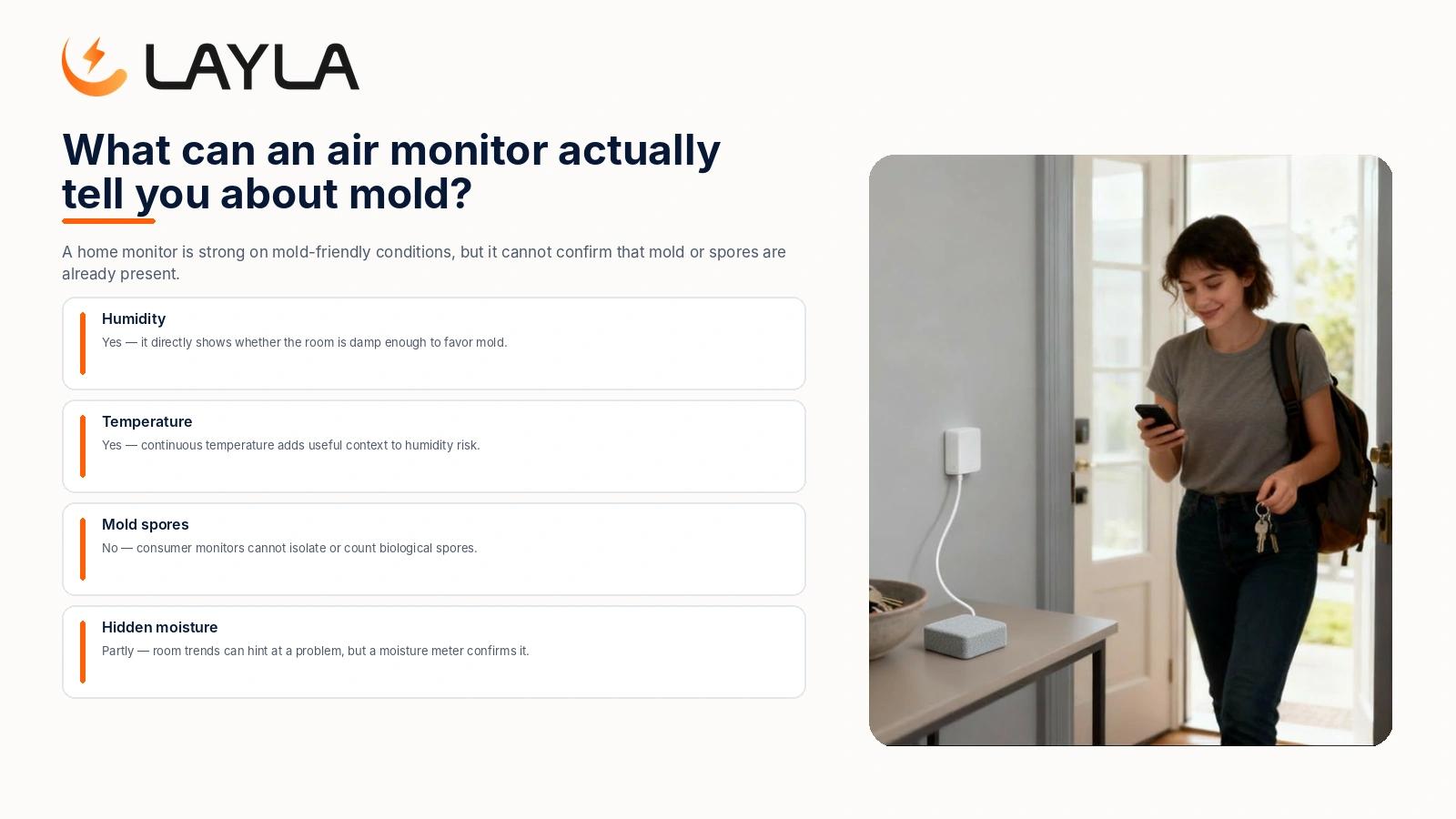
An air monitor tells you when your air is humid enough for mold to take hold, which is the actionable early-warning signal. Mold needs moisture, and indoor relative humidity is the clearest proxy for it. The generally accepted safe zone sits between 30 and 50 percent; once you push consistently above roughly 60 percent, you've entered mold-friendly territory. A monitor that tracks humidity around the clock catches those slow climbs you'd never notice by feel, like a bathroom that never fully dries out or a basement that gets muggy every summer.
That head start is the real value. You're not waiting for a musty smell or a dark patch behind the couch to tell you something's wrong. You catch the conditions days or weeks earlier and act on them, whether that means running a dehumidifier, improving airflow, or fixing a slow leak. For the precise target to aim for, our guide on what humidity level prevents mold breaks down the numbers room by room.
Temperature plays a supporting role too. Mold is most comfortable in the same warm range people are, roughly 60 to 80 degrees Fahrenheit, so a monitor that logs both temperature and humidity gives you a fuller read on risk than a cheap hygrometer alone. The combination is what tells the story. A warm room that stays damp for days is the classic recipe, and a single spot reading rarely catches it. That's why continuous tracking beats an occasional glance at a dial — the trend line is what warns you, not any one number.
Here is the honest split of what a home monitor can and can't do:
| Question | Can a home air monitor answer it? | Why |
|---|---|---|
| Is my air humid enough for mold to grow? | Yes | Humidity is a directly measured value |
| Is the temperature in the mold-growth range? | Yes | Temperature is measured continuously |
| Do I already have mold? | No | Spores are not detected or counted |
| What species of mold is it? | No | Requires lab identification |
| How many spores are in my air? | No | Requires air sampling and lab analysis |
| Is there hidden moisture behind a wall? | Partly | Room humidity can hint at it, but a moisture meter confirms |
The pattern is consistent: a monitor is strong on conditions and silent on confirmation. Both matter, but they're different jobs.
Why can't a monitor detect mold spores?
A monitor can't detect spores because identifying mold requires capturing and analyzing biological material, not reading an environmental value. Temperature and humidity are physical properties any decent sensor can measure in real time. A mold spore, by contrast, is a microscopic biological particle that has to be physically collected, then examined under a microscope or cultured in a lab to be identified. No consumer device does that.
Particulate sensors add to the confusion here. Many home monitors measure PM2.5, the fine-particle count in your air, and mold spores are indeed particles. But a particulate sensor counts all fine particles together, including dust, cooking smoke, pollen, and skin cells. It can't tell a mold spore apart from a speck of dust. So even a rising particulate reading can't be pinned on mold. It's a general air-cleanliness signal, not a mold test.
There's also a timing problem. By the time spores are airborne in numbers a sensor could theoretically pick up, the mold has usually been growing for a while. Environmental monitoring works the other way around. It flags the setup for mold before there's anything to release spores at all, which is the more useful window to catch. That's why "detecting conditions" beats "detecting spores" as a practical home strategy. Monitors read the environment; mold identification is a biology problem the environment can only hint at.
Do VOC sensors detect the musty mold smell?
A VOC sensor can register the compounds behind a musty smell, but it reads a total level and can't confirm that mold is the source. Actively growing mold releases microbial VOCs, or MVOCs, and those are largely responsible for that damp, earthy, basement odor people associate with a mold problem. You might expect a VOC monitor to sniff that out and confirm mold. It can't, and the reason matters.
Consumer VOC sensors report a single TVOC figure, meaning total volatile organic compounds. That number lumps together everything in the air that off-gasses — cleaning sprays, fresh paint, new furniture, air fresheners, cooking, and yes, MVOCs from mold. A high TVOC reading tells you the air holds more organic compounds than usual, and nothing more. It cannot isolate the mold-specific ones or say mold is present. Treat TVOC as a general air-quality gauge, not a mold detector. To understand what that reading is genuinely good for, our VOC monitor for home explainer covers it without the hype.
How do you actually confirm mold?
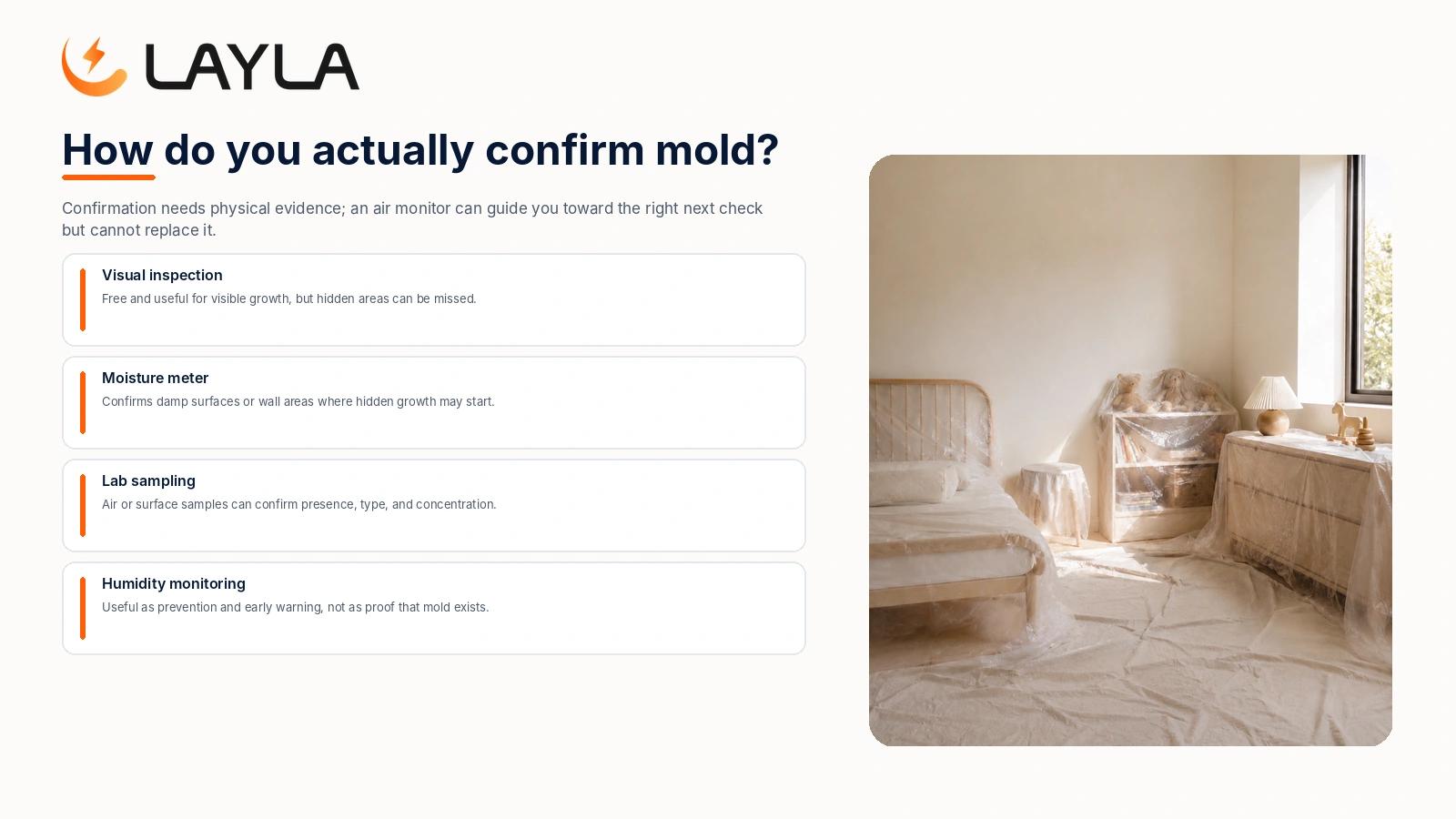
To confirm mold you need physical evidence: a visual inspection, a moisture reading, or a lab sample. A monitor points you in the right direction — but these three methods give you the answer. Here's how they stack up:
| Method | What it tells you | What it costs you |
|---|---|---|
| Humidity monitor | Whether conditions favor mold, in real time | Ongoing early warning, no confirmation |
| Visual inspection | Whether visible mold is present, and where | Free, but misses hidden growth |
| Moisture meter | Whether a surface or wall cavity is damp | Cheap, targets suspected areas |
| Lab air/surface sampling | Confirmed presence, type, and concentration | Petri-dish or ERMI-type kits, or a pro; costs more, most definitive |
Start with your eyes and your nose. A visual check of the usual suspects, such as under sinks, around windows, behind appliances, and in bathrooms, catches most surface mold for free. Knowing what to look for helps, so our rundown of the early signs of mold in your house is worth a read before you go hunting. If you suspect hidden moisture, a moisture meter pressed against walls and around plumbing will find damp spots you can't see. And when you need certainty, a petri-dish air test or an ERMI-type dust analysis, or a professional inspector, will confirm the presence, type, and rough concentration. A monitor never replaces these steps; it just tells you when it's time to take them.
So is a humidity monitor worth it for mold?
Yes, a humidity monitor is worth it as prevention, because stopping the conditions is easier and cheaper than removing mold later. You don't buy an air monitor to find mold. You buy it to make sure the conditions for mold never last long enough to matter. Mold remediation is disruptive and expensive; keeping your air below the danger threshold is neither.
That's exactly the job Layla 3.0 is built for. It tracks temperature and humidity continuously and gives you a humidity-based mold-conditions early warning, so you're alerted the moment your air trends into the range where mold thrives. The same device also reads CO2, total VOCs, particulates, an overall air-quality index, and smoke, and it can automate your AC to help hold humidity in check. It's one purchase, $99 one-time, down from $189, with no subscription. To be plain about what it is, Layla watches the conditions. It is not a mold test kit and not a dehumidifier. You can see the current pricing if you're ready to compare.
FAQ
Can an air quality monitor detect mold?
Not the mold itself. A monitor can't detect, identify, or count mold spores. What it can do is measure the humidity and temperature conditions that allow mold to grow, which gives you an early warning to act before mold appears.
Is there a home mold detector?
Not in the sense most people mean. There's no consumer device that sniffs your air and confirms "you have mold." What exists are two separate tools: environmental monitors that track the humidity conditions mold needs, and lab-based test kits, like petri-dish or ERMI-type samples, that confirm mold after the fact. They answer different questions.
Does an air monitor detect mold spores?
No. Spores are microscopic biological particles that have to be physically collected and analyzed in a lab to be identified. Home sensors, including particulate sensors, can't isolate a spore from ordinary dust, so a reading can never confirm mold.
Does Layla detect mold?
Layla detects the sustained high-humidity conditions that allow mold to grow, not the mold or its spores. Think of it as an early-warning tool that flags when your air becomes mold-friendly. To confirm actual mold, you'll still need a visual inspection or a lab test. Layla's VOC reading is also a total figure, not a mold-specific one.
Can a VOC reading confirm mold?
No. Mold gives off microbial VOCs that cause the musty smell, but a consumer sensor reports total VOCs from every source in your home. A high reading flags that something is off-gassing, not that mold is present.
Related reading

Best for: health-conscious homes
Smoke & Air Quality
Air quality, mold and smoke monitoring for healthy homes and smoke-free rentals.
Included forever — no subscription
- Mold-risk early warning
- Smoke & cigarette detection
- Air quality score (IAQ) with alerts
- CO₂ & bVOC monitoring
- AI air insights & recommendations
- Allergy-comfort monitoring
No monthly fees. Ever.
30-day money back guarantee