BLOG
Early signs of mold in your house
 By Nangyal Khan·
10 min read
The earliest signs of mold are usually a musty, earthy smell and small spots of discoloration on grout, caulk, walls, or ceilings, often long before there's an obvious problem. You might also notice persistent condensation on your windows, a room that feels damp, or allergy-like symptoms that ease once you leave the house. Catching those clues early matters, because mold can take hold on a damp surface within a day or two. This guide walks through what to sniff for, what to look for, and where mold likes to hide.
What are the earliest signs of mold?
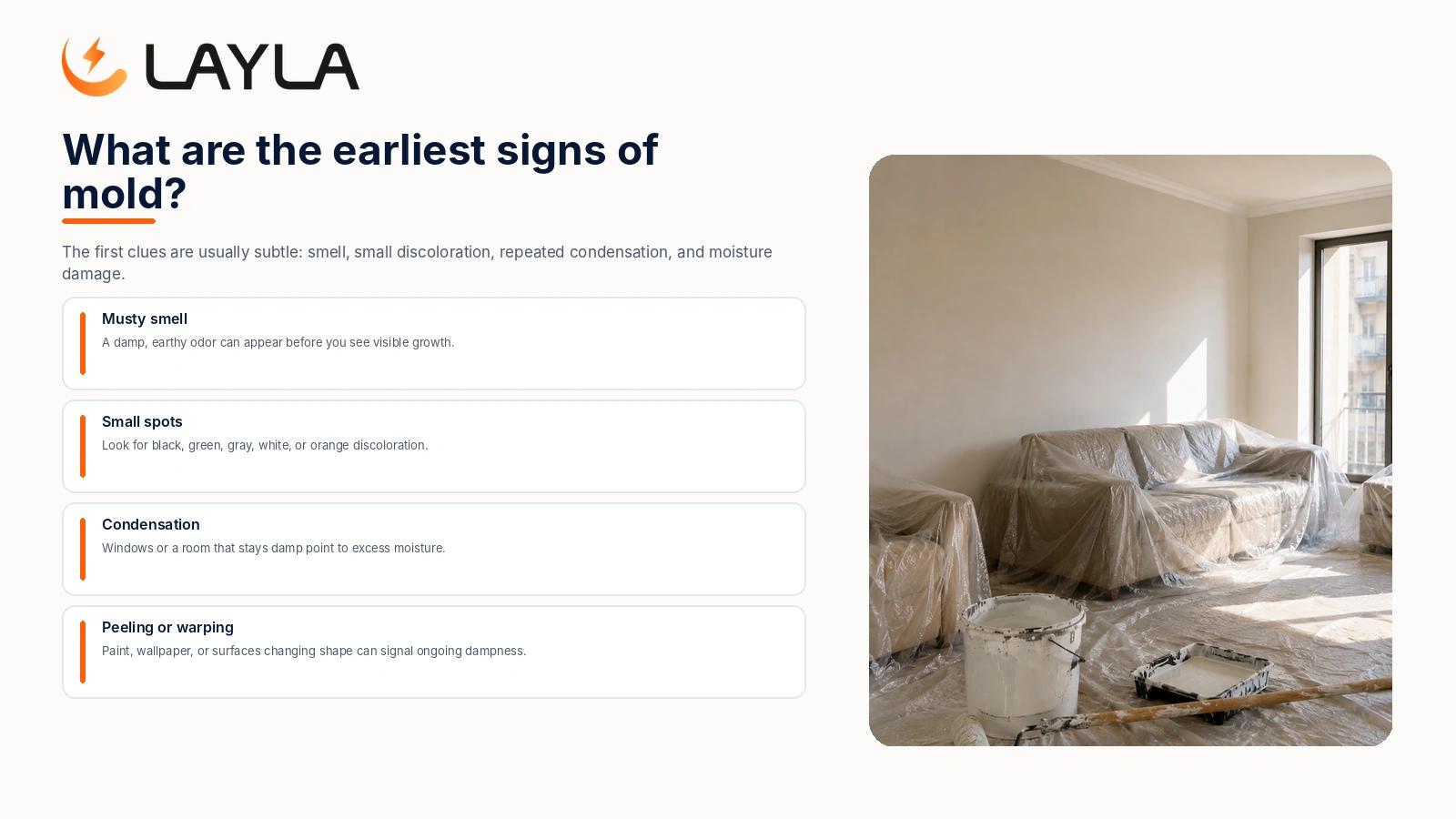
The earliest sign of mold is often something you smell before you see anything: a musty, damp, earthy odor that lingers in a particular room. Right behind it come the visual cues, like small spots or a faint film of discoloration in the corners of a shower, along window sills, or where a wall meets the ceiling.
Here's the short list most people notice first, roughly in the order they tend to show up:
- A musty or earthy smell that comes and goes, or gets stronger in one room
- Small spots or patches of discoloration — black, green, gray, white, or orange — on grout, caulk, walls, or ceilings
- Persistent condensation on windows or a general feeling of high humidity
- Paint or wallpaper that starts to peel, bubble, or warp
- Water stains, or the memory of a past leak that was never fully dried out
- A room that simply feels damp, cool, and heavy
None of these alone confirms mold, but two or three together are a strong hint that moisture has been sitting somewhere too long. Almost every case traces back to excess moisture. Mold spores are always floating around in ordinary indoor air, and they only grow once they land on a surface that stays wet, which is why how to prevent mold in your home starts with drying things out.
What does mold smell like?
Mold smells musty and earthy — think old books, a damp basement, or wet cardboard. That smell is frequently the very first clue, and it can show up before you can see a single spot.
The reason is chemistry. As mold grows, it releases microbial volatile organic compounds, or MVOCs, and those are what your nose actually picks up. Because the gases travel through the air, a musty smell can precede visible growth by days or weeks. The colony is active behind a wall or under the floor, but the surface you can see still looks clean. If you're curious about the broader family of airborne compounds behind household odors, our guide to VOCs in your home explains where they come from.
A good test: if a room smells musty when you first walk in after being away, but the smell fades as you get used to it, trust that first impression. Your nose adapts quickly, so the moment you enter is your most honest reading.
What does early mold look like?
Early mold usually looks like small, scattered dots or a thin, fuzzy film rather than the large dark blooms people picture. It often starts in the places that stay damp longest and get cleaned least.
Look closely at:
- Grout and caulk in showers and around tubs, where black or pink specks gather in the seams
- Window sills and frames, especially the lower corners where condensation pools
- Ceilings and upper wall corners, particularly in bathrooms and below roof lines
- Around and under sinks, where slow drips keep cabinets humid
Color varies more than most people expect. Early growth can be black, green, gray, white, or even orange, and the shade doesn't reliably tell you how serious it is. What matters more is texture and spread: a spot that's fuzzy, that wipes away but returns, or that keeps expanding is worth investigating. A little surface residue on a window sill after a cold snap might just need drying and cleaning, but a patch that regrows within a week points to a moisture source that hasn't been fixed.
Where does mold hide in a house?
Mold hides wherever moisture collects and air doesn't move, which is why the growth you can see is often the smaller part of the story. The hidden signs of mold tend to sit just out of view.
The usual hiding spots:
| Where to check | Why mold likes it | What early sign to watch for |
|---|---|---|
| Behind furniture on exterior walls | Cool wall surface + trapped air causes condensation | Musty smell, discoloration when you pull furniture away |
| Under sinks and in vanity cabinets | Slow drips and humidity in an enclosed space | Damp cabinet base, warped wood, faint smell |
| Bathrooms, basements, crawlspaces | Chronically high humidity and poor ventilation | Persistent musty odor, spots in corners |
| Around past or current leaks | Any lingering dampness from a roof, pipe, or window | Water stains, bubbling paint, soft drywall |
| Inside HVAC systems and ductwork | Condensation on coils; spores spread on airflow | Musty smell when the system runs |
| Under carpet and behind wallpaper | Moisture wicks in and dries slowly | Discoloration bleeding through, a stubborn smell |
Because so many of these spots are sealed off, a smell with no visible source is one of the most useful hidden mold signs you have. If a room stays musty after a good clean, the growth is probably somewhere you can't easily see: behind the wallpaper, under the carpet, or inside the wall cavity.
Can mold make you feel unwell?
Mold can be linked to allergy-like symptoms indoors, and for some people those symptoms are a real early warning that something's off in the air. This isn't a diagnosis, since bodies react differently and plenty of things cause a stuffy nose, but the pattern is worth paying attention to.
Symptoms people commonly report include sneezing, nasal congestion, an itchy or scratchy throat, and watery or irritated eyes. Those who already live with asthma or allergies may notice their symptoms feel worse than usual. The telling detail is timing: if you feel congested or irritated at home and clearly better within an hour or two of leaving, then it creeps back when you return, your indoor air may be the common thread. Track when and where the symptoms flare. A pattern that lines up with one damp room is more informative than any single bad day.
What should you do if you find early mold?
If the patch is small and on a hard surface, you can usually handle it yourself — but the real fix is always the moisture behind it. For a spot under about a square foot on tile, grout, or sealed surfaces, wipe it away with soap and water or a dedicated mold cleaner, then dry the area completely. Cleaning the surface does nothing lasting if the dampness stays, so track down the source: a leaking seal, weak ventilation, or condensation on a cold wall. Larger patches, anything growing on porous drywall or insulation, or spots that keep returning after you clean them are signals to bring in a professional. And whatever the size, get the humidity back under control, or the same stain comes back within weeks.
How do you catch mold before you can see or smell it?
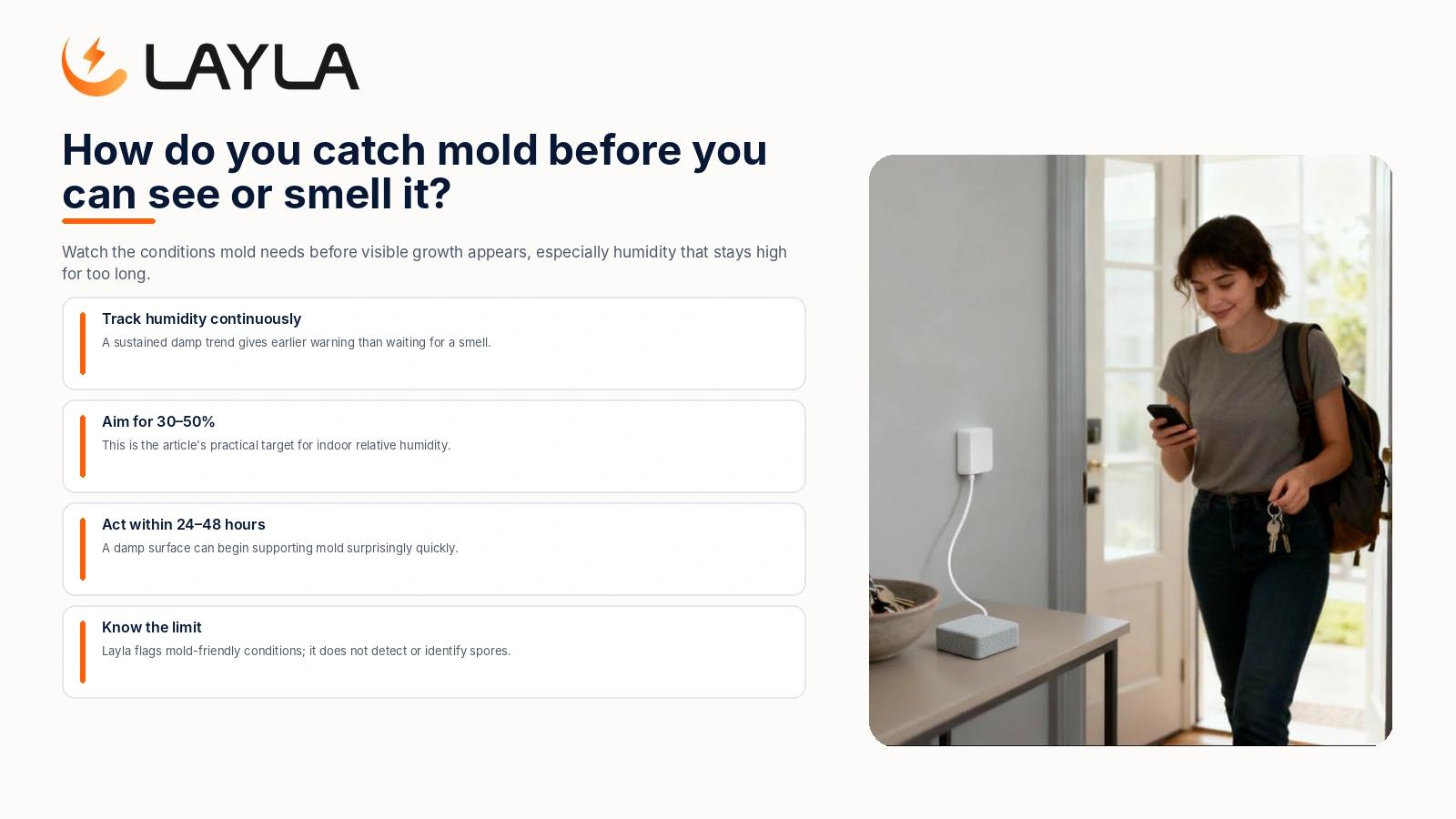
You catch mold early by watching the conditions that let it grow, not by waiting for the spots to appear. Mold needs sustained moisture, so the most reliable early warning is a humidity reading that stays high for too long.
That's the gap a home air quality monitor fills. Mold can start colonizing a damp surface within 24 to 48 hours, so knowing your humidity is climbing, before anything is visible, buys you the time to fix it. Keeping indoor relative humidity roughly in the 30 to 50 percent range is the practical target, and our breakdown of what humidity level prevents mold covers the numbers in detail.
This is where Layla comes in. Layla 3.0 is a single device that continuously tracks temperature and humidity and gives you a humidity-based mold-conditions early warning: a heads-up when the damp, high-humidity conditions that lead to mold start to build. The same device also reads CO2, total VOCs, particulates, an overall indoor air quality index, and more, so you get a full picture of the air from one sensor with no camera or microphone involved.
It's worth being clear about what a monitor does and doesn't do. Layla flags the conditions that let mold take hold; it doesn't detect, identify, or count mold spores, and it doesn't sniff out that musty MVOC smell specifically, since its VOC reading is a total level, not a mold-specific one. Confirming actual mold still means a visual check or lab sampling. What a monitor gives you is earliness: the chance to dry things out and ventilate before spores ever get a foothold. If you want to understand the boundary between measuring conditions and detecting the fungus itself, can an air monitor detect mold covers exactly that.
Layla's Air Quality tier is a one-time $99 (down from $189), with no subscription. You buy the device once and keep monitoring. You can see the full lineup on the pricing page.
FAQ
What is usually the very first sign of mold?
A musty, earthy smell is often the first sign, because mold releases airborne compounds (MVOCs) that your nose can detect before any growth becomes visible. If a room smells damp the moment you walk in, treat that as a cue to investigate.
How can I tell if I have mold without seeing it?
Watch for a persistent musty odor with no obvious source, condensation that keeps returning on windows, and allergy-like symptoms that ease when you leave the house. Sustained high indoor humidity is another strong indirect signal, since moisture is what mold needs to grow.
What color is early mold?
Early mold can be black, green, gray, white, or orange, and the color doesn't reliably tell you how serious it is. Pay more attention to texture and behavior: a fuzzy spot that wipes off but keeps coming back points to an unresolved moisture problem.
Does a musty smell always mean mold?
Not always, but a musty smell almost always means excess moisture somewhere, and moisture is the one thing mold can't grow without. If the smell persists after cleaning and airing out the room, there's likely hidden dampness or growth you haven't found yet.
How fast can mold grow in a damp spot?
Mold can begin colonizing a surface within 24 to 48 hours of it staying damp. That speed is exactly why catching high humidity early — and drying leaks or condensation quickly — makes such a difference.
Related reading

Best for: health-conscious homes
Smoke & Air Quality
Air quality, mold and smoke monitoring for healthy homes and smoke-free rentals.
Included forever — no subscription
- Mold-risk early warning
- Smoke & cigarette detection
- Air quality score (IAQ) with alerts
- CO₂ & bVOC monitoring
- AI air insights & recommendations
- Allergy-comfort monitoring
No monthly fees. Ever.
30-day money back guarantee