BLOG
What humidity level prevents mold?
 By Nangyal Khan··Updated
 10 min read
To prevent mold, keep your indoor relative humidity below 60%, and aim for a band of 30 to 50%. That range is dry enough that mold can't get the moisture it needs to grow, yet not so dry that your skin, sinuses, and wooden furniture start to suffer. Mold is opportunistic, and moisture is the one thing it can't do without, so controlling humidity is the single most effective way to keep it out of your home.
Below, you'll find the exact numbers, a risk table you can bookmark, and the practical steps for pulling a damp room back into the safe zone before spores ever get a foothold.
What humidity level does mold need to grow?
Mold needs sustained moisture, and it starts to become a real risk once relative humidity climbs above roughly 60%. That's the threshold most guidance points to, because at that level the air holds enough water for spores (which are already floating around every home) to settle, germinate, and spread across a damp surface.
The word "sustained" matters. A quick spike after a hot shower isn't the problem. Mold takes hold when humidity sits high for hours and days at a time, giving colonies the steady dampness they need. On a genuinely wet surface, mold can begin to grow within 24 to 48 hours, so a bathroom or basement that stays muggy day after day is exactly the environment it's waiting for. Keeping the air below that 60% line removes the fuel. If you want the bigger picture on the conditions mold favors and how to shut them down, our guide on how to prevent mold in your home walks through it room by room.
What's the ideal indoor humidity to prevent mold?
The ideal indoor humidity to prevent mold is 30 to 50%. Staying in that band keeps you safely under the 60% mold threshold with a comfortable margin, and it accounts for the fact that humidity fluctuates through the day as you cook, shower, and breathe.
Why not just aim as low as possible? Very dry air brings its own problems. Once relative humidity drops below about 30%, you start to notice dry skin, chapped lips, static shocks, irritated sinuses, and cracking in wood floors and furniture. So 30 to 50% is a deliberate balance, high enough to stay comfortable and low enough to starve mold. If you keep a hygrometer or an air monitor pointed at your rooms, that's the window you're steering toward, and staying inside it heads off the early signs of mold before they appear. Many people find that setting a dehumidifier to hold around 45 to 50% keeps them comfortably inside it without babysitting the numbers.
Why does 60% relative humidity matter so much?
Sixty percent relative humidity matters because it's the point where the air carries enough moisture to reliably support mold growth. Below it, spores struggle to find the water they need; above it, they don't.
Think of relative humidity as how "full" the air is with water vapor at a given temperature. As that percentage rises, more moisture becomes available to porous surfaces like drywall, grout, wood, fabric, and insulation, and those are exactly the materials mold loves to colonize. Sustained readings above 60% tip the balance in mold's favor — and once you pass 70%, the risk climbs steeply. That's why the 60% line shows up again and again in indoor-air guidance: it's a practical ceiling that, if you stay under it, keeps most homes out of trouble.
The humidity vs. mold-risk table
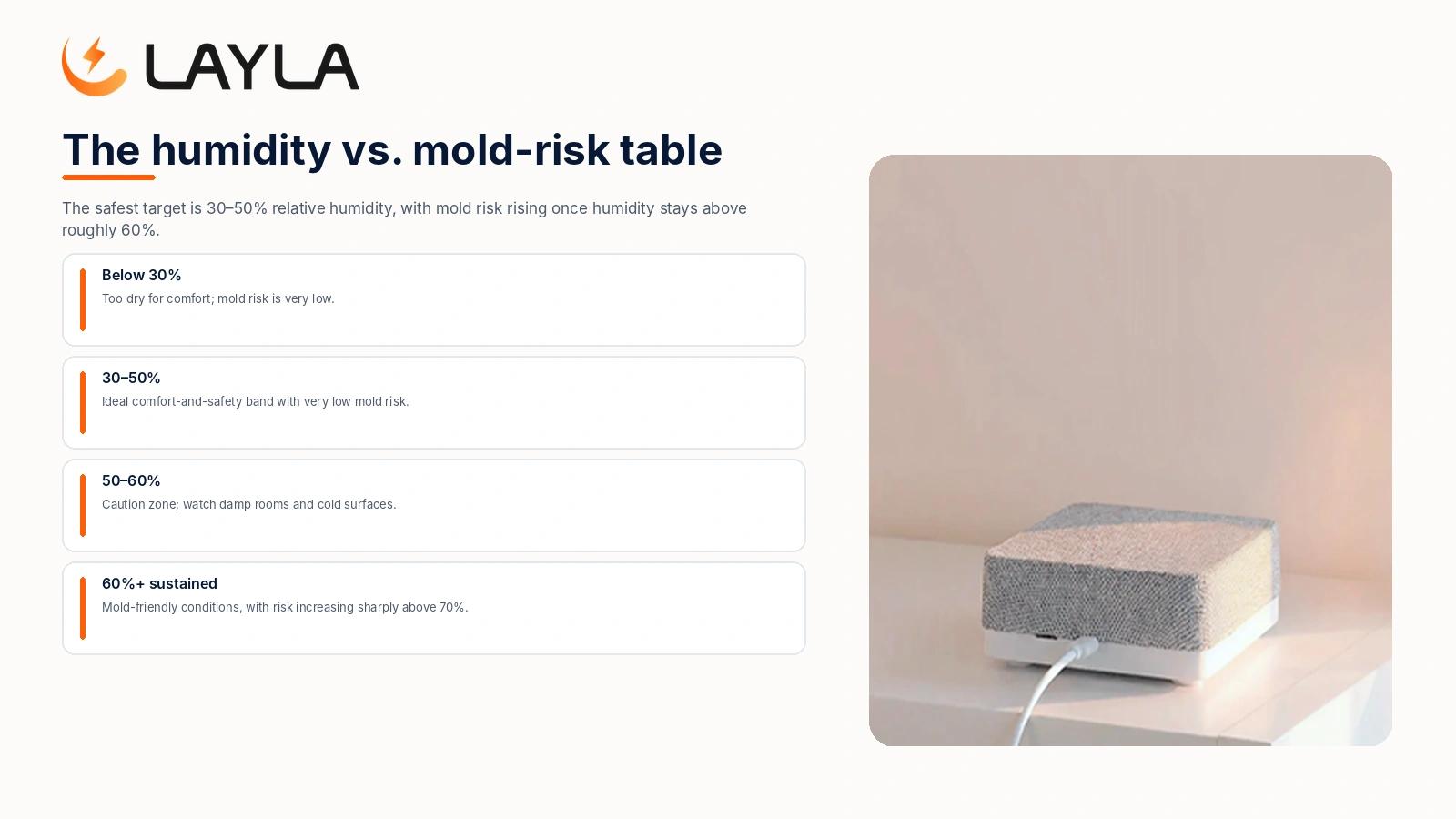
Use this quick reference to read whatever number your hygrometer or monitor is showing.
| Indoor relative humidity | What it means | Mold risk |
|---|---|---|
| Below 30% | Too dry: dry skin, static, irritated sinuses, cracking wood | None from mold, but uncomfortable |
| 30-50% | Ideal comfort-and-safety band | Very low |
| 50-60% | Caution zone: watch damp rooms and cold surfaces | Low to moderate |
| 60-70% | Mold-friendly conditions if sustained | High |
| Above 70% | Persistently wet air | Very high |
Aim to live in the 30 to 50% row. Treat 50 to 60% as a yellow light that says keep an eye on things — and act quickly whenever a room drifts past 60%.
Does high humidity always mean mold?
Not automatically, but it means the conditions are right, and that's the warning you don't want to ignore. High room humidity is a risk signal rather than a guarantee, and the twist is that mold often starts on a surface that's far damper than the room's overall reading suggests.
The part that trips people up is that relative humidity is temperature-dependent. Warm air holds more moisture than cold air, so when warm, humid room air touches a cold surface, the air right at that surface cools and its relative humidity shoots up — sometimes all the way to 100%. That's condensation, and it's why you see beads of water on single-pane windows or feel a clammy patch on an exterior wall in winter, even while your room thermostat and hygrometer read a perfectly reasonable 45 to 50%.
Those cold, condensation-prone spots (window frames, the backs of closets against outside walls, behind furniture pushed tight to a wall) are where mold frequently gets its start. So managing surface condensation matters just as much as managing the average room number. If you notice recurring damp patches, musty smells, or discoloration in corners, don't wait. A monitor can flag the damp conditions early, and whether an air monitor can detect mold explains what one will and won't tell you before a small spot becomes a bigger problem.
How do you lower indoor humidity to a safe range?
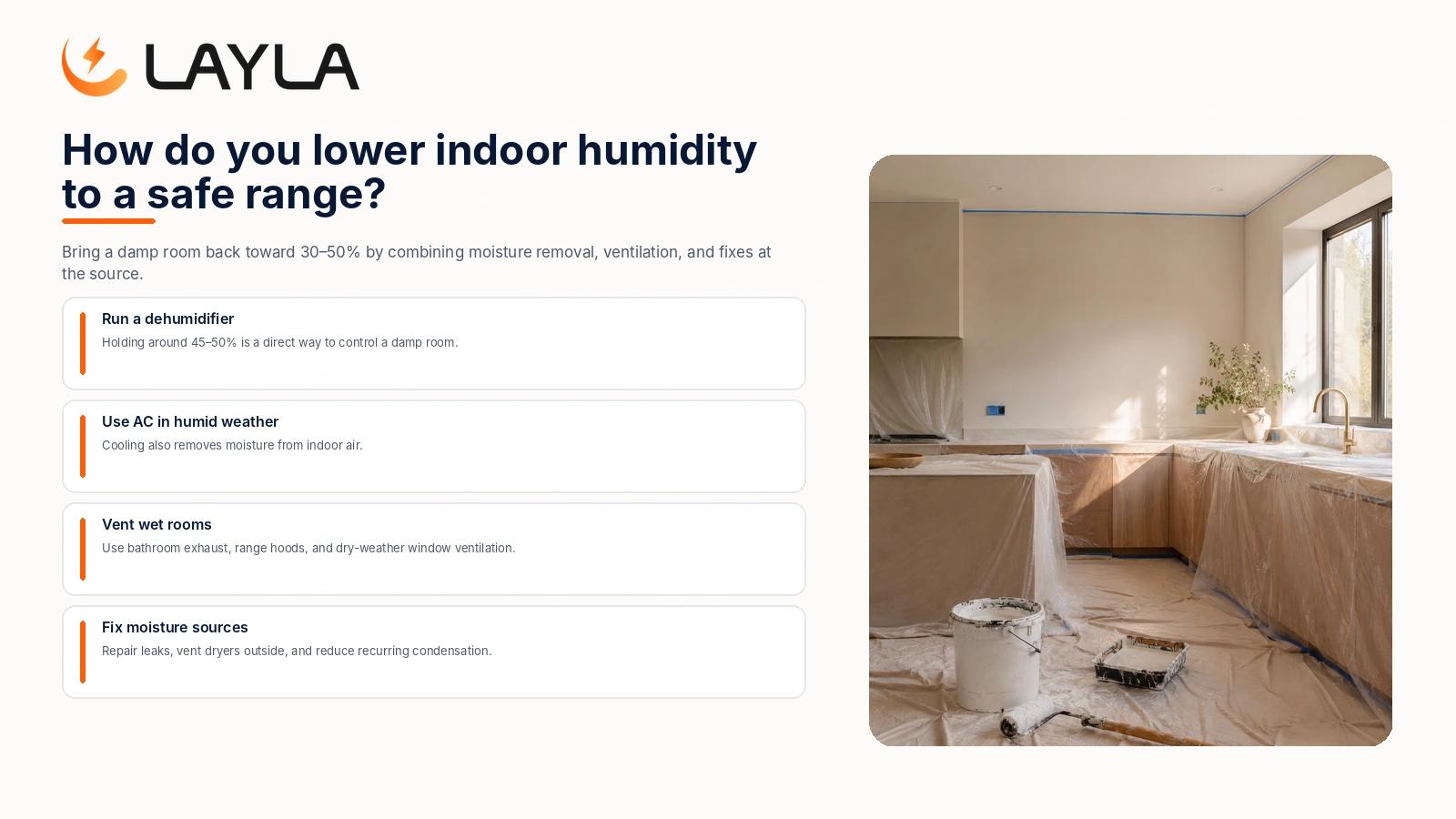
The most reliable way to lower indoor humidity is to combine a dehumidifier with good ventilation and a few fixes to the sources of moisture. No single trick does it all, but stacking a handful of them will pull a damp home back into the 30 to 50% band.
These are the moves that actually shift the numbers:
- Run a dehumidifier and set it to hold around 45 to 50%. This is the fastest, most direct lever in a humid basement or bedroom.
- Use air conditioning in warm months. AC removes moisture from the air as it cools, doing double duty on comfort and humidity.
- Ventilate the wet rooms. Run the exhaust fan during and after every shower, use the range hood while cooking, and open windows when the outdoor air is drier than the air inside.
- Fix leaks promptly. A slow drip under a sink or a small roof leak feeds mold with a steady moisture supply. Chase down the source, don't just wipe up the puddle.
- Vent your clothes dryer outside, never into the room or an attic, and cover exposed dirt in crawlspaces and sump pumps so ground moisture doesn't evaporate into the house.
- Ease off over-watering houseplants, and cluster them away from cold walls where their moisture can condense.
- Insulate cold surfaces like exterior walls, pipes, and older windows to cut the condensation that starts mold in the first place.
You don't need every item on this list. Start with the biggest source of dampness in your home, measure the result, and add measures until your rooms settle into the safe range and stay there.
Humidity also swings with the seasons, so the fix shifts too. Summer air is warm and moisture-heavy, which is when a dehumidifier and air conditioning do most of the work. Winter flips the problem. Heated indoor air turns dry, yet condensation on cold windows and exterior walls can still create damp micro-spots even when the whole-room reading looks perfectly safe. Check your numbers in both seasons rather than assuming one setting holds all year round.
How do you know your home's humidity?
You measure it, because guessing doesn't work: a room that feels "a little stuffy" could be at 55% or 70%, and those are very different risk levels. To know where you actually stand, you need a device that reads relative humidity continuously and shows you the trend over time, not just a snapshot.
That's where a home air monitor earns its place. Instead of buying a separate hygrometer and hoping you check it at the right moment, an always-on monitor tracks humidity around the clock and flags when a room drifts toward the danger zone, so you can act before mold ever starts. The same continuous-tracking logic is why people lean on a CO2 monitor for home air quality more broadly, watching the trend rather than a single snapshot.
This is where Layla 3.0 fits. Layla is a single device that tracks temperature and relative humidity continuously and gives you a humidity-based early warning when a room sits in sustained high-humidity, mold-friendly conditions, so you can see at a glance whether your rooms are in the safe 30 to 50% band or drifting into the 60%-plus mold-risk zone. It also tracks CO2, VOCs, particulates, an overall air-quality index, and smoke, and it can automate your AC to keep humidity in check, all with no camera and no microphone.
To be clear about the limits: Layla measures humidity and warns you about the conditions that let mold grow, but it doesn't identify mold spores or species, and no consumer monitor does. Confirming actual mold still means a visual inspection or a lab test. What Layla does is catch a damp room early, before those conditions have time to become a problem — and it's a monitor rather than a dehumidifier, so it tells you when to act rather than removing moisture itself.
Layla 3.0 is a one-time purchase of $99 (down from $189), with no subscription. You can see the full spec on the air quality page or check the pricing details.
FAQ
What is the ideal humidity level to prevent mold?
Keep indoor relative humidity between 30 and 50%. That band stays comfortably below the roughly 60% level where mold risk climbs, while avoiding the dryness problems that show up under 30%.
Can mold grow at 55% humidity?
It's possible but less likely if 55% is a brief peak rather than a constant reading. Fifty to 60% is a caution zone, so watch damp rooms and cold, condensation-prone surfaces, and try to nudge the average back under 50%.
How quickly can mold start growing?
On a genuinely wet or damp surface, mold can begin to grow within 24 to 48 hours. That's why fixing leaks and drying out condensation quickly matters so much.
Is low humidity bad too?
Yes. Below about 30%, air gets uncomfortably dry, which can cause dry skin, static, irritated sinuses, and cracking in wood and furniture. It won't grow mold, but that's why 30 to 50% is the target rather than "as dry as possible."
Why does my room read 45% but still get damp windows?
Because relative humidity rises at cold surfaces. When warm, moist room air meets a cold window or exterior wall, the air there cools and its humidity can hit 100%, causing condensation, even when the room average looks fine. Those cold spots are common places for mold to start.
Related reading

Best for: health-conscious homes
Smoke & Air Quality
Air quality, mold and smoke monitoring for healthy homes and smoke-free rentals.
Included forever — no subscription
- Mold-risk early warning
- Smoke & cigarette detection
- Air quality score (IAQ) with alerts
- CO₂ & bVOC monitoring
- AI air insights & recommendations
- Allergy-comfort monitoring
No monthly fees. Ever.
30-day money back guarantee