BLOG
CO2 Monitor for Home: What It Measures and Whether You Need One
 By Nangyal Khan··Updated
 11 min read
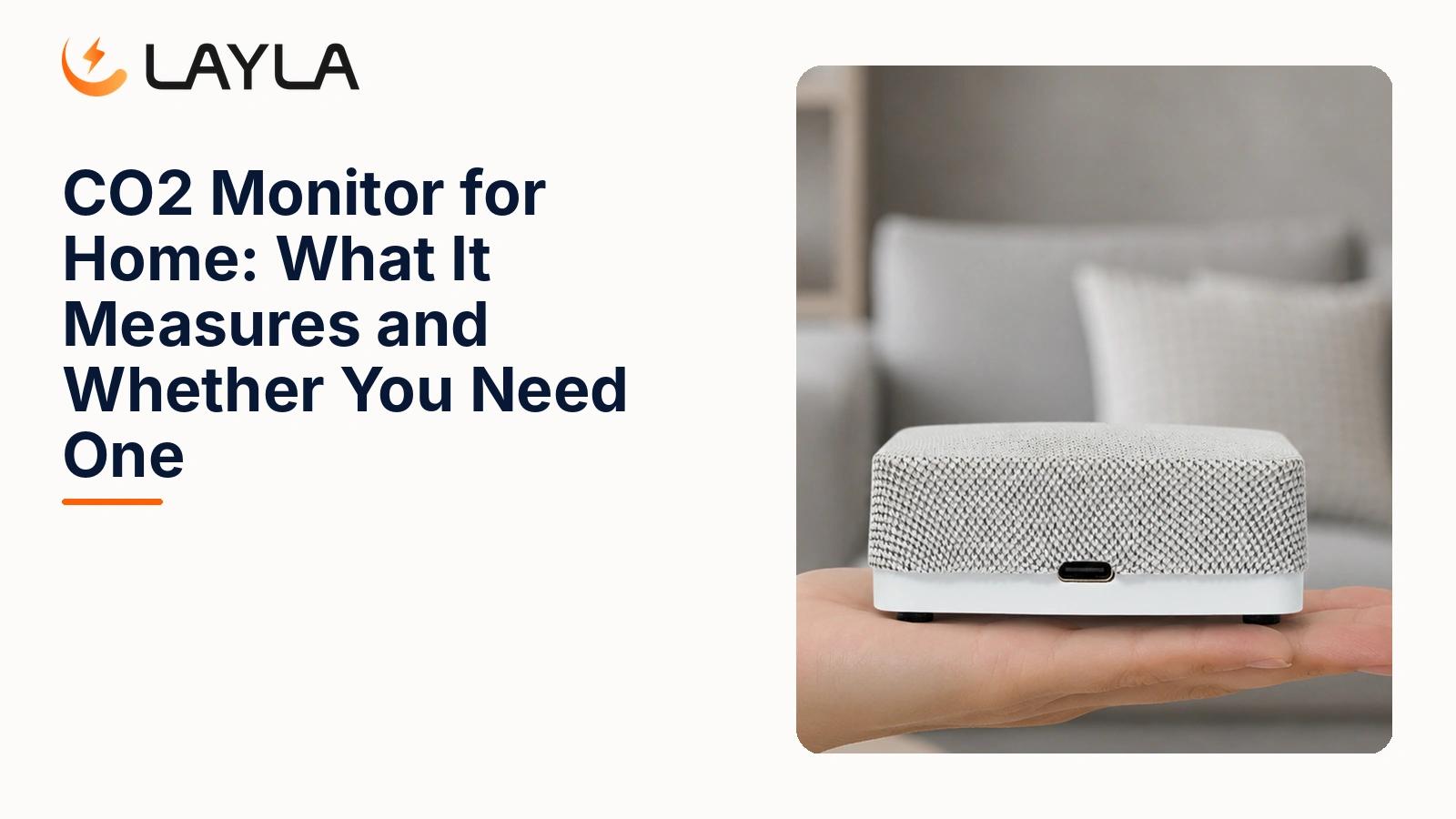
A CO2 monitor for home is a small device that reads the carbon dioxide level in your indoor air and tells you, in real numbers, how well your rooms are ventilating. You buy one because rising CO2 is the earliest signal that a space has gone stale, and stale air is what leaves you groggy at your desk or waking up unrefreshed. It does not clean the air or fix anything on its own — it shows you when to open a window, run a fan, or crack a door before the stuffiness starts costing you sleep and focus.
Most people never think about CO2 until they notice the pattern: the home office that gets heavy by mid-afternoon, the bedroom that feels close by morning even though nothing looks wrong. A monitor puts a number on that feeling. Once you can see the number climb, ventilation stops being a guess.
What does a CO2 monitor for home actually do?
A home CO2 monitor measures carbon dioxide in parts per million (ppm) and shows you a live reading, so you can act before the air feels bad instead of after.
Carbon dioxide is the gas you exhale with every breath. In a sealed room, it accumulates faster than people expect, especially with the doors shut and two or more people inside. Outdoor air sits around 420 ppm. A well-ventilated room stays close to that. A crowded, closed-up room can pass 1,500 ppm without any smell or visible sign, because CO2 is odorless and invisible.
That invisibility is the whole point of owning a meter. You can smell cooking, dust, or a musty basement. You cannot smell your CO2 climbing. The monitor is the only thing that catches it early — and early is when a fifteen-second window crack solves the problem for free.
Do you really need a CO2 monitor at home?
You benefit most from an indoor CO2 monitor if you spend long stretches in closed rooms and have noticed fatigue, headaches, or poor sleep you can't otherwise explain.
Not every household needs one. If you live in an airy place, keep windows open, and never feel that afternoon slump, a meter will mostly confirm your air is fine. But plenty of modern homes are built tight for energy efficiency, which is great for heating bills and rough on fresh-air exchange. Tight homes trap CO2. Add a home office, a small bedroom, or a family that spends winter evenings in one room with the doors shut, and levels climb.
Reach for a monitor if any of these fit:
- You work from home and lose sharpness by mid-afternoon
- You or your kids wake up tired despite a full night's sleep
- Your home is newer, well-sealed, or you rarely open windows in cold months
- Someone in the house is sensitive to stuffy air and wants a way to catch it
CO2 at normal indoor levels is a comfort and cognition signal, not a poison. It tells you the room needs air. That is a genuinely useful thing to know, and for a lot of households it explains a nagging problem they'd blamed on everything else.
What CO2 level should trigger action in a home?
Take action once your indoor CO2 climbs past roughly 1,000 ppm, and treat sustained readings above 1,400 ppm as a real problem for sleep and concentration.
Here's a reference you can keep in mind for normal vs high CO2 levels:
| CO2 level (ppm) | What it means at home | What to do |
|---|---|---|
| ~420 | Outdoor / fresh baseline | Nothing, this is ideal |
| Under 800 | Fresh, well-ventilated | Nothing, air is comfortable |
| ~1,000 | Noticeable stuffiness begins (common comfort marker) | Open a window or door, run a fan |
| 1,400+ (sustained) | Linked to worse sleep and reduced concentration | Ventilate now, don't sleep in it |
| 1,500+ | Common in a closed bedroom overnight | Add night ventilation, keep a door ajar |
The bedroom number surprises people. Close the door on a couple of sleeping adults and CO2 can drift past 1,500 ppm by the early hours, which is exactly the range tied to lighter, less restful sleep. You don't feel it happening — you feel it the next morning. A monitor with an overnight log shows you the curve and lets you test simple fixes, like leaving the door cracked or running a low fan.
Where should you place a CO2 monitor in your house?
Place a CO2 meter in the rooms where you actually spend time, at roughly breathing height, and away from windows, doors, and your own direct breath.
Position drives accuracy more than any spec on the box. A few rules that matter:
- Occupied rooms first. Bedroom, home office, and living room are where CO2 actually affects you. A hallway reading tells you little.
- Breathing height. Sit it near where your head is when you work or sleep, not on the floor and not at the ceiling.
- Away from airflow shortcuts. Right next to an open window or vent, it reads the outdoor air and misses the room. Tucked behind a monitor where you exhale onto it, it reads high.
- One where it counts. If you buy a single unit, put it in the room you occupy longest with the door most often shut. For most people that's the bedroom or the office.
Give a new monitor a few minutes to settle after you move it, and don't judge a room by a single glance. Watch the trend over an evening. The shape of the curve — rising when the door shuts, dropping when you ventilate — is what tells the real story.
What should you look for in a home CO2 monitor?
The best CO2 monitor for home reads true CO2 with a real sensor, logs the trend over time, and alerts you before levels get uncomfortable rather than after.
Cheap meters cut corners in ways that matter. Some estimate CO2 from other gases instead of measuring it directly, which drifts badly indoors. Look for these:
| Feature | Why it matters |
|---|---|
| Direct CO2 measurement | Estimated readings drift; you want the actual number |
| Trend history / logging | The overnight and afternoon curves are where the insight lives |
| Clear alerts | A nudge at 1,000 ppm beats a number you have to remember to check |
| Wider air picture | CO2 plus humidity, VOCs, and particulates tells the full story |
| No subscription | A home sensor shouldn't cost a monthly fee to keep working |
| Privacy by design | No camera or microphone in your bedroom or office |
That last row is worth weighing. A CO2 reading is more useful alongside the rest of your indoor air. Humidity that runs high for days is an early mold warning. VOCs spike from cleaning products and off-gassing from new furniture. Particulates come from cooking and dust. A device that captures the whole picture in one unit saves you a shelf of gadgets and gives you context a lone CO2 number can't.
Layla 3.0 is built exactly this way. One device reads CO2 alongside VOCs, particulates, an overall air-quality index, temperature, humidity, mold conditions, and more, with no camera and no microphone at the hardware level. It's a one-time $99 on the Air Quality tier, down from $189, with no subscription ever. If you want a home CO2 monitor that also tells you why the air feels off, not just that it does, that combination is hard to beat.
How much does a home CO2 monitor cost?
A basic home CO2 monitor runs anywhere from about $30 to $250, and the price mostly tracks the sensor inside rather than the styling. The cheap end is where you find estimators and unbranded meters with no logging. Reliable monitors with a real sensor and a display usually start around $80 to $130, and multi-sensor units that read CO2 alongside humidity, VOCs, and particulates sit higher because they measure more.
The figure that actually matters is what the device costs to own, not the sticker. Some connected monitors charge a monthly fee to keep their app, history, or alerts working, which quietly turns a $100 gadget into a recurring bill. A home sensor shouldn't do that. Layla's Air Quality tier is a one-time $99 (down from $189) with no subscription, so the overnight logging and alerts keep working for as long as you own the device, with nothing to renew.
NDIR or estimated? The sensor type that decides accuracy
Not every CO2 reading is a real CO2 reading, and the sensor inside is the single biggest factor in whether the number means anything. It's also the spec cheap meters tend to bury.
There are two common approaches. A true CO2 sensor uses NDIR (nondispersive infrared), which measures carbon dioxide directly by how it absorbs a specific wavelength of infrared light, and reports the actual gas concentration. The other approach, usually labeled "eCO2" or "equivalent CO2," doesn't measure CO2 at all. It reads VOCs with a cheaper metal-oxide sensor and estimates a CO2-like number from them, assuming the only source in the room is human breath. That assumption falls apart the moment you cook, clean, or open a bottle of nail polish, and the estimate drifts.
For a bedroom or office where you want to trust the overnight curve, NDIR is what you're after. An eCO2 meter can tell you "roughly busy or not," but it will happily jump to 1,800 ppm because someone sprayed deodorant, and it can miss a room that's genuinely stuffy. If a product page doesn't say NDIR, it's usually eCO2. Layla reads CO2 as part of a dedicated air-quality sensor suite rather than inferring it from VOCs, so its CO2 line tracks real ventilation instead of whatever you last sprayed.
Is a CO2 monitor the same as a CO detector?
No. A CO2 monitor and a CO detector track two completely different gases, and one cannot do the other's job.
CO2 is carbon dioxide, the harmless gas you exhale, tracked for comfort, sleep, and focus. CO is carbon monoxide, a poisonous, odorless combustion gas from faulty furnaces, stoves, or generators. A CO2 monitor does not detect carbon monoxide, and no air-quality monitor replaces a certified CO alarm. Keep a dedicated, certified CO alarm in your home regardless of what else you own. We break down the difference in full in CO2 detector vs CO detector.
FAQ
What is a good CO2 level for a house?
Under 800 ppm is fresh and comfortable, and anything near your outdoor baseline of about 420 ppm is ideal. Once a room passes roughly 1,000 ppm you'll start to notice stuffiness, and sustained readings above 1,400 ppm are worth acting on for sleep and focus.
Can high CO2 in my bedroom affect my sleep?
Yes. A closed bedroom with sleeping adults can climb past 1,500 ppm overnight, a range linked to lighter, less restful sleep. Cracking the door or running a low fan usually pulls it back down, and a monitor with overnight logging lets you confirm the fix. For more, see CO2 and sleep quality in the bedroom.
Is CO2 in my home dangerous?
At the levels found in normal homes, CO2 is a comfort and concentration signal, not a poison. It tells you a room needs fresh air. The truly dangerous gas is carbon monoxide (CO), which is different and requires a separate certified CO alarm.
Do I need a CO2 monitor in every room?
No. Start with one in the room you occupy longest with the door most often shut, usually the bedroom or home office. If you spend long hours in several closed rooms, a second unit helps, but a single well-placed monitor answers most households' questions.
Does a CO2 monitor clean the air?
No. A CO2 monitor measures and alerts, it doesn't filter or ventilate. It tells you when to open a window, run a fan, or improve airflow. The action is still yours, but the timing is no longer a guess.
Related reading

Best for: health-conscious homes
Smoke & Air Quality
Air quality, mold and smoke monitoring for healthy homes and smoke-free rentals.
Included forever — no subscription
- Mold-risk early warning
- Smoke & cigarette detection
- Air quality score (IAQ) with alerts
- CO₂ & bVOC monitoring
- AI air insights & recommendations
- Allergy-comfort monitoring
No monthly fees. Ever.
30-day money back guarantee