BLOG
VOC Monitor for Home: What It Does and Whether You Need One
 By Nangyal Khan··Updated
 9 min read

A VOC monitor for home is a small device that measures the level of volatile organic compounds in your indoor air and warns you when that level climbs. Think of it as a smoke alarm's quieter cousin for chemical fumes: it won't clean the air, but it tells you when the air around you has more gas-phase pollution than usual so you can open a window or step away. Most home monitors report a single "TVOC" number that rises when you paint a room, unwrap new furniture, or spray cleaner, then settles as the space airs out.
What does a VOC monitor for home actually do?
A home VOC monitor continuously samples the air and reports the total concentration of volatile organic compounds as a trend you can watch. It doesn't tell you which chemicals are present. Instead it gives you a running TVOC reading, usually shown as a level or index and sometimes in ppb or mg/m3, that goes up during off-gassing events and comes back down afterward.
That trend is the whole point. A stable, low baseline means the air is roughly what it always is. A sudden jump after you open a can of paint or plug in an air freshener tells you something is loading the room with fumes. How high the spike goes, and how quickly it clears, is far more useful for a household than any single instantaneous figure. You're looking for patterns — not lab precision.
What are VOCs, and where do they come from at home?
VOCs are volatile organic compounds, gases quietly released by a long list of everyday products. They come from things you'd never label as "chemical," which is exactly why they're easy to overlook. For a deeper breakdown, see our guide on what VOCs are in your home.
Here are the sources most likely to move the needle on a monitor:
| Household source | When VOCs are highest |
|---|---|
| Fresh paint, stains, and finishes | During and for days after application |
| Adhesives, caulk, and sealants | While curing |
| New furniture, pressed-wood, particleboard | First weeks after purchase |
| New flooring, carpet, and mattresses | First days to weeks (off-gassing) |
| Cleaning products and disinfectants | During and shortly after use |
| Air fresheners, scented candles, aerosols | While in use |
| Hairspray, nail polish, cosmetics | During application |
| Dry-cleaned clothes | Right after bringing them home |
| Printers and cooking | During active use |
None of these are exotic. A new mattress and a freshly painted bedroom can push a monitor's reading up for a week or more — and that's normal. What matters is knowing it's happening so you can ventilate on purpose instead of breathing it in for days without realizing.
Do you need a VOC monitor at home?
You benefit most from a VOC monitor if you renovate, buy new furniture, use a lot of cleaning or scented products, or simply want to understand the air where you sleep and work. If your home never changes and you already ventilate well, the case is weaker, though a monitor still catches surprises.
Certain situations tip the scale clearly toward getting one. If anyone in the household is sensitive to chemical smells, prone to headaches, or has asthma or allergies, a monitor turns a vague "this room feels stuffy" into something you can see and act on. Parents setting up a nursery, anyone who just moved into a newly built or newly renovated home, and people who work from a closed home office all have real reasons to watch VOC levels. At typical home concentrations, elevated VOCs can cause odor and, for some people, irritation of the eyes, nose, or throat, headaches, or dizziness, particularly during big off-gassing events like fresh paint or a new couch. A monitor doesn't diagnose any of that. It just points you to the cause and the fix — usually more ventilation. If you want to go further after buying one, our guide on how to reduce VOCs in your home covers the practical steps.
What VOC (TVOC) level should you worry about?
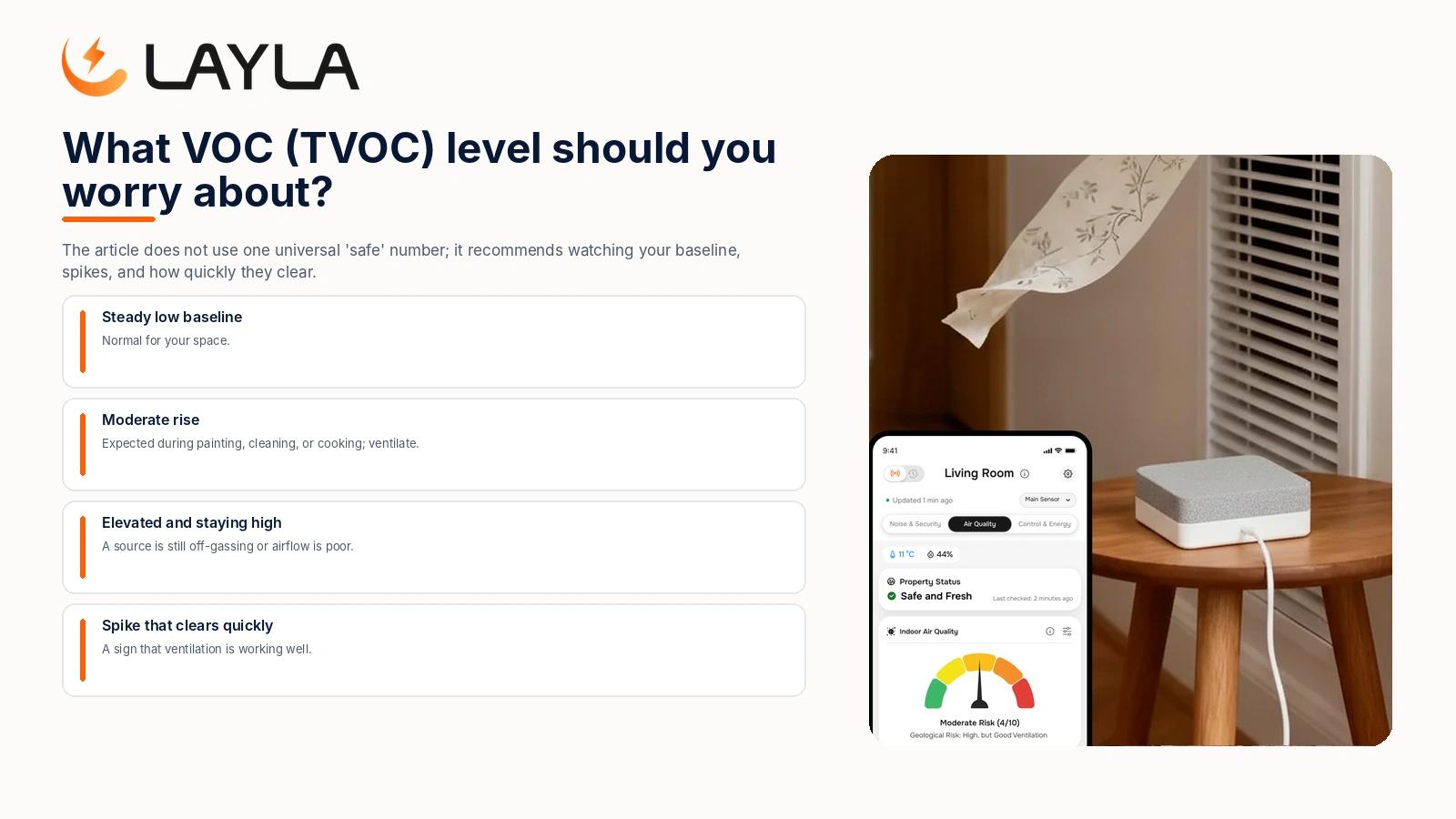
There's no single universal "safe" TVOC number, so the smarter approach is to read your monitor in relative terms: low, moderate, or elevated, and pay attention to spikes and how fast they clear. A reading that's normal in one home can be different in another, because baseline VOC levels vary with your furnishings, products, and ventilation.
This is why chasing an exact threshold misleads people. What you actually want to know is how far the reading jumps and whether it comes back down.
| What you see | How to read it |
|---|---|
| Steady low baseline | Air is normal for your space |
| Moderate rise during an activity | Expected while painting, cleaning, or cooking; ventilate |
| Elevated and staying high | Something is off-gassing; increase airflow, find the source |
| Spike that clears within an hour | Ventilation is working well |
| Spike that lingers for hours | Source is strong or airflow is poor; open more windows |
Treat the monitor as a coach — not a judge. A brief elevated reading while you clean the bathroom isn't an emergency. A reading that stays high for hours after you've finished is the signal worth acting on.
Where should you place a VOC monitor?
Put your VOC monitor where you spend time and near where products off-gas, at roughly breathing height. A bedroom, living room, or home office all make sense, and placing it near new furniture or a freshly painted wall lets you watch that source clear over time.
Avoid two spots. Don't sit it directly on top of a constant source, like right beside the stove or an always-plugged-in air freshener, because it will read that one thing instead of the room. And don't put it in the path of a wide-open window, where fresh outdoor air will mask what's actually building up indoors. The goal is a reading that represents the air you breathe — not the extremes. If you move the monitor between rooms, give it a little time to settle before you trust the new baseline.
What should you look for in a home VOC monitor?
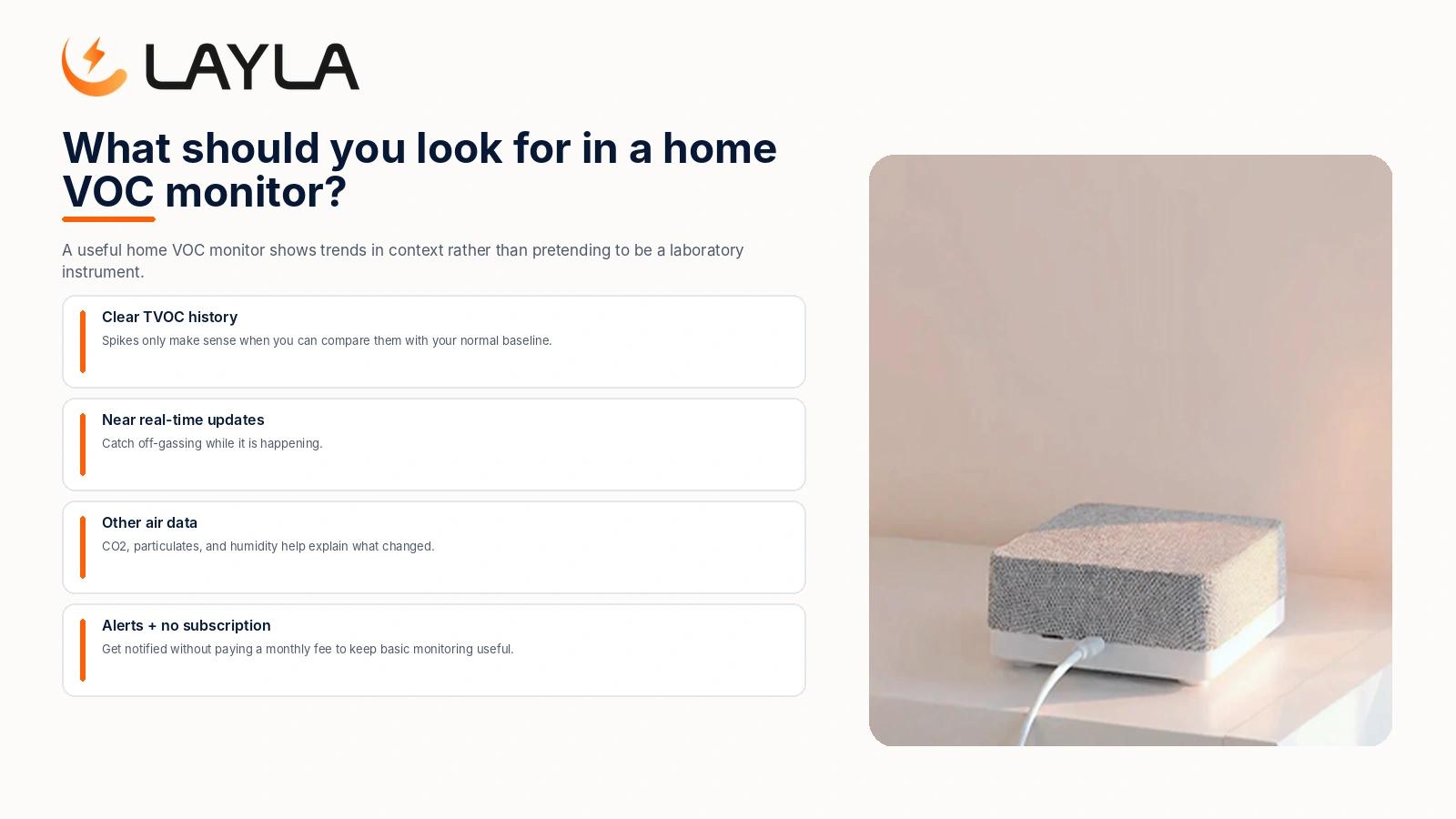
The best VOC monitor for home shows a clear TVOC trend, updates in close to real time, and ideally reports the rest of your air in the same place so a spike has context. A number on its own is less useful than a number you can compare against CO2, particulates, and humidity.
A few technical points are worth knowing before you buy. Most consumer TVOC sensors are metal-oxide (MOX) sensors. They track relative changes well, which is what you want for spotting spikes, but they aren't lab-grade instruments and shouldn't be read as absolute chemistry. Also, some inexpensive monitors estimate CO2 as "eCO2" derived from the VOC reading rather than measuring carbon dioxide directly, so if CO2 matters to you, check that it's a real measurement. Our CO2 monitor for home guide goes deeper on that distinction.
| Feature | Why it matters |
|---|---|
| Clear TVOC trend and history | Spikes only mean something in context |
| Near real-time updates | Catch off-gassing as it happens |
| Other air data in one unit | Compare VOCs against CO2, particulates, humidity |
| App alerts | Know when levels climb without staring at a display |
| No subscription | Air data shouldn't cost a monthly fee |
| Direct CO2 measurement (if listed) | Some cheap units fake it from VOCs |
This is where a single sensor that covers more of your air earns its place. Layla 3.0 measures your total VOC level and flags spikes alongside CO2 levels in your home, particulates, an overall air quality index, temperature, humidity, and mold-risk conditions, all in one device with no camera or microphone. It shows your TVOC trend and tells you when to ventilate; it measures the air rather than filtering it, so it's a monitor, not a purifier. Because it reports VOCs next to the rest of your air, a spike comes with the context you need to act. It's a one-time $99 for the air quality tier, down from $189, with no subscription.
One honest note on what these monitors do and don't tell you: Layla and other consumer VOC monitors report the total VOC level, not the identity of individual compounds. That's the right tool for spotting when your air changes and reacting to it, which is what a home actually needs day to day.
FAQ
What is a VOC monitor for home?
It's a device that measures the total level of volatile organic compounds in your indoor air and shows you when that level rises, usually as a TVOC reading. It helps you spot chemical fumes from paint, furniture, cleaners, and similar sources so you know when to ventilate.
Does a VOC monitor clean the air?
No. A VOC monitor measures air quality, it doesn't filter or purify it. Its job is to tell you when VOC levels are elevated so you can open windows, run ventilation, or remove the source yourself. If you want cleaner air, the monitor tells you when to act.
What's a good TVOC level at home?
Rather than a fixed number, read your monitor as low, moderate, or elevated and watch how spikes behave. A low, steady baseline is normal, brief rises during cleaning or cooking are expected, and a reading that stays high for hours is the one worth investigating. How fast a spike clears tells you whether your ventilation is working.
Can a home VOC monitor detect specific chemicals like formaldehyde?
Consumer VOC monitors, including Layla, report total VOCs rather than identifying individual compounds. They're built to show overall trends and spikes, which is what matters for everyday home use. For specific compound testing you'd need specialized lab equipment, which most households never need.
Where's the best place to put a VOC monitor?
In a room where you spend time, at breathing height, and near sources you want to watch such as new furniture or fresh paint. Keep it away from a constant source like the stove and away from a wide-open window, both of which distort the reading.
Related reading

Best for: health-conscious homes
Smoke & Air Quality
Air quality, mold and smoke monitoring for healthy homes and smoke-free rentals.
Included forever — no subscription
- Mold-risk early warning
- Smoke & cigarette detection
- Air quality score (IAQ) with alerts
- CO₂ & bVOC monitoring
- AI air insights & recommendations
- Allergy-comfort monitoring
No monthly fees. Ever.
30-day money back guarantee