BLOG
Indoor air quality and your health
 By Nangyal Khan··Updated
 14 min read
Indoor air quality describes how clean or polluted the air is inside your home, and it matters because most people spend around 90% of their time indoors, where the air can hold more pollutants than the air outside. That single fact reframes how you think about health at home. The air in your bedroom, kitchen, and living room is the air you breathe for the vast majority of your life, and unlike weather, it's something you can actually see, understand, and change—once you know what to look for.
This guide is the starting point for our whole allergies-and-health cluster. It walks through what indoor air quality really is, which pollutants matter most, how each one connects to comfort and health, and the practical levers that improve it. Deeper articles branch off from here for the specifics: reducing dust and PM2.5 in your home, getting the air right for babies and nurseries, managing indoor air quality and asthma, and more. Think of this as the map and the linked pieces as the routes.
A quick note before we start. Nothing here is medical advice, and the health language throughout is deliberately careful. Poor air is linked to and associated with a range of symptoms, and better air is something many people find helpful, but a monitor and a guide can't diagnose anyone. If you have persistent symptoms, that's a conversation for a clinician.
What is indoor air quality?
Indoor air quality is a measure of the pollutants, moisture, and freshness of the air inside an enclosed space like your home. It isn't one number so much as a picture built from several factors working together: the tiny particles floating in the air, the gases released by everyday products, how much stale air has built up, how humid the room is, and whether anything is burning or smoldering. Each of these has its own sources and its own effect on how a room feels and how the people in it feel.
What makes indoor air distinct from outdoor air is that a home is a fairly sealed box. Cooking, cleaning, showering, breathing, pets, furniture, and candles all add something to the air—and without enough ventilation those additions accumulate. Outdoor air pollution can drift inside too, but the home also generates plenty of its own. The good news is that the same enclosure that traps pollutants also makes them controllable. You can't change the weather, but you can open a window, run an extractor fan, swap a filter, or dry out a damp corner.
Which pollutants matter most indoors?
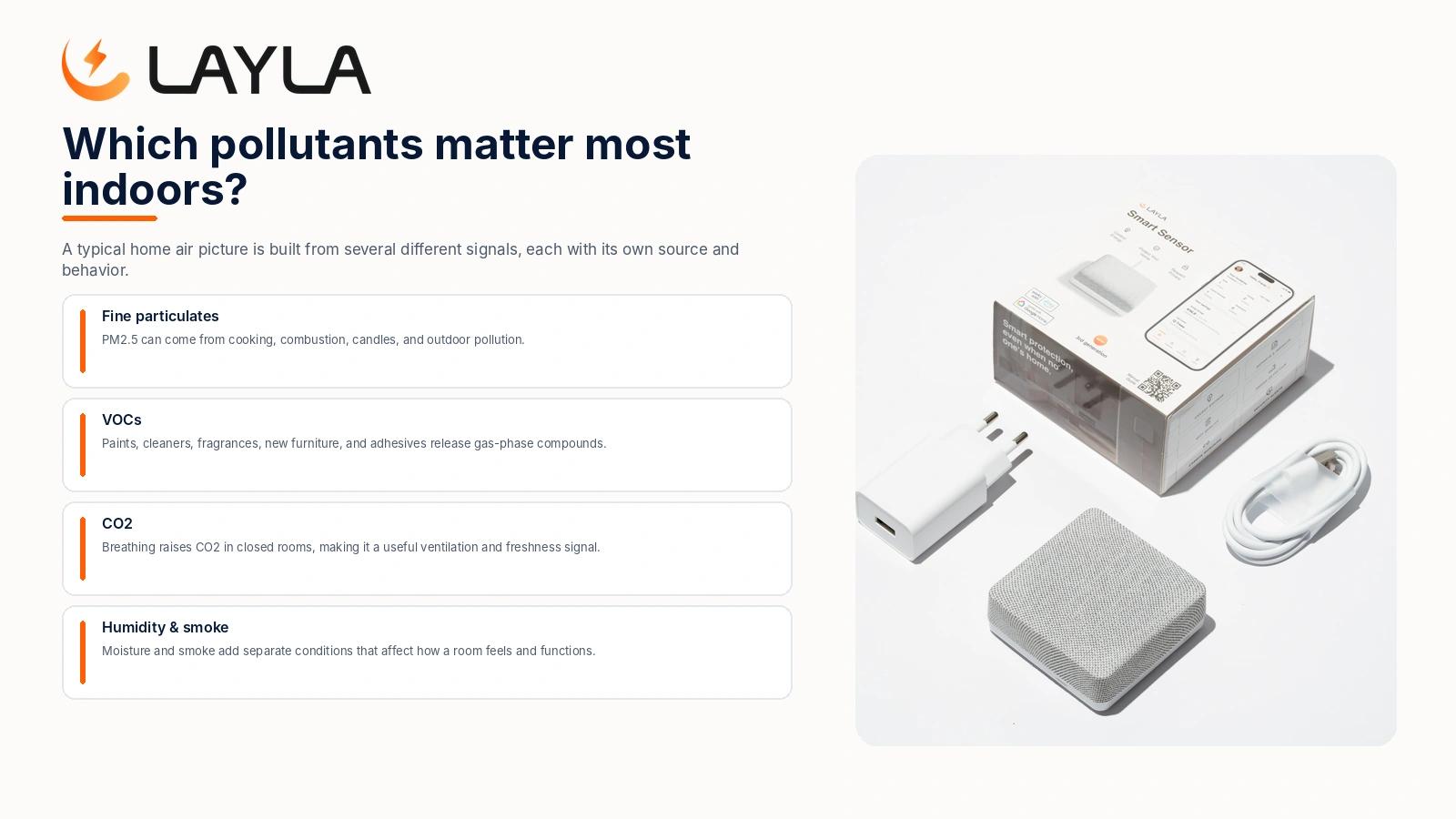
Five indoor air factors matter most in a typical home: fine particulates (PM2.5), volatile organic compounds (VOCs), carbon dioxide (CO2), humidity, and smoke. They cover the great majority of what affects comfort and health day to day, and each behaves differently, so it helps to understand them one at a time before looking at how a monitor tracks them.
Fine particulates (PM2.5) are microscopic solid and liquid particles small enough to travel deep into the lungs. Cooking (especially frying and searing), candles, wood burning, and outdoor pollution seeping in are the usual culprits at home. Because these particles are so small, they can hang in the air long after the source is gone. Higher PM2.5 is associated with respiratory irritation, and many people with sensitivities notice it first. Our deeper piece on dust and PM2.5 in your home covers sources and reduction in detail.
Volatile organic compounds (VOCs) are gases released from paints, cleaning products, air fresheners, new furniture, adhesives, and countless household items. You often smell them as that "new" or chemical odor. Individually most are harmless in small amounts, but spikes and constant low-level exposure in poorly ventilated rooms are worth managing. A dedicated VOC monitor for home explains where they come from and how to keep levels low.
Carbon dioxide (CO2) builds up from breathing in closed rooms. It isn't toxic at the levels a home reaches, but rising CO2 is the clearest sign that a room is under-ventilated and that stale air is accumulating, which many people associate with stuffiness and trouble concentrating. Treat it as a comfort and freshness signal rather than a danger signal. A CO2 monitor for home is one of the most useful things you can watch.
One clarification is worth locking in. CO2 (carbon dioxide) is not the same as CO (carbon monoxide). CO2 is the gas you exhale, and it tells you whether to ventilate. CO is a poisonous, odorless combustion gas—and it belongs to a certified carbon monoxide alarm, which every home should have alongside a certified smoke alarm.
Humidity is the amount of moisture in the air—and it's the quiet factor behind a lot of problems. Too dry and the air feels harsh and can irritate skin and airways. Too damp and you create the conditions for mold, dust mites, and musty smells. The sweet spot is roughly 30 to 50% relative humidity. Because mold follows moisture, watching humidity is the earliest warning you get. Our guides on how to prevent mold in your home and whether an air monitor can detect mold go deeper here.
Smoke from cigarettes, vaping, or cannabis is a distinct category because it combines fine particles and gases in a way that lingers and clings to surfaces. Beyond the obvious health associations, it's a comfort and freshness issue that a monitor can flag by type so you know what you're dealing with.
How does indoor air quality affect your health and comfort?
Indoor air quality affects health and comfort through the same pollutants that build up when a home isn't well ventilated, and the effects range from everyday stuffiness to symptoms that many people with sensitivities notice quickly. This is where the careful language matters: air quality is linked to comfort and wellbeing rather than being a cure or a cause of any specific condition, and individual responses vary a great deal.
On the comfort side, the connections are immediate and easy to feel. High CO2 leaves a room stuffy and can make people feel sluggish or unfocused. High humidity feels heavy and encourages that musty smell. Dry air can leave skin and throats feeling scratchy. A PM2.5 spike after cooking can make a kitchen feel hazy—even when you can't quite see it.
On the health side, the associations are well documented even if individual responses differ. Fine particulates and VOCs are associated with respiratory irritation, and many people with asthma or allergies find their symptoms are aggravated by poor air. Damp conditions and mold are linked to allergy-type responses and worse breathing for sensitive people. If air quality is a live concern for someone in your household, our focused guides on indoor air quality and asthma and choosing an air quality monitor for allergies go much deeper than a hub can. Households with the youngest and most sensitive members, or with animals, will also want the tailored advice in our pieces on air quality for babies and nurseries and air quality for pet owners.
What are healthy indoor air targets?
Healthy indoor air comes down to keeping particulates and VOCs low, CO2 fresh, and humidity in the 30 to 50% band. Rather than chasing perfection, the goal is to stay inside sensible ranges most of the time and to act quickly when something spikes. The table below sums up the main factors, where they come from, the target to aim for, and the signal a monitor gives you.
| Air factor | Typical home sources | Healthy target / range | What a monitor tracks |
|---|---|---|---|
| PM2.5 (fine particulates) | Cooking, candles, wood smoke, outdoor pollution | Lower is always better; watch for spikes | Total particulate level, rising and falling in real time |
| VOCs | Paints, cleaners, air fresheners, new furniture | Keep low; ventilate on spikes | A total TVOC figure, not individual chemicals |
| CO2 | Breathing in closed rooms | Under ~800 ppm is fresh; act past ~1,000 ppm | CO2 concentration as a ventilation cue |
| Humidity | Showers, cooking, drying laundry, leaks | 30–50% relative humidity | Relative humidity, with early warning for damp |
| Smoke | Cigarettes, vaping, cannabis | Ideally none; clear quickly if present | Smoke presence and type |
A word on how these numbers are meant to be used. PM2.5 and VOCs are about direction and spikes rather than a single magic threshold, so the habit to build is noticing when the line jumps after cooking or cleaning and responding. CO2 is the friendliest number to live by: under about 800 ppm the room is fresh, and once you drift past roughly 1,000 ppm it's time to let some air in. Humidity has a clear band, 30 to 50%, and staying inside it heads off both dry-air discomfort and damp-driven mold.
How do you measure indoor air quality at home?
You measure indoor air quality with a home air quality monitor that reads the key factors continuously and shows you trends over time. A one-off reading tells you very little, because air changes minute to minute as you cook, shower, clean, and simply breathe. What actually helps is a continuous picture, the line that climbs while dinner is on the stove and settles once you open a window, or the humidity that creeps up over a rainy week.
A good monitor turns invisible air into something you can respond to. Instead of guessing why a room feels stuffy or why a corner keeps smelling musty, you see the cause and the timing. That's the difference between reacting to a problem after it has taken hold and catching it early. The point isn't to obsess over numbers—it's to build a few simple habits around clear signals: ventilate when CO2 climbs, run the extractor when PM2.5 spikes, and dry things out when humidity drifts high.
It's worth being clear about what home monitors do and don't tell you. They measure totals rather than identifying specific culprits. A monitor shows you total particulates rising, not that the particles are pollen versus dust versus dander. It shows a total VOC (TVOC) figure climbing, not that the gas is formaldehyde versus a cleaning agent. That total-level view is exactly what you need for the daily decisions above, and it's honest about its limits. Combustion safety is a separate job, and a certified smoke alarm and a certified carbon monoxide alarm remain the right tools for fire and CO, so every home should have both.
How do you improve indoor air quality?
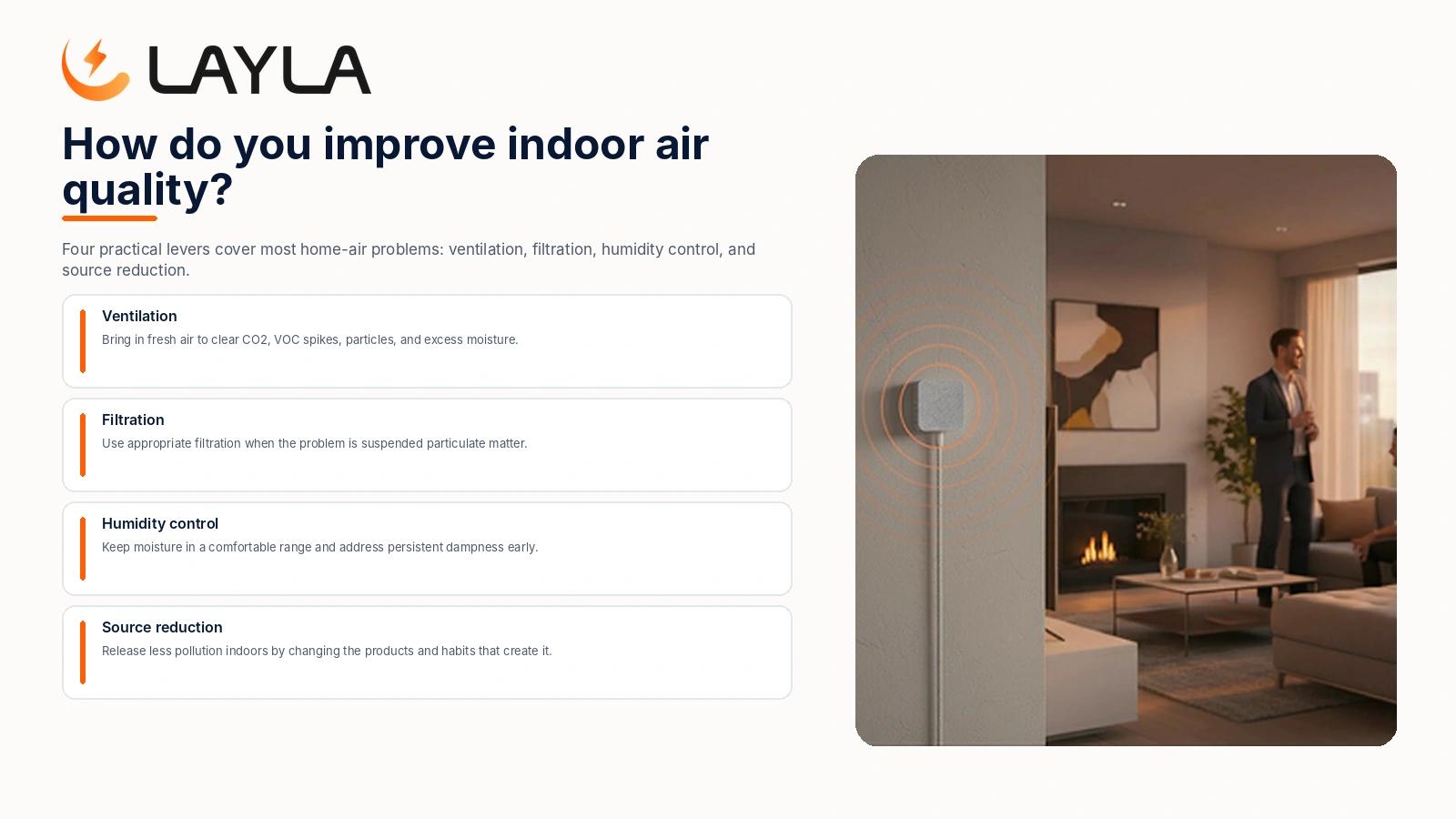
You improve indoor air quality with four core levers: ventilation, filtration, humidity control, and source reduction. Together they cover almost everything that goes wrong with home air, and none of them requires a renovation.
Ventilation is the fastest fix and the one most people underuse. Opening windows, running kitchen and bathroom extractor fans, and simply moving air through the house flushes out CO2, clears VOC and PM2.5 spikes, and carries moisture outside. When a monitor shows CO2 climbing, ventilation is almost always the answer.
Filtration handles the particles ventilation can't fully clear, especially when outdoor air is poor. A good air purifier with a quality filter pulls PM2.5 out of the air, and keeping HVAC filters clean does similar work. A monitor won't filter anything itself, but it tells you when filtering is worth running and whether it's actually helping.
Humidity control keeps you in that 30 to 50% band. A dehumidifier in damp rooms, better bathroom and kitchen ventilation, fixing leaks promptly, and drying laundry with airflow all pull moisture down. Since damp is the precondition for mold, this lever does double duty, and watching humidity gives you the earliest possible warning before mold conditions set in.
Source reduction means adding less to the air in the first place: choosing low-VOC paints and cleaners, cooking with the fan on, being sparing with candles and sprays, and keeping smoke out of the home. It's the least glamorous lever and often the most effective—because the easiest pollutant to deal with is the one you never released.
The thread running through all four is that a monitor makes them purposeful. It shows you when to ventilate, whether filtration is helping, before humidity becomes a mold problem, and which sources are spiking. It's the feedback loop that turns guesswork into a few well-timed habits.
How Layla helps you understand your home's air
Layla 3.0 is a home air quality monitor that reads the factors this guide covers and turns them into clear, real-time signals so you know when to act. It tracks total particulates and a total VOC (TVOC) figure, CO2, temperature and humidity, an overall air-quality index, mold conditions through humidity-based early warning, and smoke by type. It measures totals rather than identifying specific allergens like pollen or dander, or naming individual chemicals, and it's honest about that. The total-level view is exactly what drives the everyday ventilate-filter-dehumidify decisions this whole cluster is built around.
Layla is a monitor, not a purifier. It won't clean your air on its own; it shows you the moment to open a window, run the filter, or dry out a room—and whether what you did actually worked. For combustion safety, keep a certified smoke alarm and a certified carbon monoxide alarm in place, and let Layla handle the everyday picture of particulates, VOCs, CO2, humidity, and smoke type. It works with no camera and no microphone, so it senses your air without watching or listening to your home.
Layla 3.0 is $99 one-time on the Air Quality tier, down from $189, with no subscription ever. You can see the full sensor and features on the air quality page, and compare tiers on the pricing page.
FAQ
Is indoor air really worse than outdoor air?
It can be. Because homes are enclosed and generate their own pollutants from cooking, cleaning, and daily life, indoor air can hold more pollutants than the air outside. Given that most people spend around 90% of their time indoors, that's a large share of your total exposure, which is exactly why it's worth measuring and managing.
What is the most important indoor air factor to watch?
There isn't a single most important one, because they interact, but humidity and CO2 are the easiest to act on daily. Humidity in the 30 to 50% band heads off mold and comfort problems, and CO2 tells you plainly when a room needs fresh air. PM2.5 and VOCs matter most as spikes you respond to after cooking, cleaning, or painting.
Can a monitor tell me exactly what's polluting my air?
A home monitor shows totals, not specific culprits. It tells you total particulates or total VOCs are rising, which is what you need to decide whether to ventilate or filter, but it won't identify the particle as pollen versus dust or name a specific chemical. For the daily decisions that improve your air, the total-level view is what counts.
Does an air quality monitor replace a smoke or carbon monoxide alarm?
No, and it isn't meant to. A certified smoke alarm and a certified carbon monoxide alarm are the right tools for fire and CO detection, and every home should keep both. A monitor like Layla covers the everyday picture of particulates, VOCs, CO2, humidity, and smoke type so you can keep the air comfortable and fresh.
What's the difference between CO2 and CO?
CO2 is carbon dioxide, the gas you breathe out, and rising levels simply mean a room needs ventilating. CO is carbon monoxide, a poisonous, odorless combustion gas that requires a dedicated certified alarm. A home air monitor reads CO2 as a freshness and ventilation cue; it does not replace a CO alarm.
Related reading

Best for: health-conscious homes
Smoke & Air Quality
Air quality, mold and smoke monitoring for healthy homes and smoke-free rentals.
Included forever — no subscription
- Mold-risk early warning
- Smoke & cigarette detection
- Air quality score (IAQ) with alerts
- CO₂ & bVOC monitoring
- AI air insights & recommendations
- Allergy-comfort monitoring
No monthly fees. Ever.
30-day money back guarantee