BLOG
Indoor air quality and asthma: what the air in your home has to do with it
 By Nangyal Khan··Updated
 12 min read
The link between indoor air quality and asthma comes down to exposure: several of the most common asthma triggers are airborne conditions that build up inside a closed home. If you or someone you live with has asthma, the air indoors matters more than most people realize. We spend the majority of our lives inside, and the particles, humidity, and fumes that gather in a shut room don't announce themselves. They just accumulate. Knowing how indoor air conditions line up with common triggers, and how to keep an eye on them, gives you something concrete to act on instead of guessing.
This is not medical guidance, and nothing here replaces a conversation with your doctor about managing asthma. What follows is a plain look at the environmental side, covering which indoor air conditions are commonly linked to asthma triggers and how awareness helps you respond before a bad day gets worse.
Does indoor air quality affect asthma?
Yes, indoor air quality is widely associated with asthma symptoms, because several of the most common asthma triggers are airborne conditions that build up inside the home. Fine particulate matter, damp air that encourages mold and dust mites, strong chemical fumes, and very dry air are all environmental factors many people with asthma find aggravating. None of these are the same as asthma itself, and none of them cause it in a simple way, but they are frequently cited as things that can make symptoms flare.
Indoor air deserves attention mainly because of exposure time. Outdoor air quality gets plenty of coverage, yet a poorly ventilated bedroom, a bathroom that stays humid, or a kitchen full of cooking smoke can expose you for hours at a stretch. Indoor air is also the part you can actually influence, and the first step is seeing what's happening. A broader look at indoor air quality and your health is useful here, since asthma is one of several conditions sensitive to the same handful of factors.
What are the most common indoor asthma triggers?
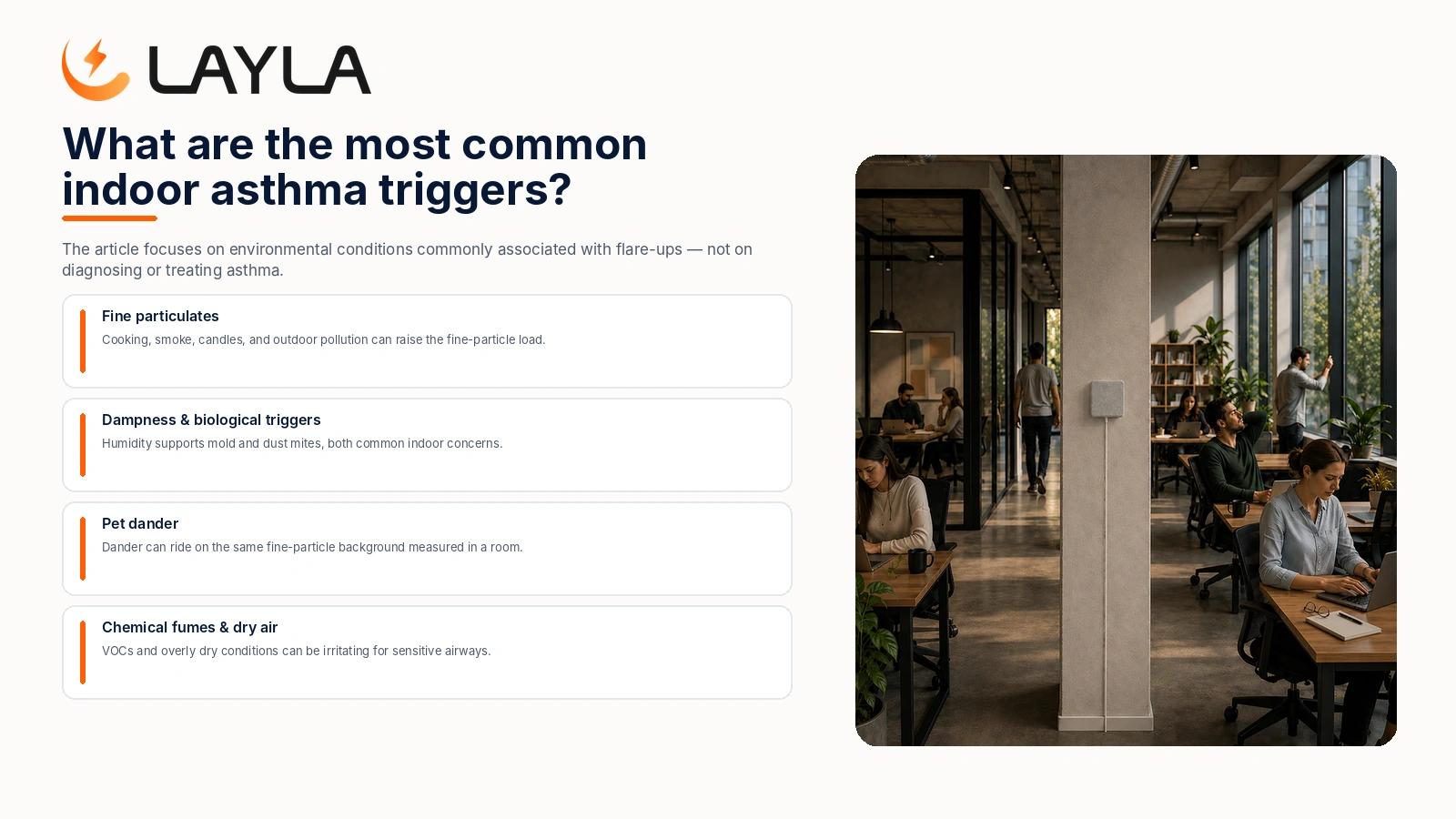
The most common indoor asthma triggers fall into a short list: fine particulates, dust mites, mold, pet dander, chemical fumes and VOCs, and overly dry air. Each one shows up in a typical home for its own reasons, and most leave an environmental signal you can track even when the trigger itself is invisible.
Fine particulates, often measured as PM2.5, come from cooking, candles, wood smoke, tobacco or vape smoke, and particles drifting in from outside. These tiny particles stay suspended in the air and are small enough to reach deep into the lungs, which is why they're so often linked to respiratory irritation. If you want the fuller picture, dust and PM2.5 in your home covers where household particulates come from and why they linger.
Dust mites are microscopic creatures that live in bedding, upholstery, and carpets. They flourish in humid conditions, and populations climb once relative humidity holds above roughly 50%. The proteins they leave behind are a well-known allergen for many people. You can't count dust mites with a home device, but you can watch the humidity that lets them multiply.
Mold is another damp-loving trigger. It grows wherever moisture collects and lingers, releasing spores into the air that many people with asthma react to. Again, the practical lever is moisture. Keeping humidity in check is the single most effective way to discourage mold, which is why how to prevent mold in your home leans so heavily on controlling damp conditions.
Pet dander, the tiny flakes of skin cats and dogs shed along with proteins in their saliva and urine, is another allergen widely linked to asthma symptoms. It settles into soft furnishings and rides along on the same fine particulates a monitor picks up, though no home device singles it out by name. If pets share your space, air quality for pet owners goes deeper on managing dander and the particulates that carry it.
VOCs, or volatile organic compounds, are gases released by paints, cleaning products, air fresheners, new furniture, and many everyday household items. Strong fumes are a recognized irritant for sensitive airways. A rundown of what VOCs are in your home explains where they come from and how ventilation reduces them.
Dry air rounds out the list. When indoor humidity drops too low, especially in winter with the heating running, the dryness itself can irritate airways for some people. The comfortable middle ground for most homes sits around 30 to 50% relative humidity.
What is the ideal humidity level for asthma at home?
For most homes, keeping relative humidity between roughly 30% and 50% is the range most often recommended for people managing asthma triggers, though the right target for you is a conversation worth having with your doctor. This band is a practical sweet spot because it sits below the level where dust mites and mold gain a foothold, yet above the point where dry air becomes irritating. Dust mite populations struggle once humidity stays under about 50%, and mold growth slows below 60%, so the 30 to 50% range keeps both in check.
Humidity is one of the most useful things to monitor precisely because it swings so much. A steamy shower, a boiling pot, a rainy week, or a basement laundry area can push a room past 50% without anyone noticing, while a heated home in a cold climate can drift well below 30%. Watching the number across a day tells you whether you need a dehumidifier, better ventilation, or a humidifier to bring things back into range. Because humidity is the shared lever behind both dust mites and mold, getting it right addresses two triggers at once.
Which indoor triggers can a home air quality monitor actually track?
A home air quality monitor tracks the environmental conditions correlated with common asthma triggers, not the triggers themselves. This is an important distinction to be honest about. A monitor does not count pollen grains, identify pet dander, tally dust mites, or name a specific chemical in the air. What it does is measure the broader signals — total fine-particle levels, total VOC levels, humidity, and carbon dioxide — that tell you when conditions are drifting toward the kind of environment triggers like.
Here's how the common triggers map to what a monitor can measure and what you can do about each:
| Common indoor trigger | Environmental signal a monitor can track | Practical action |
|---|---|---|
| Fine particulates (cooking, smoke, candles) | Total PM / fine-particle reading | Ventilate, use extraction while cooking, run a purifier |
| Dust mites | Relative humidity (populations climb above ~50%) | Keep humidity in the 30–50% range, wash bedding hot |
| Mold | Sustained high humidity / damp conditions | Dehumidify, fix leaks, improve airflow |
| VOCs and strong fumes | Total VOC (TVOC) reading | Air the room out, switch to low-fume products |
| Dry-air irritation | Relative humidity below ~30% | Add moisture, avoid over-heating |
| Stuffy, poorly ventilated rooms | CO2 level | Open a window, improve ventilation |
The value of a monitor is timing. Instead of reacting after symptoms appear, you get a read on the room while it's still fixable — the extractor fan to turn on, the window worth opening, the humidity creeping up before mold can establish. For households dealing with sensitivities, an air quality monitor for allergies covers the same measurement logic applied to allergy triggers, which overlap heavily with asthma triggers.
Why does carbon dioxide matter if it isn't a trigger?
Carbon dioxide isn't an asthma trigger in itself, but it's one of the most useful things to watch because it's a reliable stand-in for how well a room is ventilated. CO2 builds up naturally from breathing, so when levels climb in a closed bedroom overnight or a crowded living room, it's a sign that fresh air isn't circulating. And poor ventilation is exactly the condition that lets particulates, humidity, and VOCs accumulate.
Think of CO2 as the canary for stale air. A rising number doesn't mean the carbon dioxide is harming your airways at typical home levels; it means the room needs fresh air, and everything else that irritates asthma is probably concentrating along with it. Cracking a window or improving airflow brings the CO2 down and clears out the other pollutants at the same time. If you want the mechanics, CO2 levels in your home breaks down what the readings mean and when to ventilate.
How can monitoring help without making medical promises?
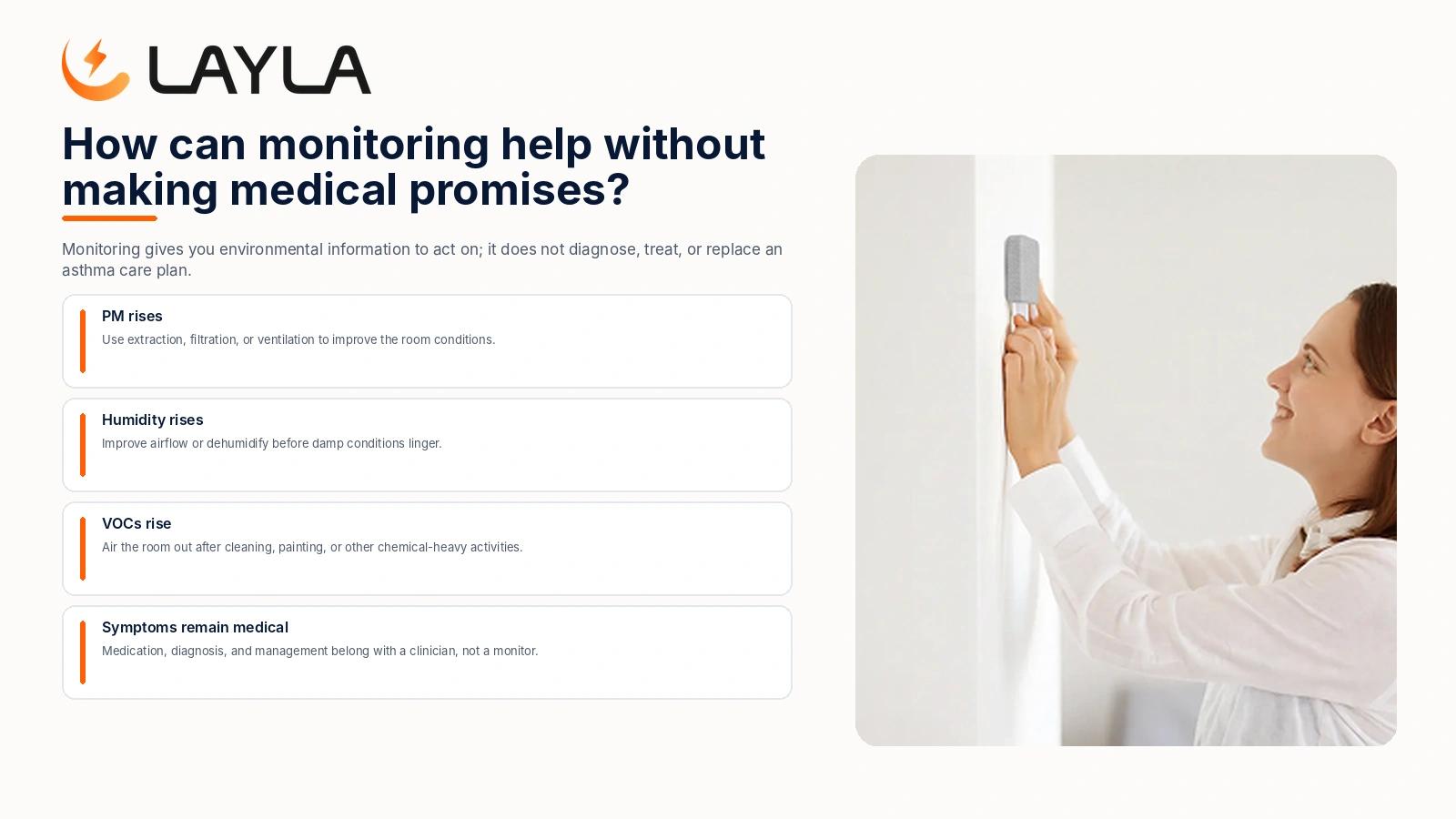
Monitoring helps by turning invisible air conditions into information you can act on — it does not treat, manage, or diagnose asthma, and it isn't a substitute for medical care. That boundary matters. A monitor won't stop a flare-up or replace an inhaler or a doctor's plan. What it does is remove the guesswork from the environmental side, so the choices within your control become clearer.
In practice, that looks ordinary. The kitchen particulate reading spikes every time you sear something, so you run the extractor fan. Humidity climbs in the bathroom, so you leave the fan on longer. VOCs rise after cleaning day, so you air the room out. None of these are cures. They're small, repeatable adjustments many people with asthma find make their home feel more comfortable, informed by data instead of hunches. For anything to do with symptoms, medication, or a management plan, your doctor remains the right source.
Practical steps to improve indoor air for asthma triggers
The most effective steps for reducing indoor asthma triggers come down to controlling moisture, cutting particulates at the source, ventilating regularly, and reducing chemical fumes. These are the fundamentals, and a monitor simply tells you where to focus.
Start with humidity, since it drives two triggers at once. Keep it in the 30 to 50% range with a dehumidifier in damp spaces or a humidifier in dry ones, and fix leaks promptly so moisture never gets a foothold. For particulates, use extraction fans while cooking, be mindful of candles and indoor smoke, and consider an air purifier in the rooms where you spend the most time — a monitor measures the air, while a purifier is what actually cleans it. Ventilate deliberately by opening windows when the outdoor air is reasonable, and don't let bedrooms stay sealed all night. For VOCs, choose lower-fume products where you can, and air out a room after painting or bringing in new furniture. Wash bedding in hot water regularly to keep dust mites down. Each step is easier to prioritize once you can see which condition in your home is actually out of range.
Where Layla fits in
Layla 3.0 is a home air quality monitor, not a purifier and not a medical device. It measures the environmental conditions in your home and shows them to you in real time so you can act. It tracks total fine particulates, total VOCs, humidity, temperature, CO2, and an overall air-quality index, along with early-warning humidity conditions that encourage mold. That covers the environmental signals most closely associated with common asthma triggers, all in one place.
It helps to be clear about what those readings are. The particulate figure is a total fine-particle count, and the VOC figure is a total (TVOC) reading. Layla doesn't identify specific allergens like pollen or dander, or name individual chemicals, because no home monitor does. What it gives you is an honest, continuous picture of the conditions that tend to accompany triggers, so you know when to ventilate, dehumidify, or clear the air. It also handles smoke detection, noise levels, and radar-based occupancy, and can automate your AC, but for asthma-aware households the air-quality readings are the core.
Layla 3.0 is $99 one-time on the Air Quality tier, down from $189, with no subscription ever. You can see the full sensor breakdown on the air quality page and compare tiers on the pricing page.
FAQ
Can an air quality monitor detect asthma triggers directly?
Not specifically. A monitor measures total fine particulates, total VOCs, humidity, and CO2 — the environmental conditions commonly linked to triggers. It doesn't count pollen, dander, or dust mites or identify individual chemicals. It tells you when the air is drifting toward trigger-friendly conditions so you can act.
What humidity level is best if someone in the home has asthma?
Most guidance points to keeping relative humidity between about 30% and 50%. That range sits below where dust mites and mold thrive and above where dry air becomes irritating. Your doctor can advise on what's right for your specific situation.
Does poor ventilation make asthma worse?
Poor ventilation lets particulates, humidity, and VOCs build up, and those conditions are commonly associated with aggravating asthma symptoms. Rising CO2 is a good signal that a room needs fresh air. Opening a window or improving airflow clears out the other pollutants at the same time.
Is Layla a medical device or a replacement for my doctor?
No. Layla is a home air quality monitor, not a medical device, and it doesn't treat, manage, or diagnose asthma. It gives you awareness of your home's air so you can make environmental adjustments. Anything to do with symptoms or treatment belongs with your doctor.
What's the single most useful thing to monitor for asthma triggers at home?
Humidity is a strong candidate because it drives two triggers at once. Dust mites and mold both thrive in damp conditions, so keeping the level in the 30 to 50% range discourages both, and it's one of the easiest numbers to correct with ventilation or a dehumidifier.
Related reading

Best for: health-conscious homes
Smoke & Air Quality
Air quality, mold and smoke monitoring for healthy homes and smoke-free rentals.
Included forever — no subscription
- Mold-risk early warning
- Smoke & cigarette detection
- Air quality score (IAQ) with alerts
- CO₂ & bVOC monitoring
- AI air insights & recommendations
- Allergy-comfort monitoring
No monthly fees. Ever.
30-day money back guarantee