BLOG
Dust and PM2.5 in your home
 By Nangyal Khan··Updated
 10 min read
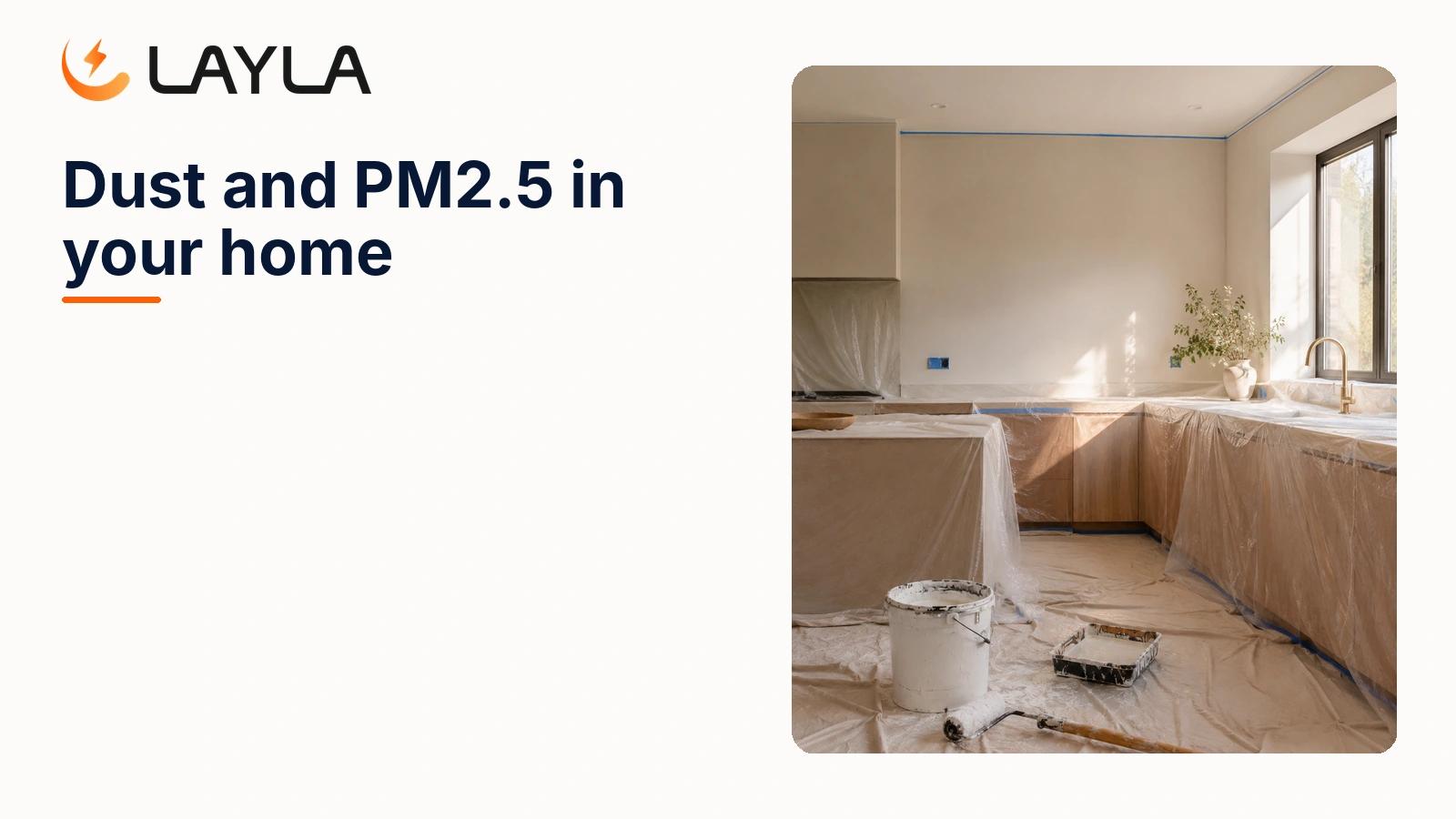
Dust and PM2.5 in your home are two of the most common indoor pollutants—and two of the easiest to ignore. You can watch dust motes drift through a sunbeam, but the particles that matter most for your lungs are the ones you'll never see. If your surfaces go filmy days after you clean them, if the air feels heavy after you cook, or if your allergies flare worse inside than out, fine particulate matter is usually part of the story.
Here's what PM2.5 and household dust actually are, where they come from, why they're worth paying attention to, and the steps that genuinely bring the levels down. Indoor particle pollution turns out to be one of the more controllable parts of your air, once you can see what's happening.
What is PM2.5 and where does it come from?
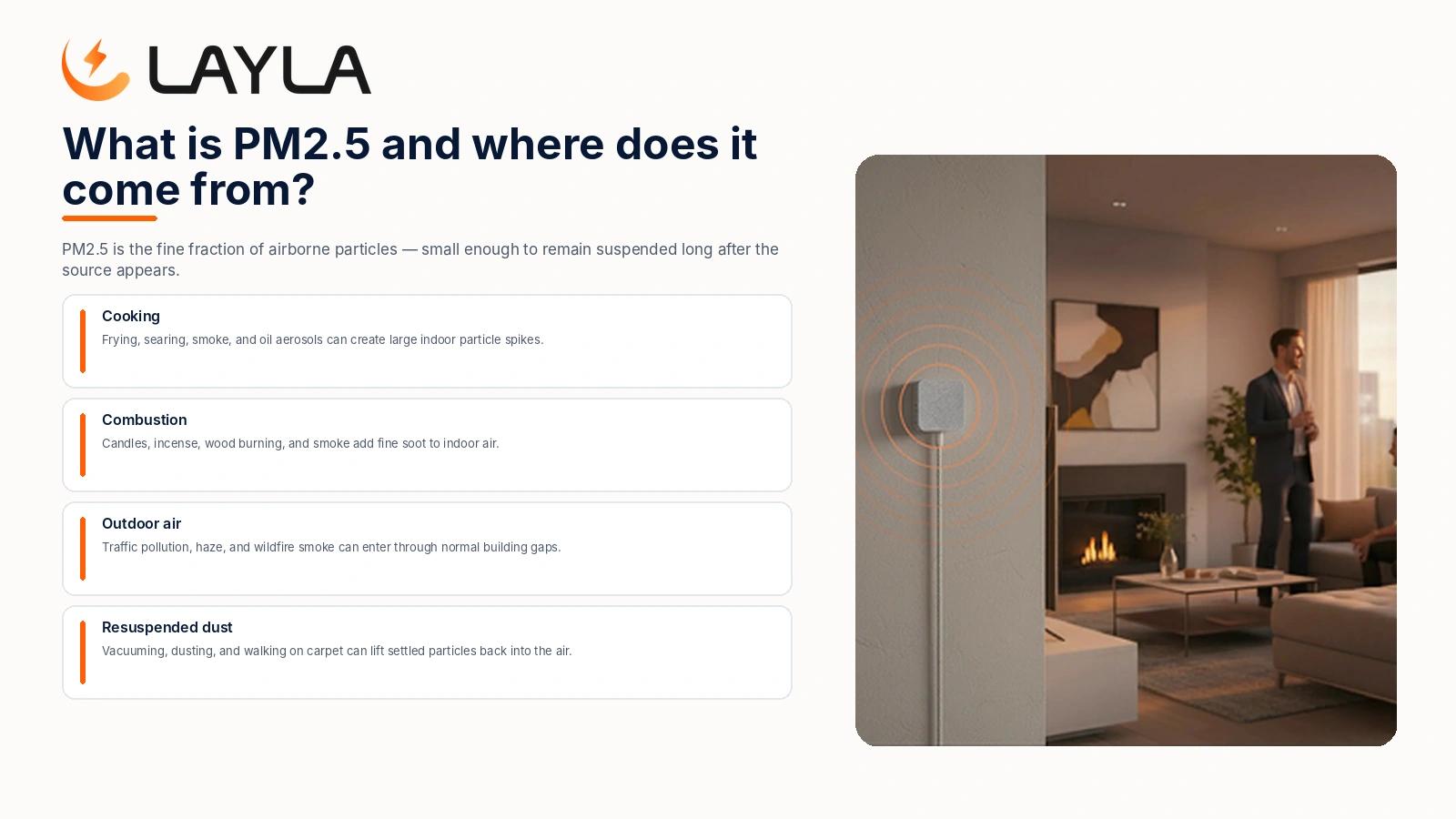
PM2.5 is fine particulate matter measuring 2.5 microns or smaller, roughly 30 times thinner than a human hair. Particles that small stay suspended in the air for hours, and when you breathe them in they travel deep into the lungs. Invisible and deeply inhalable is a bad combination, and it's why air-quality researchers watch PM2.5 so closely.
Indoors, PM2.5 comes from more sources than most people expect. Cooking is a big one, especially frying, searing, and anything that puts up smoke or oil aerosol. Candles and incense throw off fine soot. Wood-burning stoves and fireplaces are heavy contributors. Ordinary vacuuming, dusting, even walking across a carpet can lift settled particles back into the air. And a surprising share simply drifts in from outside. Traffic exhaust, wildfire smoke, and general urban haze all infiltrate through windows, doors, and the small gaps in a building.
Household dust is broader. It's a mix of skin cells, textile fibres, soil tracked in on shoes, pet dander, pollen, and tiny fragments of nearly everything in your home. The coarse part settles quickly onto surfaces. The finest part behaves like PM2.5—it lingers in the air you breathe. If dust and pet allergens are a recurring problem, an air-quality monitor for allergies helps you connect the flare-ups to what's actually happening in the room, and if you share your home with animals, our guide to air quality for pet owners covers dander and the particle load pets add.
What's the difference between PM2.5 and PM10?
The difference between PM2.5 and PM10 is particle size, and size decides how deep a particle can travel into your body. PM10 covers coarser particles up to 10 microns across. PM2.5 is the fine fraction at 2.5 microns and below.
PM10 takes in larger dust particles, some pollen grains, and mould fragments, the kind of irritants people tend to notice in the nose and throat. PM2.5 is finer and matters more for health because it can slip past the body's natural filtering and reach the deep airways. Cooking smoke, combustion soot, and infiltrated outdoor pollution mostly live in this fine range. Both are worth tracking, but PM2.5 is the number most air-quality standards and monitors lead with, since it's the fraction most strongly linked to respiratory and cardiovascular effects in the research.
Why does PM2.5 in your home matter for health?
PM2.5 in your home matters because fine particles reach deep into the lungs, and long-term exposure has been linked to a range of respiratory and cardiovascular effects in public-health research. This isn't about one bad day. It's the cumulative load of the air you breathe across the many hours you spend at home.
This is general information, not medical advice, and a home monitor is not a diagnostic tool. Even so, the patterns are consistent enough to act on. Plenty of people with asthma or allergies notice that symptoms track with indoor particle spikes, whether it's a smoky pan, a dusty cleaning session, or a wildfire day with the windows open. If breathing conditions are part of your household, our overview of indoor air quality and asthma goes deeper on the connection and on dialling back common triggers.
Children, older adults, and people with existing heart or lung conditions tend to be more sensitive, which is why air-quality guidance calls out "sensitive groups" by name. Even healthy adults can feel it. High PM2.5 causes the kind of low-grade irritation—scratchy throat, tired eyes, a stuffy head—that's easy to pin on something else.
How is PM2.5 measured, and what counts as a healthy level?
PM2.5 is measured in micrograms per cubic metre of air (µg/m³), and the lower the number, the cleaner the air. Outdoor agencies translate those raw readings into an index so a value is easy to read at a glance. The U.S. EPA tightened its PM2.5 AQI breakpoints in 2024, and the current 24-hour categories below are a useful reference for indoor air too, because your indoor levels are strongly shaped by what drifts in from outside.
| PM2.5 level (µg/m³) | Category | What it generally means |
|---|---|---|
| 0.0 – 9.0 | Good | Air quality is satisfactory; little to no concern |
| 9.1 – 35.4 | Moderate | Acceptable, but sensitive people may notice effects |
| 35.5 – 55.4 | Unhealthy for sensitive groups | Sensitive individuals may experience symptoms |
| 55.5 – 125.4 | Unhealthy | Everyone may begin to feel effects |
A sensible indoor goal is to keep everyday readings in the Good range and to learn what pushes you into Moderate or higher. That's where continuous measurement earns its keep. A single reading tells you the moment. A running trend tells you the story: which room, which activity, which time of day sends your particles climbing.
This is where a PM2.5 monitor for your home changes the picture. Instead of guessing, you watch the number climb the instant you start searing dinner and drop again once the range hood and an open window do their work. That feedback loop is what makes a new habit stick.
How to reduce dust and PM2.5 at home
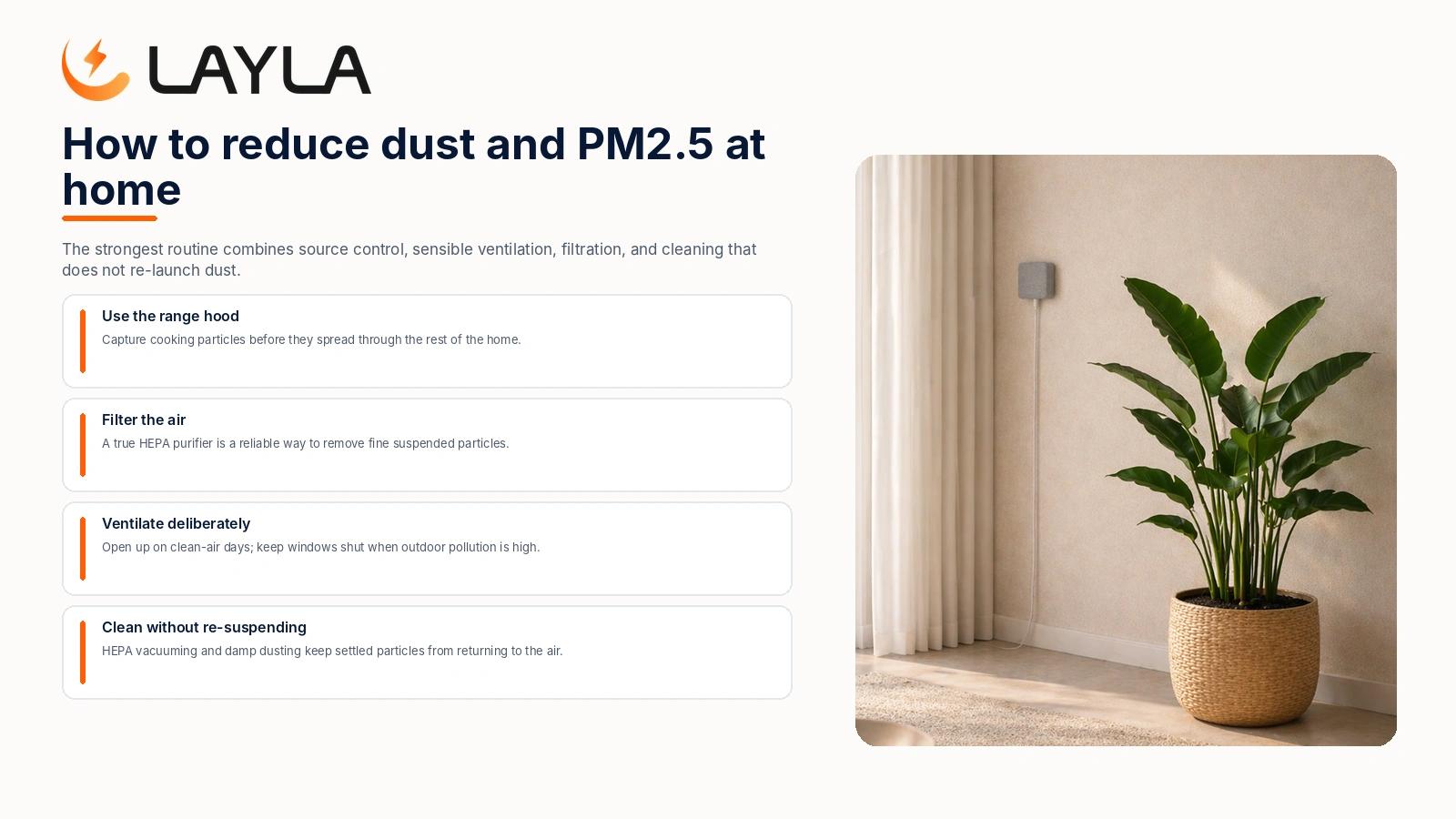
The most effective way to reduce dust and PM2.5 at home is to combine source control, ventilation, and filtration. No single step carries the whole job. Here's what actually moves the needle, roughly in order of impact.
Cook with the range hood on, every time. Cooking is one of the largest indoor PM2.5 sources, and a vented range hood pulls those particles outside before they spread. If your hood recirculates rather than vents outdoors, crack a window while you cook and leave it running afterward.
Filter the air with a true HEPA unit. A portable air purifier sized for your room, with a genuine HEPA filter, is the most reliable tool for pulling fine particles out of the air. Match it to the room, run it on the settings that matter, and change the filter on schedule. Your central HVAC filter helps too. A higher-MERV filter captures more fine particulate, as long as your system is rated to handle it.
Ventilate deliberately. Fresh air dilutes indoor pollutants, but timing is everything. On a clean-air day, opening windows flushes out cooking particles, dust stirred up by cleaning, and fumes from new products. On a high-pollution or wildfire-smoke day, do the opposite: keep the windows shut and lean on filtration. The same ventilate-when-you-can logic applies to lowering VOCs in your home and to airing out off-gassing from new furniture or a mattress.
Clean in ways that don't re-suspend dust. Vacuum with a HEPA-equipped machine, damp-dust hard surfaces instead of dry-dusting them back into the air, and wash bedding and soft furnishings regularly. Doormats and a shoes-off rule cut down on the soil and outdoor particles you'd otherwise track in.
Control humidity. Holding indoor humidity in a moderate range, very roughly 40 to 55 percent, discourages dust mites and mould, both of which add to the particle and allergen load. Too damp encourages growth. Too dry lets fine dust stay airborne longer. For more on the moisture side, see what humidity level prevents mould.
Skip the avoidable sources. Candles, incense, and a wood fireplace all spike PM2.5 fast. You don't have to give them up, but knowing they push your numbers up lets you decide when it's worth it.
What a Layla 3.0 monitor tells you about your particles
Layla 3.0 is a monitor, not a purifier. It measures your air and tells you when to act, so your ventilation, cleaning, and filtration land on real problems instead of guesswork. It tracks total particulate matter (PM) alongside CO2, total VOCs, temperature, humidity, and an overall air-quality index, and it surfaces the trend over time so you're reading patterns rather than isolated snapshots.
Here's the part worth being straight about. Layla measures the total level of fine particles in the air, a single particulate reading, and it does not identify the source of those particles. It can't tell dust from cooking smoke, pollen, or pet dander. What it gives you is the level and, more useful still, the trend. When the particle count jumps the moment you start frying and settles after you run the hood and open a window, you don't need the monitor to name the source—the timing already did. That level-and-trend signal is what turns "the air feels off" into a clear cue to ventilate, run the purifier, or clean.
Layla 3.0 is a one-time purchase of $99 on the Air Quality tier, down from $189, with no subscription ever. You can see how the air-quality sensing works on the air-quality page, and the full lineup and tiers live on the pricing page. For how particles sit alongside everything else in your air, our hub on indoor air quality and your health ties it together, and if you want to add a gas the eye can't see, what are VOCs in your home is a good next read.
FAQ
Is PM2.5 worse indoors or outdoors?
It depends on what you're doing and where you live. Outdoor air sets a baseline that infiltrates indoors, but cooking, burning candles, and vacuuming can push indoor PM2.5 well above outdoor levels for stretches at a time. Since most of us spend the bulk of our hours indoors, the indoor number often matters more day to day.
Can I see PM2.5 particles?
Generally no. PM2.5 particles are 2.5 microns or smaller, far too small to see one by one. You might catch a haze when levels are very high, during wildfire smoke or heavy cooking smoke, but the everyday particles that reach your lungs are invisible. That's exactly why a monitor helps.
Does opening a window reduce PM2.5?
It can, but only when the air outside is cleaner than the air inside. On a low-pollution day, opening windows flushes out cooking particles and dust and brings your indoor levels down. On a high-pollution or smoky day, an open window lets more particles in, so keep them closed and rely on filtration.
Will an air purifier fix my dust problem?
A true HEPA air purifier is very effective at removing fine airborne particles, including much of what makes up household dust. It won't stop dust from settling on surfaces, though, so pair it with regular damp-dusting, HEPA vacuuming, and source control like a shoes-off rule for the best results.
Does a Layla monitor tell me what's causing the particles?
No. Layla reports the total particle level and its trend, not the source. It can't separate dust from cooking smoke or pollen. In practice the timing of the spike usually gives away the cause, and the level-and-trend reading tells you when to ventilate, filter, or clean.
Related reading

Best for: health-conscious homes
Smoke & Air Quality
Air quality, mold and smoke monitoring for healthy homes and smoke-free rentals.
Included forever — no subscription
- Mold-risk early warning
- Smoke & cigarette detection
- Air quality score (IAQ) with alerts
- CO₂ & bVOC monitoring
- AI air insights & recommendations
- Allergy-comfort monitoring
No monthly fees. Ever.
30-day money back guarantee