BLOG
Air quality for pet owners: what pets do to your indoor air and how to manage it
 By Nangyal Khan··Updated
 11 min read

Air quality for pet owners is really a story about three invisible things: the fine particles dander and shed hair add to a room, the odors that drift up from litter boxes and the occasional accident, and the extra moisture a warm animal brings indoors. None of it makes a home unhealthy on its own. It just nudges the background levels of particles, smells, and humidity a little higher than they'd sit in a pet-free house. And once you can see those levels move, every bit of it becomes manageable.
This guide covers how cats, dogs, and other companion animals change your home's air, which signals are worth watching, and the everyday habits that keep it fresh. If you share your space with someone sensitive to allergens, the way you handle particles and humidity matters even more. For more background, our overview of indoor air quality and your health sets the scene, and our guide to dust and PM2.5 in your home covers the particle side in depth.
How do pets affect your home's air quality?
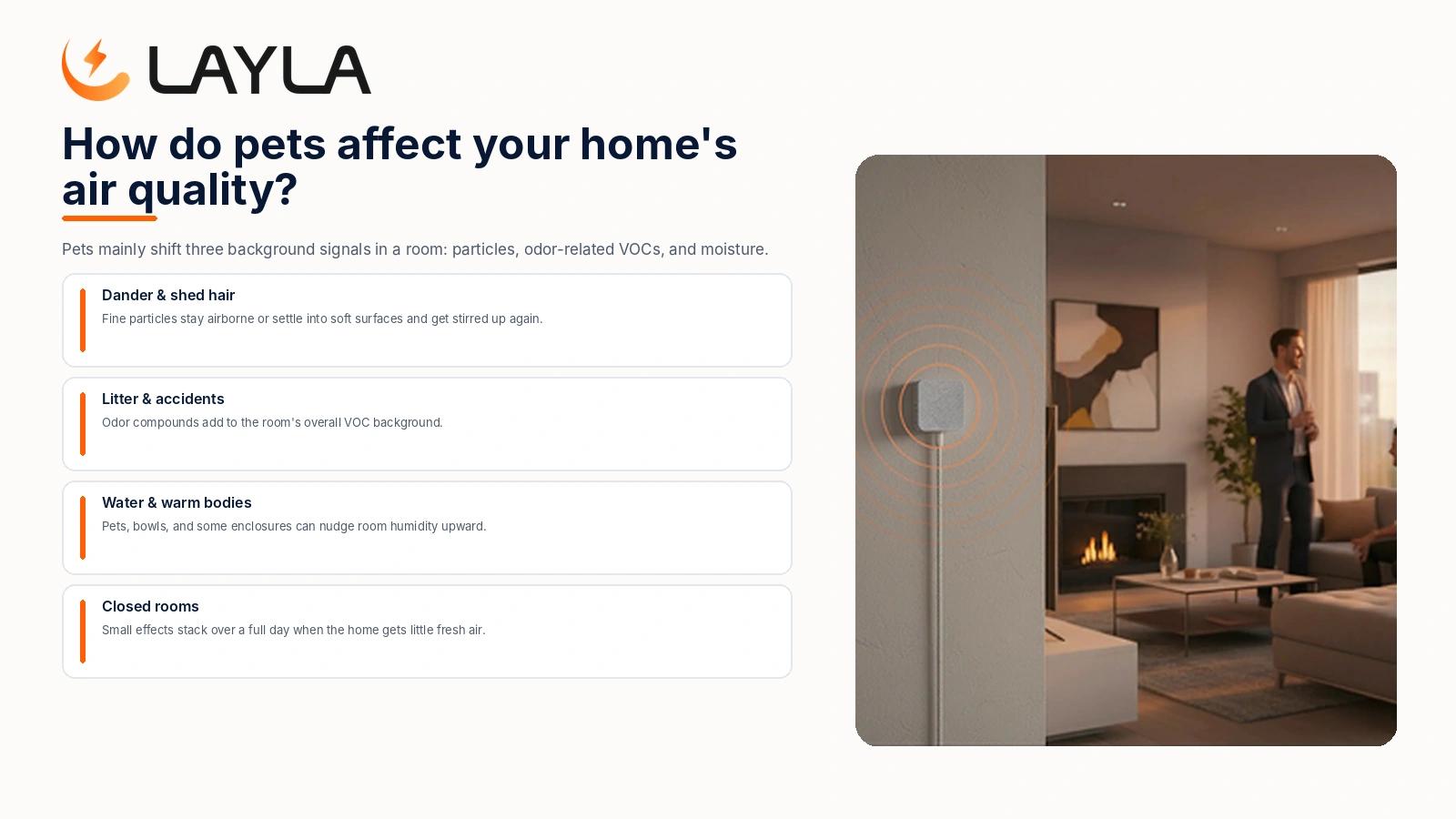
Pets affect indoor air through three routes, and it helps to picture each one. Dander (tiny flakes of skin), shed hair, tracked-in dust, and litter dust all add to the particle load drifting through your rooms. Litter boxes, accidents, and plain old "pet smell" release odor compounds. And a warm, active animal—plus water bowls and, for some pets, a humid enclosure—quietly raises the moisture in a room.
Any one of these is small. Stack them across a full day in a closed-up house and they add up to a measurably busier air profile than a pet-free home would have. So the three things worth understanding are particulates, odors (which register chemically as VOCs), and humidity. We'll take them one at a time.
Is pet dander really a problem in indoor air?
Yes. Pet dander is one of the most common indoor allergens, and it behaves as a very fine particulate that stays airborne far longer than heavier dust. Dander isn't the fur itself—it's the microscopic skin flakes animals shed constantly. The particles are so light that they drift, settle into soft surfaces, and get stirred back into the air the moment someone crosses a rug or a pet jumps on the couch.
For people sensitive to allergens, that lingering particle load is often what drives stuffy, itchy reactions indoors, and bedrooms are the worst offenders because we spend hours there breathing the same air. Shed hair plays a supporting role. It's heavier and settles faster, but it carries dander and traps dust, so a hairier home tends to run a dustier one overall—more surface area holding onto everything.
One honest caveat is that an air-quality monitor can't pick out "dander" as its own category. Dander and hair just add to the total fine-particle count in a room, and no consumer monitor can separate them from ordinary house dust. That total is still the number that matters. When it climbs, it's your cue to vacuum, ventilate, or run a filter, whether the source is the dog, last night's cooking, or plain house dust.
What about litter boxes, accidents, and pet odors?
Litter boxes, accidents, and general pet odors show up in your air as volatile organic compounds, or VOCs, the same broad family of airborne chemicals that come off cleaning products, paint, and cooking. As waste breaks down, bacteria convert the urea in urine into ammonia and other odor compounds that spread through a room and cling to fabrics. That distinctive "pet home" smell is basically a VOC signature you've stopped noticing, even when a visitor catches it the second they walk in.
A home air monitor reads these odors as part of a total VOC figure. It won't name the source or isolate a specific gas, and it won't report ammonia by name. It simply shows the overall VOC level rising and falling. In practice that's exactly what you want. When the total VOC reading climbs after a missed scoop or a hidden accident, it's a prompt to track down the source, clean it, and open a window. Our explainer on what VOCs are in your home covers where these compounds come from and how ventilation clears them, and how to reduce VOCs in your home has the fuller playbook.
The takeaway is simple. You don't need a device that "smells" ammonia by name. You need one that tells you the overall odor-chemistry load is up, so you can act before it becomes the permanent background scent of your house.
Can pets increase humidity and mold risk at home?
Yes. Pets add moisture to a home, and in the wrong spots that moisture can raise the risk of mold. Water bowls, wet accidents that soak into carpet or subfloor, damp towels after a bath, and humid enclosures like reptile tanks or covered cages all release water into the air. Minor on its own. Combined with poor ventilation, it can keep certain corners of a home damper than they should be, and the padding under a soaked carpet stays wet long after the surface feels dry.
Mold needs sustained dampness to take hold, and the classic trouble spots are the ones you overlook—under a rug where an accident soaked in, behind a water bowl, near a humid enclosure. The EPA's guidance is to keep indoor humidity below 60%, ideally in the 30–50% range, and that's the single best defense you have. A monitor that tracks humidity gives you early warning when a room drifts damp, long before you'd ever see or smell a problem. For the full playbook, see how to prevent mold in your home and, on the exact numbers, what humidity level prevents mold.
How pet air-quality factors show up on a monitor
Here's how each pet-related factor turns into something you can actually see and act on. A monitor never identifies the source. It shows the overall signal moving, and you connect the dots.
| Pet factor | How it affects the air | Signal a monitor tracks | What to do |
|---|---|---|---|
| Dander (skin flakes) | Adds to fine airborne particles | Total particulate (PM) count | Vacuum with HEPA, groom pets, run a filter |
| Shed hair + trapped dust | Raises overall dust and PM | Total particulate (PM) count | Vacuum and dust more often, wash bedding |
| Litter box / waste | Releases odor compounds | Total VOC level | Scoop daily, ventilate, deep-clean the box |
| Accidents on carpet | Odors plus trapped moisture | Total VOC + humidity | Clean thoroughly, dry the spot fully |
| Water bowls / enclosures | Adds moisture to the room | Humidity (%) | Ventilate, keep humidity 30–50% |
| Closed-up rooms | Everything concentrates | CO2 + PM + VOC | Open windows, improve airflow |
Read the table left to right and you have the whole workflow: pets create a source, the source moves a general signal, and a rising signal tells you which lever to pull.
What can pet owners actually do about it?

The most effective levers are cleaning, grooming, litter hygiene, ventilation, and humidity control. None of them expensive, all of them routine. Here's what makes the biggest difference.
- Vacuum with a HEPA filter, more often than feels necessary. Standard vacuums can throw fine particles back into the air; a sealed HEPA unit traps them instead. Hitting soft surfaces (rugs, sofas, pet beds) two or three times a week keeps the particle load down.
- Groom your pets regularly. Brushing outdoors, or in one easy-to-clean spot, pulls loose hair and dander off before it spreads through the house. For long-haired animals this is one of the highest-impact habits going.
- Stay on top of litter hygiene. Scoop daily, ventilate the area, and deep-clean the box on a schedule. Ammonia forms as waste sits, so frequent scooping is what separates an occasional VOC blip from a permanent background odor.
- Ventilate deliberately. Cracking windows for even 10 to 15 minutes flushes out built-up particles and odors faster than any single gadget. Rooms where pets sleep benefit most.
- Control humidity. Aim for 30–50%. Dry accidents completely, right down into the padding, keep water bowls out of damp corners, and watch enclosures. That keeps both odors and mold risk in check.
- Wash pet bedding and your own bedding often. Both act as dander reservoirs, and a warm wash knocks the load right down.
If allergens are your main concern, these same habits form the backbone of an allergy-aware home. Our guide to an air-quality monitor for allergies covers how tracking particles helps you time cleaning around symptoms, and indoor air quality and asthma goes deeper if breathing is the concern.
Why monitoring beats guessing on air quality for pet owners
The hard part of managing air quality for pet owners is that most of it is invisible. Dander doesn't announce itself, VOC odors fade from your own nose within minutes, and humidity creeping into a corner gives no warning at all until mold appears. So you end up cleaning on a fixed schedule that's either wasteful or too late.
A monitor swaps the guesswork for a live picture. The particle count spikes after the dog shakes off in the living room, you see it and vacuum. The total VOC reading climbs, you check the litter box before guests ever would. Humidity in the spare room drifts past 50%, you ventilate before mold gets a foothold. You stop cleaning on a hunch and start cleaning where the numbers point—which usually means less effort for a fresher home, not more.
How Layla helps pet owners keep the air fresh
Layla 3.0 is a home monitor that tracks the overall air picture pets tend to push up, so you know when to act instead of guessing. It measures the total particulate (PM) level in a room, so dander, shed hair, and tracked-in dust all land in the number that matters, though it reports a total count and can't isolate dander from ordinary dust. It tracks total VOCs, so litter-box, accident, and general pet odors surface as a rising overall reading that prompts you to clean and ventilate. That's the total odor-chemistry load, not a source-by-source breakdown, and not an ammonia reading by name. And it watches temperature and humidity, flagging a room the moment it drifts damp enough to invite mold.
Layla also tracks CO2, an air-quality index, smoke type, and noise levels, with radar-based occupancy sensing and AC automation with an Eco Mode, a full home picture in one device. It's a monitor, not a purifier. Its job is to tell you the moment to open a window, run a HEPA filter, scoop the litter, or dry a damp spot, so your cleaning routine actually lands where it counts.
Layla 3.0 is $99 one-time on the Air Quality tier, down from $189, with no subscription ever. Learn more on the air-quality page or see the full pricing.
FAQ
Does a home air-quality monitor detect pet dander specifically?
No. A monitor reports dander as part of the total fine-particle (PM) count in a room and can't separate it from ordinary house dust. That total is still the useful signal: when it rises, it's your cue to vacuum, groom, or filter, whatever the source.
Will a monitor tell me my litter box needs cleaning?
Indirectly, yes. Litter-box and waste odors register as part of a total VOC reading, not an ammonia reading by name. A monitor won't name the source, but a climbing VOC level is a reliable prompt to scoop, deep-clean, and ventilate before the smell settles in for good.
What humidity level is best for a home with pets?
Aim for 30–50%, the range the EPA recommends for keeping mold at bay. It also holds odors down and makes the damp spots pets create (soaked carpet, corners near water bowls, humid enclosures) far less hospitable to mold. A monitor's humidity reading gives early warning when a room drifts out of range.
Can pets make indoor air worse for people with allergies?
Pet dander is a common indoor allergen that adds to the fine-particle load, which can be uncomfortable for sensitive people, especially in bedrooms. This isn't medical advice, but keeping particles and dust down with HEPA vacuuming, grooming, and ventilation is the practical way to keep the air comfortable.
Do I still need to clean if I have an air monitor?
Yes. A monitor doesn't clean the air, it tells you when and where to. Think of it as a guide that aims your existing routine (vacuuming, litter hygiene, ventilation, humidity control) at the moments that actually matter, so you spend less effort for a fresher home.
Related reading

Best for: health-conscious homes
Smoke & Air Quality
Air quality, mold and smoke monitoring for healthy homes and smoke-free rentals.
Included forever — no subscription
- Mold-risk early warning
- Smoke & cigarette detection
- Air quality score (IAQ) with alerts
- CO₂ & bVOC monitoring
- AI air insights & recommendations
- Allergy-comfort monitoring
No monthly fees. Ever.
30-day money back guarantee