BLOG
Air quality monitor for allergies: what it actually tells you
 By Nangyal Khan··Updated
 10 min read
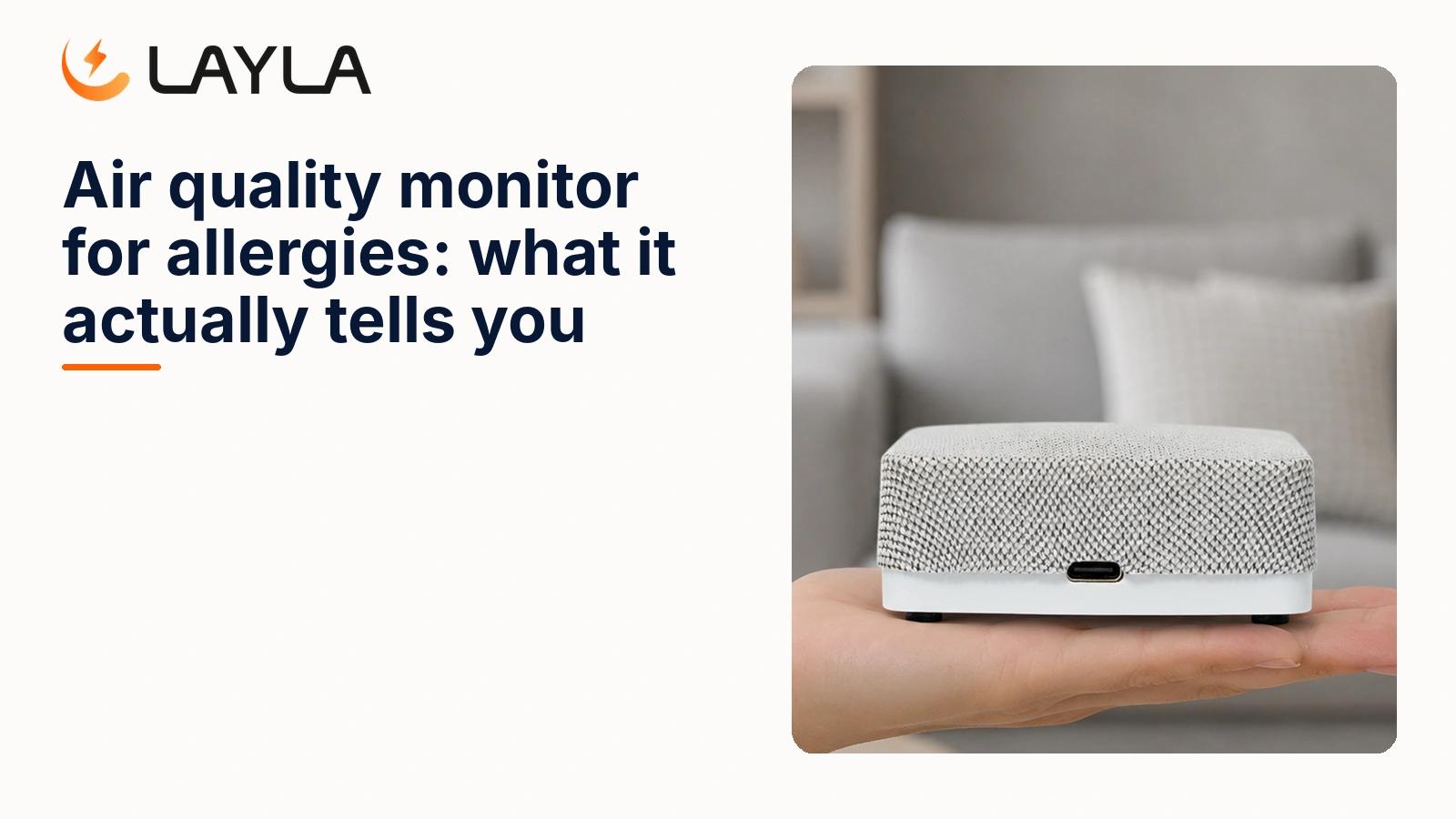
An air quality monitor can help with allergies, but not in the way most product listings imply. It does not count pollen grains, identify pet dander, or flag dust-mite allergens by name. What it does is measure the conditions those allergens tend to travel with, namely total airborne particulate matter, humidity, and general air-quality trends. That distinction matters, and getting it straight up front will save you money and frustration.
If you deal with sneezing, itchy eyes, congestion, or a scratchy throat that seems worse indoors, a monitor gives you something you rarely have with allergies—a number to act on. Instead of guessing whether the air in your bedroom is part of the problem, you get a live reading of how much fine particulate is floating around and whether the humidity has crept into a range that encourages mold and dust mites. That's the whole point. The monitor tells you when to open a window, run a purifier, or switch on a dehumidifier.
So let's be precise about what a monitor sees, what it misses, and how to actually use those readings to improve the air you breathe.
What does an air quality monitor actually detect for allergies?
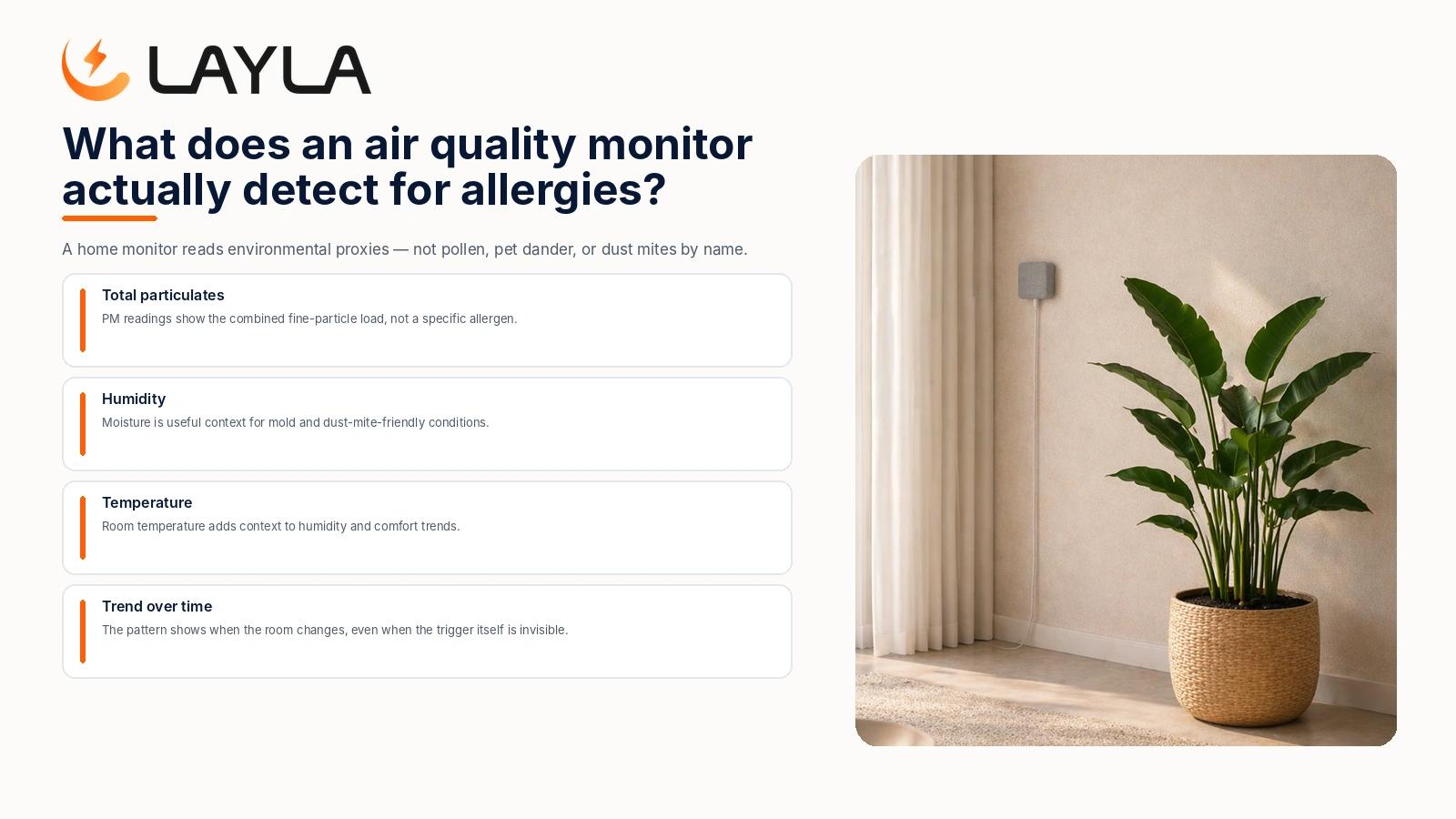
An air quality monitor measures total fine particulate matter (PM2.5 and PM), humidity, temperature, and overall air-quality trends, not individual allergens. A particulate sensor reports one number for all the fine particles suspended in the air combined. It cannot tell a pollen grain from a flake of dead skin, a dust speck, or cooking smoke. They all register as "particulate."
In a strict sense that is a limitation. But most household allergens are particulates, so when your monitor shows a spike in fine particles, allergen load is often part of what changed. Read it as a proxy. A rising particulate count during ragweed season, right after you vacuum, or when the dog shakes off on the couch is a meaningful signal, even though the sensor never "identified" pollen or dander.
Humidity is the second big lever, and it's where a monitor earns its keep for allergy sufferers. Dust mites need damp air to survive; keep relative humidity below about 50% and populations drop off sharply. That happens to overlap with the humidity range that keeps mold from taking hold, so one number does double duty. Watching relative humidity is one of the most practical habits you can build, and it's the kind of thing you'd otherwise never notice until symptoms flare.
Can an air quality monitor detect pollen, dust, or pet dander?
No consumer air quality monitor detects pollen, dust, or pet dander as distinct allergens. This is the single most misunderstood point in the category. Sensors that claim to help with allergies are almost always measuring total particulate matter, from which you infer that allergen levels may be elevated. The physics of a low-cost optical particle sensor simply don't allow species identification.
Here's the honest breakdown of what a home monitor can and can't see:
| Allergen or trigger | What a monitor sees | What it can't do |
|---|---|---|
| Pollen | Counts it inside total PM if it's fine enough | Can't isolate or name it as pollen |
| Pet dander | Registers as part of total particulate | Can't tell it's dander vs. dust |
| Dust and household dust | Shows up in PM2.5/PM readings | Can't distinguish dust from smoke |
| Dust mites | Not detected directly | Infers risk from high humidity |
| Mold | Not detected as spores | Flags mold-friendly humidity conditions |
| Cooking smoke | Sharp PM2.5 spike | Reads it as particulate, not "food" |
The takeaway isn't that monitors are useless for allergies. It's that they work by measuring the air, not by diagnosing the allergen. If a product promises to detect pollen or dander specifically—treat that claim with suspicion. For a deeper look at how fine particles behave indoors, dust and PM2.5 in your home covers where those particles come from and how they build up.
How does an air quality monitor help with allergies day to day?
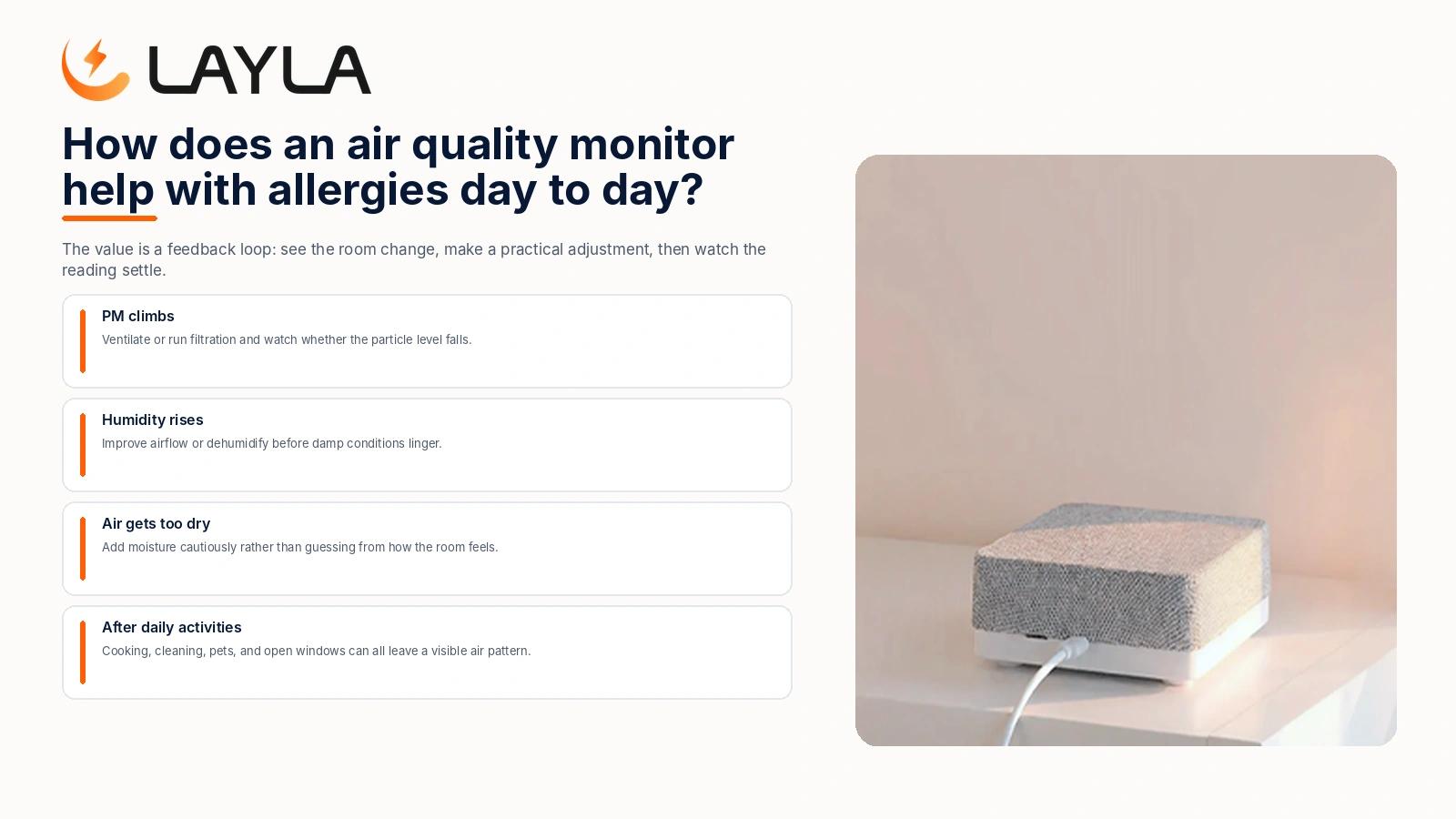
A monitor helps by turning invisible air changes into a number you can respond to, so you act before symptoms build instead of after. Part of what makes allergies so frustrating is that the triggers are invisible. You can't see pollen drift in through an open window, or the cloud of settled dust that vacuuming kicks back up. A monitor puts those moments on a screen.
Once they can see their air, most allergy sufferers settle into a few simple habits:
- When PM2.5 climbs, ventilate or run an air purifier until it settles back down.
- When humidity drifts above the safe zone, run a dehumidifier or improve airflow before mold and mites get comfortable.
- When humidity drops too low in winter, add moisture, since dry air can irritate airways and worsen congestion.
- After cooking, cleaning, or a pet's romp through the house, check whether particulate spiked and clear the air.
None of this treats or prevents an allergy. It simply helps you spot conditions associated with flare-ups so you can improve them. The monitor works as a feedback loop. Give it a week or two and you'll start to recognize your home's patterns. You'll spot the room that always runs humid, the time of day pollen sneaks in, and whether a purifier actually moves the numbers.
What PM2.5 and humidity levels should allergy sufferers aim for?
Aim for PM2.5 as low as you can keep it and relative humidity between 30 and 50 percent. Those two targets cover most of what a monitor can actually influence for allergy comfort. You want the particulate number trending low and stable, and the humidity sitting in a band that's inhospitable to mold and dust mites without drying your airways out.
| Reading | Target range | Why it matters for allergies |
|---|---|---|
| PM2.5 | As low as practical, watch for spikes | Fine particles carry much of the allergen load indoors |
| Relative humidity | 30–50% | Below ~30% dries airways; above ~50% favors dust mites, above ~60% invites mold |
| Temperature | Comfortable, stable | Sudden swings often track with humidity swings |
Relative humidity is the number to watch most closely. Dust mites start to struggle once you push below about 50%, and mold generally needs sustained readings above roughly 60% to take hold, so the 30–50% band keeps both in check. The humidity level that keeps mold from taking hold sits comfortably inside that range. On the other end, air that's too dry can irritate sensitive airways and make congestion feel worse, so chasing "lower is always better" backfires in winter.
It's worth saying that a monitor tracks mold conditions, not mold itself. It won't identify spores or species. If you're specifically worried about growth behind a wall or under a sink, read whether an air monitor can detect mold for what the humidity early-warning approach can and can't tell you.
Do VOCs matter for allergies too?
VOCs matter for indoor comfort and can aggravate sensitive airways, though they're a separate category from classic allergens. Volatile organic compounds are gases that come off paints, cleaning products, air fresheners, new furniture, and similar sources. A monitor reports a total VOC level rather than naming individual compounds, so it tells you the air has gotten "gassier" without specifying what's in it.
For allergy sufferers, the connection is indirect but real. Strong VOC exposure can irritate the eyes, nose, and throat in ways that stack on top of an existing allergy and make a bad day feel worse. A VOC spike right after you spray a cleaner or unroll a new rug is a useful nudge to ventilate. For the fuller picture, what a VOC monitor for your home measures walks through total-VOC readings and how to interpret them.
Allergies rarely trace back to one cause. Particulates, humidity, and VOCs interact, so a monitor that covers all three gives you a more complete view than a single-purpose gadget. If sensitive airways are your main concern, the overlap with asthma is worth understanding—indoor air quality and asthma covers the shared triggers, and how indoor air quality affects your health ties the signals together.
Where does Layla 3.0 fit for allergy-conscious homes?
Layla 3.0 is an honest fit if you want one device that tracks the air-quality signals correlated with allergy flare-ups rather than a gadget that overpromises. It measures particulate matter (PM), total VOCs, CO2, temperature, humidity, and an overall air-quality index, and it flags mold-friendly humidity conditions early through a humidity-based warning. It's a monitor, not a purifier or filter, so it shows you when to act—the cleaning is still up to your ventilation, purifier, or dehumidifier.
What it won't do is claim to identify pollen, dander, or dust-mite allergens by name, because no particulate sensor honestly can. Instead it gives you the readings that let you notice when your air changed and respond. Many allergy-conscious households find that's exactly the visibility they were missing.
Layla 3.0 is a one-time purchase: $99 on the Air Quality tier, down from $189, with no subscription ever. You can see the full sensor breakdown on the air quality page and compare tiers on the pricing page.
FAQ
Can an air quality monitor tell me if there's pollen in my house?
Not specifically. A monitor counts total fine particulate matter, and pollen that's small enough gets included in that number, but the sensor can't isolate pollen from dust, dander, or smoke. A rising particulate reading during pollen season is a useful signal, just not a pollen-specific one.
Will a monitor help my allergies if I already have an air purifier?
It can make the purifier more useful. The monitor shows you when particulate levels actually rise and whether running the purifier brings them down, so you're not guessing. Think of the monitor as the dashboard and the purifier as the tool that acts on what it shows.
What humidity should I keep my home at for allergies?
Between 30 and 50 percent relative humidity is the practical target. That range keeps dust mites from thriving and stays below the point where mold usually takes hold, while remaining moist enough that dry air doesn't irritate your airways. Push past 50% and mites get comfortable; sustained readings above 60% start favoring mold.
Is an air quality monitor a medical device?
No. It reports air-quality signals like particulates, humidity, and VOCs so you can make informed decisions about ventilation and cleaning. It doesn't diagnose, treat, or prevent any condition, and it's not a substitute for medical advice about your allergies or asthma.
Does the monitor detect mold spores?
No. It doesn't identify spores or species. What it does is track humidity and flag mold-friendly conditions early, since sustained high humidity is what lets mold and dust mites establish in the first place.
Related reading

Best for: health-conscious homes
Smoke & Air Quality
Air quality, mold and smoke monitoring for healthy homes and smoke-free rentals.
Included forever — no subscription
- Mold-risk early warning
- Smoke & cigarette detection
- Air quality score (IAQ) with alerts
- CO₂ & bVOC monitoring
- AI air insights & recommendations
- Allergy-comfort monitoring
No monthly fees. Ever.
30-day money back guarantee