BLOG
Air quality for babies and nurseries: a calm, practical guide
 By Nangyal Khan··Updated
 10 min read
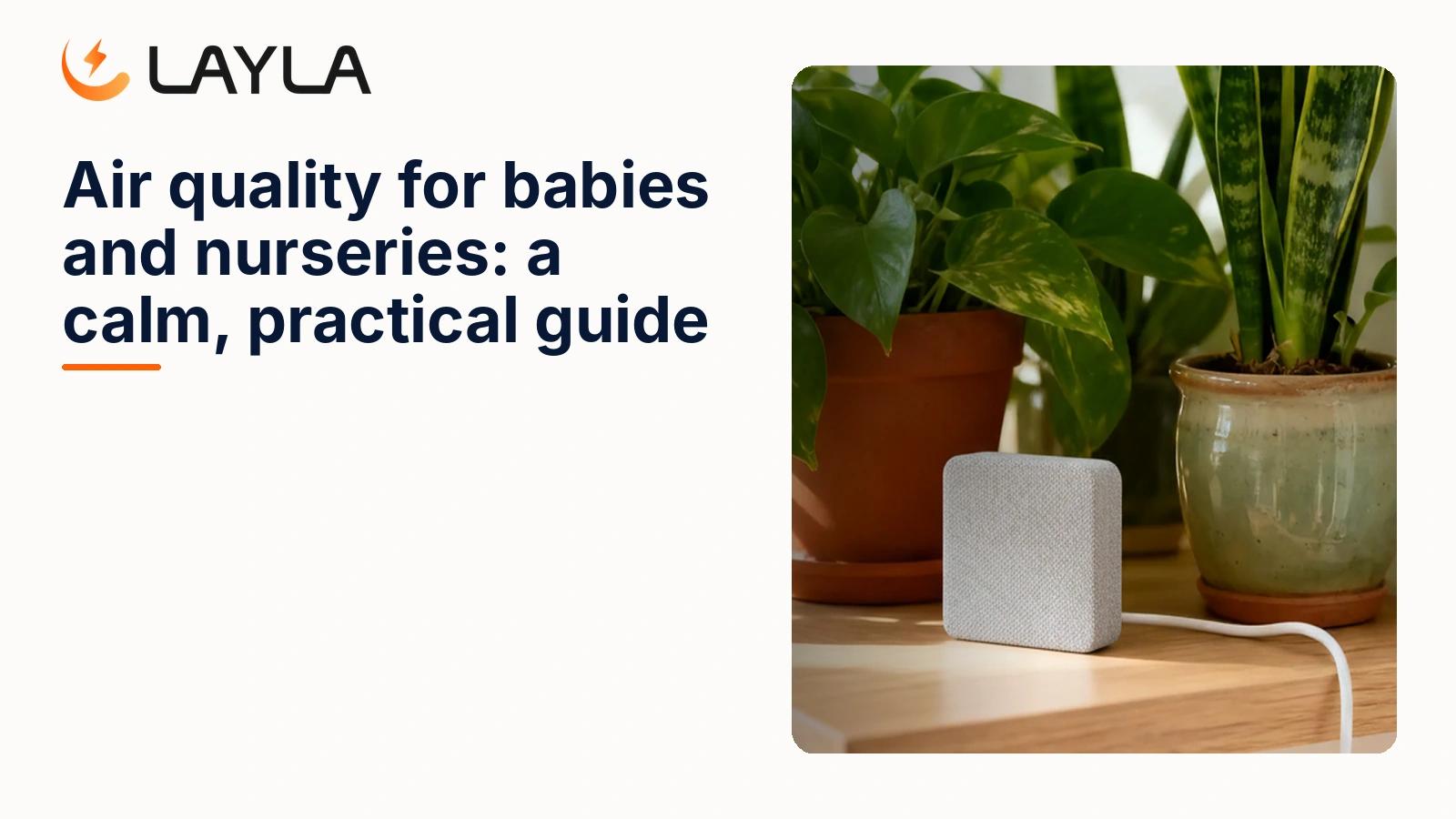
Good air quality for babies really comes down to four things you can manage without much fuss: a comfortable temperature, balanced humidity, fresh air that doesn't let stale CO2 build up, and low levels of dust and off-gassing from new furniture. Babies breathe faster than adults and spend long hours in one small room, so the air in that room is worth a little attention—not worry, just a few sensible habits. This guide walks through each factor, the ranges parents commonly aim for, and easy ways to stay on track.
None of this is about chasing perfection or fearing your own home. Most nurseries are already close to fine. The point is to know what "fine" looks like, catch the handful of moments that call for a small adjustment—airing out a new crib, running a humidifier on a dry winter night—and otherwise relax.
What's the ideal temperature for a baby's room?
Many parents aim for a nursery somewhere in the 65–72°F band (roughly 18–22°C). Guidance varies a little by source, and it's worth knowing why. Safe-sleep organisations such as the Lullaby Trust suggest keeping the room on the cooler side, around 16–20°C (about 61–68°F), because babies who get too warm are at higher risk during sleep. The American Academy of Pediatrics doesn't name an exact number and instead stresses dressing your baby appropriately for the room. So rather than fixating on a single degree, a good habit is to keep the room comfortable and slightly cool, and dress the baby in light layers to match.
Temperature also nudges everything else in the room. Warm, closed rooms tend to trap humidity and let CO2 climb, while cracking a window or door usually eases both at once. If you use air conditioning, gentle, steady cooling is kinder to a small room than big swings. Some setups can hold a comfortable band on their own, so you're not fiddling with the thermostat at 2 a.m.
What's the ideal humidity for a baby's room?
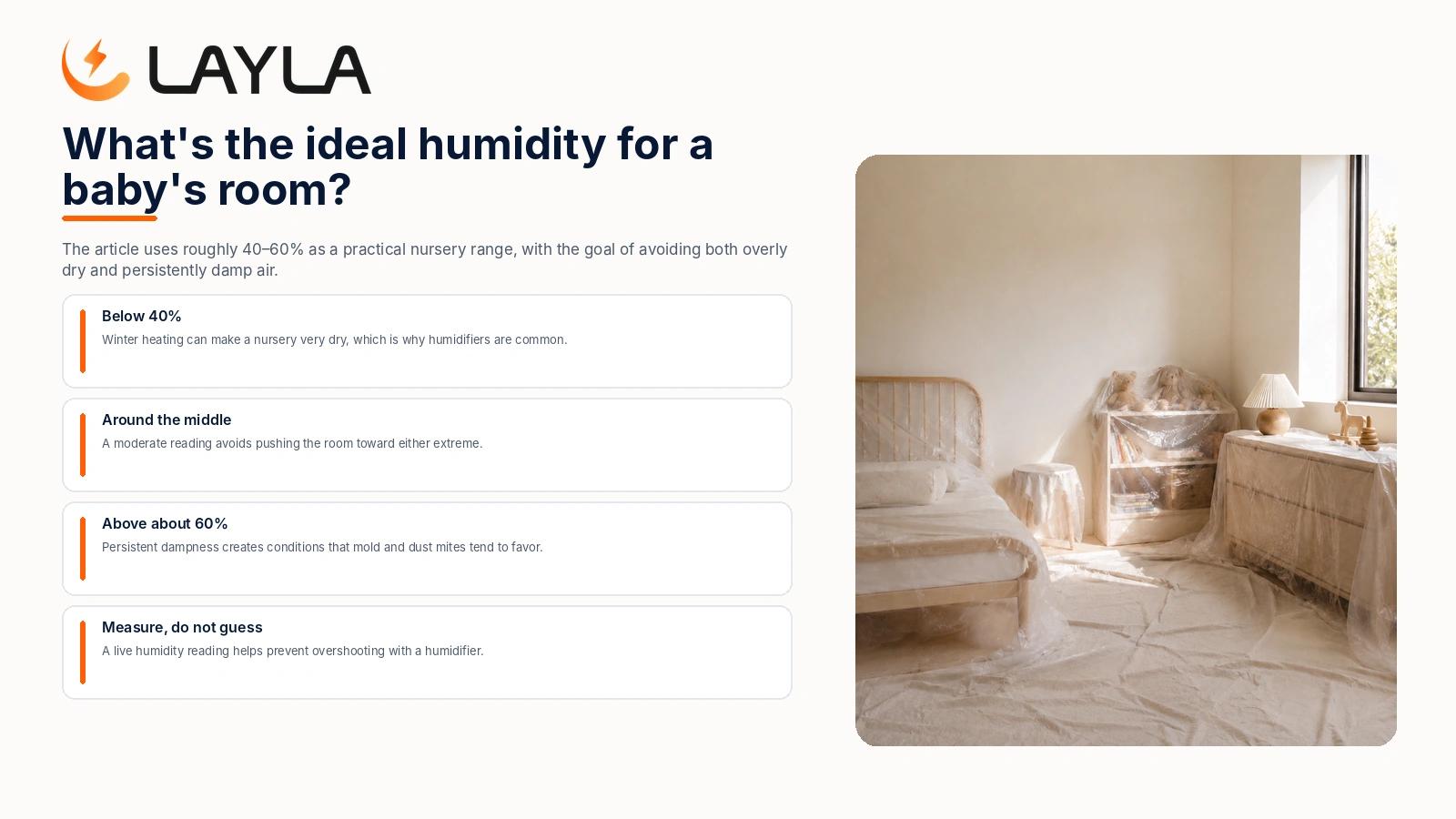
The humidity range widely recommended for a nursery is roughly 40–60%. Air that's too dry, often below 40% in winter with the heating running, can leave little airways and skin feeling irritated, which is why so many parents reach for a humidifier in the colder months. Air that's too damp, consistently above about 60%, creates the conditions mold and dust mites tend to like, so the aim is to sit comfortably in the middle rather than pushing it high "for moisture."
Humidity is one of the easiest things to overshoot with a humidifier, so it helps to watch the actual number rather than guess. If you'd like the fuller picture on where that upper limit comes from, our guide on what humidity level prevents mold covers it, and early signs of mold in your house is worth a read if you ever suspect a damp corner. A monitor is only a monitor, though: it tells you when to turn the humidifier up or down, or when to run a dehumidifier in a muggy summer room, but it doesn't add or remove moisture itself.
Why do new cribs, mattresses, and paint smell — and does it matter?
That "new" smell from a crib, mattress, or freshly painted wall is off-gassing, the release of volatile organic compounds (VOCs) from new materials, adhesives, finishes, and foams. It's extremely common with new nursery furniture, and it usually fades as the item airs out. The simplest, most reassuring habit is to unwrap and ventilate new items well before the baby uses them. Open the packaging, set the piece up in a well-aired room, and let it breathe for a good stretch before it goes into rotation.
Here's the honest part about measuring it. An air-quality monitor like Layla tracks total VOCs. It flags when the overall level in the room rises, which is useful for knowing when off-gassing is happening and when ventilation has cleared it. It does not identify specific chemicals by name or single out any one compound, it simply shows you the trend for the room as a whole. That's still genuinely helpful. You can watch the level climb after assembling a new dresser, air the room, and see it settle back down. For the practical routine (which items off-gas most and how long to air them), see our deeper piece on off-gassing from new furniture and mattresses, and if you want the background on VOCs generally, what are VOCs in your home lays it out plainly.
Should I keep the nursery door open or closed at night?
Cracking the nursery door, or leaving a window slightly open when the weather allows, is a simple way to keep fresh air moving and stop CO2 from building up in a small, closed room. CO2 isn't dangerous at the levels a home reaches—but in a tightly sealed room with the door shut for many hours, it can climb enough to make the air feel stale and stuffy by morning. A small gap is usually all it takes to keep things fresh without a draft.
This is the same idea behind good sleep air in any bedroom, just applied to a smaller space with a longer stretch of closed-door hours. If you want the background on why stale air feels the way it does, our article on CO2 and sleep quality in the bedroom goes into it. The takeaway for a nursery is gentle and low-effort. A cracked door or a briefly opened window resets the room, and a monitor takes the guesswork out of knowing when it's needed.
What about dust and fine particles?
Fine particulate matter, the dust, fibers, and airborne particles measured as PM2.5 and PM10, is worth keeping low in a room where a baby spends most of the day. Particles get stirred up by carpets, bedding, soft toys, and everyday movement, and they can drift in from cooking or outdoor air. Regular, gentle housekeeping does most of the work: washing bedding, wiping surfaces, and vacuuming with a good filter all help keep the count down.
An air-quality monitor measures total particulates rather than telling you exactly what each particle is, so it won't distinguish, say, pet dander from pollen. It shows the overall PM level and when it spikes, which is enough to notice patterns, like a rise when the heating kicks on or after a dusty afternoon, and to decide whether to ventilate or run a filter. For a fuller look at where household particles come from and how to bring them down, see dust and PM2.5 in your home.
Nursery air-quality targets at a glance
Here are the ranges many parents aim for, and why each one matters: treat them as comfortable targets, not medical thresholds. And if you have specific concerns about your baby's health, your pediatrician is the right person to ask.
| Factor | Commonly recommended range | Why it matters |
|---|---|---|
| Temperature | ~65–72°F (18–22°C), cooler end favored | A slightly cool room is comfortable for a sleeping baby and helps avoid overheating |
| Humidity | 40–60% | Below 40% can feel dry and irritating; above 60% invites mold and dust mites |
| CO2 | Fresh, well-ventilated air | Stale, closed-room air feels stuffy; a cracked door or window keeps it fresh |
| Particulates (PM2.5) | As low as practical | Dust, fibers, and fine particles are easy to reduce with cleaning and ventilation |
| VOCs (total) | Low and stable | Rises with off-gassing from new items; ventilation brings it back down |
A quick note on the whole picture. Nursery air quality is really just the air quality in your home, focused on one important room. If you'd like to zoom out, our hub on indoor air quality and your health ties temperature, humidity, particulates, and VOCs together.
How a monitor helps in a nursery
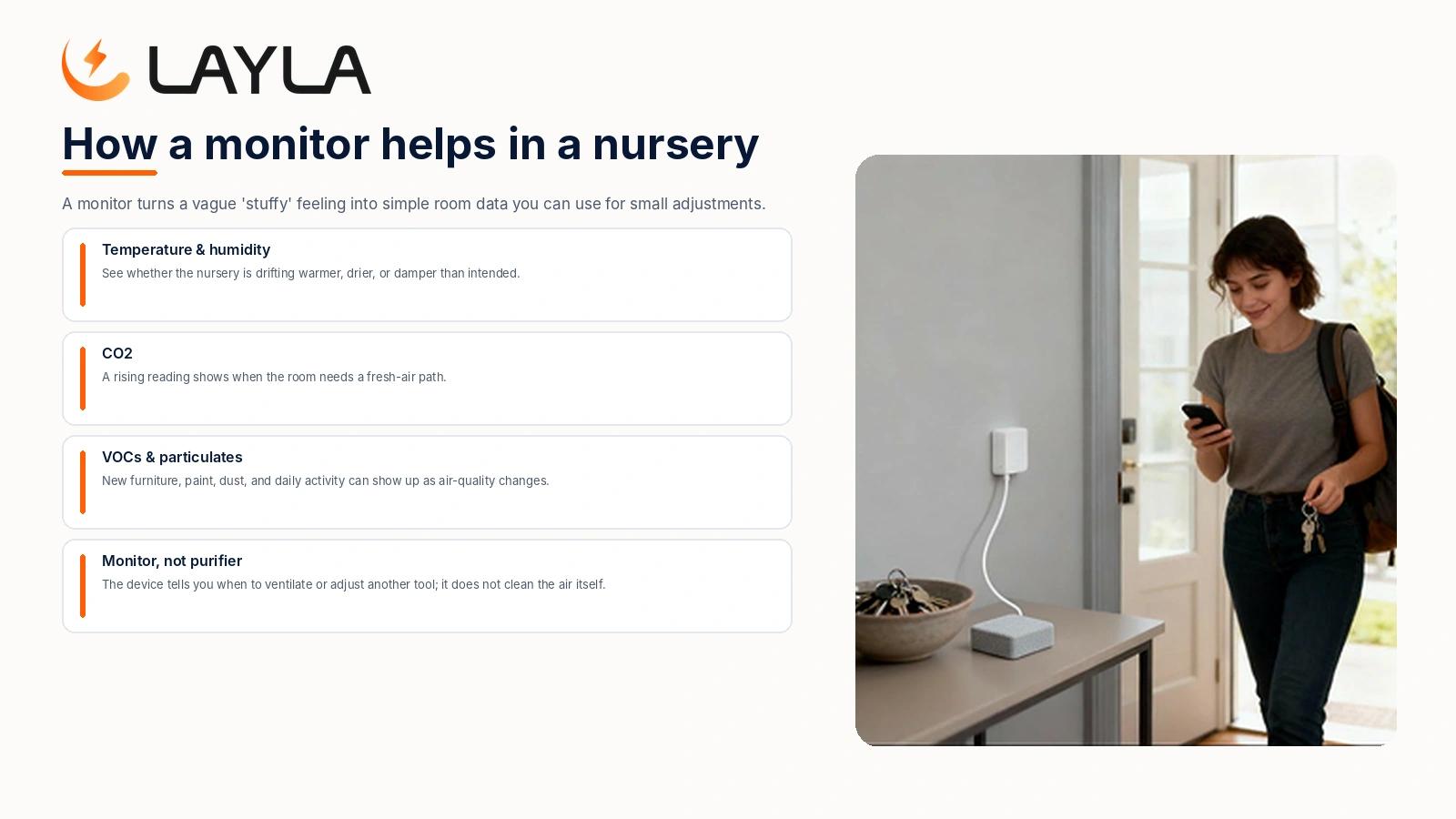
An air-quality monitor turns "I think the room feels stuffy" into an actual number you can act on. Instead of guessing whether the humidifier is running too high or whether the new dresser is still off-gassing, you get a live reading of temperature, humidity, CO2, total VOCs, and particulates in one place. For a nursery, the value is mostly in the small nudges: a gentle prompt to crack the door, dial the humidifier back, or air the room after a new-furniture day.
A monitor is not a purifier, humidifier, or dehumidifier—it's the part that tells you when to use those tools, and when the air has settled so you can stop. That division of labor is really the point. You keep control, and the readings tell you where control is needed.
Layla 3.0 in the nursery
Layla 3.0 is a home air-quality monitor that tracks temperature, humidity, CO2, total VOCs, particulates, and mold-friendly conditions in one calm device, so you can see when a nursery needs a small adjustment. It watches humidity for the early conditions that lead to mold, flags when total VOCs rise after new furniture or paint, and shows you when a closed room could use fresh air. These are the practical moments that actually come up when you're setting up and living in a baby's room.
One detail parents tend to appreciate is that Layla has no camera and no microphone at all. Its occupancy sensing uses radar rather than a lens or a mic, and its noise reading is a decibel level with no audio recording, so nothing in a nursery is ever watched or listened to. It's a quiet monitor, not a baby cam.
A sensible bit of best practice, separate from Layla: keep a certified smoke alarm and carbon monoxide alarm in your home, tested regularly. Those are dedicated life-safety devices, and every home with a nursery should have them.
Layla 3.0 is $99 one-time on the Air Quality tier, down from $189, with no subscription ever. You can see the full sensor and how it works on the air-quality monitor page.
FAQ
What is the best air quality for a nursery?
There's no single perfect setting. Many parents aim for a slightly cool room in the ~65–72°F range (18–22°C), humidity between 40–60%, fresh well-ventilated air, and low levels of dust and VOCs. The idea is comfortable, stable, and fresh rather than any exact target.
Do I need an air-quality monitor for a baby's room?
It's optional, but a monitor makes the guesswork disappear. It shows you when humidity is drifting high, when a closed room has gone stale, or when a new crib is still off-gassing, so you adjust based on a real reading rather than a hunch. It's a convenience and peace-of-mind tool, not a medical device.
Can an air-quality monitor detect specific chemicals from new furniture?
No. A monitor like Layla measures total VOCs, meaning it flags when the overall level in the room rises rather than naming a specific compound. That's still useful for knowing when off-gassing is happening and when ventilation has cleared it. Airing new items out before use is the main habit that helps.
How do I lower VOCs from a new crib or mattress?
Unwrap and ventilate the item well before your baby uses it: set it up in an aired room and let it breathe. Opening windows and keeping air moving speeds the process, and a monitor lets you watch the total VOC level settle back down.
Is CO2 in a closed nursery something to worry about?
At home levels, CO2 isn't dangerous, but a tightly closed room over many hours can get stuffy and stale. Cracking the door or briefly opening a window keeps the air fresh. If you're ever concerned about your baby's health, check with your pediatrician.
Related reading

Best for: health-conscious homes
Smoke & Air Quality
Air quality, mold and smoke monitoring for healthy homes and smoke-free rentals.
Included forever — no subscription
- Mold-risk early warning
- Smoke & cigarette detection
- Air quality score (IAQ) with alerts
- CO₂ & bVOC monitoring
- AI air insights & recommendations
- Allergy-comfort monitoring
No monthly fees. Ever.
30-day money back guarantee