BLOG
Layla vs Aranet4: should you buy a CO2 specialist or an all-in-one air monitor?
 By Nangyal Khan··Updated
 12 min read

If you're weighing layla vs aranet4, you're really deciding between two different philosophies of indoor air monitoring. The Aranet4 is a single-purpose CO2 instrument with a reputation for trustworthy numbers. Layla is an all-in-one home air monitor that tracks CO2 alongside particulate matter, chemical pollutants, humidity, mold-forming conditions, and even the type of smoke in the air. One does a single thing exceptionally well — the other covers the whole room. Which is right for you depends on a simple question: do you want the most trusted CO2 reading on the market, or do you want to see the entire air picture in one place?
Let's be clear up front, because fairness matters here. Aranet4 is better at raw CO2 accuracy than Layla, and it runs for years on a set of batteries. Those are real advantages and this article won't pretend otherwise. But if CO2 is only part of what you care about, the comparison shifts quickly.
What does the Aranet4 actually measure?
The Aranet4 measures four things: carbon dioxide, temperature, humidity, and atmospheric pressure (and pressure only shows inside the app, not on the display). That's it. It is a dedicated CO2 monitor, and it was designed that way on purpose. There's no particulate sensor, no VOC sensor, no smoke detection, nothing for mold risk. If you want a reading that tells you whether a stuffy bedroom or a crowded office is building up carbon dioxide, the Aranet4 does that with genuine precision.
The sensor inside is a true NDIR CO2 sensor, rated to ±(30 ppm + 3%), which is why air-quality enthusiasts and HVAC professionals trust it as a benchmark. When people want to verify that another device is reading CO2 correctly, they often check it against an Aranet4. That trust is earned, and it's the single strongest reason to buy one. If you want to understand why that number matters in the first place, our guide to CO2 levels in your home walks through what healthy and unhealthy ranges look like.
What does Layla measure that Aranet4 doesn't?
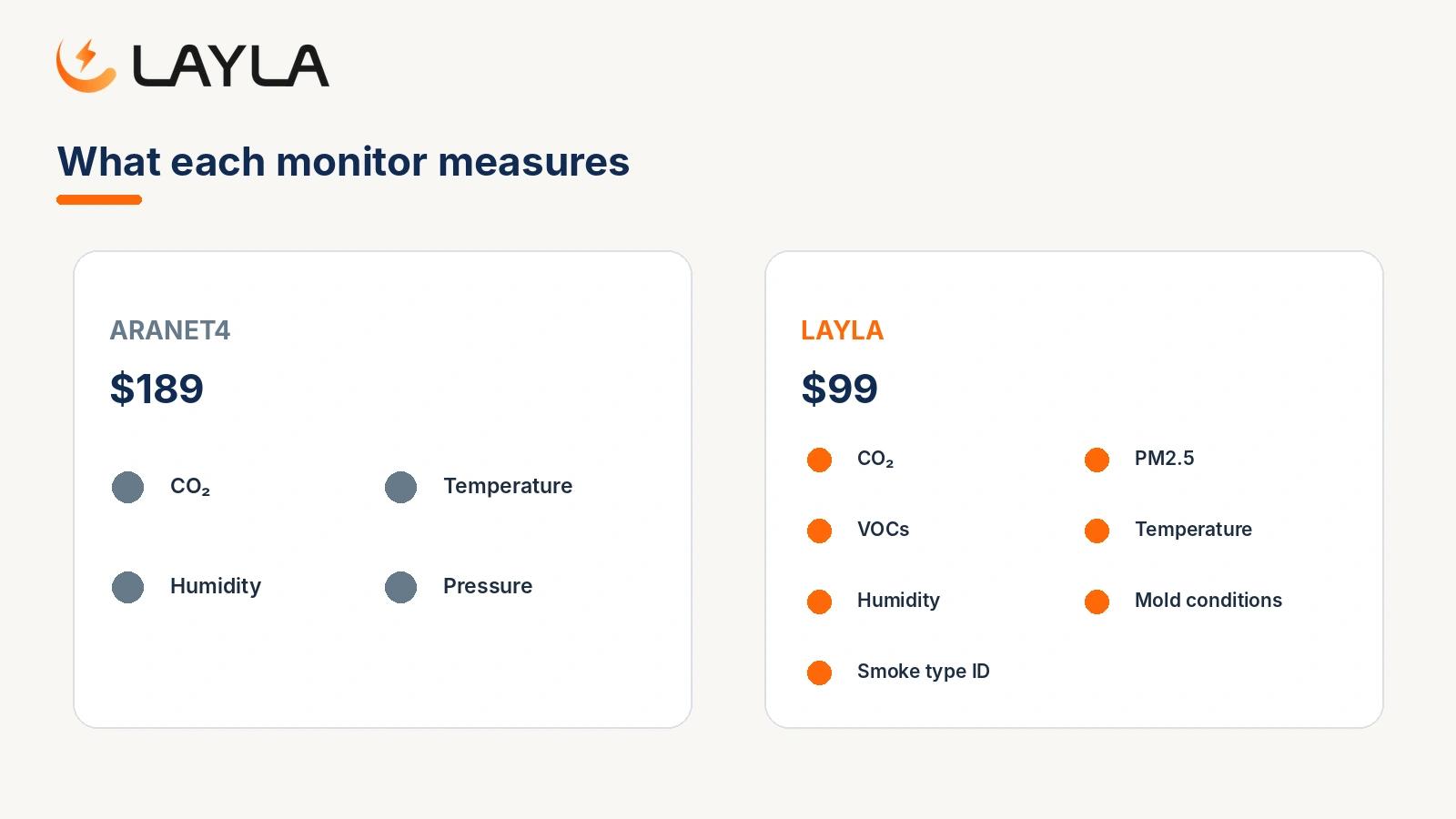
Layla measures CO2 too, but it wraps that reading inside a much broader air-quality picture. In a single device you get carbon dioxide, PM2.5 (fine particulate matter from dust, cooking, and smoke), total VOCs from chemicals and off-gassing, a combined air-quality index, temperature, and humidity. It also watches for the humidity conditions that let mold take hold, giving you an early warning before a problem grows rather than detecting spores after the fact.
Then there's the feature no CO2 monitor offers — smoke type identification. Layla can tell the difference between cigarette, vape, and cannabis smoke and grade its intensity, which is useful whether you're protecting a no-smoking household or just want to know what triggered a spike. None of that exists on the Aranet4, because the Aranet4 was never meant to do it. If particulates and chemicals are on your radar, our primers on dust and PM2.5 in your home and VOCs in your home explain why a single CO2 number can miss a lot of what you're actually breathing.
What's easy to miss is how much of this matters day to day. PM2.5 is the signal that fires when you sear a steak, light a candle, or run a fireplace, and it's often the thing making a room feel heavy when the CO2 reading looks fine. VOCs climb when you paint a wall, unbox new furniture, or spray a cleaning product, then fade as the room airs out, so you can actually see whether a smell is clearing or lingering. Humidity sits quietly behind both comfort and mold. Too low and your throat and sinuses dry out in winter; too high for too long and you're creating the exact conditions damp-loving mold needs. Layla watches that humidity band and flags when it drifts into mold-forming territory, which is early warning rather than after-the-fact cleanup. Smoke type identification sits on top of all of it, telling you whether a particulate spike came from cooking or from someone lighting a cigarette, vape, or cannabis nearby.
The practical upshot is that one Layla replaces what would otherwise be a shelf of single-purpose gadgets. Matching its coverage with separate devices means a CO2 monitor, a particulate meter, a VOC sensor, and a hygrometer — each with its own app or display and its own price tag. Seeing all of those readings together in one timeline is also what makes them useful. A PM2.5 spike at 7pm sitting next to a humidity climb tells a story that four disconnected gauges never would.
To be honest about where the line falls: Layla's CO2 reading is a capable, useful home measurement, but it is not reference-grade and it does not match the Aranet4's NDIR precision. If the exact CO2 figure to the last few ppm is your top priority, the Aranet4 is the more accurate instrument. Layla's value is that CO2 is one signal among six, not the only one.
How layla vs aranet4 compares on the things that matter
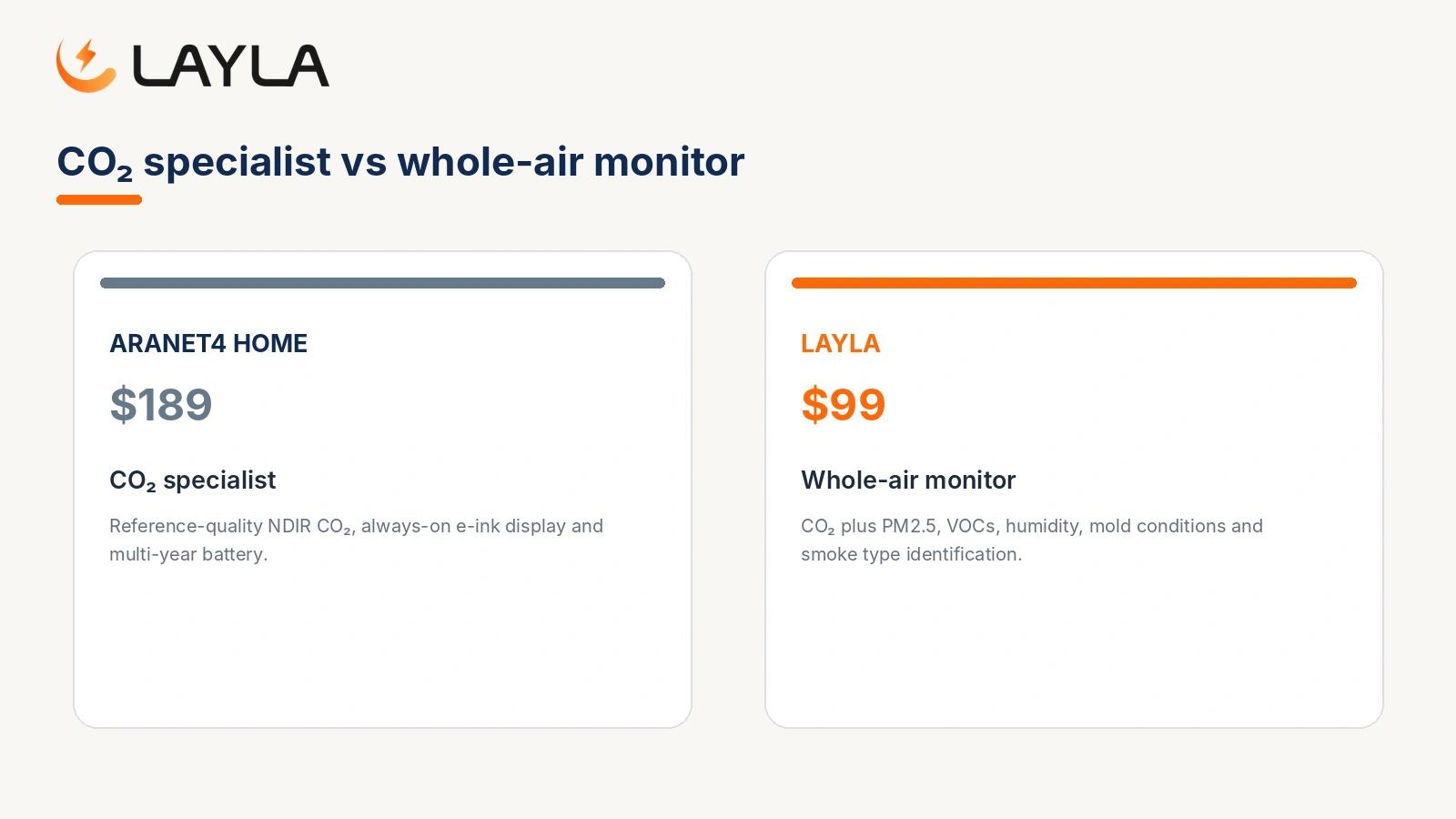
Here's the honest trade-off. The Aranet4 gives you the most trusted CO2 number on the market, plus an always-on e-ink display you can read across a room and a battery that can last up to four years on alkaline cells (and far longer on lithium at slower sampling). It's pocket-sized, and it talks to your phone over local Bluetooth rather than Wi-Fi. For a single-metric tool, it is close to ideal, and if that single metric is all you want, it's hard to beat.
Where it gets expensive is scope — you're paying $189 for essentially one headline reading. There's no Wi-Fi or remote viewing unless you buy a separate, pricier PRO base station, and the on-device memory holds only about 15 days before you need to sync it to your phone. For many people that's perfectly fine. For anyone who wants to understand their air more completely, it means buying a second or third device to cover particulates, chemicals, and humidity risk.
Layla takes the opposite approach. One device, six-plus signals, visible in an app, for a one-time $99 on the Air Quality tier with no subscription ever. That's roughly half the price of an Aranet4 for considerably more coverage. The catch, stated plainly, is that Layla doesn't match the Aranet4's CO2 precision and it isn't a multi-year battery device you tuck in a bag. It's a connected home monitor, not a portable reference tool. You're trading pinpoint accuracy on one metric for a complete view across many. If you want the full reasoning behind choosing a home CO2 monitor, we cover it in our CO2 monitor for home guide.
It's worth spelling out the practical trade-offs honestly, because they cut both ways. The Aranet4's e-ink display does its job better than almost anything connected. You can read it from across a room, it updates without draining power, and you never need a phone to glance at it. The battery outlasts any monitor Layla competes with, and because the device talks to your phone over local Bluetooth rather than Wi-Fi, it stays self-contained and easy to carry. If you move between a bedroom, a home office, and a classroom, you can slip it in a pocket and check the number anywhere. Those are genuine advantages for a portable, glanceable tool.
Layla's strengths live on the other side of that line. Because it stays connected over Wi-Fi, it keeps a continuous history you can scroll back through for weeks or months rather than a rolling 15-day buffer you have to remember to sync. It can push an alert to your phone the moment something crosses a threshold, so you learn about a VOC spike or a mold-risk humidity run while you're at work, not when you next walk past a screen. And it's doing that across every metric at once instead of a single number. The honest summary is that the Aranet4 is the better glanceable, portable, offline instrument, and Layla is the better always-on, whole-home record. Neither framing is wrong — they're built for different jobs.
At a glance
| Layla (Air Quality) | Aranet4 Home | |
|---|---|---|
| What it measures | CO2, PM2.5, VOC, AQI, temp, humidity, mold conditions, smoke type ID | CO2, temperature, humidity, pressure (app) |
| CO2 accuracy | Capable home reading | Reference-quality NDIR, ±(30 ppm + 3%) |
| Display | App-based | Always-on 2.9" e-ink |
| Connectivity | Wi-Fi app, no base station needed | Bluetooth local (Wi-Fi needs separate PRO base) |
| Battery | Powered / connected device | Up to 4 years alkaline, 9+ years lithium |
| Privacy | No camera, no mic, radar occupancy | No camera or mic |
| Price | From $99 one-time (Air Quality), no subscription | $189, no subscription |
Which one should you buy?
Picture two buyers, because most people are clearly one or the other. The first is the ventilation-focused CO2 purist. They already know their air problem is stuffiness and stale-room buildup, they want to prove a window or an HVAC change actually lowers CO2, and they trust a reference number above all else. They'll carry the device between rooms, cite the ppm figure in a condo board meeting, and never miss the extra metrics because those were never the point. For that person, the Aranet4 is exactly right and anything broader is wasted spend.
The second is the whole-air-picture buyer. They don't have one suspected problem — they want to understand the room. Maybe cooking smells linger, maybe a child's allergies flare, maybe there's a corner that feels damp, and they'd rather see CO2, particulates, chemicals, and humidity together than guess which single meter to buy first. They value getting an alert on their phone over reading a display, and they'd rather spend less on one capable device than more on several specialists. For that person, Layla is the better fit, and the slightly-less-precise CO2 reading is a trade they'll never feel.
Buy the Aranet4 if your single goal is the most trusted CO2 number, ideally on a device you can carry between rooms or workplaces and forget about for years at a time. It is the right tool for the CO2 purist, for ventilation testing, and for anyone who values a glanceable display and multi-year battery over breadth. We mean that genuinely; it earns its reputation.
Buy Layla if you want the whole air picture in one device at a lower price. You'll get CO2 plus particulates, chemicals, humidity, mold-conditions, and smoke identification for a one-time $99, with no subscription and no camera or microphone in your home. You give up a little CO2 precision and the multi-year battery, and you gain coverage of everything else that affects how your air actually feels and performs. For most homeowners trying to understand their whole environment rather than one number, that's the better value. If you later want noise, radar occupancy, or AC automation, Layla's higher pricing tiers add those, up to the All-in-One at $299, though the $99 Air Quality tier covers the full air-monitoring suite on its own. You can see the full air-quality feature set on the Layla air quality page.
If you're still mapping the category, it's worth comparing against the other all-in-one options too, like our Layla vs Airthings and Awair Element alternative breakdowns.
How your air affects how you feel
High CO2 doesn't just make a room feel stuffy; it's linked to drowsiness, headaches, and poorer concentration, which is exactly why bedroom and office air gets so much attention. But CO2 is only one lever. Fine particulates irritate the lungs, VOCs off-gas from furniture and cleaning products, and persistent high humidity invites mold. A single-metric monitor can flag one of these while you stay blind to the rest. That's the core argument for an all-in-one approach, and it's covered in more depth in our guides on CO2 and sleep quality and indoor air quality and your health.
Frequently asked questions
Is Layla a good Aranet4 alternative?
Yes, if you want more than CO2. Layla covers CO2 plus PM2.5, VOCs, humidity, mold conditions, and smoke type for a one-time $99, which is about half an Aranet4's price while monitoring far more of your air. It's the stronger choice when you want breadth and value rather than a single dedicated reading.
Does Layla require a subscription?
No. The Air Quality tier is a one-time $99 with no subscription, ever. The same is true of the Aranet4, which is a one-time purchase at $189. Neither device locks features behind a monthly fee.
Is the Aranet4 more accurate than Layla for CO2?
Yes, on CO2 alone the Aranet4 is more accurate. It uses a reference-quality NDIR sensor rated to ±(30 ppm + 3%) and is widely trusted as a CO2 benchmark. Layla's CO2 reading is a capable home measurement but isn't reference-grade, so if a precise CO2 number is your only concern, the Aranet4 is the better instrument.
Can Layla detect particulates and chemicals?
Yes. Layla measures PM2.5 fine particulate matter and total VOCs alongside CO2, which the Aranet4 does not do at all. That's the main reason to choose an all-in-one monitor if you care about more than carbon dioxide.
Which should I buy if I want to track my air over time?
Layla is the stronger choice for ongoing history. Because it stays connected over Wi-Fi, it keeps a continuous record you can scroll back through for weeks and sends alerts to your phone when a reading crosses a threshold, across all six signals at once. The Aranet4 stores roughly 15 days on the device before you sync it and shows one metric at a time, which suits spot checks more than a long-running whole-home log.
Does Layla use a camera or microphone?
No. Layla has no camera and no microphone. Its optional occupancy sensing on higher tiers uses radar presence detection, not audio or video, so your privacy stays intact.
Related reading

Best for: health-conscious homes
Smoke & Air Quality
Air quality, mold and smoke monitoring for healthy homes and smoke-free rentals.
Included forever — no subscription
- Mold-risk early warning
- Smoke & cigarette detection
- Air quality score (IAQ) with alerts
- CO₂ & bVOC monitoring
- AI air insights & recommendations
- Allergy-comfort monitoring
No monthly fees. Ever.
30-day money back guarantee