BLOG
Layla vs Airthings: which indoor air quality monitor should you buy?
 By Nangyal Khan··Updated
9 min read

If you're weighing Layla vs Airthings for your home, the short version is this. Both devices read the same core air you breathe every day, so the decision comes down to what each one adds on top and what you pay to get it. The Airthings View Plus brings a dedicated radon sensor. Layla brings smoke type identification and early mold-condition warnings, with no subscription and a one-time price that runs a fraction of the Airthings unit. Below, I walk through where they overlap, where they diverge, and which one fits your home.
Air quality monitors have become a normal household thing, somewhere between a smart thermostat and a smoke alarm. You want to know when CO2 is climbing in a stuffy bedroom, when particulate matter spikes while you cook, when humidity creeps toward the level where mold takes hold. Both of these devices answer those questions. Everything else — and there's a lot of it — is where they stop looking like twins.
Neither brand is a bad choice. The View Plus is a capable unit, and radon is worth caring about. What this comparison answers is narrower: for the money you're about to spend, which device tells you more about the air in your particular home?
What do Layla and the Airthings View Plus both measure?
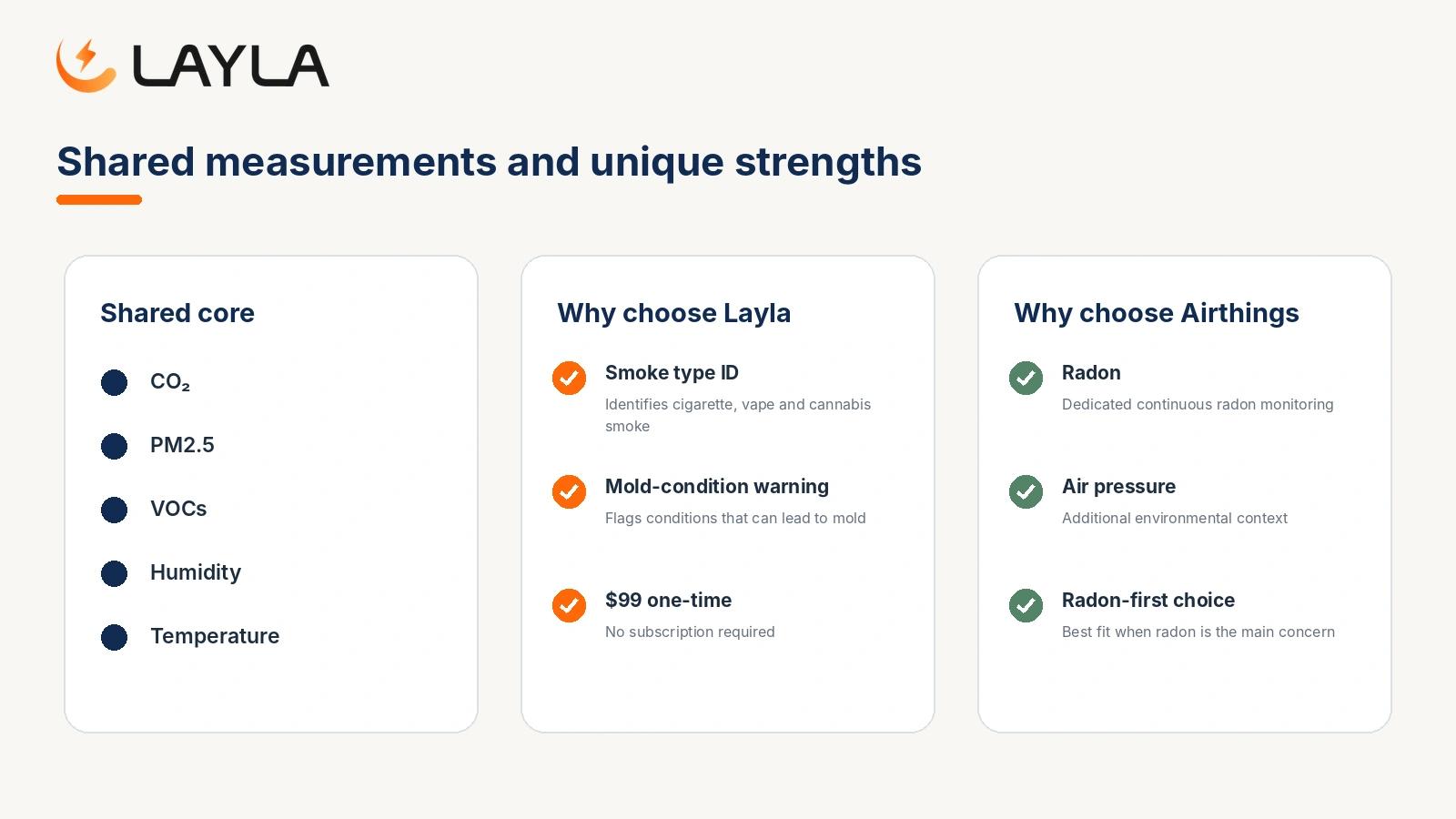
Both monitors track the same five core air readings: particulate matter (PM2.5), carbon dioxide (CO2), volatile organic compounds (VOC), temperature, and humidity. That's the shared backbone, and it covers most of what matters for everyday indoor air.
PM2.5 is the fine particulate that comes off cooking, candles, wildfire smoke, and traffic drifting through a window. CO2 is your stuffiness and ventilation signal; when it builds up in a closed room, focus slips and sleep suffers, which is why a CO2 monitor for the home has become such a popular first purchase. VOCs are the gases off-gassing from paint, cleaning sprays, and new furniture; if you've ever wondered what the VOCs in your home are, both devices will at least flag when they spike. Temperature and humidity round out the picture, and humidity in particular is the number that decides whether mold gets a foothold.
So on the fundamentals, this is close to a tie. Both give you a live read, both trend over time, both will tell you when to open a window. If the core air picture is all you want, and for plenty of people it is, either device does the job. The gap opens up once you look at what sits on top of that shared layer.
What does the Airthings View Plus do that Layla can't?
The Airthings View Plus measures radon and Layla does not. Beyond the shared core air readings, the two genuine extras on the View Plus are a dedicated radon sensor and an air pressure sensor. If radon is your main concern in a basement or on a lower floor, the View Plus is the better buy for that specific need.
The air pressure sensor is the other extra. It's minor for most households, useful context for weather-sensitive folks and for understanding how your home's envelope behaves, but it rarely tips a buying decision on its own.
That's the honest case for Airthings, and it holds up if radon is your main worry. Set radon aside, though, and the picture shifts. The View Plus retails at $329.99, call it about $330. The noise and light sensors Airthings mentions in its materials sit behind the business plan; on the consumer unit you'll never see a noise reading, and occupancy is only ever estimated from CO2 on the business dashboard, not shown on the device you buy for home. Airthings also sells a cluster of adjacent products, the Renew purifier, a View Plus Duo two-pack, and the older Wave line, so one box doesn't do everything. For a straight home air monitor, the View Plus is a capable, radon-first device at a premium price.
Why would a home buyer choose Layla over Airthings?
A home buyer picks Layla for broader everyday coverage at a one-time price, with nothing gated behind a plan. You pay once, you get everything the device does, and no subscription shows up later to charge you. That combination is what makes Layla a strong Airthings alternative for most homes that aren't chasing radon specifically.
Start with smoke. Layla doesn't just flag "some particles." It identifies the type of smoke — cigarette, vape, or cannabis — and grades the intensity, so a faint trace reads differently from a room filling up. For a household with teenagers, a shared wall, or anyone who wants to know whether vaping is happening indoors, that's a real capability, not a spec-sheet footnote. Airthings registers particulate from smoke but won't tell you what kind.
Then there's mold. Layla watches the conditions that let mold start, mainly humidity and damp, and warns you early, before you're scrubbing a wall. It isn't detecting spores or naming a species, and it shouldn't claim to; it's catching the environment mold needs to grow. Anyone who's read up on what humidity level prevents mold or how to prevent mold in your home knows that staying ahead of humidity is most of the battle. Both devices measure humidity. Layla turns that reading into a mold-risk signal and nudges you before the damp wins.
Now the money. Layla's Air Quality tier is a one-time $99, down from $189, with no subscription ever. The Airthings View Plus runs about $330. You get the same core air readings plus smoke ID and mold warning for well under a third of the price, and nothing recurring. For a lot of households, that one line settles the question.

Privacy is worth a note. Layla ships with no camera and no microphone at the hardware level, and when the wider system does presence sensing it uses radar, not a lens or a mic. If the idea of a connected sensor listening or watching in your home bothers you, that design should matter, and it should bother more people than it does.
Layla also scales without forcing you into a new ecosystem. The air monitor is the entry point. Higher tiers add decibel monitoring and radar-based occupancy, along with AC/HVAC automation and an Eco Mode that trims energy use by not conditioning empty rooms. The All-in-One is $299 one-time for the full set. None of that is required to get a great air monitor, since the $99 tier stands on its own, but the upgrade path is there if you later want your home to adjust itself and shave a little off the bill. With Airthings, the extra sensors you might hope for live on a business plan a homeowner can't buy.
Layla vs Airthings at a glance
| Layla | Airthings View Plus | |
|---|---|---|
| Core air (PM2.5, CO2, VOC, temp, humidity) | Yes | Yes |
| Radon | No | Yes |
| Air pressure | No | Yes |
| Smoke type ID (cigarette/vape/cannabis) | Yes, with intensity grading | No |
| Mold-condition early warning | Yes | Humidity reading only |
| Noise / occupancy | On higher tiers (radar, no mic) | Business plan only, not on consumer unit |
| AC/HVAC automation | On higher tiers (Eco Mode) | No |
| Camera / microphone | None | None |
| Subscription | None, ever | None for basic use |
| Price | From $99 one-time (Air Quality), no subscription | about $330 |
What neither Layla nor Airthings can do
Neither device detects carbon monoxide, and neither is a certified fire or CO alarm, so keep a dedicated CO alarm whichever one you choose. It's the most important caveat in the comparison, and it applies to both equally.
The confusion is easy to fall into, because CO2 and CO look almost identical in writing yet do completely different things. That's the reason a CO2 detector is not the same as a CO detector. CO2 is the stuffiness-and-ventilation gas these monitors track. CO, carbon monoxide, is the odorless combustion gas that a UL-listed CO alarm exists to catch. An air quality monitor, Layla or Airthings, shows how your air is trending; it isn't a life-safety device. The right setup is a good monitor paired with a proper CO and smoke alarm, and that holds whichever brand you pick here.
Which one is right for your home?
Choose Airthings if radon is your primary concern. Choose Layla if you want broader everyday coverage, smoke and mold insight, and a one-time price with no subscription. That's the whole decision.
In a radon region, or with an inspection flag on record, lead with the View Plus and accept the roughly $330 outlay for that dedicated sensor. For most other homes — the health-conscious cook, the parent watching for indoor vaping, the apartment dweller fighting winter humidity and stuffy bedrooms — Layla covers more of daily life for far less and leaves room to grow into noise, occupancy, and energy automation later. See the full feature set on the Layla air quality page and the tier breakdown on pricing. Whichever way you go, understanding indoor air quality and your health is what makes any monitor worth owning.
Frequently asked questions
What does the Layla air quality monitor measure?
Layla tracks PM2.5, CO2, total VOCs, an overall air-quality index, temperature, humidity, and mold conditions, and it identifies smoke type, cigarette, vape, or cannabis, with intensity grading. It's one all-in-one device, and the Air Quality tier is a one-time $99 with no subscription.
Is Layla a good Airthings View Plus alternative?
Yes, for most homes. Layla reads the same core air as the View Plus (PM2.5, CO2, VOC, temperature, humidity), adds smoke type ID and mold-condition warnings, and costs $99 one-time versus about $330, with no plan gating any feature. The one exception is radon, which only the View Plus measures.
Does Layla detect radon?
Layla doesn't have a radon sensor; the Airthings View Plus does. For everything else, Layla covers more ground at a lower price.
Do Layla or Airthings detect carbon monoxide?
Neither one detects carbon monoxide, and neither is a certified fire or CO alarm. Both measure CO2, which is a different gas. Keep a dedicated UL-listed CO alarm alongside whichever monitor you choose.
Does Layla require a subscription?
No. Layla is a one-time purchase with no subscription, ever. The Air Quality tier is $99, and the All-in-One, which adds noise monitoring, radar-based occupancy, and AC automation, is $299 one-time.
Related reading

Best for: health-conscious homes
Smoke & Air Quality
Air quality, mold and smoke monitoring for healthy homes and smoke-free rentals.
Included forever — no subscription
- Mold-risk early warning
- Smoke & cigarette detection
- Air quality score (IAQ) with alerts
- CO₂ & bVOC monitoring
- AI air insights & recommendations
- Allergy-comfort monitoring
No monthly fees. Ever.
30-day money back guarantee