BLOG
The best Awair Element alternative now that it's discontinued
 By Nangyal Khan··Updated
 12 min read

If you came looking to buy an Awair Element, the short answer is that it's been discontinued. The best all-around alternative for most people is Layla, which measures the same core air the Element did (PM2.5, VOCs, CO2, temperature, humidity) and adds a few things the Element never had, for a one-time $99 with no subscription. Two other devices earn a mention if you have a specific need. The Airthings View Plus makes sense if you want radon on top of everything else, and the Aranet4 Home fits if your main interest was the Element's CO2 reading and you want reference-grade accuracy. For a straight like-for-like replacement, though, Layla is where most displaced Awair shoppers should look.
What follows is the plain version of all three — what actually happened to the Element, what to look for in a replacement, and how the main options compare.
What happened to the Awair Element?
The Awair Element was discontinued and is no longer reliably available to buy. It disappeared from Amazon around April 2026, where it now shows as "Currently Unavailable," and the only places it still turns up are Awair's own store (with uncertain stock) and the used market on eBay. Where it is still listed new, the price has climbed to around $299. Awair appears to be winding down its consumer line, which matters beyond stock: a monitor you can't get long-term app support or replacements for is a shaky thing to build your home's air tracking around.
None of that is a knock on the device itself. The Element was genuinely well liked. It had a clean, minimalist design, and the "Awair Score" was one of the easiest-to-read air summaries anyone has shipped. It measured PM2.5, VOCs, CO2, temperature and humidity, ran on a free app, and never asked for a subscription. It didn't do radon, carbon monoxide, smoke identification, noise or occupancy, but for everyday indoor air it covered the essentials cleanly. The problem is simply that you can't count on buying or supporting one today, which is why you're reading this.
What to look for in a replacement
The best replacement is the one that covers the same core measurements you relied on, without locking them behind a subscription. The Element's real value came from four or five readings working together — fine particulate matter (PM2.5), volatile organic compounds, carbon dioxide, and temperature and humidity. If a "cheaper" alternative drops one of those, it isn't really replacing the Element. It's replacing part of it.
Start with CO2, because that's where the shortcuts hide. A true NDIR sensor measures carbon dioxide directly by how it absorbs infrared light, which is the accurate method the Element used. A cheaper "eCO2" or "estimated CO2" reading doesn't measure CO2 at all. It infers a number from the VOC sensor, so it drifts and can be badly wrong when cooking or cleaning throws off the VOC baseline. If watching ventilation and CO2 buildup was part of why you liked the Element, make sure the replacement does real NDIR CO2, not eCO2. It's worth reading up on CO2 levels in your home if you want a sense of what the numbers actually mean.
PM2.5 is the next thing to protect. This is the fine-particle reading that catches cooking smoke, wildfire haze, dust and candle soot, and it's the measurement most tied to how air affects you day to day. A proper laser particle counter reports PM2.5 in micrograms per cubic meter, so steer clear of monitors that only give a vague "good/bad" light with no number behind it. For more on that reading, dust and PM2.5 in your home breaks down what actually moves it. VOCs matter alongside it for the chemical side of the air — off-gassing furniture, paint, cleaning products, aerosols. Most consumer monitors, the Element included, report these as a single total VOC figure (TVOC) rather than naming individual compounds, which is normal and useful as a trend line.
Humidity deserves more credit than it usually gets, because it's your earliest mold signal. Mold doesn't need a leak to take hold. It needs sustained damp, and relative humidity drifting above roughly 60% for long stretches is the condition that lets it start. A monitor that tracks humidity over time turns that into a usable early warning long before you'd see a stain or catch a musty smell. If that's a worry in your place, can an air monitor detect mold? is worth a read on what a sensor can and can't tell you.
Then weigh the things that quietly cost you later. Ongoing cost is the big one. Part of what made the Element pleasant was that the app was free forever, so I'd be careful with monitors that hide history, trends or alerts behind a monthly subscription, or that need a separate hub you also have to buy and power. A "cheap" monitor with a paywalled app can cost more over two years than a pricier one you pay for once. Privacy is the other thing to think about. If a device adds presence or occupancy features, check how it senses, because radar presence detection is private in a way a camera or microphone isn't. Of the genuine extras, radon is a real reason to pay more, as is reference-grade CO2 accuracy, but neither is something everyone needs. With that in mind, here's how the alternatives stack up.
Which air quality monitor is most like the Awair Element?
For a close like-for-like match plus a bit more, Layla is the most complete Awair Element alternative. It measures the same core set the Element tracked, carbon dioxide, total VOCs, PM2.5, an overall air-quality index, temperature and humidity, so the day-to-day experience of watching your indoor air is familiar if you're coming from an Awair Score. Where it goes further is in two directions Awair never did for home users. It flags mold conditions early by watching for the humidity patterns that let mold take hold, a quieter and more useful warning than waiting to see or smell a problem. And it identifies smoke by type, telling cigarette, vape and cannabis apart and grading the intensity, rather than just logging a particulate spike. That smoke type-ID is something no other monitor on this list does.
The pricing is the headline for anyone annoyed by where the Element landed. Layla's air-quality tier is a one-time $99 (down from $189), with no subscription, ever. You own the readings and the history; nothing gets paywalled later. Higher tiers exist and add things like noise monitoring, radar-based occupancy sensing, and AC automation with an Eco Mode, up to an all-in-one bundle at $299, but you don't need any of that to replace an Element. The $99 tier alone covers the air monitoring an Awair fan is actually looking for. It's also private by design: there's no camera and no microphone anywhere in the system, and the occupancy sensing on the upper tiers uses radar presence detection, not recording. For a displaced Awair shopper who wants the same core air plus a cleaner upgrade path, that combination of same measurements, more coverage and one payment is the strongest fit. You can see the full spec on the Layla air-quality monitor page and the tiers on the pricing page.
A couple of honest limits, so you're not surprised. Layla reports total VOCs as a single number rather than naming individual compounds, the same way the Element did, and it isn't an air purifier. For most people replacing an Element, none of that is a gap.
Moving from an Awair Element to Layla: what changes
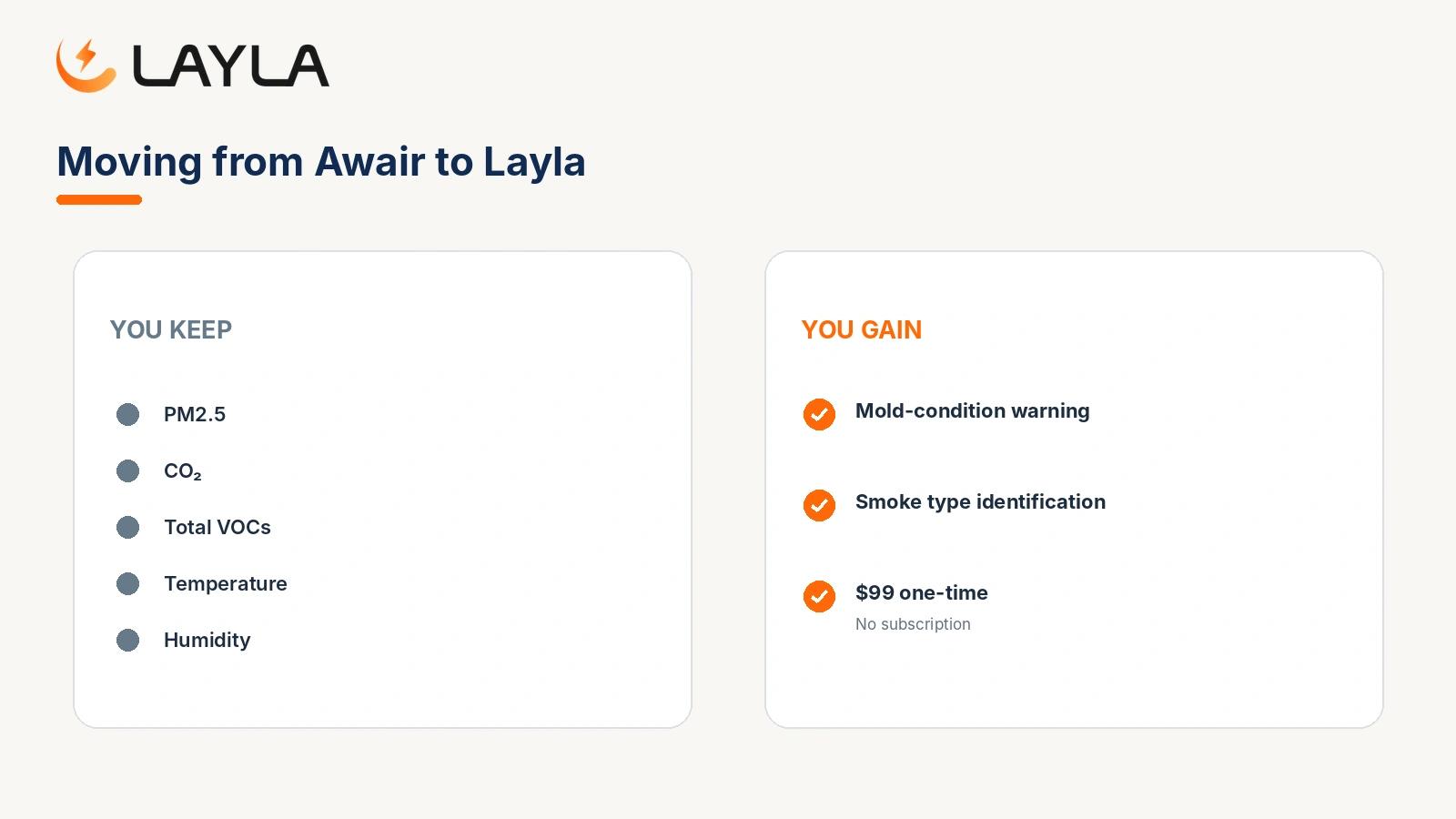
If you were happy with the Element and just need somewhere to land, it helps to be plain about what you gain and what you give up. You keep everything that mattered: PM2.5, carbon dioxide, total VOCs, humidity and temperature, reported as an overall air-quality score you read the same way you read the Awair Score. You gain three things the Element never offered home users — early mold-condition warnings from humidity patterns, smoke identification by type, and a one-time $99 price with no subscription in place of a device that now costs around $299 where it's listed at all. What do you give up? Realistically nothing meaningful, since the few things Layla leaves out, like radon, the Element didn't do either.
When a different monitor is the smarter pick
If what you really valued about the Element was the CO2 reading, and you want it as accurate as possible, the Aranet4 Home is the pick. At $189 it uses a true NDIR carbon-dioxide sensor, the reference-grade method labs and ventilation pros trust, paired with a multi-year replaceable battery and an e-ink display that's effortless to glance at across a room. For tracking ventilation in a bedroom, home office or classroom, where rising CO2 is the signal to open a window, it's excellent, and arguably more precise on that one number than anything else here. The catch is how narrow it is. It's built around CO2 with temperature and humidity along for the ride, but there's no PM2.5 and no VOCs, so it tells you nothing about cooking smoke, off-gassing or the particulate side of your air. That makes it a specialist rather than an Element replacement, unless CO2 was genuinely the single number you cared about. There's more in Layla vs Aranet4 if you're weighing the two.
There are cheaper options, too, but be clear about what you're giving up. The IKEA Vindstyrka ($49.99) and the Amazon Smart Air Quality Monitor (about $70) are inexpensive ways to watch particulates and VOCs, and either can be fine as a basic indicator. Neither truly matches the Element, though, because neither gives you its CO2 reading. The Vindstyrka has no CO2 at all, and the Amazon monitor measures carbon monoxide rather than carbon dioxide, which is a different thing entirely. If CO2 mattered to you, treat these as supplements rather than replacements. We go deeper on both in Layla vs IKEA Vindstyrka and Layla vs the Amazon Smart Air Quality Monitor.
At-a-glance: the main Awair Element alternatives
| Monitor | Price | What it measures | Best for |
|---|---|---|---|
| Layla | From $99 one-time, no subscription | PM2.5, CO2, TVOC, AQI, temp, humidity, mold conditions, smoke type-ID | The best all-around Element replacement |
| Airthings View Plus | ~$330 | Radon, PM2.5, CO2, VOCs, humidity, temp | If you specifically want radon |
| Aranet4 Home | $189 | CO2 (reference-grade NDIR), temp, humidity — no PM2.5 or VOCs | If you only cared about accurate CO2 |
| IKEA Vindstyrka | $49.99 | PM2.5, VOCs, temp, humidity (no CO2) | A cheap basic indicator |
| Amazon Smart AQ Monitor | ~$70 | PM2.5, VOC, CO, temp, humidity (no CO2) | Budget, if you don't need CO2 |
Frequently asked questions
What's the best replacement for the Awair Element?
For most people, Layla is the best replacement. It measures the same core air the Element did, PM2.5, CO2, VOCs, temperature and humidity, and adds mold-condition warnings and smoke type identification, all for a one-time $99 with no subscription. If you have a narrower need, the Aranet4 covers lab-grade CO2.
Is the Awair Element discontinued?
Yes. The Element has been effectively discontinued and is no longer reliably available. It vanished from Amazon around April 2026, where it's listed as "Currently Unavailable," and where it's still sold new the price has risen to around $299. Awair appears to be winding down its consumer products.
Can I still buy an Awair Element?
Only unreliably. A few units turn up on Awair's own store with uncertain stock, and used ones appear on eBay, but you can't count on new availability or long-term app support. Because of that, buying a current alternative is the safer move.
Does Layla do everything the Awair Element did?
It covers all the Element's core air measurements and adds mold conditions and smoke type-ID, so in day-to-day use it does more. The one thing worth knowing is that Layla doesn't measure radon or carbon monoxide, and like the Element it reports total VOCs rather than naming individual compounds. Neither radon nor CO was something the Element measured either, so you're not giving up anything you had.
What's the cheapest Awair Element alternative that still measures CO2?
Among the fuller monitors, Layla at a one-time $99 is the most affordable option that keeps the Element's CO2 reading alongside PM2.5, VOCs, temperature and humidity. The sub-$70 IKEA and Amazon monitors are cheaper but drop true CO2, so they don't fully replace the Element.
Does Layla need a subscription or a separate hub like some monitors?
No. Layla's air-quality tier is a one-time $99, and the app, your readings and your full history are yours to keep — there's no monthly fee and nothing gets paywalled later. It also doesn't need a separate hub to work. That matters when comparing prices, because a cheaper monitor with a subscription-locked app can quietly cost more over a couple of years than paying once.
Will a replacement feel familiar if I'm used to the Awair Score?
Yes. Layla rolls its measurements, PM2.5, CO2, TVOC, humidity and temperature, into a single overall air-quality index, so the habit of glancing at one score and watching it rise or fall is much the same as reading the Awair Score. The underlying readings are there too if you want to drill into what moved the number.
Related reading

Best for: health-conscious homes
Smoke & Air Quality
Air quality, mold and smoke monitoring for healthy homes and smoke-free rentals.
Included forever — no subscription
- Mold-risk early warning
- Smoke & cigarette detection
- Air quality score (IAQ) with alerts
- CO₂ & bVOC monitoring
- AI air insights & recommendations
- Allergy-comfort monitoring
No monthly fees. Ever.
30-day money back guarantee