BLOG
Layla vs IKEA Vindstyrka: which indoor air monitor is right for your home?
 By Nangyal Khan··Updated
 13 min read

If you're weighing Layla vs IKEA Vindstyrka, here's the quick version. The IKEA Vindstyrka is a cheap, good-looking glanceable display that shows you live particulate and VOC levels, while Layla is a full standalone monitor that logs history, sends alerts, and measures CO2, which the Vindstyrka doesn't. Both read your air. Only one keeps a record of it without buying a separate hub.
That gap matters more than the sticker price suggests, so it's worth walking through what each device actually does before you decide. Neither is a bad product; they're just built for different buyers.
What is the IKEA Vindstyrka and what does it measure?
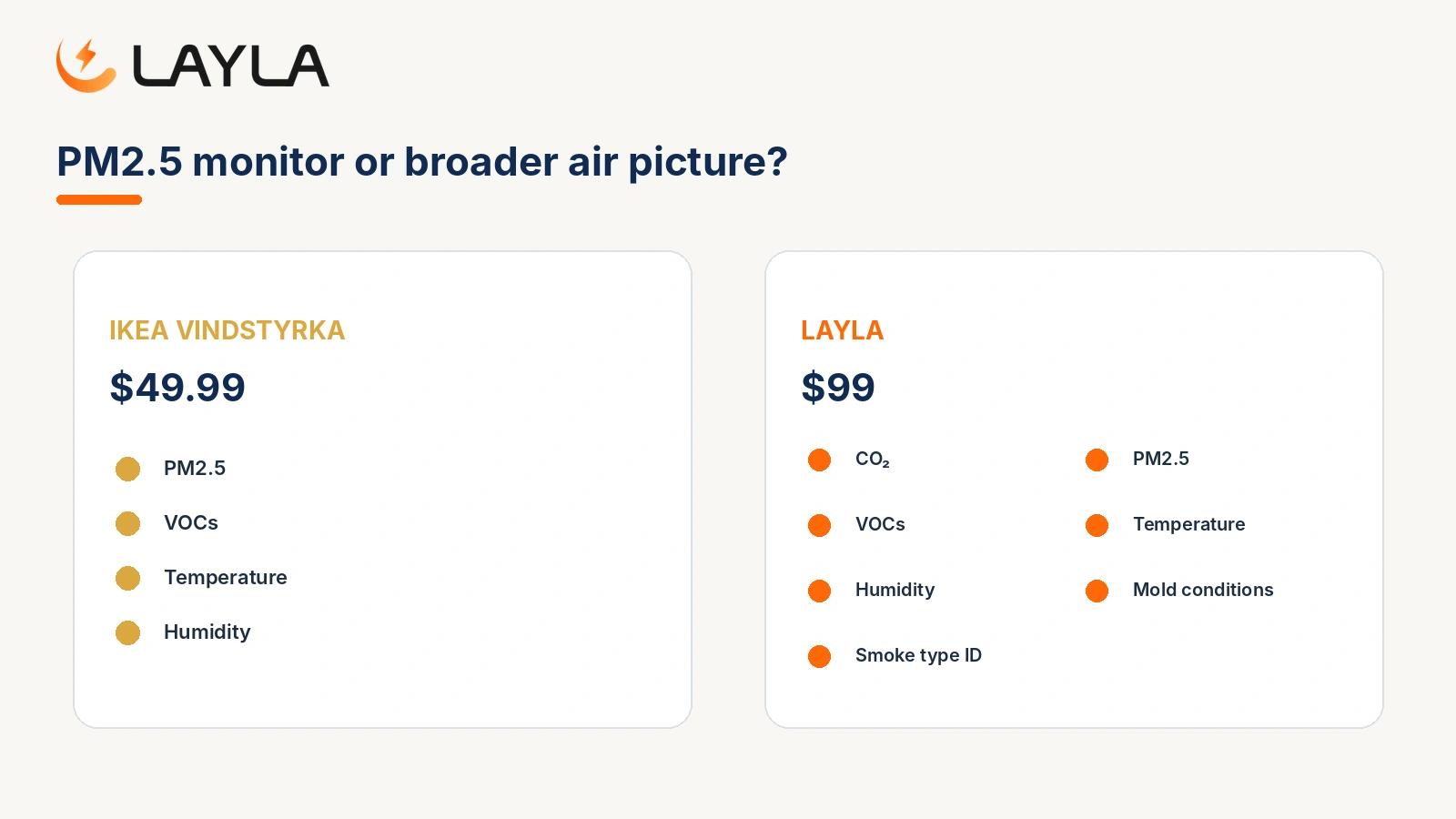
The IKEA Vindstyrka is a $49.99 desktop air-quality display built around Sensirion's SEN54 sensor, and it measures four things: PM2.5 particulate matter, total VOCs shown as an index, temperature, and humidity. It surfaces a rising or falling trend arrow for VOCs and a simple color status for air quality at a glance, which is genuinely useful when you just want to know "is the air okay right now?" without opening an app.
Here's the honest case for it. At fifty dollars, powered over USB-C, with a clean readout that needs no account and no setup, the Vindstyrka is good value. The Sensirion sensor inside it is a decent, capable sensor. If all you want is a tidy at-a-glance particulate and VOC readout sitting on a shelf, something that tells you when cooking smoke or a dusty afternoon has spiked the air, it does that job well and cheaply. For a lot of people, that's enough, and it would be dishonest to pretend otherwise.
It also plays nicely inside IKEA's own smart-home world. If you already own a DIRIGERA hub and a STARKVIND purifier, the Vindstyrka can trigger the purifier automatically when particulates climb. That's a neat, self-contained loop for anyone who's already bought into IKEA's ecosystem.
But two gaps are worth stating plainly, because they're easy to miss on the shelf.
Does the IKEA Vindstyrka measure CO2?
No — the IKEA Vindstyrka does not measure CO2, and that's the single biggest thing to know before buying one. The SEN54 sensor inside it covers PM2.5, VOCs, temperature, and humidity, but carbon dioxide is simply not on the list.
That's a real limitation, not a technicality. CO2 is the headline number for ventilation and stuffiness. When a closed bedroom or a full home office starts to feel stale, heavy, or sleep-wrecking, rising CO2 is usually the reason — and it's the metric that tells you to crack a window or run the fan. A monitor that skips CO2 can tell you the air has particles or VOCs in it, but it can't tell you the room needs fresh air, which is the question most people are actually trying to answer.
PM2.5 and CO2 answer two completely different questions, and it helps to see why. Particulates measure what's floating in the air, so smoke, dust, cooking residue, the stuff you'd filter out with a purifier. CO2 measures something you can't filter at all. It builds up because people breathe it out, and the only way to bring it down is to move air in and out of the room. A PM-only readout can show a calm green status while the real problem is a CO2 level that's quietly climbed past 1,000 or 1,500 ppm overnight, which is exactly the range where people report grogginess, headaches, trouble concentrating, and restless sleep. The display looks fine, the room feels awful, and the device has no way to connect the two.
This matters most in the rooms where you spend the longest with the door shut. Take a bedroom with two sleeping adults. Particulates stay low all night while CO2 climbs until morning, and a PM-only monitor never registers that anything happened. If you want to understand what good numbers look like, our guide to CO2 levels in your home breaks down the thresholds, and our CO2 monitor for home explainer covers what to look for in a device.
Layla measures CO2 directly, alongside particulates and VOCs, so it answers both "is the air clean?" and "is this room ventilated?" in one place. You see the particulate spike from cooking and the CO2 build-up from a closed room on the same screen, which is the difference between knowing your air has a problem and knowing which problem it is.
What does Layla measure, and how is it different?
Layla is an all-in-one indoor air monitor that tracks CO2, total VOCs, PM2.5, an overall air-quality index, temperature, and humidity, and it works as a complete standalone device with history, alerts, and remote access built in. Where the Vindstyrka gives you a live readout, Layla gives you a live readout plus the record of what happened while you weren't looking.
That standalone part is the quiet differentiator. With Layla, the logging, the trend charts, the push alerts, and the ability to check your air from your phone while you're out are all included in the device itself. There's no separate hub to buy and no smart-home platform you have to commit to. You plug it in, and the full experience is there.
The history and alerts are worth dwelling on, because they change what the device is for. A live display answers "right now." History answers "what's the pattern," which is usually the more useful question. That's how you find out your bedroom CO2 always peaks around 5 a.m., or that VOCs spike every time the cleaner comes, or that bathroom humidity creeps up every winter. Alerts then close the loop, so instead of standing in front of a screen at the moment something goes wrong, you get a push notification when particulates spike overnight or CO2 crosses your threshold. On the Vindstyrka, every one of those capabilities lives behind the hub. On Layla, they're the baseline.
Layla also reaches a little wider than particles and gases. It watches humidity closely enough to give early warning on the conditions that let mold take hold — not spore counts, but the damp, stagnant conditions that precede a problem — which is a more preventive way to think about mold in your home. That's a genuinely different job from an air readout, since it tracks conditions over time, and it's the kind of slow-building problem only history can catch. Layla can also identify the type of smoke in the air, distinguishing cigarette, vape, and cannabis and grading the intensity, which no glanceable VOC display attempts. A VOC index will twitch upward when someone smokes, but it can't tell you whether that was a scented candle, aerosol spray, or an actual cigarette. Layla can, and it logs when and how strong. On the privacy side, Layla uses radar for occupancy sensing on its wider system, with no camera and no microphone anywhere in the product.
Put together, the readings reinforce each other. CO2 tells you about ventilation, PM2.5 about what's airborne, VOCs about chemicals off-gassing, humidity about the slow conditions that invite mold, and smoke type-ID about what kind of event just happened. A single-metric spike can be ambiguous; the combination usually isn't.
If you want to go deeper on the gases themselves, our piece on what VOCs are in your home explains the compounds both of these devices are reacting to, and indoor air quality and your health covers why the combination of readings matters more than any single number.
The hub problem: why the Vindstyrka's real price is higher than it looks
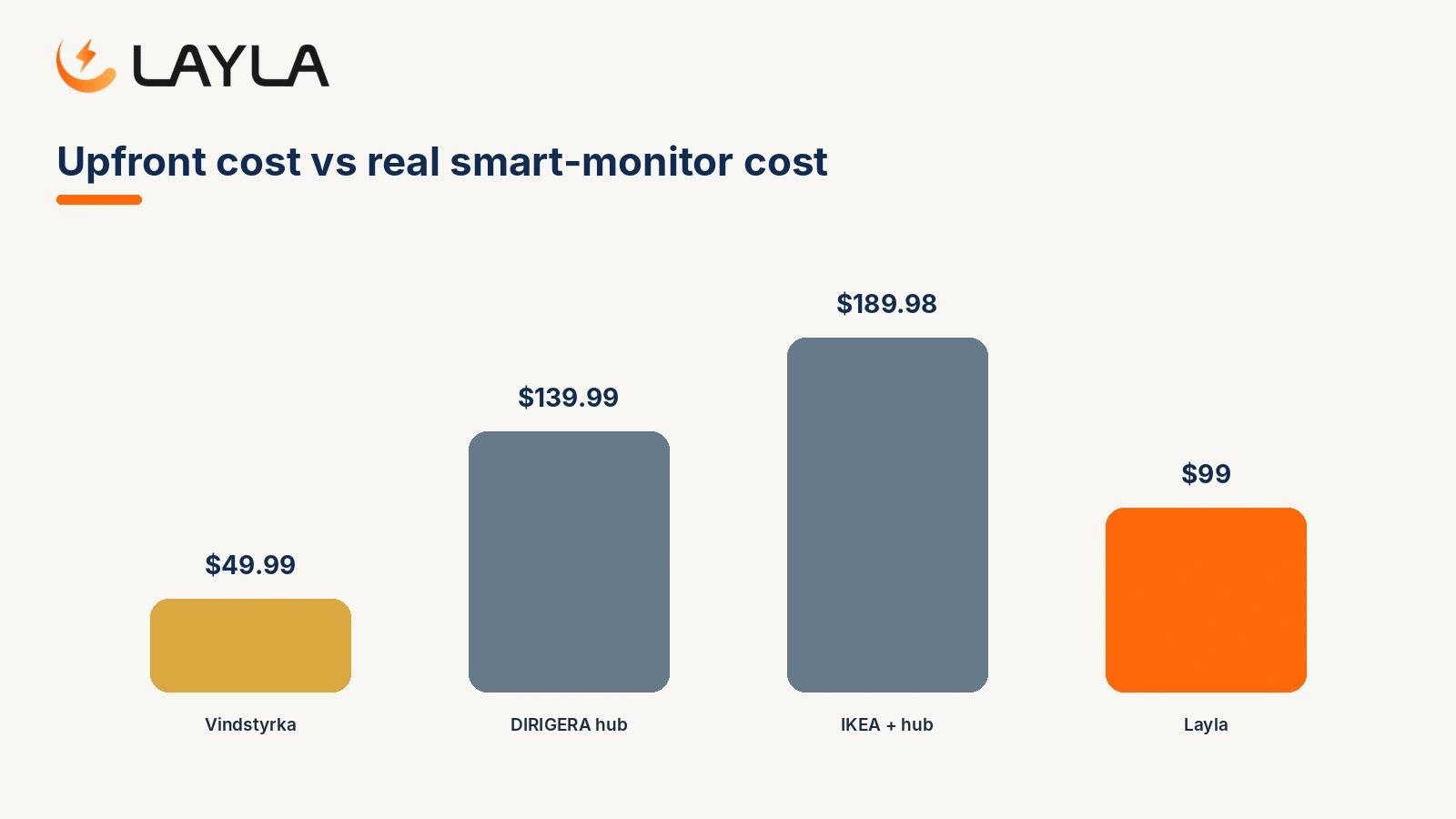
The Vindstyrka costs $49.99, but its "smart" features cost about $190 once you add the hub it requires, and that reframes the whole comparison. On its own, the Vindstyrka shows you live PM2.5, VOCs, temperature, and humidity with a color status, and that's it. The moment you want history, alerts, remote access from your phone, or any automation, you need IKEA's DIRIGERA hub, which runs $139.99 and connects the sensor over Zigbee, plus the IKEA Home smart app.
Here's the math laid out plainly. The sensor on its own is $49.99. To make it remember or notify you of anything, add the DIRIGERA hub at $139.99. That's $189.98 before you've bought anything else, and it buys a monitor that still can't measure CO2. For most people who want a "smart" air monitor, then, the hub isn't optional, it's part of the real purchase price, and you're committing to IKEA's hub and app rather than a device that just works on its own.
So the standalone Vindstyrka has no logging, no history, no alerts, and no export. It's a live display. To turn it into something that remembers yesterday's air or pings you when particulates spike overnight, you're into roughly $190 of hardware and a Zigbee dependency. Even then, the IKEA Home app's history and export have historically been minimal, so treat deep trend data or CSV downloads as limited and hub-gated rather than guaranteed. The honest read is that the $49.99 price tag answers a different question than most buyers are asking. If you genuinely only want a glanceable screen, it's a great deal. If you want the things people usually mean by "air quality monitor," the price roughly quadruples and the device still has blind spots.
Layla puts all of that — history, alerts, remote access — in the base device for a one-time $99, with no hub and no subscription. Once you account for the hub, the Vindstyrka's smart setup actually costs nearly double what Layla's air-quality tier does, and it still doesn't measure CO2, doesn't do smoke type-ID, and leans on a single smart-home platform. The raw $49.99 price is real and fair for a simple display. The "smart Vindstyrka" price is a different number entirely.
At a glance: Layla vs IKEA Vindstyrka
| Layla | IKEA Vindstyrka | |
|---|---|---|
| Price | From $99 one-time, no subscription | $49.99 (+$139.99 hub for history/alerts) |
| CO2 | Yes | No |
| PM2.5 | Yes | Yes |
| Total VOCs | Yes | Yes (indexed, with trend arrow) |
| Temperature & humidity | Yes | Yes |
| Mold-condition early warning | Yes | No |
| Smoke type-ID (cigarette/vape/cannabis) | Yes | No |
| History & trend logging | Yes, standalone | Hub required |
| Alerts & remote access | Yes, standalone | Hub required |
| Hub needed | No | Yes, for anything beyond live display |
| Camera / microphone | None (radar occupancy) | None |
| Subscription | None | None |
Both devices avoid subscriptions and both keep cameras and microphones out of your home, which is worth crediting on both sides. The split is really about depth: the Vindstyrka is a display, Layla is a monitor.
Which one should you buy?
Buy the IKEA Vindstyrka if you want the cheapest possible at-a-glance readout and nothing more. If you've got $50, you already live inside the IKEA ecosystem, and you mainly want a clean screen that tells you when the air gets dusty or smoky, maybe to kick off a STARKVIND purifier automatically, it's a sensible, honest little device. You'll be giving up CO2, history, and alerts unless you spend on the hub, but if you don't care about those, the value is real.
Choose Layla if you want to actually understand and track your home's air rather than just glance at it. The CO2 reading alone changes what you can diagnose, since it's the number that explains stuffiness and poor sleep. Add standalone history and alerts with no hub, humidity and mold-condition warnings, smoke type-ID, and a one-time $99 price, and you get a monitor that does substantially more out of the box than the Vindstyrka can even with its hub attached. If this is the direction you're leaning, the Layla air-quality monitor page covers the full spec, and pricing lays out the tiers.
To make it concrete, picture three households. Someone who just wants a kitchen shelf display to flag cooking smoke, and who already owns a DIRIGERA hub and a STARKVIND purifier, is well served by the Vindstyrka: it's cheap, it looks good, and the purifier automation closes the loop. A parent worried about a stuffy nursery or a bedroom that feels stale by morning should skip a PM-only display entirely, because the thing they need to see is CO2, and that means Layla. And anyone diagnosing a recurring problem, such as a damp bathroom or air that's worse on some days than others, needs the history and alerts that come built in on Layla or bolted on at hub prices with the Vindstyrka. Match the device to the question you're trying to answer, and the choice usually makes itself.
It also helps to see Layla against the rest of the field. If you're cross-shopping, our comparisons with Airthings and Aranet4 cover the pricier, more specialized end of the market, and our roundup of the best air quality monitors for home puts all of them side by side.
Frequently asked questions
Is Layla a good IKEA Vindstyrka alternative?
Yes. Layla is a strong IKEA Vindstyrka alternative for anyone who wants more than a live display. It measures everything the Vindstyrka does (PM2.5, VOCs, temperature, humidity) and adds CO2, plus history, alerts, and remote access as a standalone device with no hub, for a one-time $99 with no subscription.
Does the IKEA Vindstyrka measure CO2?
No. The Vindstyrka's Sensirion SEN54 sensor measures PM2.5, VOCs, temperature, and humidity, but not CO2. That's a meaningful gap, since CO2 is the main indicator of poor ventilation and stuffiness. Layla measures CO2 directly.
Do I need the DIRIGERA hub with the Vindstyrka?
For a live on-screen readout, no, the Vindstyrka works standalone. But history, alerts, remote access, and automations all require IKEA's DIRIGERA hub ($139.99) and the IKEA Home smart app, with the sensor connecting over Zigbee. That pushes the real cost of a "smart" Vindstyrka to around $190.
Does Layla need a hub or subscription?
No. Layla's history, alerts, and remote access are built into the device, so there's no separate hub and nothing to pair over Zigbee. There's also no subscription, ever, and the air-quality tier is a one-time $99. Worth noting, Layla reports total VOCs as a single index rather than naming individual compounds, as both of these monitors do.
Why does CO2 matter if the Vindstyrka already measures particulates and VOCs?
Because they measure different problems. PM2.5 and VOCs tell you what's in the air you could filter out, while CO2 tells you whether the room is actually ventilated. CO2 builds up from people breathing in a closed room and can only be lowered by bringing in fresh air, not by a purifier. A particulate display can read clean and green while CO2 climbs into the range that causes grogginess, headaches, and poor sleep. Layla measures CO2 directly, so it catches the stuffiness a PM-only monitor can't see.
Which is better value, Layla or the Vindstyrka?
For a bare live display, the Vindstyrka at $49.99 is cheaper and perfectly fair. But once you add the hub needed for history and alerts, it costs roughly $190 and still lacks CO2 and smoke detection. Layla delivers history, alerts, CO2, and more for a one-time $99, which makes it the stronger value for anyone who wants a real monitor rather than a readout.
Related reading

Best for: health-conscious homes
Smoke & Air Quality
Air quality, mold and smoke monitoring for healthy homes and smoke-free rentals.
Included forever — no subscription
- Mold-risk early warning
- Smoke & cigarette detection
- Air quality score (IAQ) with alerts
- CO₂ & bVOC monitoring
- AI air insights & recommendations
- Allergy-comfort monitoring
No monthly fees. Ever.
30-day money back guarantee