BLOG
Quiet hours for vacation rentals: the usual window, the wording, and how to enforce it without a camera
 By Nangyal Khan··Updated
11 min read
Last updated: October 28, 2026
Quiet hours for a vacation rental start at 10 p.m. in every local rule with set times that we checked, and end at 7 or 9 a.m. Sebastopol, California sets 10:00 p.m. to 7:00 a.m., and Scottsdale, Arizona points guests to 10 p.m. to 9 a.m. If your city sets a window, use it. If it doesn't, 10 p.m. to 8 a.m. sits between those two examples. Then do three things: put the window in Airbnb's standard quiet-hours rule, write it in plain words, and have a way to know when it's being broken while you're asleep somewhere else.
Quiet hours are a fixed overnight window, set in your house rules and sometimes in local law, during which guests keep noise low enough that the neighbors can sleep. They're the one rule that turns "please be considerate" into something you can point to.
The usual quiet-hours windows
These are the rules we checked. Where a source gives no clock times, the table says so rather than guessing.
| Place | Quiet hours | What else the rule says | Source |
|---|---|---|---|
| Sebastopol, California | 10:00 p.m. to 7:00 a.m. | No amplified outdoor sound at any time; quiet hours must appear in every listing and rental agreement | City vacation rental agreement form |
| Scottsdale, Arizona | "particularly between the hours of 10 p.m. to 9 a.m." | Any gathering that disturbs the peace or quiet of a neighborhood is prohibited | City Good Neighbor Guide for visitors |
| Malta | Not set in the 2026 regulations | A named person must be available around the clock to receive complaints | Tourism Accommodation Regulations, S.L. 409.24 (Legal Notice 92 of 2026); more in our Malta guide |
| Palm Springs, California | Set by the city | Palm Springs sets its own response-time and fine rules | Our Palm Springs guide |
| Airbnb | You choose the window | Quiet hours is one of seven standard house rules: "Select when noise should be kept to a minimum." | Airbnb, Important changes to house rules |
All sources checked October 28, 2026.
The end time varies more than the start. A later finish, like Scottsdale's 9 a.m., is kinder to neighbors who sleep in at weekends.
What local rules require beyond the times
The clock times are the easy part — most of the work in a quiet-hours rule is about what you, the host, have to do when guests ignore them.
Put it in writing where guests book. Sebastopol requires every listing and advertisement to include a notice that quiet hours must be observed between 10:00 p.m. and 7:00 a.m., and the same rule has to be in the rental agreement.
Be reachable, and be fast. Sebastopol requires the operator to answer the phone 24 hours a day and to be on the premises within one hour when called. Malta's 2026 regulations require a named person available around the clock to receive complaints. Response clocks like these are a good reason to pair quiet hours with an alert. Noise & Security Pro, with quiet-hours enforcement tells you the moment noise passes your overnight limit, so your contact is on the way before the neighbor picks up the phone.
Keep a record. Sebastopol asks operators to document every complaint, and how it was resolved, to the Planning Director within 72 hours. Failing to respond or report counts as a violation in its own right.
Count your strikes. In Sebastopol, any combination of three administrative citations or violation findings within two years means the permit is revoked, and the owner can't reapply for at least two years. Palm Springs sets its own response-time and fine rules, covered in our Palm Springs guide.
Other markets are stricter about who can host at all than about the clock. New York's short-term rental rules, which Local Law 18 enforces through registration, require the host to be present for stays under 30 days, so quiet hours there are your own night as much as the neighbors'. Our guides to NYC Local Law 18, Miami Beach STR rules and the East Hampton rental registry cover the rest. Wherever you are, check your city or county's own page before you settle on a window.
House-rules wording you can copy
Airbnb has changed how house rules work. In an announcement dated October 20, 2026, it launched seven standard rules for hosts to choose from: maximum overnight guests, quiet hours, events, pets, "Smoking, vaping, and e-cigarettes", commercial photography and filming, and lock up at checkout (help article 472 gives the names; both pages checked October 28, 2026). The new house-rules policy takes effect November 20, 2026. Guests are required to follow those rules. If one breaks a rule during the stay, or says before check-in that they intend to, you can cancel without fees. Anything else is a request, for during the stay or before checkout. Requests have to be reasonable, guests are only encouraged to follow them, and the fee-free cancellation doesn't apply. Rules and requests all go in the listing's "House rules and requests" section, and Airbnb says you "shouldn't write additional rules elsewhere on your listing, in messages, or on signs in your home."
So set quiet hours as Airbnb's standard rule, with your window. Set events to not allowed and the maximum overnight guests to what the home really sleeps. Then add the wording below as a request, which fills in what you'd like guests to do during those hours. A welcome book is for practical details like Wi-Fi and appliances; let it point guests back to the house rules in their booking rather than restating them. If your city requires something posted inside the home, as Sebastopol does with its permit and standards, post exactly what the city asks for.
Standard rules to switch on in the listing
- Quiet hours: 10 p.m. to 8 a.m. (or your city's window)
- Events: not allowed
- Maximum overnight guests: the number the home sleeps
Request wording (copy and edit; optional for guests)
- During quiet hours, please keep voices, music and the TV low enough that they can't be heard outside the home or through shared walls, and keep the patio, balcony, garden and pool area quiet.
- Our neighbors live here all year. Thank you for helping us stay welcome on this street.
Disclosure line for the listing description
- The living area has a noise sensor. It measures sound levels only and never records audio or video.
That disclosure isn't a rule. Airbnb allows noise decibel monitors as long as you disclose them, so it belongs in the listing anyway. Keep the rest short, so quiet hours doesn't get lost. Our vacation rental house rules template covers the other standard rules (smoking, pets, lock up at checkout) and the requests that go with them.
Enforcing quiet hours without a camera
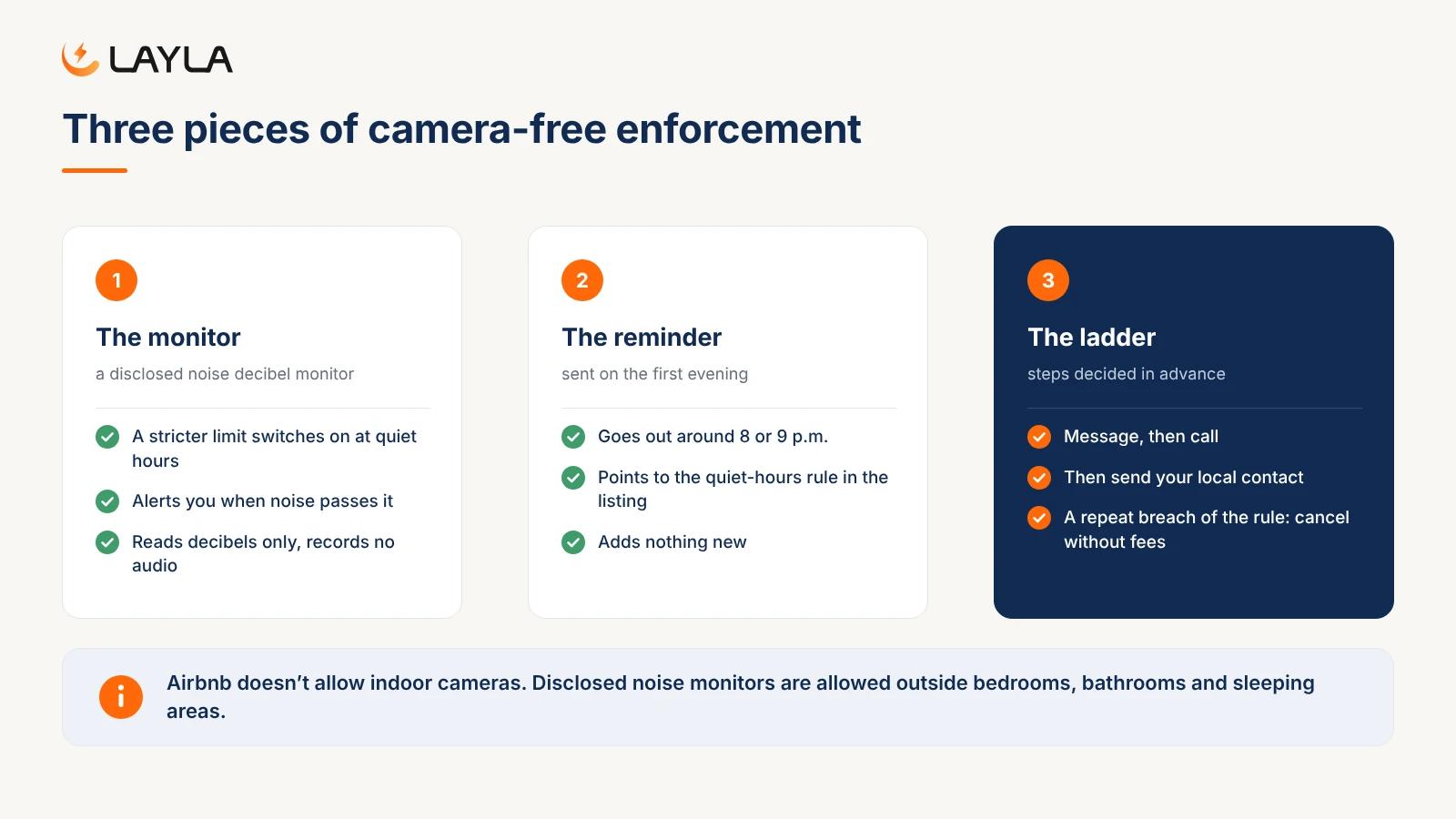
Airbnb doesn't allow indoor cameras, even switched off. What it does allow is a noise decibel monitor in the home, as long as you disclose it and keep it out of bedrooms, bathrooms and sleeping areas (Airbnb help article 3061, checked October 28, 2026). Enforcement without a camera rests on three pieces: the monitor, a message the guest gets without you typing it at midnight, and a ladder of steps you've decided on in advance.
The monitor
A noise monitor turns quiet hours from a line in the listing into something you can see. You set a daytime limit and a stricter overnight one, and the stricter limit switches on when quiet hours begin. If you want this done for you, Noise & Security Pro is $179 once: you set custom quiet hours and noise limits per property, get an instant alert when noise passes your threshold, and keep 180 days of timestamped incident reports. Noise Basic, at $149 once, also includes quiet-hours enforcement with 7 days of history. Neither records audio. Each reads a decibel level and nothing else.
Pro adds the AI party detector, which looks at how many people are inside, how loud it is and what time it is, so a crowd at 1 a.m. reads differently from two people with the TV up. If you're still choosing between devices, our comparison of noise monitors for Airbnb lays them out, and our guide to acceptable decibel levels explains where to set the overnight limit.
The automated guest message
The best enforcement happens before anything is loud. Schedule a short message in your PMS or messaging tool for the first evening of every stay, around 8 or 9 p.m. Under Airbnb's new policy, it should remind guests of the quiet-hours rule already in your listing and add nothing new. Airbnb's house-rules quick reply does exactly that.
"Hi [name], hope you've settled in. A quick reminder that quiet hours here start at 10 p.m., as set out in the house rules in your booking. The neighbors are close, so after 10 please keep music and voices low. Have a great evening."
A second template, ready to send the moment an alert comes in:
"Hi [name], the noise level in the living room has been high for a while, and it's now quiet hours under the house rules in your booking. Could you turn things down for the rest of the night? Thanks for sorting it."
Both messages point back to a rule the guest saw before booking, and add nothing new.
Hosts who want alerts to land in their own team tools can connect them: Layla's integrations page lists an API and 5,000+ apps through no-code automation.
The escalation steps
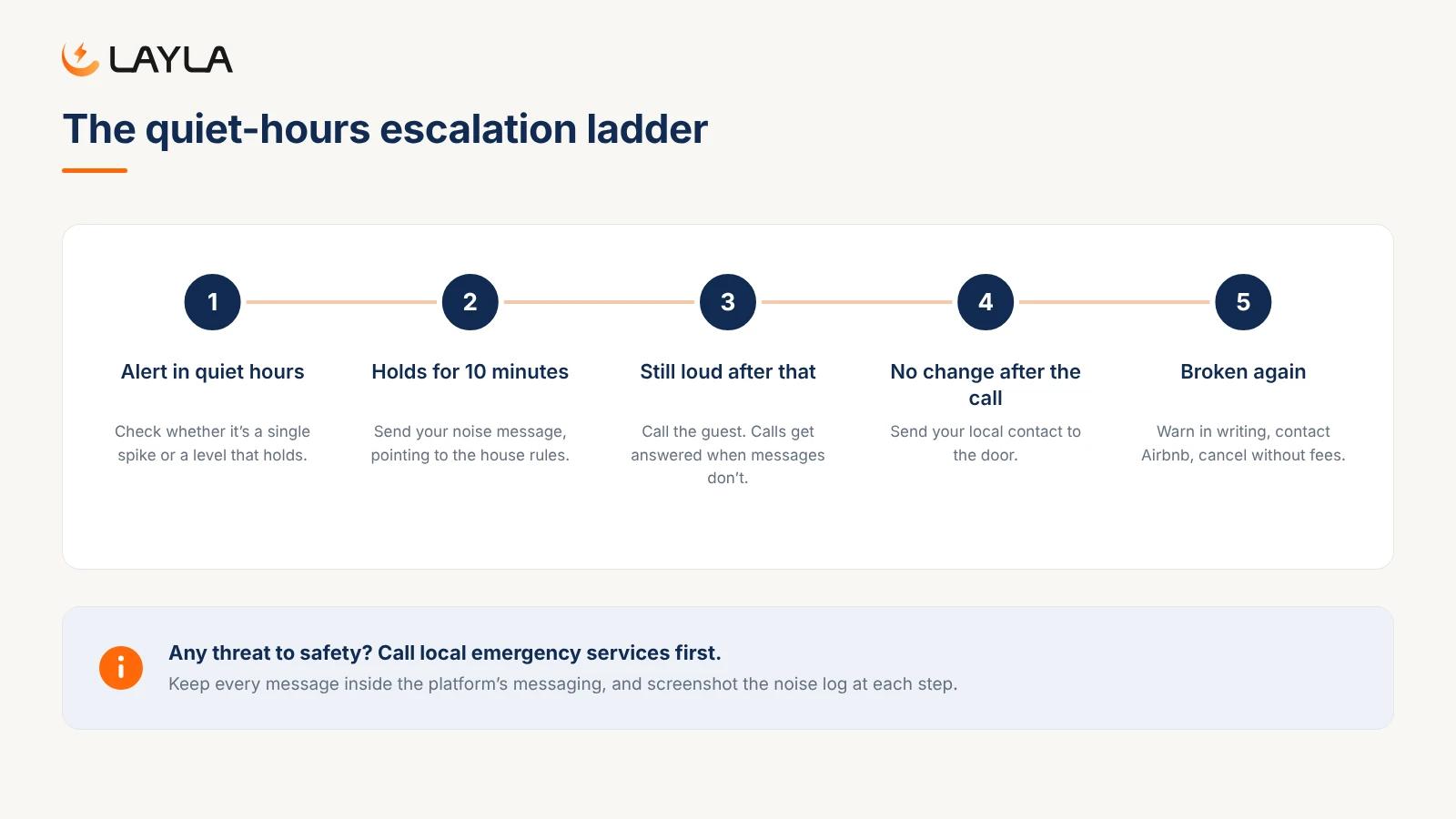
Decide the ladder before the night you need it. A reasonable one looks like this.
- Alert during quiet hours. Check whether the level is a spike or is holding. A single bang needs nothing.
- Level holding for 10 minutes. Send the second message above.
- Still loud 15 minutes later. Call the guest. Calls get answered when messages don't.
- No change after the call. Send your local contact. If your city expects someone on-site within a set time, such as Sebastopol's one hour, this is the step it's measuring.
- Broken again after a reminder. Tell the guest in writing that the stay may be cancelled, then contact Airbnb. Airbnb's October 20, 2026 announcement says you can cancel a reservation without fees or other consequences if a guest breaks one of your house rules during the stay. That covers rules, not requests, which is why quiet hours have to be set as the standard rule.
- Any threat to safety. Call local emergency services first, then deal with the platform.
Keep every message inside the platform's messaging, and screenshot the noise log at each step.
When a guest breaks quiet hours
Start by assuming the guest simply lost track of time. People forget, a birthday runs late, someone turns the speaker up without noticing the hour. A polite, specific message with the time and the level gives them an easy way to put it right — and keeps the tone friendly if you need to follow up.
When it doesn't end there, think about the morning after. Write down what happened while it's fresh: alert times, message times, what the guest said, whether your contact visited. Save the noise report. If a neighbor complains, you'll want to answer with times and numbers rather than "I'll look into it". Our guide to handling an Airbnb noise complaint from a neighbor covers that conversation step by step, with templates.
Then fix the gap that let it happen. Was quiet hours missing from the listing, or set to start at midnight? Was the overnight threshold too high to catch voices? Was there no first-evening reminder? One change usually closes it.
FAQ
What are quiet hours on Airbnb?
Quiet hours on Airbnb are a window the host sets for when noise should be kept to a minimum. They're one of the seven standard house rules Airbnb launched on October 20, 2026, and under its house-rules policy, effective November 20, 2026, guests are required to follow them. If your city sets a window, use it.
What are the quiet hours rules for vacation rentals?
Quiet hours rules for vacation rentals come from two places: your city and your house rules. Sebastopol, California, for example, sets 10:00 p.m. to 7:00 a.m., bans amplified outdoor sound and requires quiet hours in every listing. Some cities also set a response clock. Sebastopol requires the operator on the premises within one hour when called.
How to enforce quiet hours in a rental?
To enforce quiet hours, set them as Airbnb's standard quiet-hours rule, remind guests of that rule on the first evening, and use a disclosed noise monitor that switches to a stricter overnight limit when quiet hours begin. When it alerts, message the guest, call if it continues, then send a local contact. A breach during the stay lets you cancel without fees.
What are typical quiet hours for a vacation rental?
Typical quiet hours for a vacation rental start at 10 p.m. and end between 7 and 9 a.m. Sebastopol, California sets 10 p.m. to 7 a.m., and Scottsdale, Arizona points guests to 10 p.m. to 9 a.m. Where your city sets no times, 10 p.m. to 8 a.m. sits between those two examples.

Best for: serious hosts
Noise Pro
Compliant with Airbnb's rules and local noise laws worldwide. Advanced protection for serious hosts.
Included forever – no subscription
- AI party detector
- Instant noise alerts with timestamps
- Live data feed, no 5-minute delay
- 180-day data history
- Radar intruder & vacant-home alerts
- Property status dashboard
- Outdoor temperature & humidity
- Automatic AI accuracy updates
- Daily & weekly summary reports by email
No monthly fees. Ever.
Your indoor air is 2-5x more polluted than outdoor air.
The EPA confirms it, but most people have no idea. You spend 90% of your time indoors breathing air you've never measured.
CO2 builds up silently.
A bedroom with two people can hit 2,500 ppm overnight. Harvard research shows decision-making drops 50% at 1,400 ppm. That brain fog and morning fatigue? It might not be bad sleep - it's bad air.
VOCs are off-gassing in every room.
New furniture, carpets, paint, cleaning products indoor VOC levels run up to 10x higher than outdoors. Some, like formaldehyde and benzene, are classified carcinogens. You can't smell most of them.
Mold starts in 24 hours.
When humidity exceeds 60%, mold begins colonizing within a day. 47% of U.S. homes show visible mold. Average remediation cost: $2,368 severe cases hit $30,000. A sensor that warns you before mold starts is orders of magnitude cheaper than cleanup.
Standard smoke detectors only catch fires.
They don't detect cigarette, vape, or marijuana smoke at low levels. For landlords and hosts, unauthorized smoking causes damage that goes unnoticed for weeks.
Post-COVID, people want data.
66% of Americans are more cautious about indoor air since the pandemic. 61% say they'd trust a space more if it monitored air quality. The awareness shift is permanent.
30-day money back guarantee