BLOG
Acceptable decibel levels: what 50, 60, 70 and 80 dB mean in a rental, by day and at night
 By Nangyal Khan··Updated
11 min read
Last updated: October 28, 2026
Acceptable decibel levels depend on who is listening and when. The World Health Organization's guidance for homes is an average of 35 dB indoors during the day and 30 dB in a bedroom at night, with single peaks kept under 45 dB, plus an outdoor night-time target of 40 dB. Normal conversation sits at about 60 dB. In a rental, that means a living room running at 60 to 70 dB at seven in the evening is ordinary life. The same level held past 10 p.m. is what keeps the people next door awake, and 80 dB is the low end of the range the NIH's hearing institute gives for motorcycles.
Below, each of those levels gets an everyday sound to go with it, followed by what local rules measure and a way to set an alert threshold for your own property.
A decibel reading is a measure of sound pressure on a logarithmic scale. Most health guidance uses A-weighted decibels (dBA), which the American Speech-Language-Hearing Association describes as levels "weighted to how the human ear receives noise". Because the scale is logarithmic, small steps matter: NIOSH guidance, as summarized by ASHA, halves the safe listening time for every 3 dB above 85 dBA.
Decibel levels with everyday examples
Every figure below comes from a health or safety body, with the source named in the last column. Where sources give a range, the range is shown.
| Level | What it sounds like | Source |
|---|---|---|
| About 25–30 dBA | A whisper | Yale EHS chart (25); ASHA (about 30) |
| 40 dBA | A suburban area at night | Yale EHS chart |
| 55 dBA | A household refrigerator | Yale EHS chart |
| About 60 dBA (60–70) | Normal conversation | ASHA (about 60); NIDCD (60–70) |
| 60–65 dBA | A business office | Yale EHS chart |
| 75 dBA | A vacuum cleaner | Yale EHS chart |
| 80–110 dBA | Motorcycles and dirt bikes | NIDCD |
| 85 dBA | City traffic | Yale EHS chart |
| 91 dBA | A lawnmower | ASHA |
| 94–110 dBA | Sporting events and concerts | NIDCD |
| 110–129 dBA | Sirens | NIDCD |
Sources: NIDCD, Noise-Induced Hearing Loss (updated April 16, 2025); ASHA, Noise and Apps (2023); Yale Environmental Health & Safety, Decibel Level Comparison Chart. All checked October 28, 2026.
What does 60 dB sound like?
Sixty decibels is two or three people talking at a normal volume across a table. ASHA puts normal conversation at about 60 dBA, the National Institute on Deafness and Other Communication Disorders gives 60 to 70 dBA, and Yale's chart lists a business office at 60 to 65. During the day it's nothing. Nobody complains about a conversation at lunch. At 2 a.m. it's a different matter, because the background has dropped to suburban-night levels around 40 dB and voices carry.
50, 70 and 80 dB in plain terms
50 dB is quieter than a running fridge (55 dB on Yale's chart) and louder than a suburb at night (40 dB). It's also the level the WHO uses for outdoor living areas: above 50 dB on average during the day and evening, people on a patio or in a garden start to be moderately annoyed.
70 dB is a loud conversation or a television turned up, at the top of NIDCD's conversation range and just under a vacuum cleaner. NIDCD says sounds at or below 70 dBA, even after long exposure, are unlikely to cause hearing loss. Through a wall at midnight, though, it's a complaint.
80 dB is where the louder end of everyday life starts. NIDCD's motorcycle range begins at 80 dBA, and long or repeated exposure at or above 85 dBA can cause hearing loss.
What's acceptable indoors and outdoors, by day and at night
The most useful numbers here come from the WHO, which publishes health-based guideline values rather than legal limits. They describe what the person hearing the noise should be exposed to, averaged over hours.
| Setting | WHO guideline | Source |
|---|---|---|
| Outdoor living area, day and evening | 50 dB (moderate annoyance) and 55 dB (serious annoyance), averaged over 16 hours | WHO Guidelines for Community Noise, 1999, Table 1 |
| Inside a home, day and evening | 35 dB, averaged over 16 hours | WHO 1999, Table 1 |
| Inside a bedroom, at night | 30 dB averaged over 8 hours; single peaks no higher than 45 dB | WHO 1999, Table 1 |
| Outside a bedroom window, at night | 45 dB averaged over 8 hours; peaks no higher than 60 dB | WHO 1999, Table 1 |
| Outside, at night (yearly average) | 40 dB Lnight,outside as the target; 55 dB as an interim target | WHO Night Noise Guidelines for Europe, 2009 |
| Road traffic at night | Below 45 dB Lnight | WHO Environmental Noise Guidelines for the European Region (2018 guidelines; WHO's publication page dates it January 30, 2019) |
Sources: WHO, Guidelines for community noise (1999); WHO Europe, Night noise guidelines for Europe (2009); WHO Europe, Environmental noise guidelines for the European Region. All checked October 28, 2026.
So what are acceptable noise levels at night? For the neighbor, the answer is about 30 dB inside their bedroom, with no single sound above 45. For your rental, it's whatever keeps their bedroom there. Your sensor sits in your living room, not theirs, so the number it reads will always be higher than what reaches next door. How much the walls take off depends on the building, which is why a threshold has to be set on your own property rather than copied from a chart.
So the threshold belongs to your room, not to a chart. Noise & Security Pro, $179 once, lets you set custom quiet hours and noise limits per property, sends an instant alert when the level passes your threshold, and keeps 180 days of noise and occupancy history. It measures a decibel level only. No audio is ever recorded. If you're comparing devices first, our comparison of noise monitors for Airbnb covers the options.
WHO's 2018 guidelines for the European Region supersede the 1999 document, but they state that all of the 1999 indoor guideline values "should remain valid". That's why the bedroom figure of 30 dB still holds. The 2018 guidelines also set a yearly average of 70 dB for leisure noise from all sources combined, which tells you how loud a lifestyle can be before health effects show up.
What ordinances actually use
None of the short-term rental rules we've covered on this blog gives you a decibel number to stay under. They work with audibility, the time of night and how fast you respond.
- Sebastopol, California. The city's vacation rental agreement form says "No amplified outdoor sound is permitted" and sets quiet hours from 10:00 p.m. to 7:00 a.m., which have to appear in every listing and rental agreement (City of Sebastopol form, checked October 28, 2026).
- Scottsdale, Arizona. The city's guide for visitors says any activity or gathering that disturbs the peace or quiet of a neighborhood is prohibited, "particularly between the hours of 10 p.m. to 9 a.m." (City of Scottsdale Good Neighbor Guide, checked October 28, 2026).
- Malta and Palm Springs, California. Both set their own noise and response rules for short lets. See our guides to Malta's short-let noise rules and Palm Springs vacation rental rules.
- New York City. Local Law 18 is about registration, not decibels, but registered hosts who break the rules face fines of up to $5,000 per violation (Local Law 18 of 2022, §26-3104, checked October 28, 2026). Our Local Law 18 guide explains what's left for hosts.
In practice, "too loud" means audible in someone else's home during quiet hours, whatever the meter says. Your quiet-hours window is therefore the most important setting you have, and our guide to quiet hours for vacation rentals covers how to choose one and set it as Airbnb's standard quiet-hours rule in your listing.
Why the decibel number alone shouldn't be the alert
A threshold on its own will either wake you for nothing or miss the night that matters. Three things change what a reading means.
How long it lasts. The WHO values above are averages over 8 or 16 hours — not instant readings. A door slamming is a peak. A party is a level that holds. If your phone buzzes for every spike, you'll learn to ignore it, and that's worse than no alert at all.
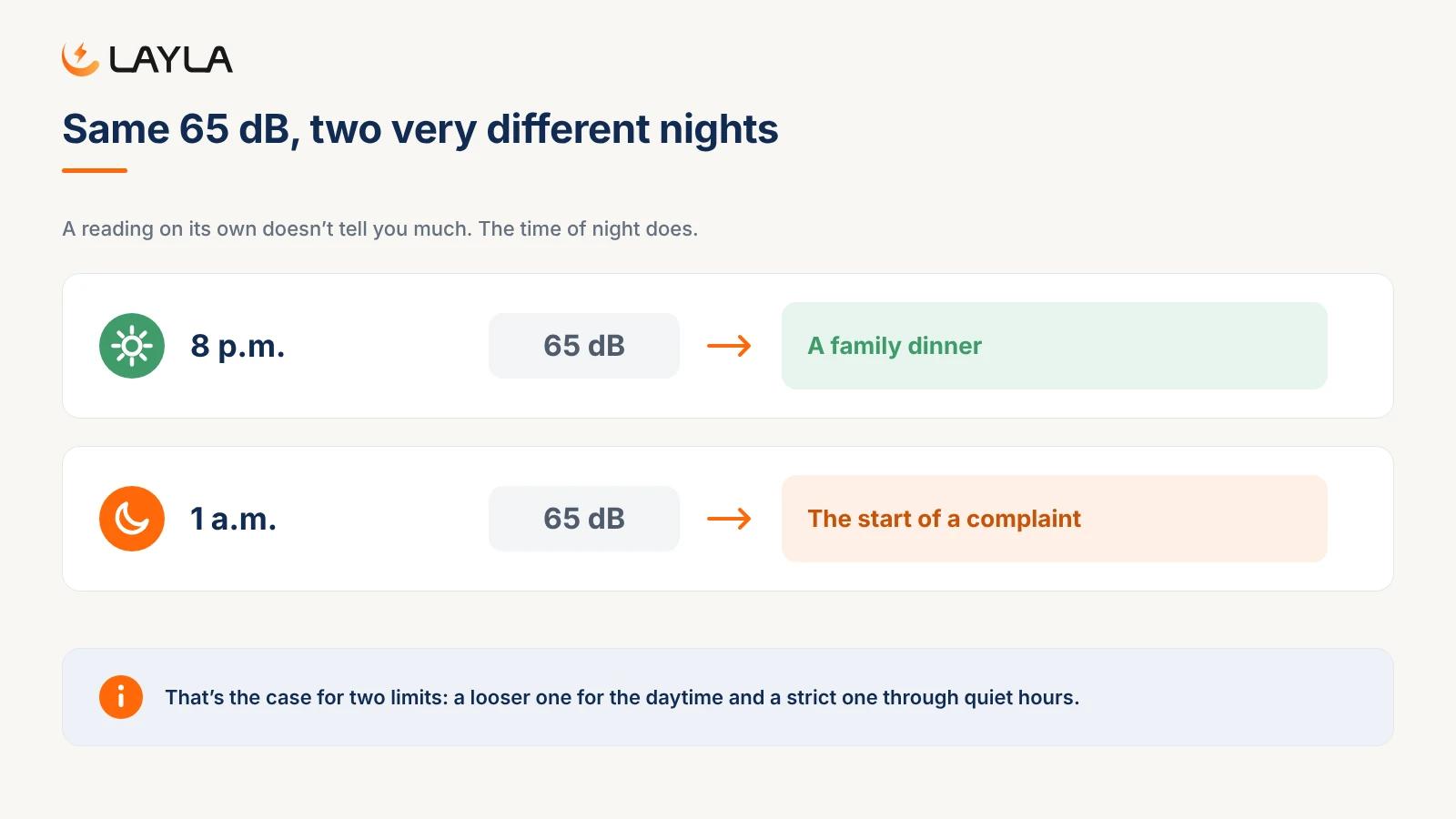
The time of night. Sixty-five decibels at 8 p.m. is a family dinner. The same reading at 1 a.m. is the start of a complaint. That's the case for running two limits: a looser one for the daytime and a strict one through quiet hours.
Repeated peaks. The WHO sets a separate ceiling of 45 dB for single noises in a bedroom at night, because sleep is broken by peaks even when the average stays low. A group shouting every few minutes may never hold a high level, yet it's exactly what a neighbor describes the next morning.
Headcount matters too. Ten people talking quietly at midnight can be more trouble than two people with the television up. Layla's AI party detector, on Noise & Security Pro and All-in-One, looks at how many people are inside, how loud it is and what time it is, using radar for the count rather than a camera.
How to set a noise threshold for a rental
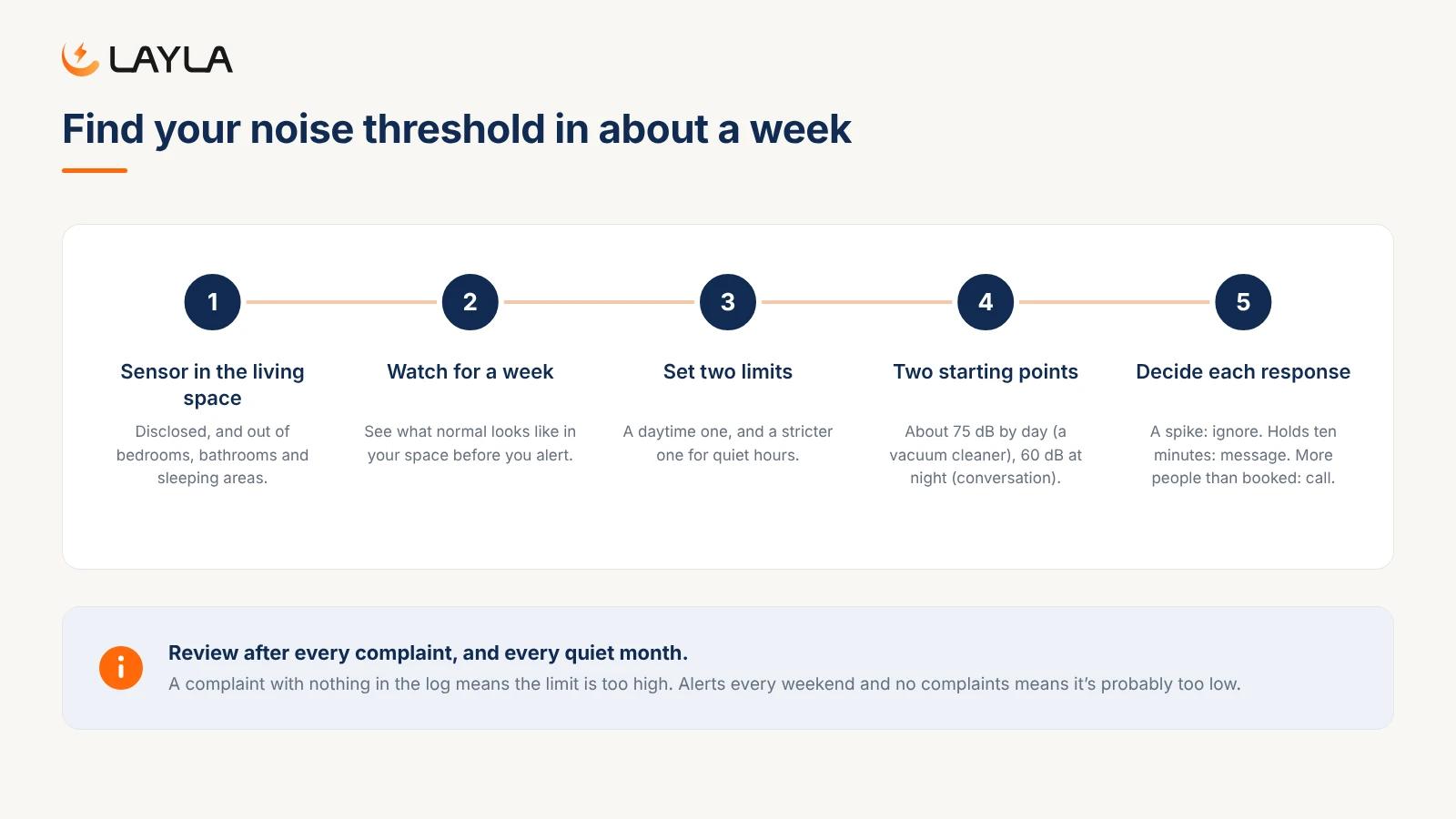
There's no universal number. There is a method that gets you to the right one in about a week.
- Put the sensor in the main living space. Airbnb allows noise decibel monitors inside a listing as long as you disclose them and keep them out of bedrooms, bathrooms and sleeping areas (Airbnb help article 3061, checked October 28, 2026). The living room is where gatherings happen anyway. Our guide to whether monitoring sensors are allowed in an Airbnb covers the disclosure wording.
- Watch before you alert. Look at a week of ordinary stays to see what normal looks like in your space. A tiled apartment reads louder than a carpeted cottage with the same people in it.
- Set two limits, matched to your quiet hours. Use a daytime limit and a stricter overnight one that switches on when quiet hours start.
- Use the table as a starting point, not a rule. A reasonable first try is a daytime limit around vacuum-cleaner level (75 dB) and an overnight limit around conversation level (60 dB). Then adjust from your own data.
- Decide what each alert means before it comes. A single spike, ignore. A level that holds for ten minutes during quiet hours, send a message. A level that holds with more people inside than booked, call. If a neighbor has already been in touch, our guide to handling an Airbnb noise complaint from a neighbor walks through the order of steps.
- Review after every complaint, and every quiet month. If a neighbor complained and your log shows nothing above the overnight limit, the limit is too high or the noise came from outside. If you've had alerts every weekend and no complaints, it's probably too low.
Set up this way, an alert only reaches you when it's worth getting out of bed for.
FAQ
What are acceptable decibel levels in a home?
WHO guidance puts acceptable decibel levels in a home at 35 dB on average indoors by day and 30 dB in a bedroom at night, with single peaks under 45 dB. In a garden or on a patio, annoyance starts at about 50 dB. Normal conversation is about 60 dB, so these are levels for the person hearing the noise, not the room making it.
What decibel is too loud for neighbors?
None of the local rules we checked sets a decibel number. They work with quiet hours and disturbing the peace instead, such as Sebastopol's 10 p.m. to 7 a.m. As a guide, the WHO wants bedrooms at about 30 dB at night. Inside your rental, a level held near conversation volume (60 dB) after 10 p.m. is a sensible point to step in.
What are acceptable noise levels at night?
The WHO's night target is 40 dB outside, measured as a yearly average, with 55 dB as an interim goal. Inside a bedroom it recommends 30 dB averaged over eight hours and no single noise above 45 dB. For a rental, that means keeping music and loud voices below the level where they carry through walls during quiet hours.
What does 60 dB sound like?
Sixty decibels is normal conversation, two or three people talking across a table. ASHA puts conversation at about 60 dBA, NIDCD gives 60 to 70 dBA, and Yale's chart lists a business office at 60 to 65. In the daytime it's unremarkable. At night in a suburb, where Yale's chart puts background noise at about 40 dB, voices at this level carry noticeably.

Best for: serious hosts
Noise Pro
Compliant with Airbnb's rules and local noise laws worldwide. Advanced protection for serious hosts.
Included forever – no subscription
- AI party detector
- Instant noise alerts with timestamps
- Live data feed, no 5-minute delay
- 180-day data history
- Radar intruder & vacant-home alerts
- Property status dashboard
- Outdoor temperature & humidity
- Automatic AI accuracy updates
- Daily & weekly summary reports by email
No monthly fees. Ever.
Your indoor air is 2-5x more polluted than outdoor air.
The EPA confirms it, but most people have no idea. You spend 90% of your time indoors breathing air you've never measured.
CO2 builds up silently.
A bedroom with two people can hit 2,500 ppm overnight. Harvard research shows decision-making drops 50% at 1,400 ppm. That brain fog and morning fatigue? It might not be bad sleep - it's bad air.
VOCs are off-gassing in every room.
New furniture, carpets, paint, cleaning products indoor VOC levels run up to 10x higher than outdoors. Some, like formaldehyde and benzene, are classified carcinogens. You can't smell most of them.
Mold starts in 24 hours.
When humidity exceeds 60%, mold begins colonizing within a day. 47% of U.S. homes show visible mold. Average remediation cost: $2,368 severe cases hit $30,000. A sensor that warns you before mold starts is orders of magnitude cheaper than cleanup.
Standard smoke detectors only catch fires.
They don't detect cigarette, vape, or marijuana smoke at low levels. For landlords and hosts, unauthorized smoking causes damage that goes unnoticed for weeks.
Post-COVID, people want data.
66% of Americans are more cautious about indoor air since the pandemic. 61% say they'd trust a space more if it monitored air quality. The awareness shift is permanent.
30-day money back guarantee