BLOG
Malta's 2026 Short-Let Noise Rules: What Airbnb Hosts Actually Have to Do
 By Nangyal Khan··Updated
 9 min read
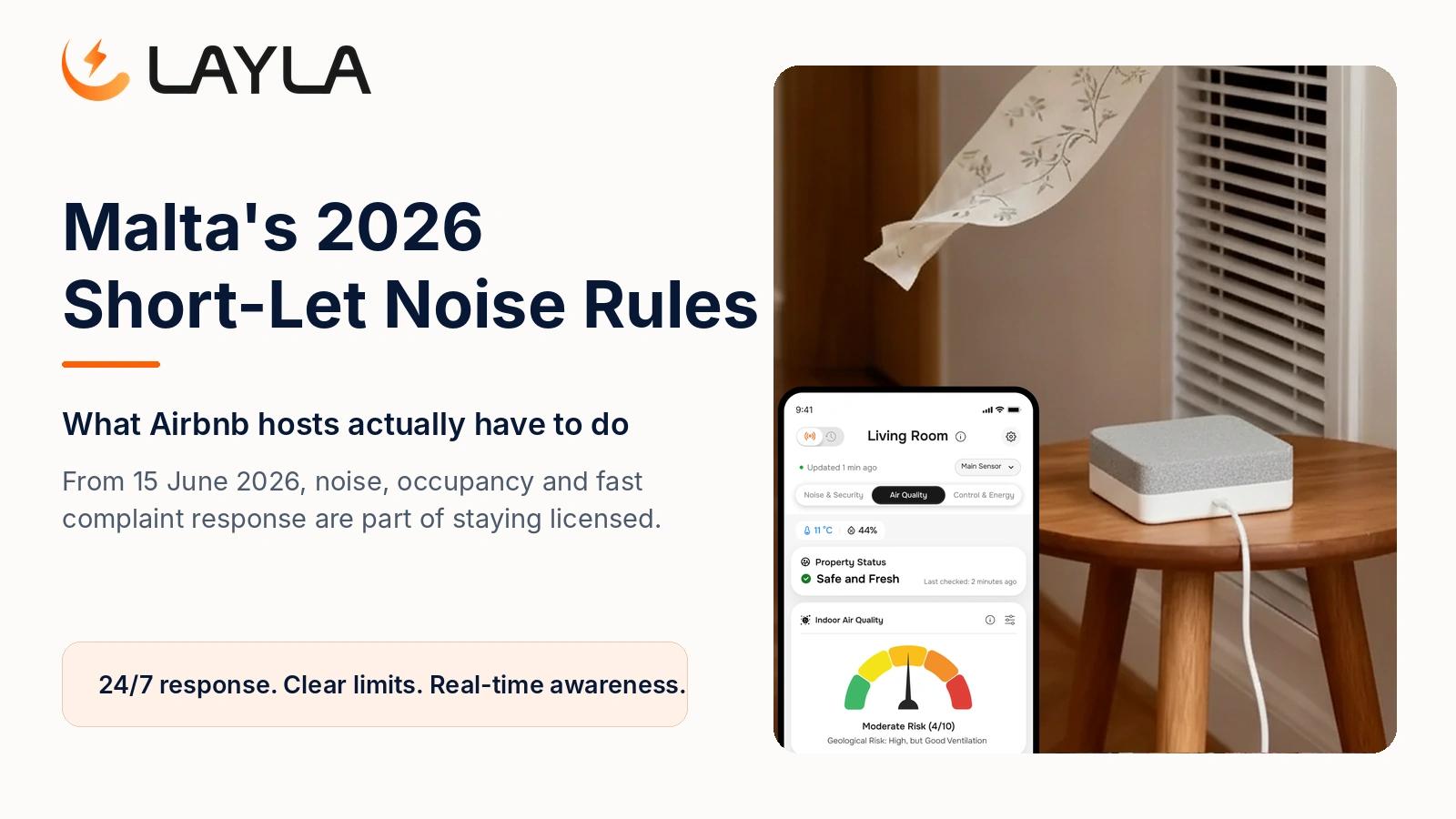
Short version: Since 15 June 2026, Malta's Tourism Accommodation Regulations (S.L. 409.24) treat noise as a licensing issue rather than a matter of manners. If you hold a short-let licence, you now have to keep someone reachable around the clock to deal with complaints, stay inside strict occupancy limits, and steer well clear of noise breaches that can cost you the licence itself. And if you're renting without a licence at all, getting caught bans both you and the property from applying for three years.
If you let out a holiday apartment in Malta or Gozo, the ground shifted this summer. Noise has quietly become one of the quickest ways to lose your licence, and the responsibility for preventing it now sits with you, not the guest who caused it. So it's worth understanding what the new rules actually say, what "quiet hours" means in practice, and how to keep a place under control without babysitting it every night.
What actually changed in June
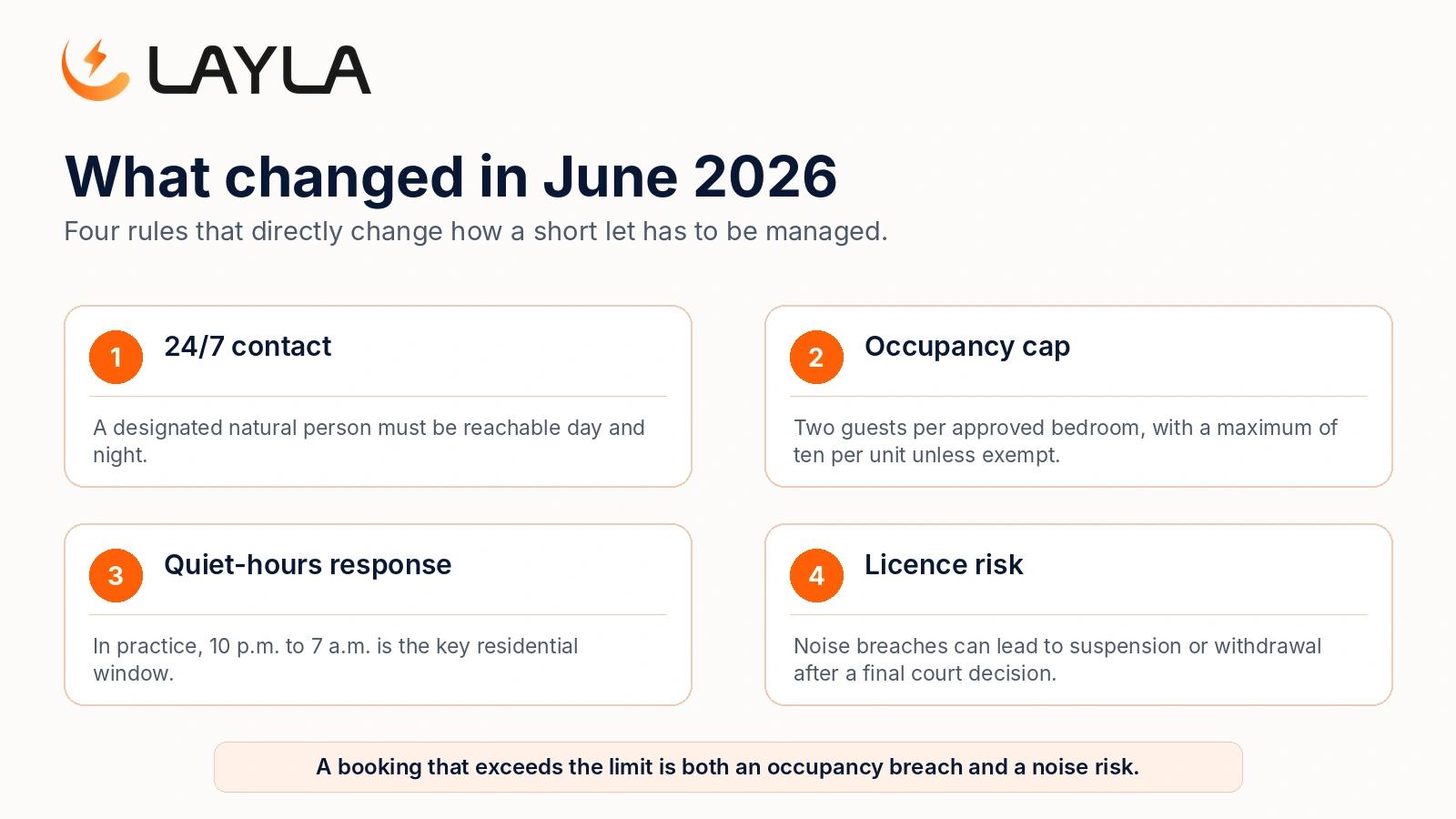
The Tourism Accommodation Regulations 2026 (Subsidiary Legislation 409.24) took effect on 15 June 2026. If you already hold a licence, transitional provisions mean it stays valid for now. But every new application and every renewal from here on has to meet the updated standards.
None of this came out of nowhere. For years, residents in the busier rental districts had been complaining about noise, rubbish and the general churn of strangers coming and going next door. The government's answer wasn't to ban short lets. It was to make hosts carry more of the responsibility, and neighbour relations sit right at the heart of it.
Three parts of the new rules are the ones that'll actually change how you run a place.
Someone has to be reachable, day and night
This is the big one. Every licensed property now has to name a designated natural person available 24 hours a day, 7 days a week, to receive complaints and address problems, and those contact details have to be on file with the Malta Tourism Authority and kept current.
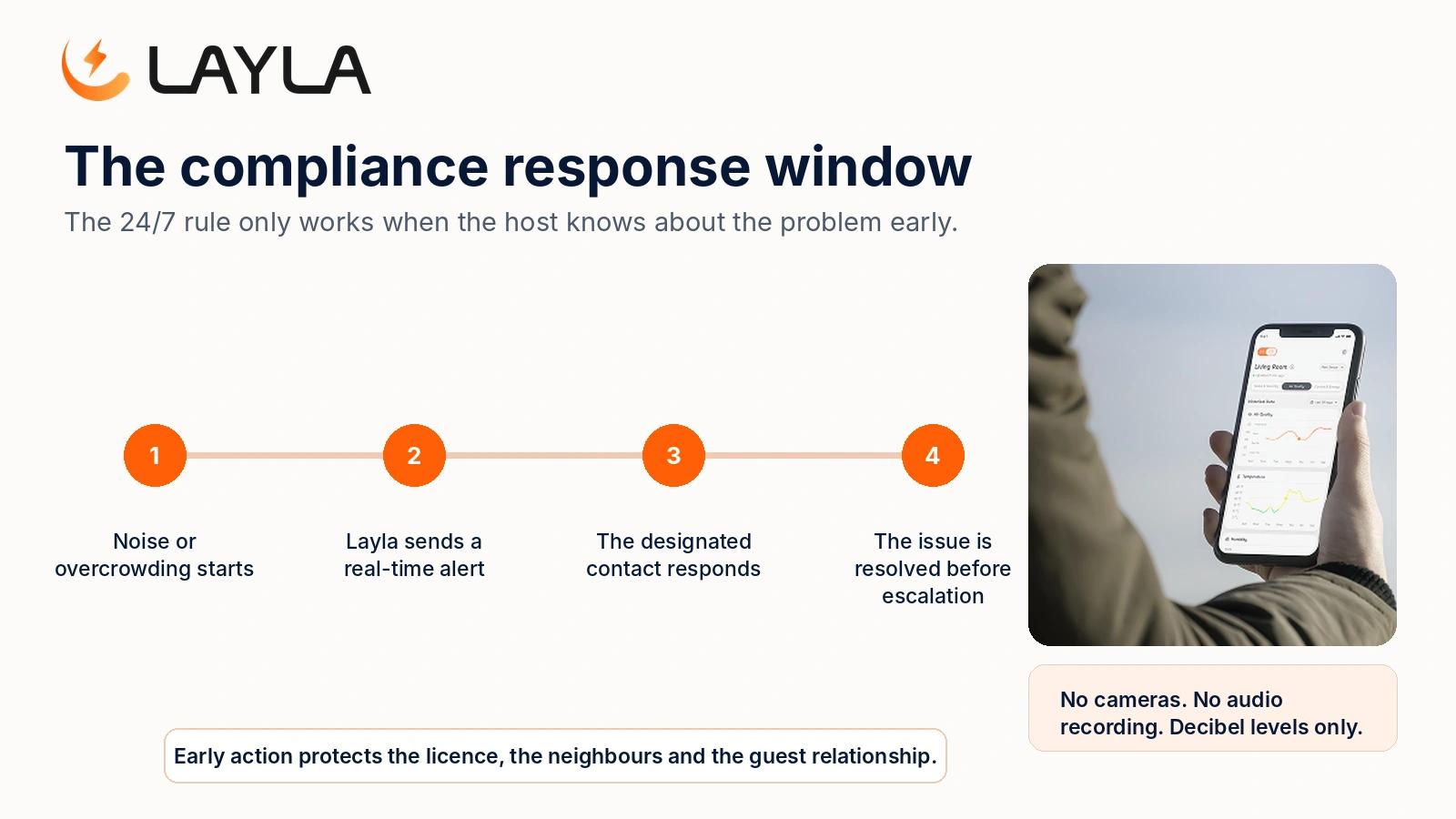
Think about what that means at street level. It's 1 a.m., a guest has the music up, and a neighbour is fed up. Someone connected to your property has to be able to do something about it right then, not at nine the next morning when you finally check your messages. In other words, knowing what's going on inside your rental in real time has stopped being a nice extra and become part of staying licensed. You can't defuse a problem you only hear about after the neighbour has already rung the authorities.
Overcrowding is where the trouble usually starts
A quiet couple rarely gets you a noise complaint. Overcrowding and parties do. The 2026 rules go straight at that with firm caps on how many people can stay:
- Two people per bedroom approved by the Planning Authority
- A maximum of ten people per unit, unless it has independent road access
- No single booking longer than 90 consecutive days
A "booking for four" that quietly becomes fifteen is now two problems at once: a noise risk and a breach of your licence terms. The hosts who stay out of trouble tend to be the ones who notice the extra bodies early, before the party finds its second wind.
Noise can genuinely cost you the licence
The MTA has teeth here. It can suspend or withdraw a licence for breaches relating to noise where that's established by a final court decision. That alone should give any host pause, but it sits next to a much blunter rule for anyone tempted to skip the paperwork entirely.
Operating a short let without a valid MTA licence disqualifies that person from applying for a licence for three years, and the dwelling itself is also ineligible for the same three-year period. Read that twice, because the penalty sticks to the property, not just to you. Sell up or hand it on, and the ban travels with it.
So what counts as quiet hours in Malta?
The regulations set the enforcement machinery. The day-to-day expectation is a bit more familiar. In practice, 10 p.m. to 7 a.m. is the quiet-hours window everyone works to for residential lets, and spelling it out to guests is the bare minimum of what's expected of a host. In the nightlife-heavy spots like St Julian's and St Paul's Bay, there's also a 2019 legal notice that stops loud music being audible to nearby homes after 1 a.m.
Here's the catch worth knowing. In Malta, noise is often handled as a nuisance rather than a clean legal breach, so enforcement can be slow. That works in your favour and against you. One bad night probably won't cost you the licence. But neighbours who feel brushed off don't let it go, and a stack of repeat complaints is exactly the kind of paper trail that eventually does.
Staying on the right side of it
Most of compliance here comes down to two things: heading off trouble, and reacting fast when it starts anyway. A routine that works looks roughly like this:
- Sort your 24/7 contact and file it with the MTA. Make sure whoever it is can genuinely answer at night, not just during office hours.
- Put quiet hours in writing. 10 p.m. to 7 a.m., stated in the booking confirmation, the house rules and somewhere visible in the flat.
- Set the tone at check-in. Guests who know they're in a residential building, and that noise is being kept an eye on, behave differently.
- Keep tabs on how many people are actually there. A booking for four shouldn't turn into a dozen without you knowing.
- Deal with things while they're small. The whole point of the round-the-clock rule is early response, and that only works if you find out a room's getting loud before the neighbour does.
Where a noise monitor actually earns its keep
The rules tell you that you're responsible for noise and that you have to react quickly. They don't tell you how. That gap is where a proper noise monitor pays for itself.
Something like Layla keeps an eye on sound levels inside the place and pings you the moment they cross a line you've set, so you can step in during those quiet hours instead of reading about it in a one-star review. You pick the thresholds, which means a flat wedged into an apartment block and a standalone villa can be tuned completely differently. It works off decibel levels, not recordings, so there's no camera and no audio capture. That matters for guest trust, and it matters legally too. It'll also flag when there are clearly more people inside than the booking allows, which is usually your first hint that a quiet evening is turning into something else.
The problem nobody books for: smoking indoors
Noise gets the headlines, but ask any Maltese host renting to tourists or students and the second complaint is almost always the same. Someone lights up in a non-smoking flat, and you're the one left with the cleaning bill, the smell that ruins the next few reviews, and occasionally a neighbour complaint landing in the same pile as the noise.
The same Layla sensor is built for this too. It's a smart smoke detector that picks up even faint traces and is designed to tell cigarette, vape and marijuana smoke apart. It grades what it finds as low, medium or high and keeps updating as things change, so you're not just told "smoking happened", you can see whether it's one sneaky cigarette by the window or a room slowly filling up. The alerts land in real time, on the first faint trace, which is exactly when you still have a chance to message the guest before the place needs a deep clean. And like the noise side, you set the thresholds you care about.
For student housing and short lets, where the no-smoking rule gets tested constantly, that's the difference between a house rule you can only hope people follow and one you can actually act on.
Worth being straight about one thing, though. Layla's smoke detection is there to catch smoking, not fire. It isn't a life-safety fire alarm, and it doesn't replace the smoke detector, fire extinguisher, fire blanket and gas detector (where applicable) the regulations require in the kitchen. Those are separate safety kit you have to fit regardless. What Layla handles is the behaviour side, the noise and the smoking that quietly eats into your licence, your ratings and your cleaning margin, in real time and without a camera in the room.
Frequently asked questions
When did Malta's new short-let regulations take effect?
The Tourism Accommodation Regulations 2026 (S.L. 409.24) came into force on 15 June 2026. Existing licences stay valid under transitional provisions, but all new applications and renewals have to meet the new standards.
Do I need a licence to run an Airbnb in Malta?
Yes. No property may be advertised or rented for short stays without a valid Holiday Furnished Premises licence from the Malta Tourism Authority. Get caught operating without one and both you and the property are banned from applying for three years.
What are the quiet hours for short-term rentals in Malta?
In practice it's 10 p.m. to 7 a.m. for residential lets. In nightlife districts, a 2019 legal notice also stops loud music being audible to nearby homes after 1 a.m.
Can I really lose my licence over noise complaints?
Yes. The MTA can suspend or withdraw a licence for noise-related breaches where that's established by a final court decision. Repeated, documented complaints are the usual road to it.
How many guests can legally stay in a Maltese short let?
Two people per approved bedroom, up to ten per unit unless the unit has independent road access. No single booking can run longer than 90 consecutive days.
Does a noise monitor record my guests?
No. A privacy-first noise monitor reads decibel levels only. No cameras, no audio recording, so it catches loud events without capturing anything anyone says.
Can a sensor tell if guests are smoking or vaping?
Yes. Layla's smart smoke detection picks up faint traces and is designed to tell cigarette, vape and marijuana smoke apart, grading each event low, medium or high in real time. It's there to flag smoking-policy violations early. It's a behaviour monitor, not a fire alarm, so it doesn't replace the fire smoke detector the regulations require.
Sources
- Malta Tourism Authority — Short-Let Rented Accommodation
- Mamo TCV Advocates — New Tourism Accommodation Regulations (S.L. 409.24): A Guide for Short-Let Property Owners in Malta
- The Shift News — Malta to clamp down on unlicensed Airbnb rentals with three-year ban (Nov 2025)

Best for: full property coverage
All-in-One
Noise monitoring, smoke detection and smart AC control for complete coverage.
Everything included
Everything in Noise & Security Pro
AI party detector, noise alerts, intruder & break-in, occupancy, 180-day history, indoor + outdoor climate
Everything in Smoke & Air Quality
Air quality index (IAQ), CO2, bVOC, mold & smoke — full indoor + outdoor climate
Everything in AC Control & Energy
Smart AC (150+ brands), Eco Mode, schedules, filter health
Plus exclusive
- Advanced reports & insights
- Priority support
- Priority support
No monthly fees. Ever.
One sensor. Full coverage
One sensor. Full coverage.* Layla 3.0 monitors noise, air quality, motion, occupancy, temperature, humidity, pressure, VOCs, CO2, and controls your AC - from a single device on your shelf.
No subscription means no surprise costs.
Pay once. Every feature unlocked. Forever. No monthly fees eating into your rental margins or household budget.
The smartest buy is the one you make once.
Other solutions charge per-feature monthly subscriptions that exceed the device cost within a year. Layla's all-in-one pays for itself compared to any subscription alternative.
30-day money back guarantee