BLOG
Palm Springs Airbnb Rules: Compliance, Fines & More
 By Nangyal Khan··Updated
 8 min read

Palm Springs Vacation Rental Ordinance: 2026 Host Survival Guide
With law enforcement becoming more structured in recent years, short-term rental rules have evolved for hosts in Palm Springs. The City Council adopted Ordinance 2075 on November 28, 2022, strengthening oversight and clarifying expectations for vacation rental operators. Staying compliant helps protect rental income and reduces the risk of fines or permit suspension. This guide explains the key requirements hosts should understand in 2026 to operate confidently and avoid common compliance mistakes.
Is Airbnb Banned in Palm Springs?
No. Airbnb is legal in Palm Springs, and in 2018 voters rejected a proposed ban on rentals in single-family neighbourhoods. The city limits rentals instead of banning them. Under the framework set by Ordinance 2075, once 20% of the homes in an organised neighbourhood already hold a vacation rental certificate, new standard permits go on a waitlist. So the real question is not whether you can host, but whether a permit is available for your street and which type you qualify for.
Which Palm Springs Permit Do You Need?
Palm Springs issues three kinds of vacation rental certificate, and the one you need depends on how you use the home:
- Vacation Rental (standard) covers homes rented while the owner is away. These count toward the 20% neighbourhood cap and are capped at 26 rental contracts a year for permits issued after November 2022. Older permits kept a 36-contract limit in the city's October 2025 vote.
- Homeshare covers owners who live on-site during the stay. It is not subject to the contract cap, which makes it the most flexible option.
- Junior Vacation Rental is a lower-cost permit capped at six contracts a year and exempt from the neighbourhood density cap, aimed at occasional hosts.
Whichever you hold, the certificate number must appear on every listing, and the permit has to be renewed on time to stay valid.
How Fast Must You Respond to a Complaint?
This one catches hosts out. Palm Springs requires a designated local contact who is reachable 24 hours a day, seven days a week, and who can be on-site in person within 30 minutes of a complaint about noise or guest behaviour. A number that rings to voicemail will not cut it. This is where remote noise monitoring pays off, because an early alert lets your contact step in before a neighbour ever calls the city.
Registration Requirements for Hosts
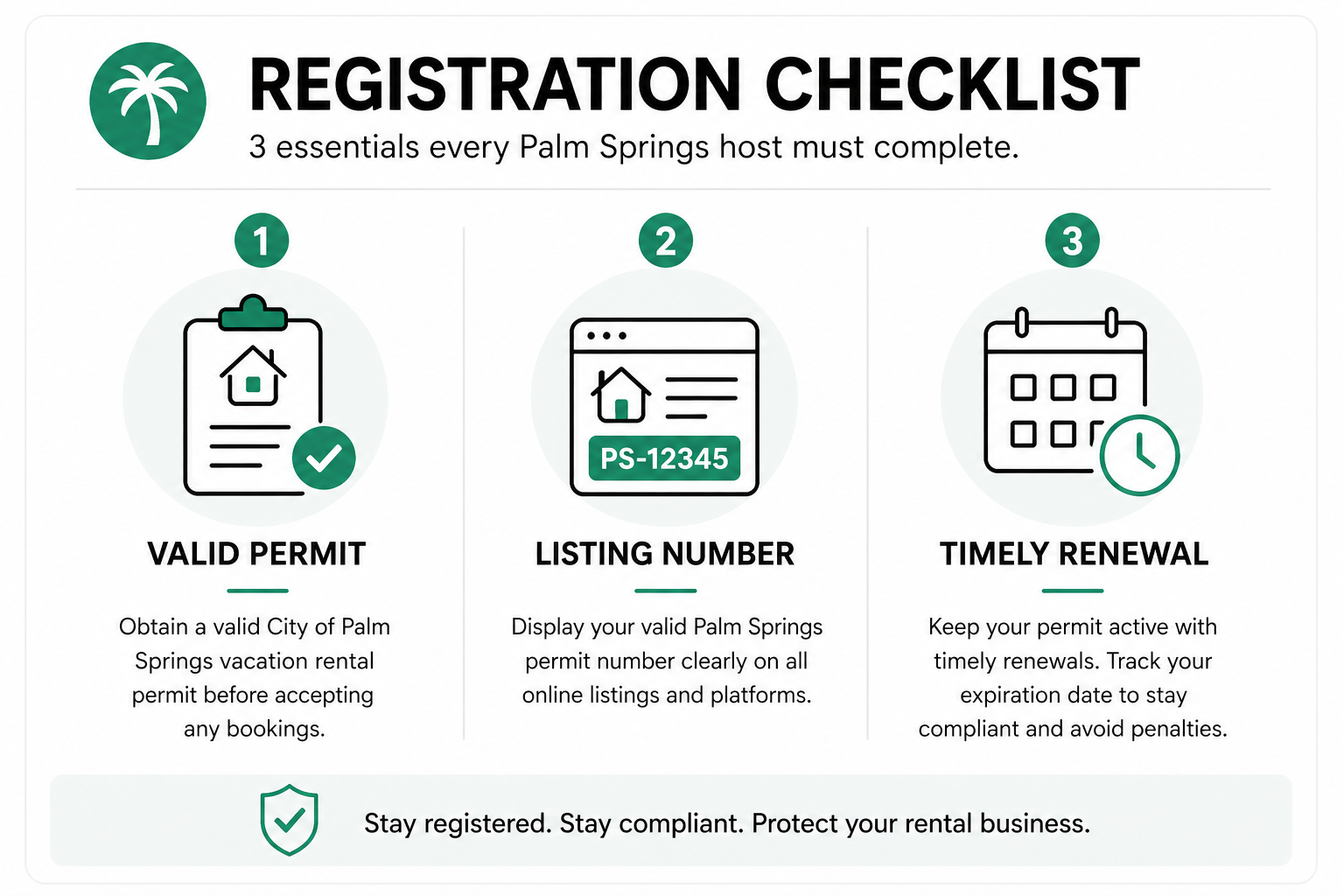
Hosts running short-term rentals in Palm Springs must hold a valid city vacation rental permit before they can accept bookings. The permit is the foundation of staying compliant, and it shows the city that the property meets local operating standards.
The application asks for property details, owner identification and current contact information, including a designated local contact who can respond quickly to complaints or emergencies.
Permits have to be renewed on time, so track your expiration dates carefully, and your permit number has to appear on every listing. Keeping that paperwork current is the simplest way to avoid a compliance slip.
Occupancy Limits and Guest Rules
Occupancy and guest-conduct limits exist to protect neighbourhood character and keep complaints down.
- Overnight occupancy typically follows a bedroom-based formula, often allowing two guests per bedroom plus a limited additional allowance.
- Daytime visitor numbers are capped separately and cannot exceed city-defined thresholds even for short gatherings.
- Parking availability must match guest capacity, with space requirements tied directly to bedroom count.
- Hosts remain responsible for guest behaviour, including noise levels, parking compliance and adherence to quiet-hour expectations.
Noise Monitoring and Quiet Hours
Noise control is one of the most strictly enforced Palm Springs Airbnb rules. Quiet hours are enforced overnight, with limits placed on outdoor gatherings that could disturb neighbouring homes. According to the Palm Springs Vacation Rental Ordinance, late-night use of patios, pools and outdoor spaces is closely monitored, especially in residential zones.
Amplified sound such as speakers, music systems or event-style setups is restricted outside during these hours. Repeated violations can quickly lead to warnings, fines or even permit suspension.
To reduce risk and maintain compliance, some hosts use monitoring and compliance tools like Layla.eco to stay aligned with local expectations.
Safety Compliance Expectations
Safety compliance is a core requirement for every vacation rental. Working smoke detectors are mandatory, along with carbon monoxide alarms where applicable, and exit routes must stay clear. Many hosts add sensor-based monitoring, like Layla, to keep an eye on noise and air quality between stays.
Emergency exit routes must remain clearly accessible at all times and the property must meet basic habitability standards such as sanitation, ventilation and structural safety. Hosts should also keep the property inspection-ready to avoid delays or penalties during city checks.
Taxes Hosts Must Collect
Tax compliance is a core part of running a legal short-term rental in Palm Springs.
- Hosts must collect and remit 11.5% Transient Occupancy Tax (TOT) on rent and applicable fees for stays under 28 days.
- A 1% Tourism Business Improvement District (TBID) assessment also applies to eligible short-term stays.
- In some cases, an additional 9.25% sales tax may apply to total charges depending on how the booking is structured.
- Some booking platforms automatically collect and remit TOT, but this is not consistent across all channels.
- When platforms do not collect taxes, the responsibility falls directly on the host to ensure payment is submitted correctly and on time.
- Accurate record-keeping of bookings, payments, and tax submissions is essential to avoid audits or penalties.
Penalties for Non-Compliance
In Palm Springs, enforcement is strict and penalties escalate quickly. Operating without a valid permit can result in fines of up to $5,000 along with a permanent ban from short-term rental activity. Failure to submit required contract summaries may lead to $2,500 fines and a six-month suspension of the rental permit, according to the Palm Springs short-term rental law.
The city also maintains a high enforcement success rate, with over 98% of citations upheld by the administrative appeals board. This makes it difficult to overturn violations once issued. These measures highlight the importance of full compliance to avoid long-term operational loss.
Frequently Asked Questions
How much does a Palm Springs vacation rental permit cost?
It depends on the permit type. A standard Vacation Rental certificate runs around $1,046 a year, a Homeshare (where you live on-site) is closer to $261, and a Junior Vacation Rental sits in between at roughly half the standard fee. The city updates these amounts periodically, so check the current figure before you apply.
How many nights can I rent out my Palm Springs property?
Palm Springs limits you by rental contracts rather than nights. Permits issued after November 2022 are capped at 26 contracts a year, older permits kept a 36-contract limit after the city's October 2025 vote, and junior permits are capped at six. One contract can cover a multi-night stay, so the cap bites hardest if you take lots of short bookings.
Can I still get a new permit in my neighborhood?
Not always. Once 20% of the homes in an organised neighborhood already hold a certificate, new standard permits go on a waitlist until a spot frees up. Homeshares and junior permits are handled differently, so if your street is capped, those routes may still be open to you.
Do I have to live in the home to rent it out?
No. A standard Vacation Rental permit covers homes rented while you are away. If you do stay on-site during bookings, a Homeshare permit is cheaper and skips the contract cap. Pick the permit that matches how you actually use the home, because operating under the wrong one is a common way to slip out of compliance.
Compliance with the short term rental law in Palm Springs requires consistent attention to registration, occupancy limits and safety standards. With enforcement becoming more active and penalties escalating quickly, even small oversights can lead to costly consequences or permit suspension. Staying compliant is no longer optional for hosts who want long-term stability in the market.
Rules vary sharply from city to city. If you host in other US markets, it is worth reading our guide to short-term rental rules in Miami Beach before you list there.
Managing compliance does not have to be manual. Layla helps hosts simplify operations, stay aligned with local requirements, and catch issues before they become expensive problems. Start smarter and protect your rental business with less effort
In Palm Springs a permit hinges on good-neighbour behaviour, so noise is what really puts a licence at risk. A reliable noise monitor for your vacation rental helps you catch problems early and protect that permit.

Best for: full property coverage
All-in-One
Noise monitoring, smoke detection and smart AC control for complete coverage.
Everything included
Everything in Noise & Security Pro
AI party detector, noise alerts, intruder & break-in, occupancy, 180-day history, indoor + outdoor climate
Everything in Smoke & Air Quality
Air quality index (IAQ), CO2, bVOC, mold & smoke — full indoor + outdoor climate
Everything in AC Control & Energy
Smart AC (150+ brands), Eco Mode, schedules, filter health
Plus exclusive
- Advanced reports & insights
- Priority support
- Priority support
No monthly fees. Ever.
One sensor. Full coverage
One sensor. Full coverage.* Layla 3.0 monitors noise, air quality, motion, occupancy, temperature, humidity, pressure, VOCs, CO2, and controls your AC - from a single device on your shelf.
No subscription means no surprise costs.
Pay once. Every feature unlocked. Forever. No monthly fees eating into your rental margins or household budget.
The smartest buy is the one you make once.
Other solutions charge per-feature monthly subscriptions that exceed the device cost within a year. Layla's all-in-one pays for itself compared to any subscription alternative.
30-day money back guarantee