BLOG
Is Airbnb Legal in NYC? Local Law 18 Guide for Hosts (2026)
 By Nangyal Khan··Updated
 7 min read
According to the NYC Local Law 18, short-term rentals under 30 days are legal in New York City only when the host is physically present during the stay and the listing is registered with the Mayor's Office of Special Enforcement. Unregistered listings face fines up to $5,000 per violation. Stays of 30 days or longer remain unregulated and now make up the majority of NYC's legal short-term rental market in 2026.
Short-term rental rules in New York City have tightened in recent years as officials respond to housing shortages, safety concerns, and the rapid growth of online booking platforms. NYC Local Law 18 of 2022 is a regulation that reshaped the short-term rental landscape by introducing strict registration, verification and hosting requirements. For many hosts, this law has determined whether they can continue operating at all, making it one of the most impactful policies in the city's rental ecosystem.
Is Airbnb Legal in NYC?
Yes, Airbnb is legal in New York City, but its operation is heavily restricted under NYC Local Law 18. Hosts can legally list short-term rentals only if they register with the New York City Mayor's Office of Special Enforcement and live in the property as their primary residence. Entire-apartment rentals for less than 30 days are generally prohibited. This means that Airbnb remains legal in NYC only if they abide by the limitations set by NYC Local Law 18.
NYC Local Law 18 Explained
NYC Local Law 18 of 2022, also known as the Short-Term Rental Registration Law, is a strict regulatory framework introduced in New York City to control home-sharing activity and limit illegal short-term rentals. Its core purpose is to protect long-term housing supply, improve and guest safety. The law also brought transparency to a market that had grown rapidly through online platforms.
The law officially took effect on September 5, 2023, marking the start of active enforcement. From that point, hosts could no longer legally operate short-term rentals without meeting the new requirements.
A central part of the system is oversight by the New York City Mayor's Office of Special Enforcement. This office manages host registrations, verifies compliance, and enforces penalties for violations. Hosts must register with the OSE and receive approval before listing their property.
Key Requirements Under NYC Local Law 18
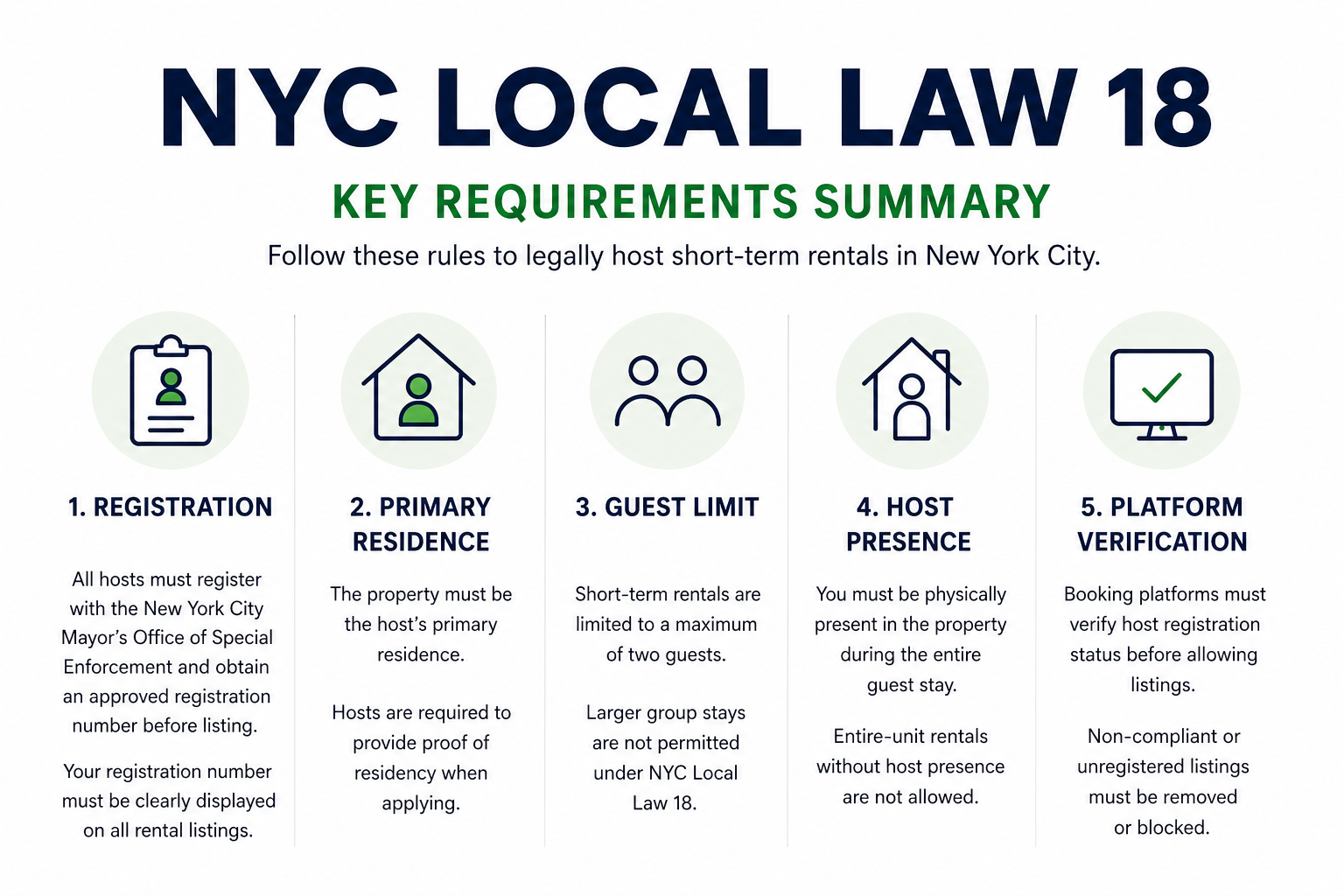
NYC Local Law 18 introduces strict conditions that every host in New York City must follow to legally operate short-term rentals. These rules are designed to ensure transparency, safety, and compliance across all listings.
Mandatory Registration
- All hosts must register with the New York City Mayor's Office of Special Enforcement
- Approved registration number must be obtained before listing
- Registration number must be clearly displayed on all rental listings
Primary Residence Rule
- The property must be the host's primary residence
- Hosts are required to provide proof of residency when applying
Guest Limits
- Short-term rentals are limited to a maximum of two guests
- Larger group stays are not permitted under NYC Local Law 18
Host Presence Requirement
- Hosts must remain physically present in the property during guest stays
- Entire-unit rentals without host presence are not allowed
Platform Verification Rules
- Booking platforms must verify host registration status before allowing listings
- Non-compliant or unregistered listings must be removed or blocked
These requirements form the core structure of NYC Local Law 18 and define what is legally permitted for short-term rental activity in the city.
Penalties for Non-Compliance
As of March 2026, enforcement under NYC Local Law 18 has become stricter. The authorities are actively targeting illegal short-term rentals across New York City. Hosts who fail to comply face steep financial and legal consequences.
- Maximum fines can reach $5,000 per violation, making unregistered rentals a costly risk.
- Recent enforcement actions show the city is increasing pressure on illegal operators. In March 2026, the Department of Buildings announced nearly $400,000 in fines tied to illegal rental activity.
- One Queens property owner was fined $307,500 for unlawfully converting a two-family home into five units.
- A Manhattan property owner was also fined $74,000 for violations linked to illegal rental use.
- Listings found violating NYC Local Law 18 can be removed or permanently blocked by booking platforms.
These enforcement trends show that NYC Local Law 18 is no longer just about registration compliance; it is now backed by aggressive penalties and active investigations.
How Platforms Responded to Local Law 18
Major booking platforms like Airbnb and Vrbo quickly adapted to NYC Local Law 18 by integrating the city's verification system into their booking process. Before a listing can accept reservations, the platform must confirm that the host has a valid registration issued by the New York City Mayor's Office of Special Enforcement.
Since enforcement began, both Airbnb and Vrbo have either removed or blocked thousands of non-compliant listings. These measures have been taken to significantly reduce illegal short-term rental activity.
How Tools Like Layla Help Hosts Stay Compliant
Staying compliant with NYC short-term rental registration rules requires more than paperwork. Tools like Layla.eco help hosts stay organised by simplifying property oversight and reducing operational risks. From monitoring property conditions to improving guest comfort, smart automation can support smoother day-to-day hosting.
With features like automatic climate control, real-time home environment monitoring and instant alerts for maintenance issues in one app, Layla gives hosts better visibility and faster response times. All this makes it easier to effortlessly manage short-term rentals in New York City.
FAQs
Is Airbnb legal in NYC?
Yes, New York City allows Airbnb rentals. Moreover, stays under 30 days are only legal if the host is present and the listing is properly registered under Local Law 18.
What is NYC Local Law 18?
NYC Local Law 18 of 2022 is a short-term rental regulation that requires hosts to register their listings and be physically present for stays under 30 days.
How many guests can stay in a NYC short-term rental?
According to New York City Local Law 18, a host can have no more than two guests staying at the same time in a short-term rental.
How do I register my NYC short-term rental?
To register a short-term rental in New York City, submit your application through the Mayor’s Office of Special Enforcement (OSE) registration portal. The prospective host must get an approved registration number before listing.
What are the penalties for violating Local Law 18?
Violating New York City Local Law 18 can result in fines of up to $5,000 per violation, listing removal, revoked registration and legal action. The city may also impose penalties equal to three times the illegal revenue collected, ensuring unregistered short-term rental operations are not financially viable.
NYC Local Law 18 has reshaped short-term rentals in New York City, but hosting is still possible for those who meet the legal requirements. Hosted stays, primary-residence rentals and bookings over 30 days are viable options. A compliance-first approach is essential to avoid fines, listing removals and legal risk. As enforcement continues to tighten, staying informed and operationally prepared will be key for long-term success.
Stay ahead of NYC short-term rental regulations with Layla →
Short-term rental rules vary sharply from city to city. For other tightly regulated US markets, see our guides to short-term rentals in Miami Beach and vacation rental rules in Palm Springs.
Even fully registered, the fastest way to lose an NYC listing is a neighbour noise complaint. A dependable noise monitor for your Airbnb flags parties before they escalate, so you stay compliant and off the city's radar.

Best for: full property coverage
All-in-One
Noise monitoring, smoke detection and smart AC control for complete coverage.
Everything included
Everything in Noise & Security Pro
AI party detector, noise alerts, intruder & break-in, occupancy, 180-day history, indoor + outdoor climate
Everything in Smoke & Air Quality
Air quality index (IAQ), CO2, bVOC, mold & smoke — full indoor + outdoor climate
Everything in AC Control & Energy
Smart AC (150+ brands), Eco Mode, schedules, filter health
Plus exclusive
- Advanced reports & insights
- Priority support
- Priority support
No monthly fees. Ever.
One sensor. Full coverage
One sensor. Full coverage.* Layla 3.0 monitors noise, air quality, motion, occupancy, temperature, humidity, pressure, VOCs, CO2, and controls your AC - from a single device on your shelf.
No subscription means no surprise costs.
Pay once. Every feature unlocked. Forever. No monthly fees eating into your rental margins or household budget.
The smartest buy is the one you make once.
Other solutions charge per-feature monthly subscriptions that exceed the device cost within a year. Layla's all-in-one pays for itself compared to any subscription alternative.
30-day money back guarantee