BLOG
Miami Beach STR Rules & Fines: The Host's 2026 Cheat Sheet
 By Nangyal Khan··Updated
 7 min read
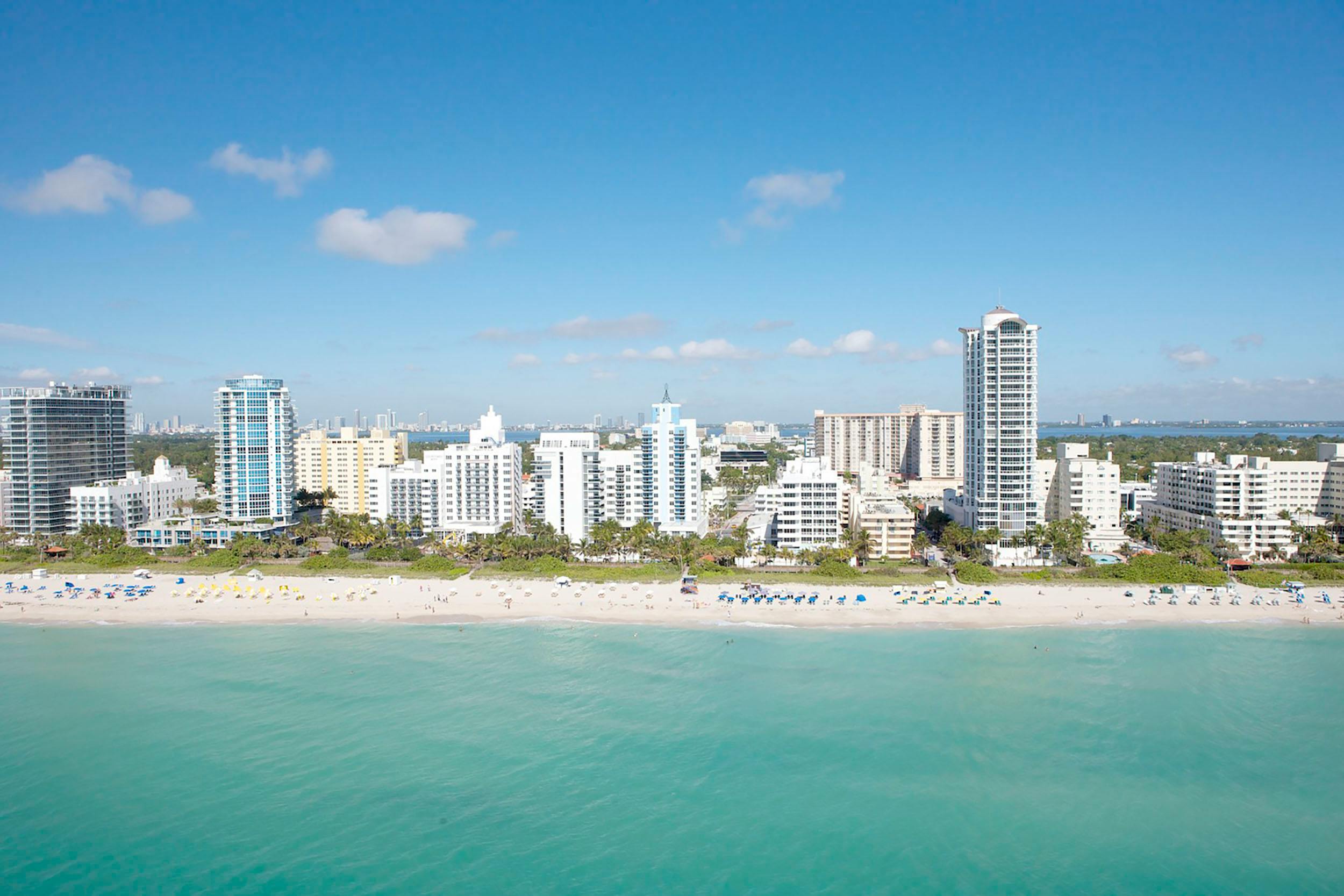
Miami Beach remains one of the most tightly regulated short-term rental markets in Florida, with strict zoning laws, licensing requirements and aggressive enforcement against illegal listings. For hosts, understanding these rules before listing is essential to avoid costly mistakes. Operating in the wrong zone, missing permits or failing tax obligations can trigger significant Miami Beach Airbnb fines, along with potential legal action and listing disruptions. Staying compliant is key to protecting rental income and avoiding costly penalties.
Are Short-Term Rentals Legal in Miami Beach?
Short-term rentals are legal in Miami Beach, but only in specific zoning districts where transient occupancy is permitted. In practice, many residential neighbourhoods prohibit rentals shorter than six months and one day, which makes zoning one of the most important compliance factors for hosts. Florida lets cities set their own rules, and Miami Beach uses that power to impose stricter licensing and operational requirements than most of the state.
Where STRs Are Allowed in Miami Beach
Short-term rentals in Miami Beach are not allowed citywide and are heavily restricted by zoning. In most cases, STRs are limited to designated commercial or high-density residential districts where transient occupancy is legally permitted. Hosts must confirm zoning eligibility and obtain a local Certificate of Use before operating.
Commercial Zoning Districts
Many STR-friendly properties are located in commercial zones where hotel-style and transient lodging operations are permitted.
RM-3 High-Intensity Residential Zones
Certain high-density residential areas, including parts of South Beach, may allow short-term rentals under specific building and zoning conditions.
Approved Condo-Hotels
Some condo-hotels are legally structured for daily, weekly or monthly rentals, provided the building permits transient occupancy.
Designated Resort and Mixed-use Districts
Select resort-oriented and mixed-use areas may permit STR activity, depending on local land-use regulations and licensing approval.
Before listing, hosts should verify their property’s zoning designation and secure a valid Certificate of Use to avoid violations and fines.
How to Check If Your Address Allows Short-Term Rentals
Because eligibility comes down to the exact zoning of a single property, never assume. Check the address itself. Miami Beach publishes an official short-term rental zoning map and a list of buildings approved for transient use, and that map is the only reliable way to know whether your block qualifies. Two properties on the same street can fall on opposite sides of the line.
Once the address checks out, Miami Beach also requires your Business Tax Receipt and Resort Tax numbers to appear in every listing, so guests and inspectors can see the property is registered. Advertising without them is one of the most common and most avoidable violations.
Miami Beach STR Registration Requirements
To operate legally in Miami Beach, hosts must complete several registration steps before listing a property. The city enforces strict compliance through licensing, zoning checks and tax registration to ensure all short-term rentals meet local standards. Securing a valid Miami Beach STR license is mandatory, along with proof that the property is legally eligible for transient use.
- Obtain official approval from the city before hosting short-term stays.
- Register for a Business Tax Receipt, which every STR operator is required to hold.
- Confirm the property is located in a zone where STRs are permitted.
- Submit legal documents confirming property ownership and location.
- A responsible local contact must be available for emergencies or complaints.
- Meet fire and building codes, including smoke detectors, safe exits and occupancy rules.
- Register with the Florida Department of Revenue and Miami-Dade County for tourist and sales taxes.
- Many buildings restrict or fully ban short-term rentals, so written permission is often required.
Safety and Property Compliance Checklist
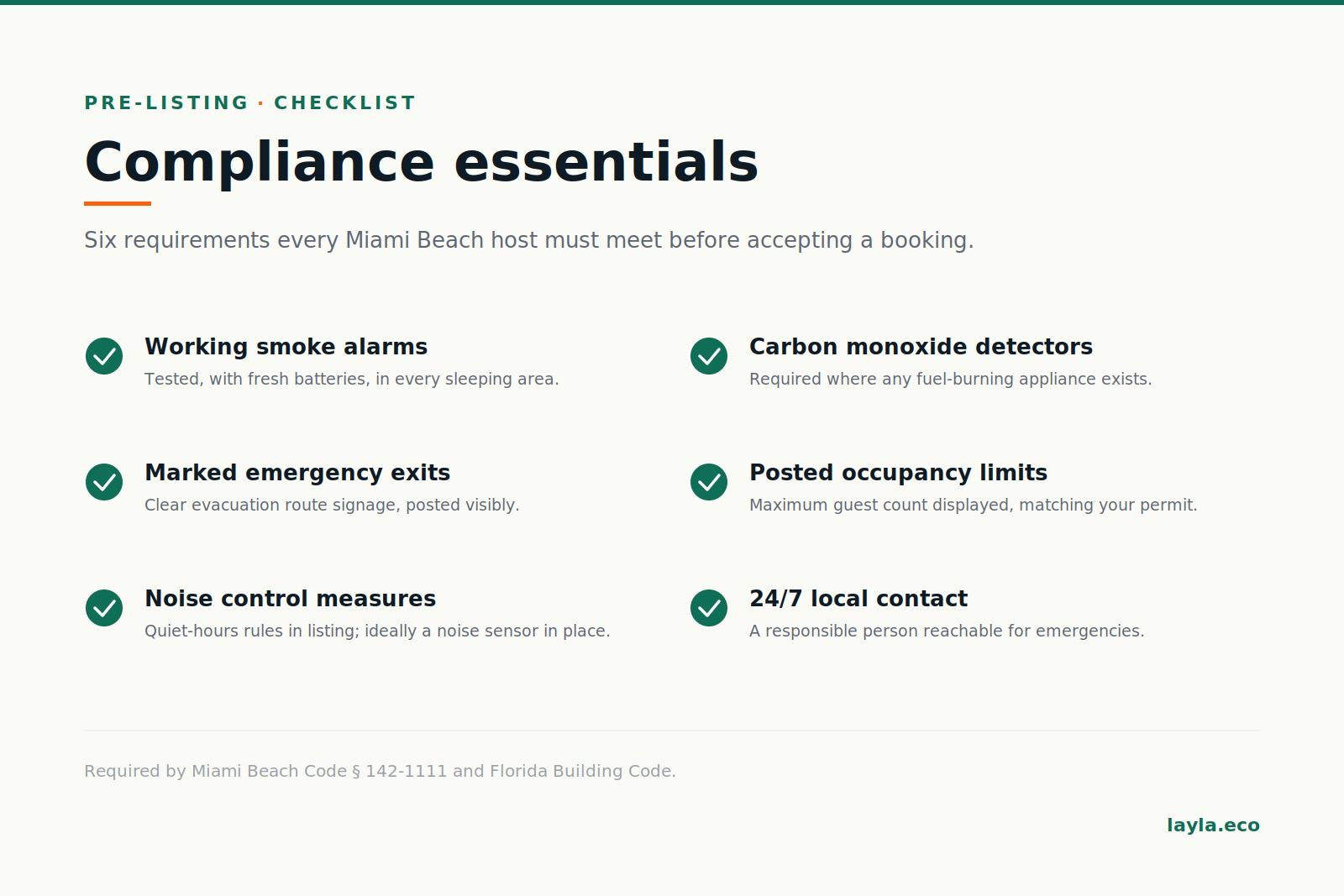
Safety and property compliance are enforced year-round in Miami Beach. During peak periods like spring break, inspections and enforcement ramp up as visitor numbers surge, so it pays to be ready before the busy season arrives.
Hosts must ensure working smoke alarms and carbon monoxide detectors are installed, along with clearly marked emergency exits and evacuation instructions for guests. Properties must follow occupancy limits and may face safety inspections to confirm compliance with building codes.
Noise control matters too, with strict nuisance rules aimed at cutting complaints during busy periods. Many hosts use monitoring tools like Layla to catch noise and air-quality issues early and stay on the right side of the rules year-round.
Tax Rules for Miami Beach Hosts
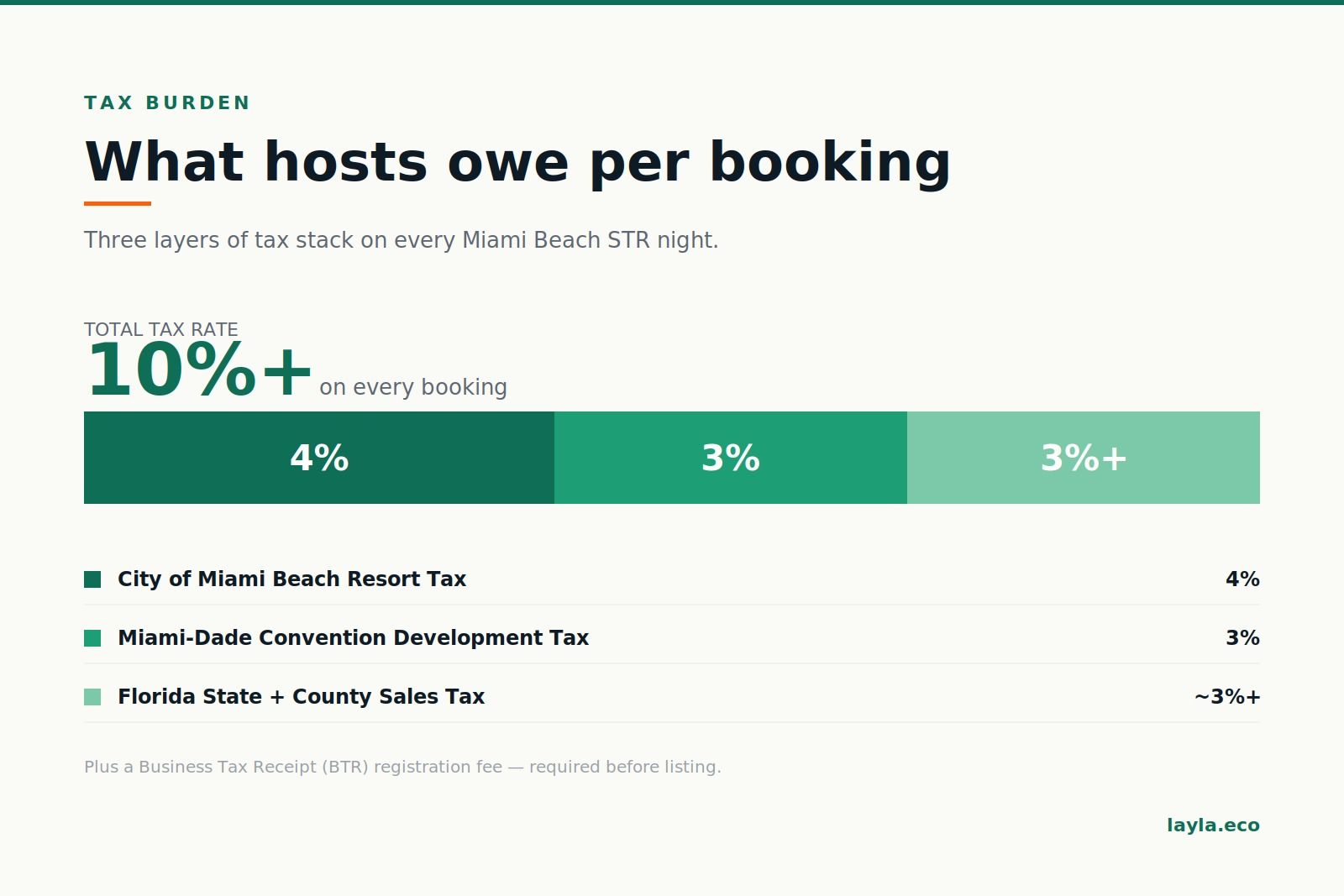
Hosts in Miami Beach face strict tax requirements. Operating legally means holding a Business Tax Receipt (BTR) and collecting a 4% city Resort Tax on rental income, plus a 3% Miami-Dade County Convention Development Tax. Once state-level taxes are added, the total burden often tops 10%.
Miami Beach STR Fines and Penalties
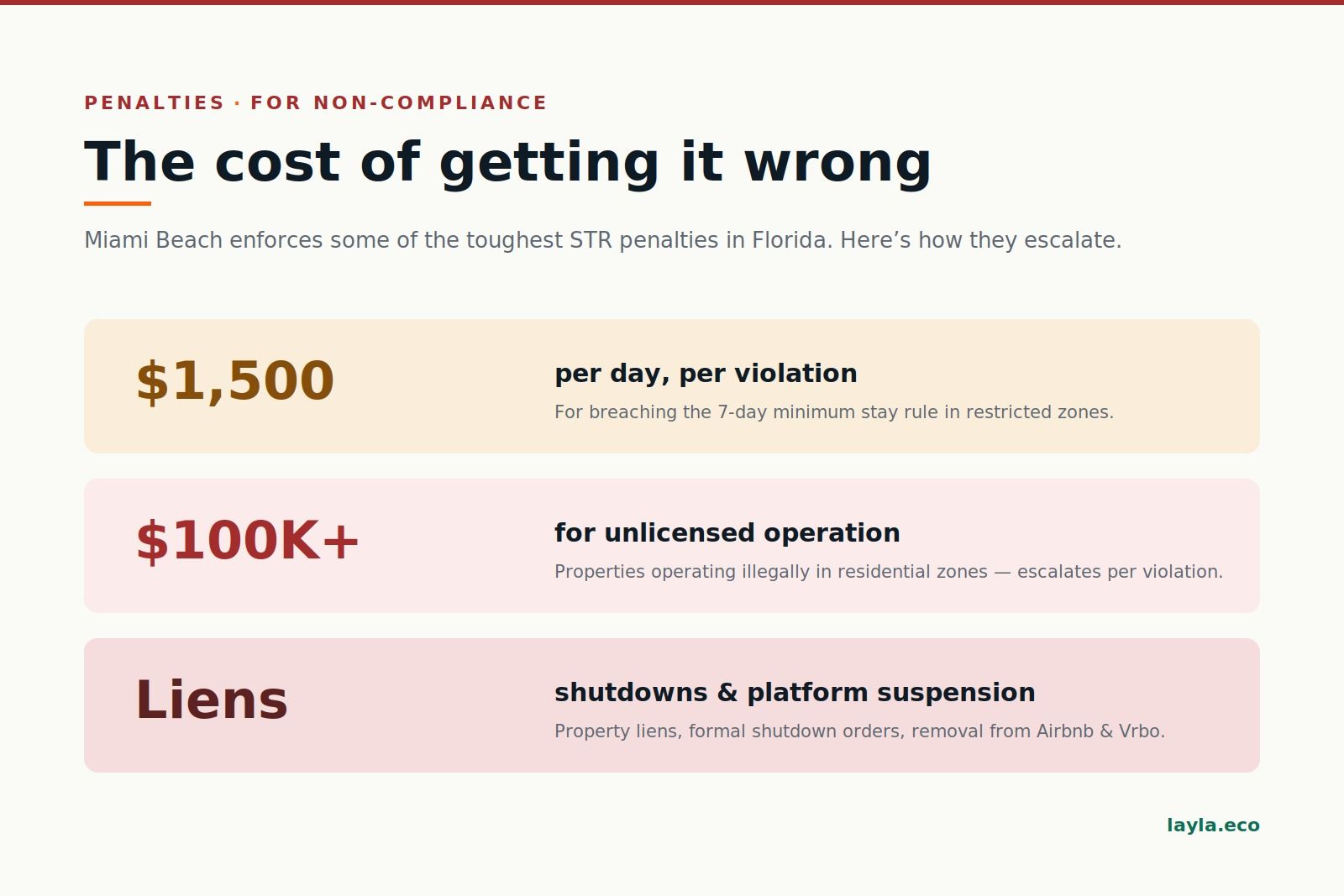
Miami Beach runs some of the toughest short-term rental enforcement in Florida. Renting below the legal minimum term in a restricted residential zone, or operating without the right approvals, can trigger daily fines that escalate quickly.
The city once advertised penalties of $20,000 for a first offense rising to $100,000 for repeat violations, but Florida's Third District Court of Appeal ruled those amounts unlawful in 2020. Under state law, municipal fines are capped at $1,000 per day for a first violation and $5,000 per day for repeats. The zoning restrictions themselves still stand, and enforcement can include liens, shutdown orders and removal from booking platforms. Because the penalty amounts have been in flux, confirm the current figures with Miami Beach Code Compliance before you list.
To avoid these costly penalties, hosts must maintain a valid business tax receipt and complete all required local STR registrations before accepting guests.
Frequently Asked Questions
Can you Airbnb a house in Miami Beach?
In most cases, no. Short-term rentals are prohibited in single-family homes and across most low-density residential zones, where the minimum stay is six months and one day. Whole-home short lets are generally only legal in specific higher-density and commercial districts, and only in buildings the city has approved for transient use.
What is the minimum rental period in Miami Beach?
In the restricted residential zones it is six months and one day, so anything shorter counts as an illegal short-term rental. In the districts where short stays are allowed, the property still needs the right licences and registrations before you can list it.
How much are the fines for an illegal short-term rental in Miami Beach?
The city once advertised $20,000 for a first offense rising to $100,000, but a Florida appeals court struck those amounts down in 2020 because state law caps municipal fines at $1,000 a day for a first violation and $5,000 a day for repeats. The zoning rules still stand and enforcement is aggressive, so confirm the current penalty amounts with Miami Beach Code Compliance before you list.
Do I need a licence to run an Airbnb in Miami Beach?
Yes. Legal hosts need a Certificate of Use, a Business Tax Receipt, and a Resort Tax account, and both the Business Tax Receipt and Resort Tax numbers must appear in every listing. Leaving those numbers off is one of the most common violations the city cites.
Compliance in Miami Beach takes more than just publishing a listing. From zoning limits to tax obligations and aggressive enforcement, staying informed is what keeps hosts out of costly trouble.
Regulations differ dramatically by city. If you also host on the West Coast, see our guide to Palm Springs vacation rental rules.
A proactive approach helps hosts stay operational and stress-free in one of Florida’s most regulated STR markets. For instance, go all-in with full automation, AI insights and lifetime access with Layla to improve efficiency and protect your property year-round.
Miami Beach enforces its noise limits aggressively, and a single late-night complaint can mean a fine. A good noise monitor for your rental warns you before things get loud enough to draw attention.

Best for: full property coverage
All-in-One
Noise monitoring, smoke detection and smart AC control for complete coverage.
Everything included
Everything in Noise & Security Pro
AI party detector, noise alerts, intruder & break-in, occupancy, 180-day history, indoor + outdoor climate
Everything in Smoke & Air Quality
Air quality index (IAQ), CO2, bVOC, mold & smoke — full indoor + outdoor climate
Everything in AC Control & Energy
Smart AC (150+ brands), Eco Mode, schedules, filter health
Plus exclusive
- Advanced reports & insights
- Priority support
- Priority support
No monthly fees. Ever.
One sensor. Full coverage
One sensor. Full coverage.* Layla 3.0 monitors noise, air quality, motion, occupancy, temperature, humidity, pressure, VOCs, CO2, and controls your AC - from a single device on your shelf.
No subscription means no surprise costs.
Pay once. Every feature unlocked. Forever. No monthly fees eating into your rental margins or household budget.
The smartest buy is the one you make once.
Other solutions charge per-feature monthly subscriptions that exceed the device cost within a year. Layla's all-in-one pays for itself compared to any subscription alternative.
30-day money back guarantee