BLOG
Vacation rental house rules: a copy-paste template, and how to make each rule stick
 By Nangyal Khan··Updated
11 min read
Last updated: October 28, 2026
Good vacation rental house rules are short and easy to check. On Airbnb that now means two lists. The first is the standard rules you switch on: quiet hours as clock times, "Smoking, vaping, and e-cigarettes", maximum overnight guests, events, pets and lock up at checkout. The second is a few reasonable requests, such as daytime visitors and small check-out tasks. The template below gives you both, ready to set up in your listing. Airbnb launched the seven standard rules on October 20, 2026, and the policy behind them takes effect November 20, 2026 (Airbnb, October 20, 2026, checked October 28, 2026).
House rules are the conditions a guest agrees to follow for the length of the stay. On Airbnb they sit in the listing's "House rules and requests" section, visible to anyone who views the listing, and confirmed guests see them again in their booking terms and automated emails (Airbnb help article 472, checked October 28, 2026). A vague rule doesn't protect you, and neither does one buried where guests never look. A rule with a number in it does.
The template (copy and paste)
Swap the bracketed parts for your own details. On Airbnb, switch on the standard rules in the listing editor, then add the requests in the same section, choosing "During the stay" or "Before checkout" for each (help article 472, checked October 28, 2026). Guests are required to follow the rules and only encouraged to follow the requests. On other platforms and in a direct-booking rental agreement, both lists work as written.
Standard rules to switch on in Airbnb
- Quiet hours: [10 p.m.] to [8 a.m.]
- Smoking, vaping, and e-cigarettes: not allowed
- Maximum overnight guests: [4]
- Events: not allowed
- Pets: [not allowed / allowed]
- Lock up at checkout: on
- Commercial photography and filming: [not allowed]
Requests to add (reasonable, optional for guests)
- During the stay: Please keep music and voices low enough that they can't be heard outside the home, and keep outdoor areas quiet after [10 p.m.].
- During the stay: Daytime visitors are welcome, [up to 2, leaving by 9 p.m.]. Please ask before inviting anyone.
- During the stay: [If pets are allowed:] Please keep pets off beds and sofas, and don't leave them alone in the home.
- Before checkout: Please put used dishes in the sink, gather used towels, separate trash and recycling into the indoor bins and turn off the air conditioning.
This home has a sensor in the [living room] that measures noise levels, air quality and how many people are present. It has no camera and records no audio or video.
That last line is neither a rule nor a request. It's your device disclosure, and it belongs in the listing anyway (more on that in what Airbnb allows for monitoring sensors).
How to word each rule so it holds
The test for every line is simple: could you show someone, with a time and a number, that it was broken? If not, rewrite it.
| Topic | Vague (hard to enforce) | Specific (holds up) |
|---|---|---|
| Quiet hours | "Please be respectful of neighbors" | Rule: quiet hours 10 p.m. to 8 a.m. |
| Smoking | "No smoking" | Rule: "Smoking, vaping, and e-cigarettes" not allowed |
| Guests | "No extra guests" | Rule: maximum overnight guests 4 |
| Parties | "No wild parties" | Rule: events not allowed |
| Pets | "Pet friendly" | Rule: pets allowed; request: not left alone in the home |
| Check-out | "Leave the place tidy" | Rule: lock up at checkout; request: dishes in the sink, towels gathered, AC off |
Quiet hours
Pick a window and write the times. Check your local rules first, because some cities set their own. Sebastopol, California, for example, sets 10 p.m. to 7 a.m. (city vacation rental form, checked October 28, 2026). Then make sure the window means something on the night. A noise sensor with quiet hours set applies a stricter overnight limit automatically, so the same volume that's fine at 8 p.m. sends you an alert at midnight. That's the quiet-hours enforcement in Noise & Security Pro, $179 once, which measures sound as a decibel level and never records audio. Our guide to quiet hours for vacation rentals covers how to choose the window and the limits.
Smoking and vaping
Let the standard rule do the work. It's called "Smoking, vaping, and e-cigarettes" (help article 472), so vaping is in the name, and Airbnb's own guidance treats a no-smoking rule as covering tobacco, cannabis and e-cigarettes (help article 2894). That leaves no room to argue that vaping was different. If you allow smoking outside, add a request saying exactly where, so a balcony doesn't turn into the smoking room.
Want to know when it's broken? Smoke & Air Quality, $99 once, detects cigarette, vape and cannabis smoke and tells you which it was. More in how to detect vaping in a rental without cameras.
Occupancy and visitors
Use the number the home actually sleeps, not the number you'd tolerate. Airbnb's standard rule is maximum overnight guests, and it asks guests to respect "the approved number of overnight guests." Daytime visitors are a separate question, and Airbnb lists limiting them as an example of a request. Guests are encouraged rather than required to follow it, so a visitor limit doesn't carry the fee-free cancellation the overnight maximum does. A blanket "no visitors" is easy to state but hard to defend for a week-long family stay, so consider allowing a small number with an end time.
Parties and events
Set the events rule to not allowed. Airbnb bans disruptive gatherings on every listing anyway, but your own rule removes any argument about what counts. If you do allow small events, such as a birthday dinner, add a request with a headcount and an end time. How hosts catch the gatherings that happen anyway is covered in how to stop parties in your Airbnb without cameras.
Pets
Set the standard pets rule, then add details such as size or keeping pets off the furniture as requests. On Airbnb, "except in limited circumstances, hosts are required to accept Service Animals even if they don't accept pets" (help article 2166), so a rule that seems to refuse them only causes trouble.
Check-out
Lock up at checkout is the standard rule. Everything else before departure is a request, and Airbnb's new policy gives examples of what's reasonable: guests can be asked to put used dishes in the sink, gather used towels, separate trash and recycling into indoor bins and turn off the AC when they leave. It says guests shouldn't be asked to wash and put away dishes, strip the beds, start laundry or take garbage off-site, because "most guests want to avoid unexpected chores." Keep your list on the right side of that line.
Where your rules have to appear
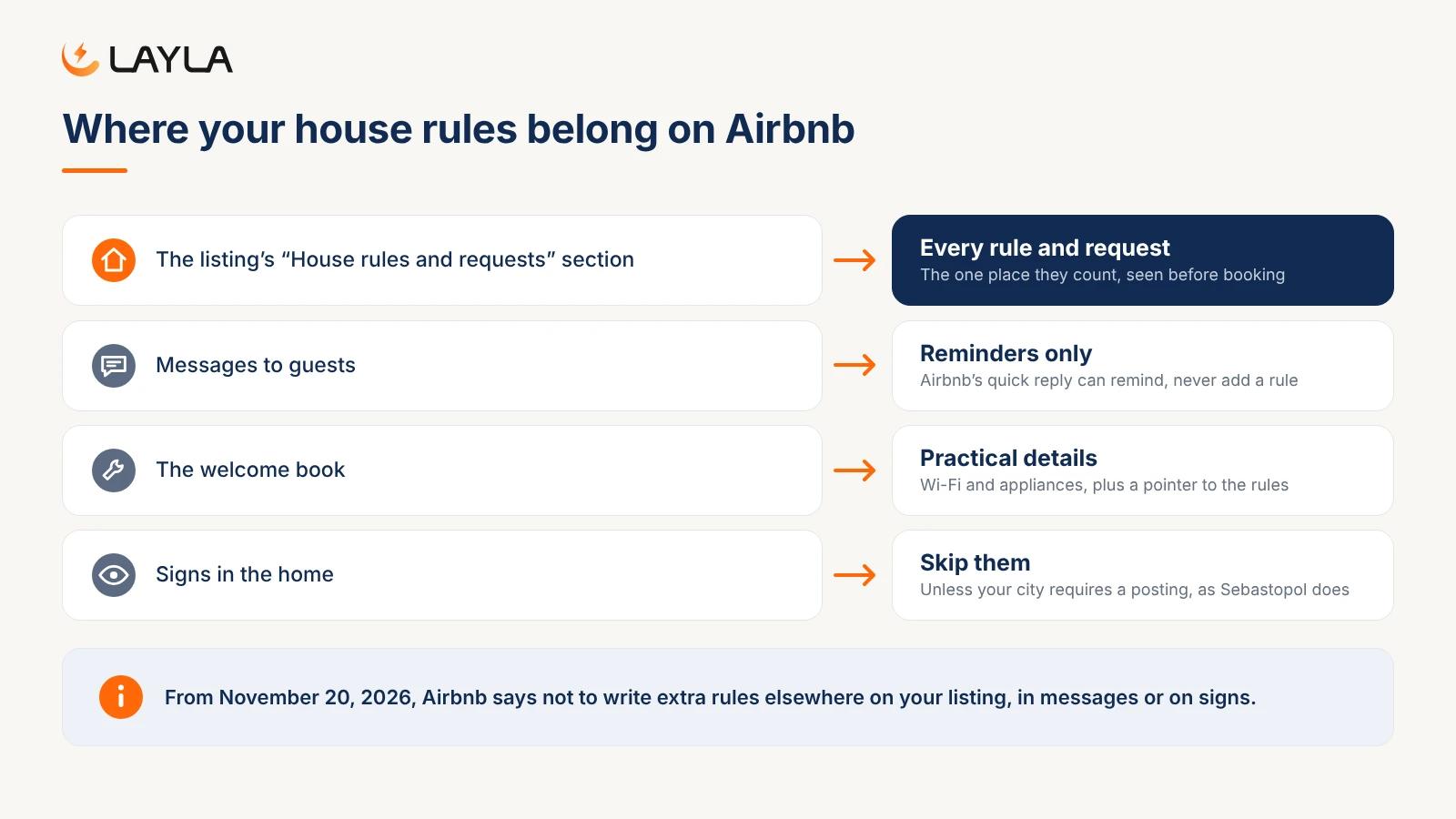
In the listing, and nowhere else. This is where house rules for Airbnb guests become part of the booking. Rules and requests both go in the listing's "House rules and requests" section. Under the policy that takes effect November 20, 2026, Airbnb says: "You shouldn't write additional rules elsewhere on your listing, in messages, or on signs in your home." Requests that don't meet its standard are flagged in the listing editor. Local rules, such as HOA or city fines, have their own place on the listing, and contracts go in its Contracts section rather than in requests (help article 472). Airbnb "doesn't help enforce, or require guests to sign, your contracts." On other platforms and for direct bookings, put the same text in the listing and your rental agreement.
In messages, as a reminder only. A message can remind guests of a rule that's already in the listing, and Airbnb now offers your house rules as a quick reply for that. It can't add a new one.
In the welcome book, as a pointer. Airbnb describes the house manual as the place for day-to-day details, "like how to turn on the hot water heater, or where to find an extra blanket" (help article 1255). Keep it to that, plus one line sending guests back to the house rules in their booking, without restating or adding to them.
Not on signs. Airbnb asks hosts not to put rules on signs, so skip the card by the door. The exception is a city that requires something posted inside. Sebastopol requires the permit and its standards to be posted in the property, and where a rule like that applies, post exactly what the city asks for.
How each rule is actually enforced
A rule you can't check is only a suggestion. The table shows how hosts find out a rule was broken, and what they do next.
| Rule or request | How you find out | What you do |
|---|---|---|
| Quiet hours | Noise alert during the quiet-hours window, with level and duration | Message the guest with the reading and a deadline |
| Smoking and vaping | Smoke alert naming cigarette, vape or cannabis, with a timestamp | Message the guest; keep the event for any cleaning claim |
| Guests and visitors | Occupancy alert when the headcount passes your guest limit | Ask who's staying; escalate to the platform if it doesn't change |
| Parties | Party alert when headcount and noise climb together late at night | Message, then contact the platform; never go over in person |
| Pets | Cleaner's report and photos after check-out | Raise it with the guest, then the platform, with photos |
| Check-out | Cleaner's arrival report; smart lock log if you have one | Note it in your review; claim costs only for real damage |
The sensor rows matter most, because they cover the rules that cost you the most when they're broken. Noise Basic includes noise alerts, quiet-hours enforcement and an occupancy alert when a stay exceeds your guest limit. Noise & Security Pro adds the AI party detector, which looks at how many people are inside, how loud it is and what time it is before calling something a party. If you're comparing devices, start with our guide to the best noise monitor for Airbnb.
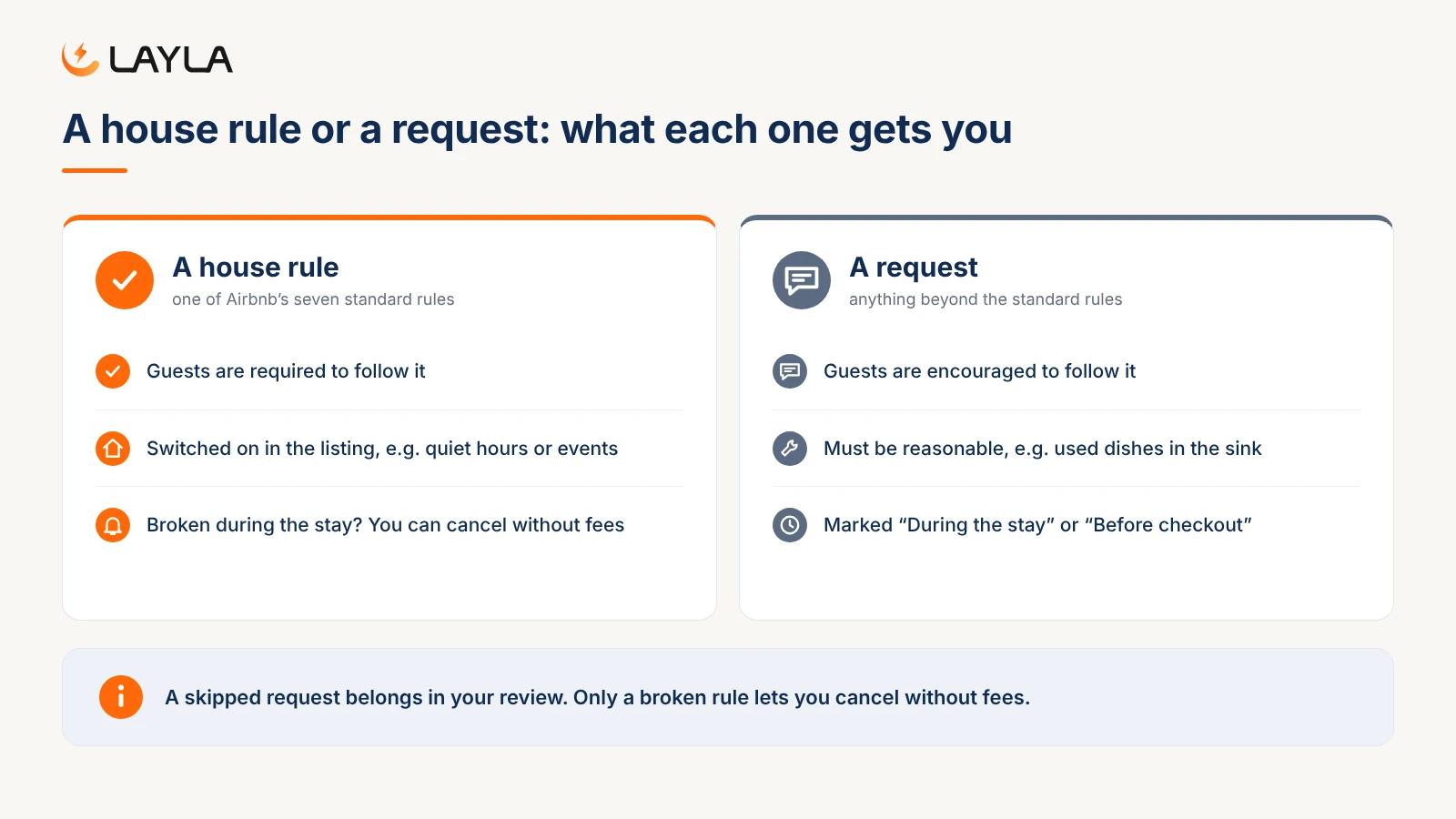
On Airbnb, your rules carry weight. "Guests are required to follow your house rules," and if a guest breaks one during the stay, or says before check-in that they intend to, Airbnb says you can cancel the reservation without fees or other consequences. Requests don't carry that weight. Guests are "encouraged to comply" with them, so a skipped check-out task belongs in your review, not in a cancellation. Airbnb's party guidance lists noise monitor readings and texts from neighbors as useful evidence, and asks hosts to file any reimbursement request no later than 14 days after the reservation ends (Airbnb host tips, October 20, 2026). A timestamped reading attached to a clear rule makes the case plain.
FAQ
What should vacation rental house rules include?
On Airbnb, switch on the standard rules that fit your home: quiet hours with clock times, "Smoking, vaping, and e-cigarettes", maximum overnight guests, events, pets and lock up at checkout. Then add a few reasonable requests, such as a limit on daytime visitors and small check-out tasks. Keep each rule specific enough that you could show it was broken.
Is there a vacation rental house rules template I can copy?
Yes. The template above has two parts: the standard rules to switch on in Airbnb, with brackets for your own times and numbers, and short requests for outdoor noise, visitors, pets and check-out. It follows Airbnb's examples of reasonable requests, so it works as an Airbnb house rules template, and the wording carries over to other platforms.
How do Airbnb house rules work from November 2026?
Since October 20, 2026, hosts choose from seven standard rules: maximum overnight guests, quiet hours, events, pets, smoking and vaping, commercial photography and filming, and lock up at checkout. Guests are required to follow them. Anything else is a reasonable request that guests are encouraged to follow. The policy takes effect November 20, 2026, and everything goes in the listing's "House rules and requests" section.
Can I cancel if a guest breaks my house rules?
On Airbnb, yes, for house rules. If a guest breaks one during the stay, or says before check-in that they intend to, you can cancel without fees or other consequences. That doesn't apply to requests, which guests are only encouraged to follow. Keep evidence: a timestamped noise or smoke reading, neighbor messages and photos make the case clear.
How do I enforce house rules without cameras?
Use sensors that measure rather than record. A decibel-based noise monitor enforces quiet hours, a smoke sensor catches smoking and vaping, and a radar occupancy sensor counts people without an image. Airbnb allows disclosed noise monitors outside bedrooms, bathrooms and sleeping areas, and bans indoor cameras, outside a narrow exception in Japan. Message the guest with the reading first, then escalate.

Best for: serious hosts
Noise Pro
Compliant with Airbnb's rules and local noise laws worldwide. Advanced protection for serious hosts.
Included forever – no subscription
- AI party detector
- Instant noise alerts with timestamps
- Live data feed, no 5-minute delay
- 180-day data history
- Radar intruder & vacant-home alerts
- Property status dashboard
- Outdoor temperature & humidity
- Automatic AI accuracy updates
- Daily & weekly summary reports by email
No monthly fees. Ever.
Your indoor air is 2-5x more polluted than outdoor air.
The EPA confirms it, but most people have no idea. You spend 90% of your time indoors breathing air you've never measured.
CO2 builds up silently.
A bedroom with two people can hit 2,500 ppm overnight. Harvard research shows decision-making drops 50% at 1,400 ppm. That brain fog and morning fatigue? It might not be bad sleep - it's bad air.
VOCs are off-gassing in every room.
New furniture, carpets, paint, cleaning products indoor VOC levels run up to 10x higher than outdoors. Some, like formaldehyde and benzene, are classified carcinogens. You can't smell most of them.
Mold starts in 24 hours.
When humidity exceeds 60%, mold begins colonizing within a day. 47% of U.S. homes show visible mold. Average remediation cost: $2,368 severe cases hit $30,000. A sensor that warns you before mold starts is orders of magnitude cheaper than cleanup.
Standard smoke detectors only catch fires.
They don't detect cigarette, vape, or marijuana smoke at low levels. For landlords and hosts, unauthorized smoking causes damage that goes unnoticed for weeks.
Post-COVID, people want data.
66% of Americans are more cautious about indoor air since the pandemic. 61% say they'd trust a space more if it monitored air quality. The awareness shift is permanent.
30-day money back guarantee