BLOG
How to Detect Vaping in a Rental Without Cameras
 By Nangyal Khan·
9 min read
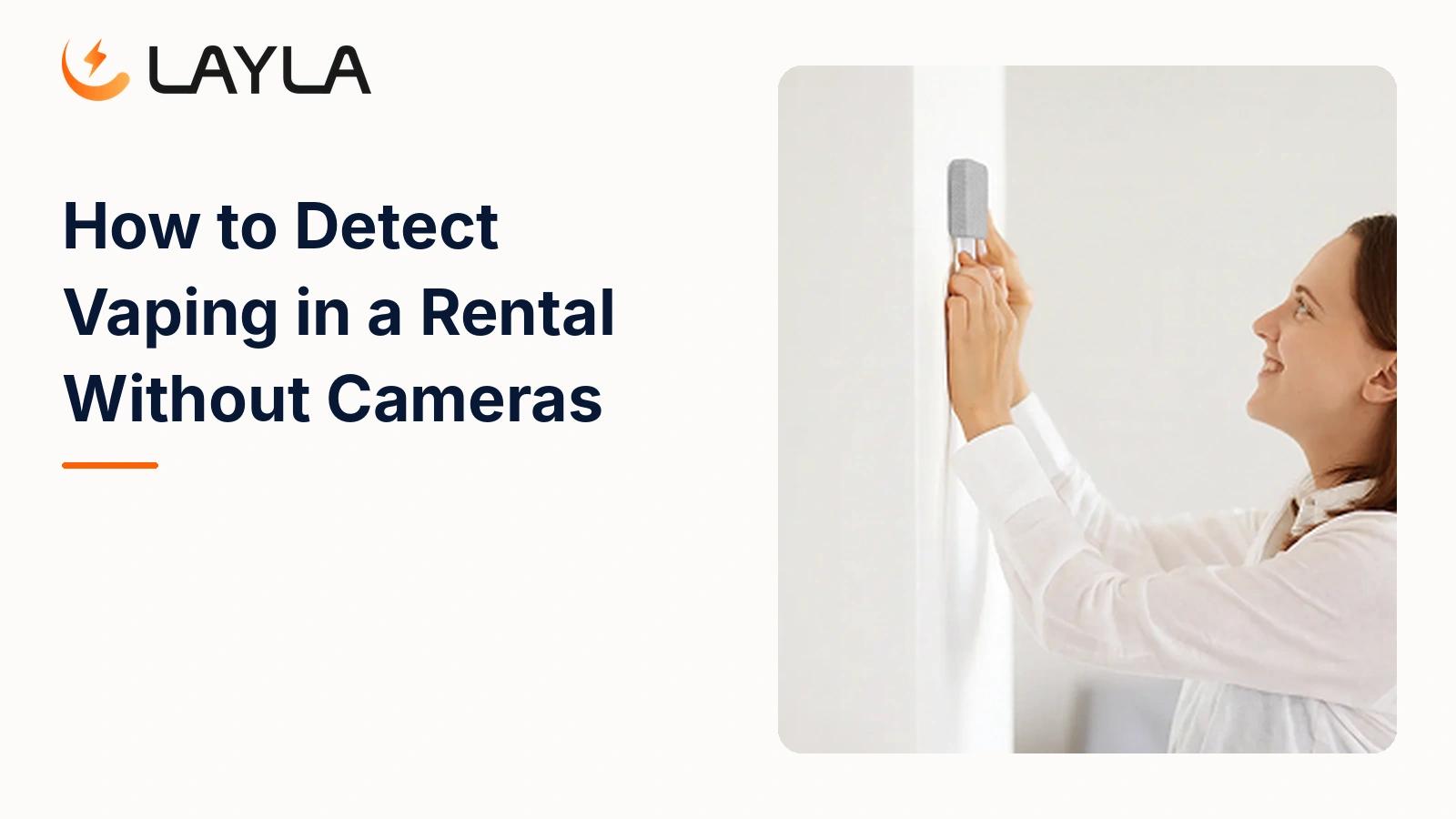
Vaping is the one that slips through. There's no ash, no burn on the nightstand, no stale cloud sitting in the curtains the next morning. A guest blows it toward a cracked window, the mist thins out inside a minute, and by checkout all you've got is a faint sweetness you could easily mistake for air freshener. Then the next guest walks in, says the bedroom smells like candy, and now you've got a complaint with no timestamp and nobody to pin it on.
So most hosts think camera first, and stop cold. You can't put one inside a rental. Airbnb, Vrbo and Booking.com all ban indoor cameras and microphones, and even a doorbell cam pointed at the entrance has to be declared. Honestly, a camera wouldn't help you anyway. Vaping is something you smell, not something that shows up on a wide-angle lens at 2am. The question was never how to watch the room. It's how to tell what happened in the air after everyone's gone, without watching a soul.
Why vaping is so much harder to catch than cigarettes
Cigarette smoke is heavy stuff. It carries a thick load of particles that drift around, soak into fabric and hang about for hours, which is exactly why a room somebody smoked in yesterday still announces itself today. All that density also makes cigarettes fairly easy to detect. There's plenty of material floating around for a sensor to read.
Vape is the opposite. It's mostly propylene glycol and glycerine flashed into a fine aerosol, and it evaporates fast, leaving barely any particulate behind. A sensor tuned only to cigarette-level particle loads can sit in a room where someone just vaped and pick up almost nothing.
That one fact is worth stopping on before you spend money. A device that "detects smoke" is not automatically a device that detects vaping. Loads of them miss it completely. If vaping is the actual problem you're trying to solve, that specific capability is what you check for, not smoke detection in general.
The ways hosts try to catch it, and how well they work
Some hosts lean on the cleaner's nose. It costs nothing, and it depends entirely on luck. Same-day turnover with a window left open overnight, and the trail's already cold. It also hands you nothing you can act on, because "my cleaner thought it smelled like vape" is not something anyone honours in a dispute. It works as a backstop and nothing more.
A "no vaping" line in the house rules is a step up, and you should absolutely have one. But a rule you can't enforce is really just a polite request. The guests who vape indoors already read that rule and figured the odds of getting caught were zero. Shift those odds and the rule starts doing its job.
Then there's the smoke alarm on the ceiling. That's a fire-safety device tuned for combustion, not a monitoring tool. It'll either ignore the aerosol entirely or, worse, scream the whole building awake over a bit of shower steam. Leave it to do what it's there for.
The only approach that genuinely fixes this is a sensor built to read the air. It watches continuously, recognises the signature vaping leaves, and pings you in real time with something you can actually use, no camera and no microphone anywhere in the room. It reads the air, not the person.
How air-quality detection works without spying on anyone
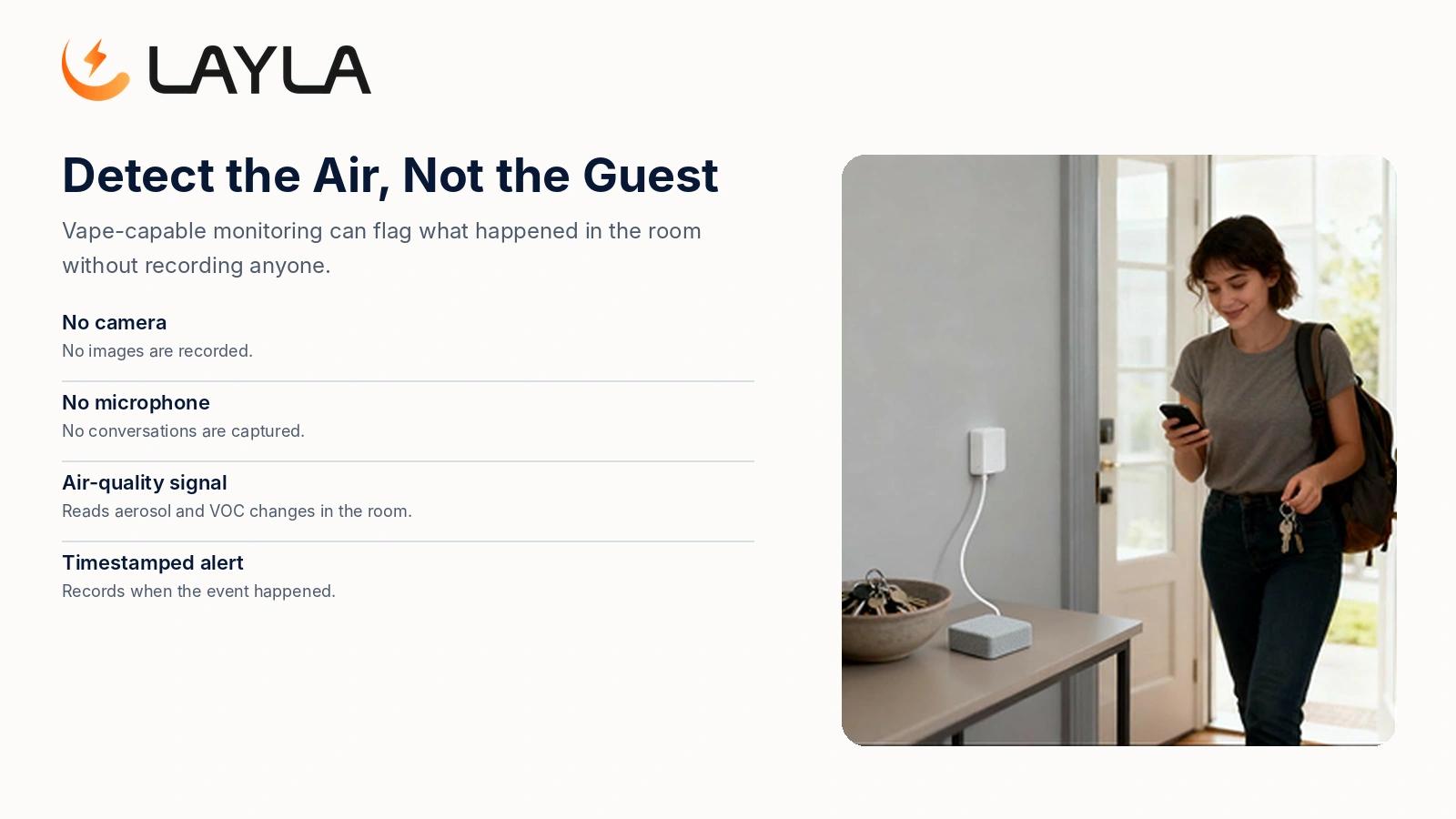
The reason this stays firmly on the right side of the privacy line is simple. It isn't surveillance. A vape-capable sensor doesn't record pictures or sound. It samples the air the same way a thermostat samples temperature, watching for the fingerprint vaping leaves behind, a jump in fine particulate alongside the volatile compounds in the aerosol. When that pattern shows up, it stamps the time and sends you an alert. What you learn is that something got vaped in the living room at 11:40pm. You learn nothing about who the guest is, what they said, or what they look like, because the device never had any of that to begin with.
That's precisely the kind of monitoring the platforms allow. Airbnb lets you run environmental and smoke monitoring as long as you disclose it in the listing. What it bans is cameras and mics inside. A sensor that reads decibels and air chemistry, with no lens and nothing recorded, stays compliant once you've declared it. And that declaration earns its keep twice over. A guest who reads "this home has an air-quality sensor that detects smoking and vaping" is far less likely to try it in the first place. Detection you announce works as a deterrent long before it's ever evidence.
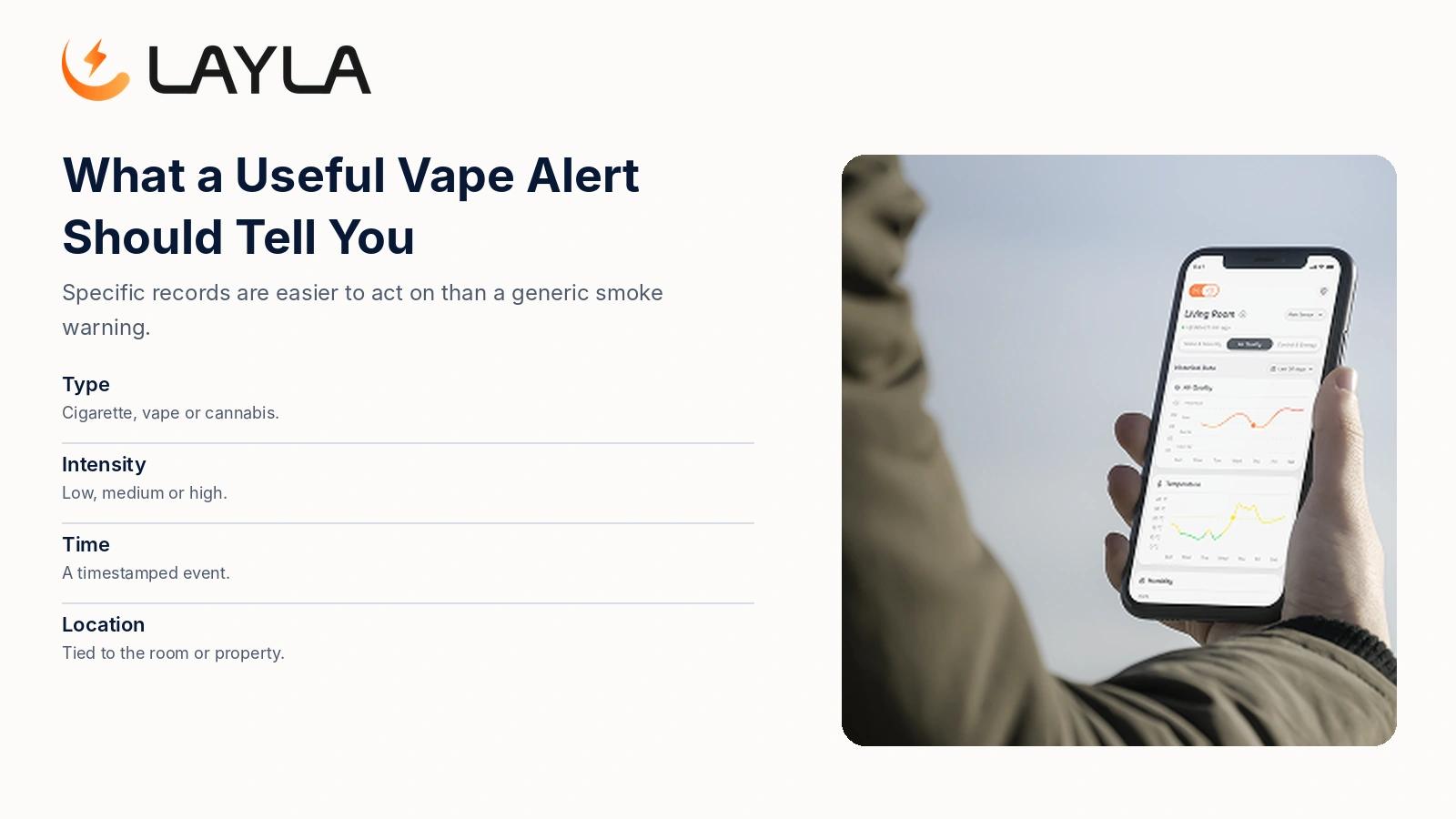
Where the good sensors separate themselves is in what the alert actually tells you. Catching that someone vaped is the bare minimum. What turns a hunch into a fee you can defend is a device that names the type, cigarette, vape or cannabis, and grades how strong it was, low, medium or high, updating live as it builds and clears. "Vape detected, medium, 11:40pm, living room" is a claim you can stand behind. "The room smelled funny" is not. A read on air quality helps too, since the compounds a vape leaves can register on a VOC sensor after the visible mist has long gone. So the guest who cracked a window and flapped a towel around hasn't necessarily wiped the record clean.
What to look for in a vape-capable sensor
Sort the options with a few blunt questions. Does it actually detect vaping, or just cigarette smoke? Does the alert name the type and grade the intensity, or does it only mumble "smoke"? Can you set the threshold so you're not chasing a guest who lit a candle? Does it work with no camera and no mic, so you can disclose it and stay platform-safe? And is it a one-time buy, or a subscription that switches your protection off the day you stop paying?
That last one bites harder than it looks. A fair few vape detectors only run while you keep paying, month after month, and the device goes dark the moment the subscription lapses. Across a couple of units and a few years, that quietly turns into real money.
This is where Layla lands for most hosts. It picks up cigarette, vape and cannabis, tells you which one, grades every event from low to high with live updates, and lets you set the alert threshold yourself. No camera, no microphone, so it's clean to disclose. The same sensor also tracks air quality, reads noise as a decibel level, and watches occupancy. And it's a one-time $99 right now, discounted from $189, with nothing recurring after that. You set it up on Wi-Fi yourself in a few minutes, add one line to your listing, and vaping stops being the violation that gets away with it.
A setup that actually holds up
Put the sensor somewhere central, not buried in a cupboard, so it reads the rooms guests actually use. Set the threshold with a bit of sense, high enough to shrug off a scented candle or a steamy shower, sensitive enough to flag a real vape. Add one clear line to your house rules and listing saying the home is monitored for smoking and vaping by an air-quality sensor, with no cameras or mics anywhere inside. Then leave it running. Most of the payoff shows up before anyone ever vapes, in the guests who read that line and simply don't bother. For the few who try anyway, you'll have a timestamped, typed, graded record waiting, on a day the cleaner would otherwise have found nothing at all.
Frequently asked questions
Can you really detect vaping without a camera?
Yes, and a camera wouldn't help even if you were allowed one. Vaping gets detected through the air, not on video. An air-quality sensor reads the particulate and chemical signature vape leaves and alerts you in real time, with no lens and nothing recorded. That's also what keeps it inside Airbnb and Vrbo rules, which ban indoor cameras and mics but allow disclosed environmental monitoring.
Will a normal smoke alarm detect vaping?
Usually not. A hardwired smoke alarm is a fire-safety device built for combustion particles, and vape carries far fewer of them, so it tends to either miss vaping or false-alarm on steam. It also can't log an event or message you. For enforcement you want a monitoring sensor made to recognise vaping, sitting alongside your required fire alarm rather than replacing it.
Is vape detection allowed on Airbnb?
Yes, as long as you disclose it. Airbnb permits smoke and air-quality monitoring that's noted in the listing, and prohibits cameras and microphones in interior spaces. A sensor with no camera or mic meets that standard, and disclosing it is your strongest deterrent on top.
How do I prove it was vaping and not something else?
Pick a sensor that names the type and grades the intensity rather than one that only reports "smoke." An alert reading "vape detected, medium" with a timestamp and a room is far more defensible in a platform dispute than a generic smoke flag or a cleaner's hunch.
Do I have to pay a subscription to detect vaping?
No. Some vape detectors are subscription-only and stop working the day you cancel, but not all of them. A one-time device like Layla (currently $99, down from $189) detects cigarette, vape and cannabis with no recurring fee, and adds air-quality, noise and occupancy monitoring from the same unit.
Related reading
- Best Cigarette, Vape & Cannabis Smoke Detectors for Rentals (2026)
- Cigarette, Vape, and Cannabis: How Layla's Smoke Detection Actually Works
Catch vaping while there's still time to do something about it, without a camera in sight. See how Layla protects your rental: cigarette, vape and cannabis detection with air quality, noise and occupancy from one sensor, bought once.

Best for: health-conscious homes
Smoke & Air Quality
Air quality, mold and smoke monitoring for healthy homes and smoke-free rentals.
Included forever — no subscription
- Mold-risk early warning
- Smoke & cigarette detection
- Air quality score (IAQ) with alerts
- CO₂ & bVOC monitoring
- AI air insights & recommendations
- Allergy-comfort monitoring
No monthly fees. Ever.
30-day money back guarantee