BLOG
Cigarette, Vape, and Cannabis: How Layla's Smoke Detection Actually Works
 By Nangyal Khan··Updated
 10 min read
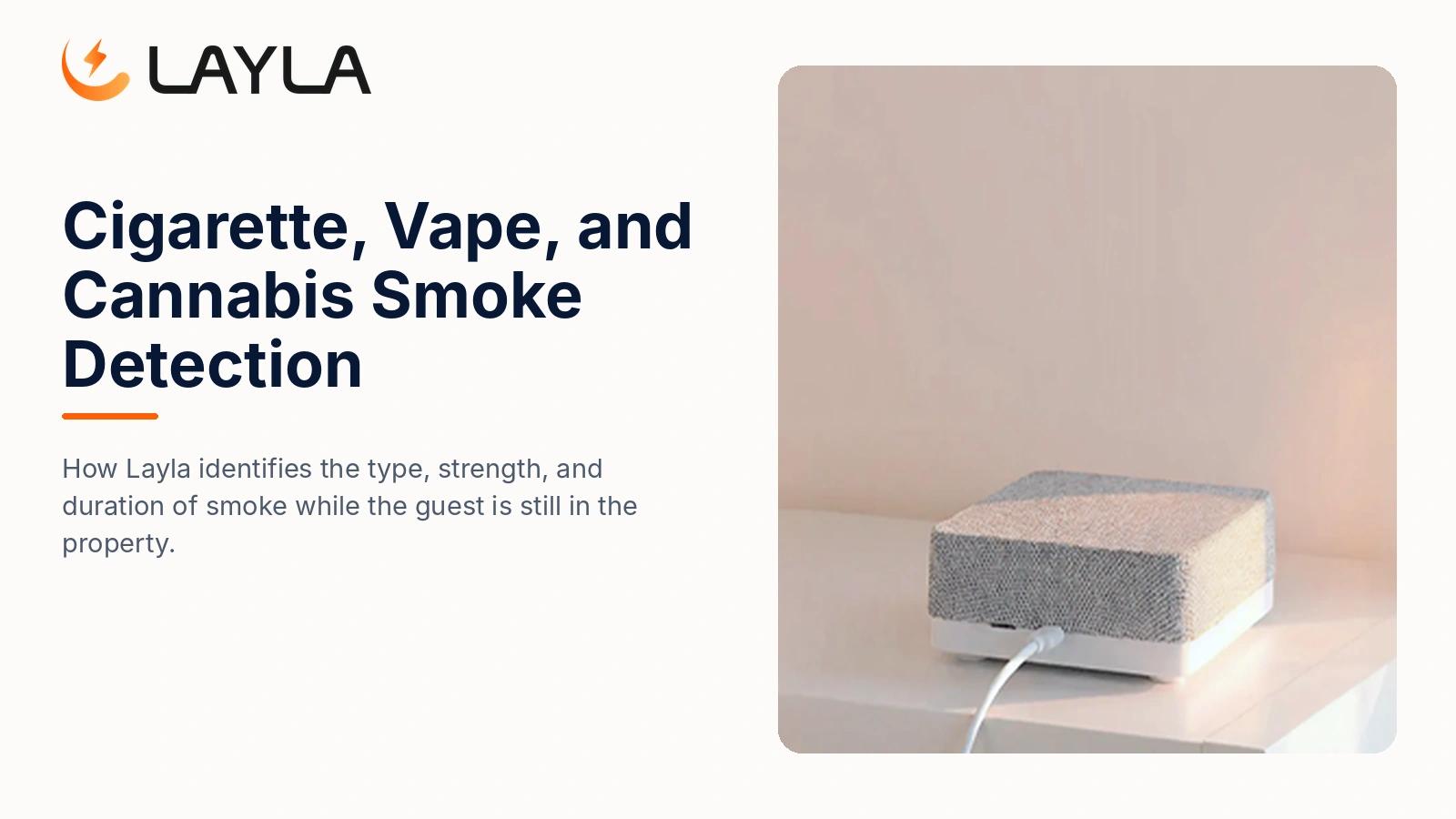
Here's the scene almost every host knows. It's three days after checkout, the cleaner opens the door, and the smell of stale cigarettes lands before the light switch does. The guest who lit up is long gone, the deposit's closed, and now the unit's off the calendar while you throw the windows open and hope the next booking can't tell. Smoking is the violation that hides. There's no bang, no neighbour on the phone, nothing loud enough to reach you on the night it happens, so it usually costs you money and never costs the guest a thing.
That's the gap Layla's smoke detection is built to close. Most of what we write is about noise, because parties are loud and easy to catch. Smoke is the quiet problem, and catching it takes a sensor that does more than notice something is burning. It needs to know what's burning, how much, and for how long, and it needs to tell you while the guest is still in the building. Here's how that works, with a quick word on the air quality it also monitors and the two setup things worth getting right.
What Layla actually detects
Layla's sensor is a smart smoke detector, not a passive alarm that only wakes up for a house fire. It reads the air non-stop and is sensitive enough to pick up even faint traces, the sort you get from a guest leaning out a cracked window rather than lighting up in the middle of the room. Ventilation, airflow, and where the sensor sits all affect what actually reaches it. That sensitivity is the point. By the time smoke is thick enough for a person to smell across the room, the session is already well underway.
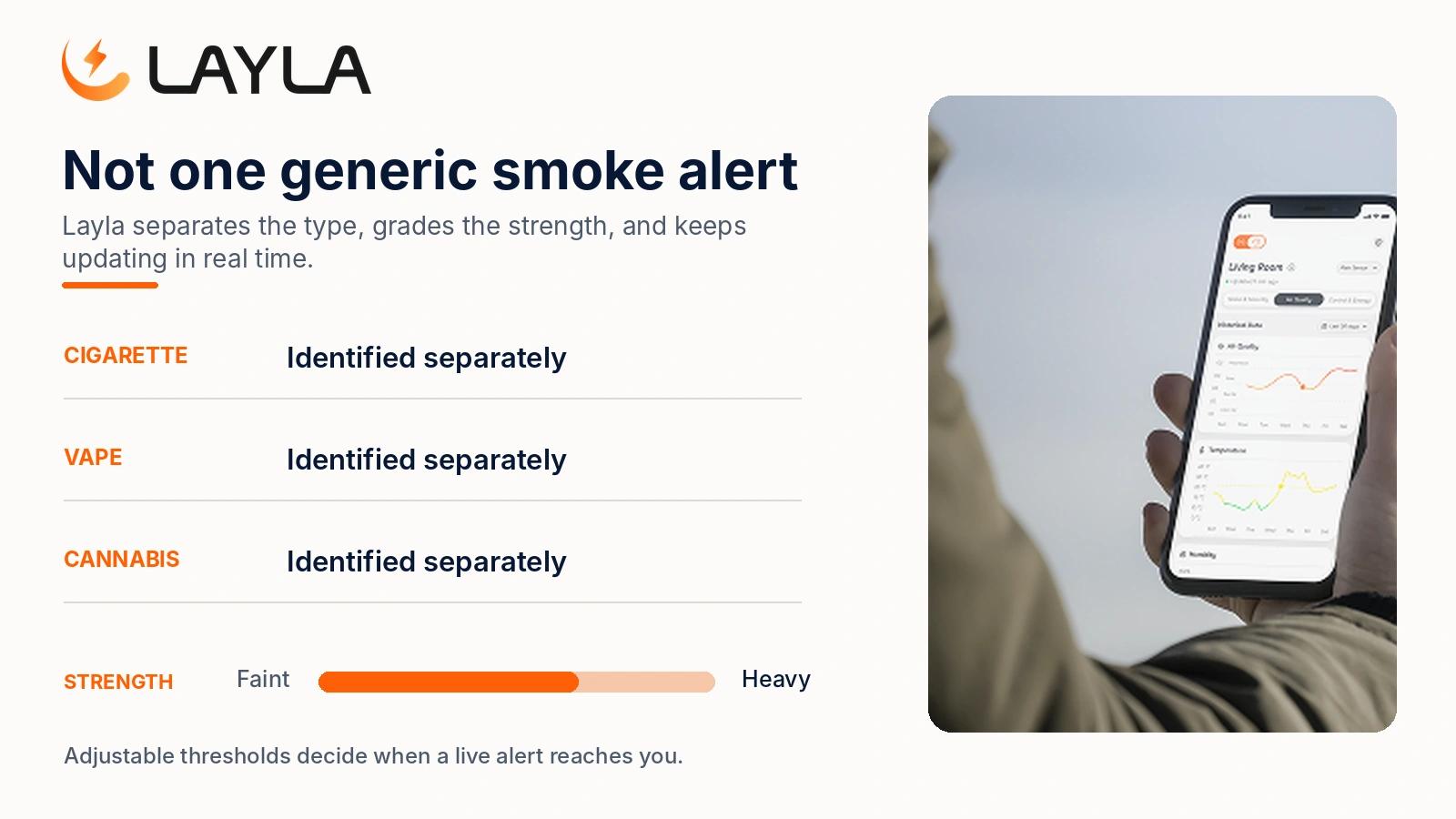
What sets it apart is that it reads the type, not just the presence. Cigarette, vape, and cannabis smoke each leave a different chemical fingerprint, and the sensor pulls them apart instead of lumping everything under one blunt "smoke" flag. For a host that difference is everything. Cannabis in a strict no-smoking unit is a different conversation, a different house-rule breach, and in some places a different legal footing than a guest sneaking a vape. Walking into that message already knowing which one you're dealing with keeps you accurate and keeps any charge you raise defensible.
It grades the strength as well, from a faint low reading up to a heavy one, and it keeps updating as things move rather than pinging once and going dark. You can watch a trace thicken into a proper haze, or ease off after a window goes up. Someone taking a single nervous pull by the balcony door looks nothing like a room being run as a lounge, and the sensor shows you which you've got instead of leaving you to guess. You also draw the line yourself, because the alert threshold is adjustable. Set it low to hear about the faintest whiff, or raise it so only a real, sustained session pulls you in. Either way the alert reaches you live, the same night, while there's still something you can do about it.
Smoke is one part of a bigger picture
Before we go deeper on smoke, one thing needs saying: air quality is a major part of what Layla does, not a footnote to it. The same unit tracks CO₂, VOCs, and airborne particulates, along with temperature, humidity, and mould risk, and rolls the lot into one clear indoor air-quality reading. That's the gap between a spotless room that still feels stuffy and stale on arrival and one you actually know is fresh.
It's too big a subject to cram into a paragraph here, so treat this as the headline and not the whole story. If air quality shapes how you run your place, and for most hosts it should, the air-quality monitoring page lays out everything it measures and why each reading matters. With that flagged, back to smoke.
Get the placement right, or the rest doesn't matter
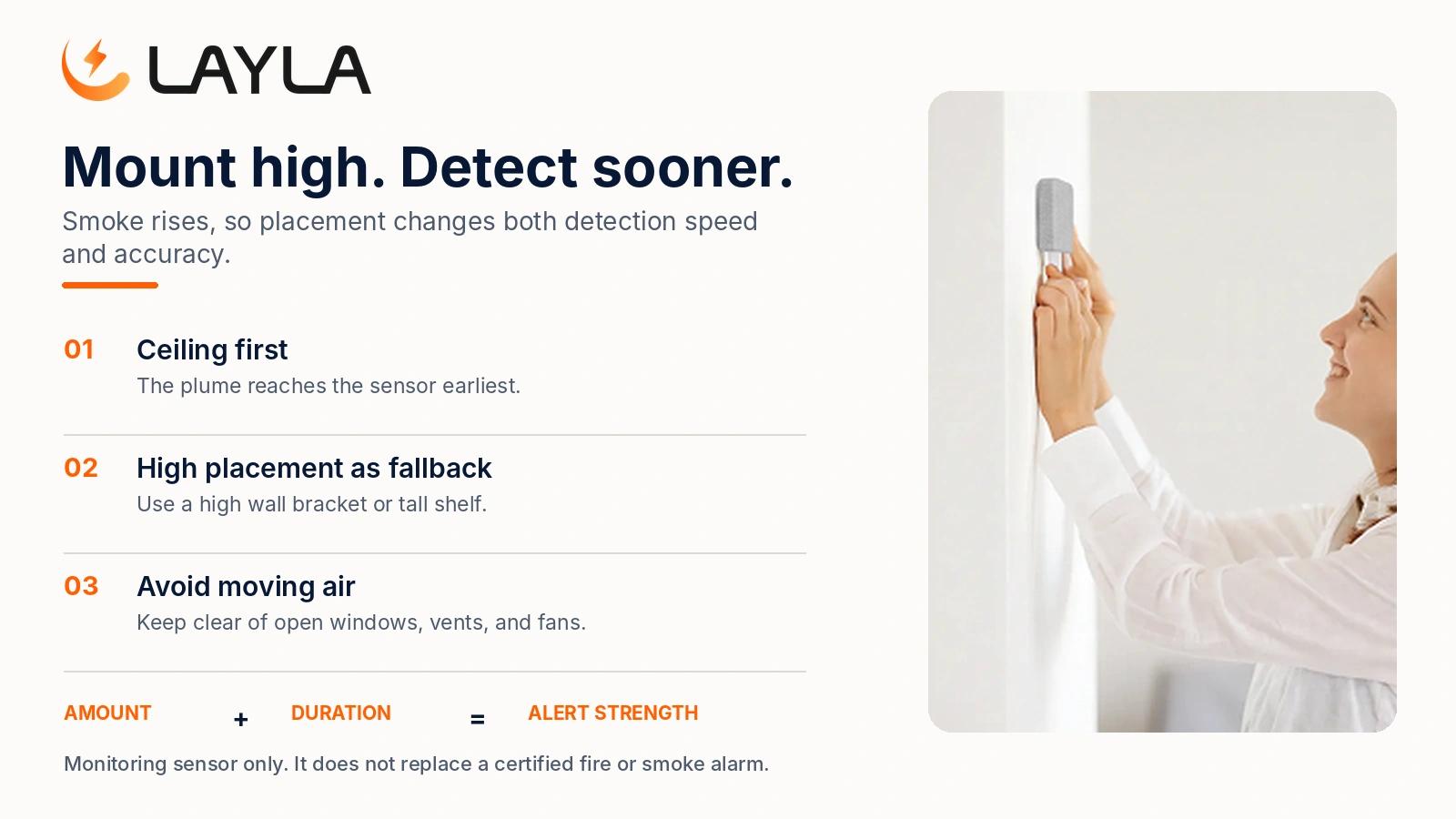
Now the part people most often get wrong. A great sensor in a bad spot is a mediocre sensor, and it comes down to one bit of basic physics: warm smoke and vape clouds are lighter than the air around them, so the moment someone exhales, that plume heads straight up and spreads across the ceiling before it ever sinks back into the room.
That's why the ceiling is the right home for it. Mount it there and you've parked the sensor exactly where the smoke arrives first, which buys you the earliest warning and the truest read on how heavy the session is. Drop that same sensor onto a bookshelf or a side table and you've quietly crippled it, because now the smoke has to fill the top of the room and work its way back down before enough reaches the unit to register. A light session can thin out and vanish before that happens. Every foot below the ceiling is delay you're adding and accuracy you're giving away.
If a ceiling fix genuinely isn't possible, go as high as the room allows. A tall shelf or a wall bracket near the ceiling still meets most of the rising plume. Just keep it clear of open windows, AC vents, and fans, since a steady draft will pull the smoke sideways and out before the sensor gets a clean look. Ceiling first, high up as a fallback, table height as the place good detection goes to struggle.
Why it takes a moment, not a millisecond
A guest who expects a beep the second they spark up has it wrong, and so does a host who thinks silence for a minute means the sensor missed it. Smoke detection isn't a light switch. It leans on two things at once: how much smoke is in the air, and how long it lingers.
That patience is deliberate. A trace has to reach a real concentration and hold there before the reading climbs, which is exactly what keeps the sensor from crying wolf over a puff that's gone in two seconds. It's also why the intensity grade means something. A little smoke over a short spell reads low; a heavier cloud, or a thin one that just won't clear, pushes it up as it gathers and holds. The amount and the time set the level together, which is the sensor telling a slip apart from a habit. And it ties straight back to placement, because a ceiling sensor sitting where the smoke's thickest first sees that concentration build sooner and reads the true level faster. A low one is forever working off a watered-down, late version of the same event.
From a live alert to a charge that sticks
All of this only pays off if you can act on it, and the timing is what makes that possible. Because the alert lands live, tagged by type and graded by strength, you end up holding a timestamped record of the thing while it was actually happening.
"It smelled of smoke when we cleaned" is something a guest shrugs off. A log showing cannabis smoke hitting a high reading at 11:40pm, on a night that booking held the keys, is far harder to wave away. It won't prove which individual lit up or guarantee a platform rules in your favour, but it ties a named, graded event to a moment in the stay. You can message mid-stay and settle it calmly before it grows, and if it turns into a dispute you're standing on a record instead of a memory. That's often the difference between a smoking fee you can actually enforce and one you quietly write off, which across a year of bookings adds up to real money.
What it isn't, and what to tell your guests
A limit worth being straight about first. This is a monitoring sensor, not life-safety kit. It reads smoke as an air-quality signal to tell you someone is smoking; it is not a certified fire or smoke alarm, and it does not replace the safety devices your property is legally required to have. Keep those exactly where they are and let Layla handle the policy side, which is the part a fire alarm was never built to care about.
And tell people it's there. Airbnb and the other platforms require you to disclose monitoring devices, and that rule works in your favour here, because a sensor with no camera and no microphone is an easy thing to be open about. Put a clean line in your listing and house rules: the home is non-smoking and carries environmental monitoring for noise and air quality, with no cameras or audio. That keeps you compliant and quietly does half the work for you, since a guest who knows you'll know is far less likely to spark up in the first place.
Frequently asked questions
Can it tell cigarette, vape, and cannabis apart?
Yes. Layla reads the different chemical signatures of cigarette, vape, and cannabis smoke rather than firing one generic "smoke" alert, so you know which house rule was broken before you message the guest.
Where should I mount the sensor?
On the ceiling. Smoke rises, so a ceiling-mounted sensor sits where the plume arrives first and reads it earliest and most accurately. If a ceiling mount isn't possible, place it as high as you can near the ceiling and away from windows, vents, and fans. Mounted low, it detects late, because the smoke has to fill the upper room and sink before it reaches the unit.
Why doesn't it alert the instant someone lights up?
Detection depends on both how much smoke is present and how long it lasts. A trace has to reach a real concentration and hold there to register, which keeps a two-second puff by an open window from reading the same as a full session. It's also why the intensity grade climbs as smoke builds up over time.
Does it monitor air quality as well as smoke?
Yes. The same unit tracks CO₂, VOCs, and particulates for an overall indoor air-quality reading, plus temperature, humidity, and mould risk, alongside noise and occupancy. No camera, no audio recording.
Is Layla a fire or smoke alarm?
No. It detects smoke as an air-quality signal to tell you someone is smoking. It is not a certified fire or smoke alarm and does not replace the required safety devices in your property.
Do I have to tell guests it's installed?
Yes. Disclosing monitoring devices is required, so note it in your listing and house rules. It's an easy disclosure because there's no camera and no audio, and being open about it also deters smoking before it starts.
Related reading
- Noise Monitoring for Vacation Rentals in 2026: The Complete Guide for Remote Hosts
- Airbnb Anti-Party Technology: What Actually Works in 2026
- The Best No-Subscription Noise Monitor for Airbnb (No Monthly Fees, 2026)
Tired of finding out about smoking three days too late? See how Layla covers your rental — smoke, air quality, noise, and occupancy from one sensor, with no camera and no audio.

Best for: health-conscious homes
Smoke & Air Quality
Air quality, mold and smoke monitoring for healthy homes and smoke-free rentals.
Included forever — no subscription
- Mold-risk early warning
- Smoke & cigarette detection
- Air quality score (IAQ) with alerts
- CO₂ & bVOC monitoring
- AI air insights & recommendations
- Allergy-comfort monitoring
No monthly fees. Ever.
30-day money back guarantee