BLOG
Noise Monitoring for Vacation Rentals in 2026: The Complete Guide for Remote Hosts
 By Nangyal Khan··Updated
 11 min read
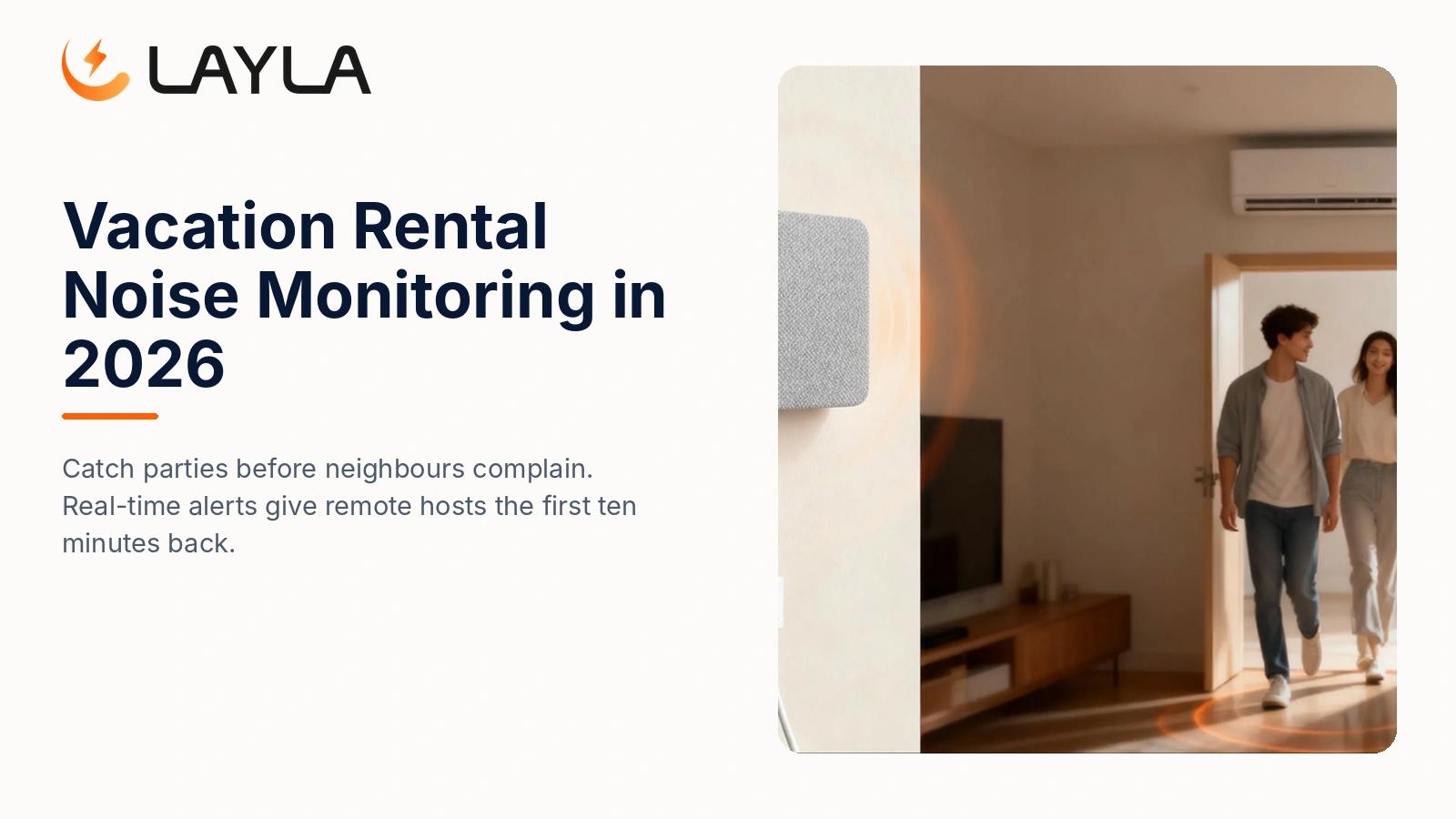
It is a Saturday night, you are two states away, and your rental is booked to a group of six. What you cannot see is that six has quietly become twenty. Cars are lining the street, a neighbour is annoyed enough to look up the city's noise ordinance, and another is already drafting a complaint to the platform. By the time any of it reaches you, the party has been running for two hours and the fine is effectively written.
That is the shape of nearly every serious problem in short-term rentals. It happens on a night you are not there, and you learn about it only after it is too late to matter. Noise monitoring exists to change that one thing. It gives you back the ten minutes at the start, when a party is still a text message rather than a fine, a suspension, or a neighbour who never lets it go.
There is a lot of confusion about what these devices do, whether Airbnb even allows them, and which one is worth buying. The sections below work through each, from the platform rules to how the cost lands over the years you own the place.
Why noise is the risk that ends listings
Hosts worry about a lot of things, but noise is the one that reaches straight into the parts of the business you cannot control. A single loud night can trigger a neighbour complaint, and neighbour complaints are what cities act on when they suspend permits or tighten short-term-rental rules. The platforms respond to the same signal. Enough noise reports against a listing, and the account itself is at risk.
None of that is really about the decibels. It is about the fact that you were not there to stop it, and had no way of knowing until the damage was done. Guests rarely set out to throw a blowout. A booking for a quiet weekend turns into a gathering, the gathering grows, and nobody in the room is tracking how loud it has become. The problem is not malice. It is the absence of a warning, and a warning is exactly what monitoring provides.
What a vacation rental noise monitor does
A noise monitor tracks loudness over time. It reads the decibel level in the property and alerts you when it stays high long enough to mean something real, not a slammed door or a group laughing over dinner, but the sustained wall of sound that says a gathering has tipped into an event.
What it does not do matters just as much. It does not record audio. It has no camera. It cannot hear a conversation or see a room. That restraint is deliberate, because a device that measured anything more would be both illegal on most platforms and intolerable to guests. Layla's noise and security sensor reads sound level and occupancy patterns through a small, discreet unit, enough to know a party is forming, never enough to intrude on the guests who booked your place to enjoy it.
The ten minutes that decide everything
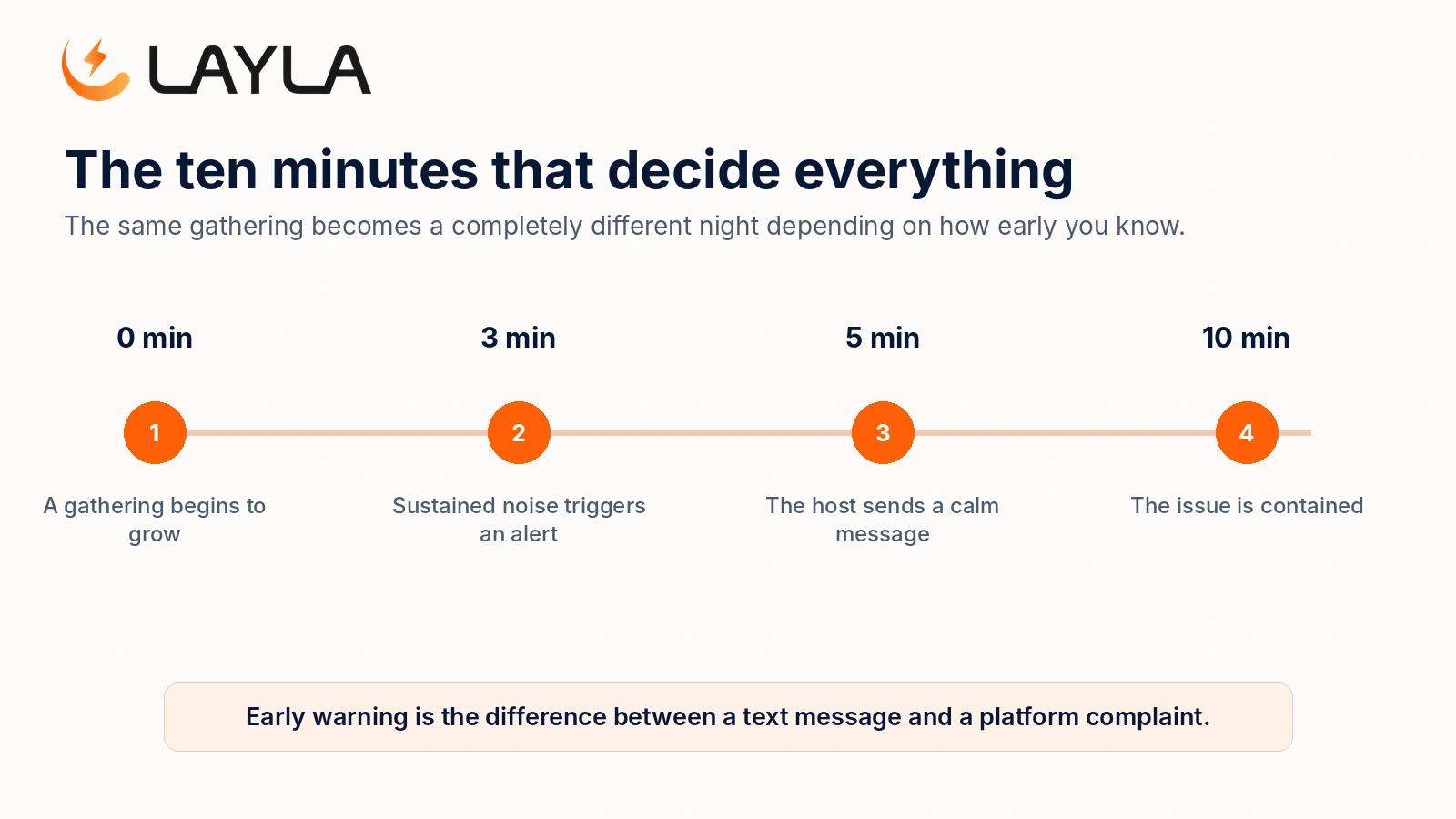
The value of monitoring is almost entirely about timing. An unauthorized party is a manageable problem for roughly its first fifteen minutes and an unmanageable one after that. Early on, a single message ends most situations. "Hi, we've had a report of noise, please keep it down." Guests almost never realize how loud they have become, and a polite nudge does the work before a neighbour ever reaches for their phone.
Miss that window and the tools left to you are all worse. You are calling a neighbour to check, sending someone to the door, or explaining to the platform why your listing generated a complaint. Same party, entirely different night, and the only variable that changed is whether you knew early. Everything a monitor buys you comes down to being first to know instead of last.
What to look for in a noise monitor for a rental
A few things separate a monitor that protects a listing from one that just sits on a shelf. It should alert in real time, not summarize after the fact, because a report the next morning cannot stop tonight's party. It should be discreet, since a bulky or obviously-recording device unsettles guests and invites bad reviews. It should measure sound level only, both for platform compliance and for guest trust. And it is worth asking what happens to the cost over the years you own the rental, because the pricing model varies more than the hardware does.
Those criteria are where the popular options genuinely diverge.
NoiseAware, Minut, and Layla compared
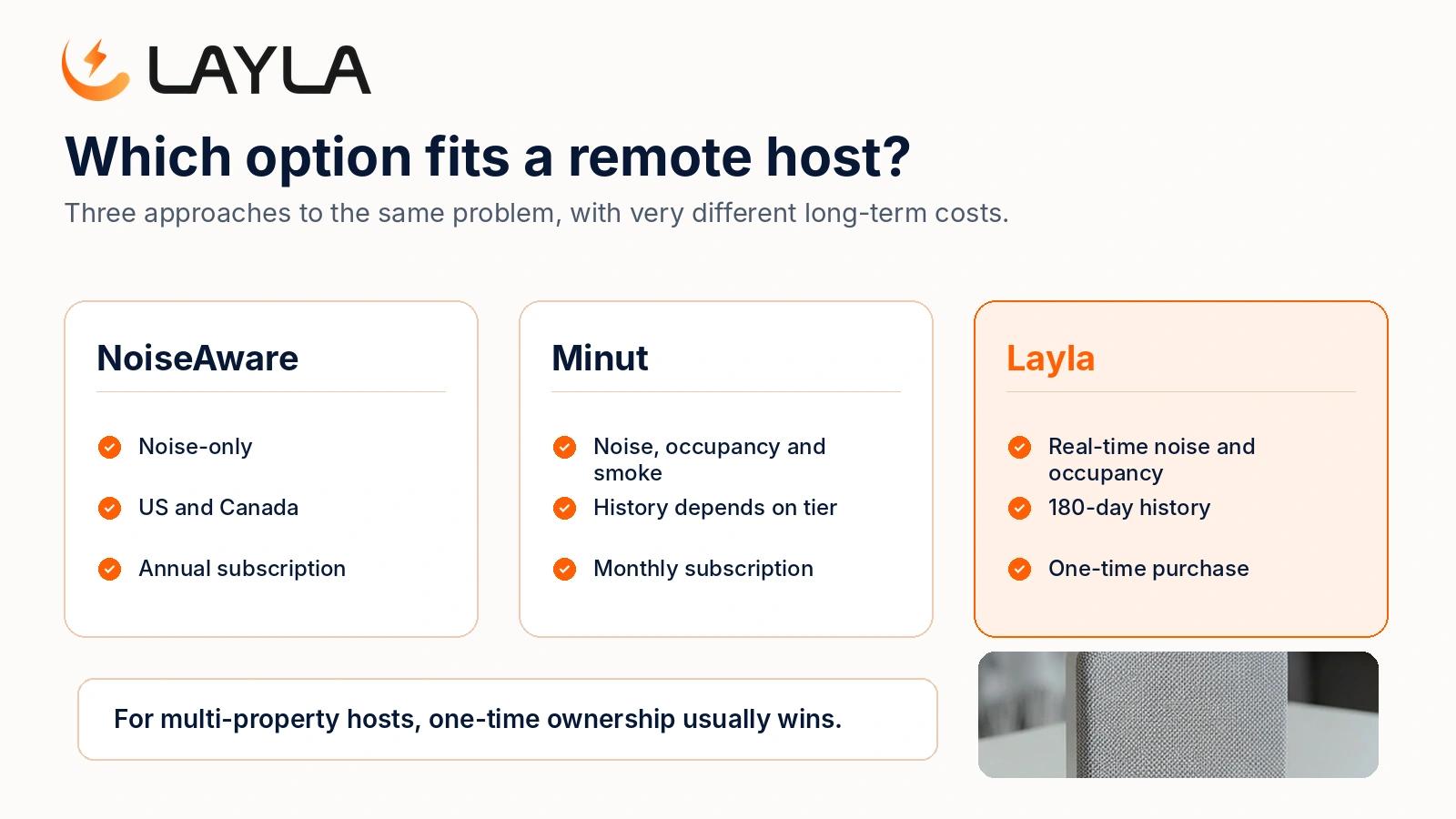
Three names dominate the vacation-rental conversation. They approach the same problem from different angles.
| NoiseAware | Minut | Layla | |
|---|---|---|---|
| Device (upfront) | Included in plan; $99 outdoor add-on | ~$100 (Minut device) | $179 / $299 (one-time) |
| Ongoing subscription | ~$180/yr per property | $5–15/mo per home | None |
| Noise monitoring | Yes | Yes | Yes |
| Occupancy / extra-guest alerts | No | Yes | Yes |
| Smoke & vape detection | No | Cigarette smoke | Cigarette, vape, cannabis |
| Air quality | No | Climate only | CO₂, humidity, mold risk |
| Cameras / audio | None | None | None |
| Availability | US & Canada | Wider | Wider |
NoiseAware is the best-known noise-only option. It monitors decibel levels indoors, offers a weatherproof outdoor sensor as a roughly $99 one-time add-on, and is sold as a subscription at around $180 per year for each property. It is a proven, focused tool, but two things limit it for many hosts. It is available only in the United States and Canada, and it does nothing beyond noise, so smoking and air quality are simply outside its scope.
Minut is the more sensor-rich alternative. Its device tracks noise and occupancy and adds cigarette-smoke and climate sensing, which makes it more capable than noise-only hardware. It runs on a subscription of roughly $5 to $15 per month for each home, and the tier you choose also decides how long your noise history is kept, from as little as seven days on the entry plan to unlimited on the top one. For a single unit that is workable. Across several, the monthly fees and the retention limits both start to bite.
Layla is the one-time-purchase option. The Pro plan is $179 and covers real-time decibel monitoring, timestamped alerts, quiet-hours enforcement with automatic guest notifications, occupancy estimation, and a full 180-day noise history, with no cameras and no audio recording. The All-In-One plan at $299 adds smoke and air quality on top. There is no subscription on any of it. You buy the sensor once and it keeps working. For a host with more than one property, or one who simply dislikes renting hardware forever, that is the difference that tends to settle the decision.
Are noise monitors allowed by Airbnb and Vrbo?
This is the question that stops many hosts before they start, so it is worth answering clearly. Yes. Sound-level monitoring that records no audio is permitted by Airbnb and Vrbo, and is often actively encouraged as a responsible-hosting measure. What the platforms prohibit is different: indoor cameras are banned outright, and any device that records audio is not allowed inside the property.
The rule for staying compliant is simple. Use a decibel-only monitor, keep it in the shared living space rather than any private area, and disclose it in your listing. A monitor that measures level and not content meets all three by design, which is why decibel-only devices are now the norm for rentals.
Beyond noise: the costs that show up at turnover
Parties are loud, which makes them the easy problem to catch. The expensive problems in a rental are the silent ones.
A guest smokes in a strictly non-smoking unit, and you find out from the smell during turnover. Too late to bill them, too late to air the place out before the next check-in. A device that catches smoke as it happens changes that entirely. Layla detects it in real time and distinguishes cigarette from vape from cannabis, grading how strong the trace is so you can tell a cracked-window one-off from a living room treated like a lounge. The alert reaches you the same night, while a charge is still enforceable.
Underneath that runs the slow stuff that Layla's air-quality monitoring is built to catch. Humidity drifting toward mold in a bathroom that never fully dries. Stale, high-CO₂ air in a unit shut up tight between stays. None of it trips an alarm on its own, and all of it turns into a repair bill or a "musty smell" review if nobody is watching. This is also the clearest line between the options. A noise-only system sees none of it, while an all-in-one sensor reads it from the same unit already watching for parties.
The cost over time, honestly compared
For a host, the pricing model usually matters more than the sticker price, so it is worth working through.
Say you run three units. On NoiseAware at roughly $180 per property per year, that is about $540 a year, every year, for as long as you host. On Minut's mid-tier at around $120 per home per year, roughly $360 a year, recurring. Layla's Pro plan at $179 per unit is a one-time outlay of about $537, after which the ongoing cost is nothing. The subscription overtakes the one-time purchase inside the first eighteen months, and every year after that the gap widens in your favour. Scale it to more units and the case only gets stronger, because a recurring fee multiplies with your portfolio while a one-time purchase does not.
Subscription pricing can suit a host with a single unit and no wish to spend up front. Past one property, buying the hardware once is almost always the cheaper answer over any realistic time horizon.
What hosts say
The proof is in whether it holds up in a real rental. "I received the Layla smart home agent mainly for my friends' short-term rental, and it's been a game-changer," writes verified Amazon reviewer Liz. "Setup took literally minutes." Another host, Amirah Askander, chose it for a converted Airbnb and notes that "it's small so it isn't an eye sore or take up a ton of room," the discreet quality that keeps guests comfortable. A third verified reviewer using it for rental-property monitoring calls it "one of those rare products that just works." Discreet, fast to set up, and reliable, which is exactly what a remote host needs from a device they will rarely think about again.
Frequently asked questions
Do vacation rental noise monitors record what guests say?
No. They measure sound level and duration, not audio content. Layla has no microphone recording and no camera, so it can tell you a property is loud without capturing any conversation. This is also why sound-level monitoring is permitted by platforms where recording is not.
Are noise monitors allowed by Airbnb and Vrbo?
Yes. Decibel-only monitoring that records no audio is permitted and often encouraged, provided you place it in a shared area and disclose it in your listing. Indoor cameras and any audio recording inside the property are prohibited.
What is the best noise monitor for a vacation rental?
NoiseAware is a solid noise-only choice in the US and Canada but is subscription-based and covers nothing else. Minut adds more sensors but still charges monthly with tiered data retention. Layla suits most hosts best because it is a one-time purchase with no subscription and also detects smoke and monitors air quality.
Will a noise monitor stop guests from throwing a party?
It will not physically prevent one, but it alerts you the moment sustained noise begins, when a single message usually ends the situation. The value is early warning, catching a gathering in its first minutes rather than after a neighbour has already complained.
Can it detect smoking or vaping in the rental?
Yes. Layla detects smoke and distinguishes cigarette, vape, and cannabis, with intensity grading, alerting you the same night so a violation is still enforceable rather than discovered at turnover.
Is there a monthly fee?
No. Layla is a one-time hardware purchase with no subscription, which over the life of a rental costs less than the recurring per-property fees charged by subscription-based competitors.
Related reading
- The Best No-Subscription Noise Monitor for Airbnb (No Monthly Fees, 2026)
- Airbnb Anti-Party Technology: What Actually Works in 2026
- Got a Neighbor Complaint About Your Airbnb? Here's Exactly What to Do
- Noise Monitoring for Landlords: Where the Legal Line Falls
Hosting a place you can't physically watch? See how Layla covers a short-term rental — no camera, no audio, no subscription.

Best for: full property coverage
All-in-One
Noise monitoring, smoke detection and smart AC control for complete coverage.
Everything included
Everything in Noise & Security Pro
AI party detector, noise alerts, intruder & break-in, occupancy, 180-day history, indoor + outdoor climate
Everything in Smoke & Air Quality
Air quality index (IAQ), CO2, bVOC, mold & smoke — full indoor + outdoor climate
Everything in AC Control & Energy
Smart AC (150+ brands), Eco Mode, schedules, filter health
Plus exclusive
- Advanced reports & insights
- Priority support
- Priority support
No monthly fees. Ever.
One sensor. Full coverage
One sensor. Full coverage.* Layla 3.0 monitors noise, air quality, motion, occupancy, temperature, humidity, pressure, VOCs, CO2, and controls your AC - from a single device on your shelf.
No subscription means no surprise costs.
Pay once. Every feature unlocked. Forever. No monthly fees eating into your rental margins or household budget.
The smartest buy is the one you make once.
Other solutions charge per-feature monthly subscriptions that exceed the device cost within a year. Layla's all-in-one pays for itself compared to any subscription alternative.
30-day money back guarantee