BLOG
Noise Monitoring for Landlords in 2026: Where the Legal Line Falls, and What to Deploy
 By Nangyal Khan··Updated
 10 min read
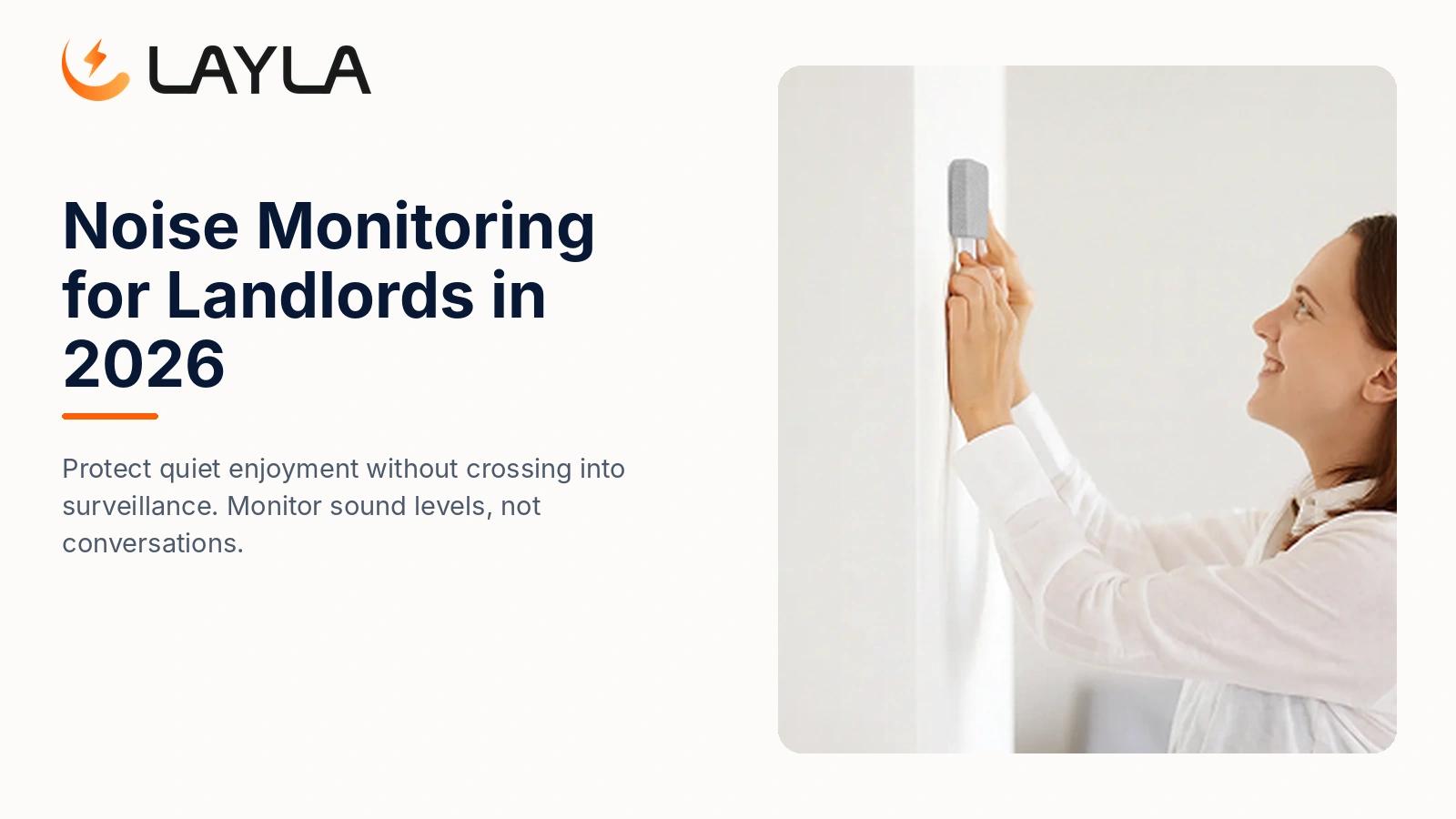
Every landlord owes each tenant quiet enjoyment, the legal right to live in the unit without unreasonable disturbance. The complication is that the duty runs in two directions at once. You owe it to the tenant in unit 3, and you owe it to the tenants in 2 and 4 when unit 3 throws a party every weekend. When those obligations collide, you are expected to act. But the moment you reach for a way to actually see what is happening, you run straight into the same privacy protections you are trying to enforce.
So the real question for a landlord is not whether to care about noise. It is how to know about it without crossing a line that turns you from the person upholding quiet enjoyment into the person violating it. That line is sharper than most owners assume, and done properly, noise monitoring sits comfortably on the right side of it. What follows is where the line falls, what the law lets you measure, and which devices on the market fit a rental property rather than a spare room.
What the law lets you do, and what it doesn't
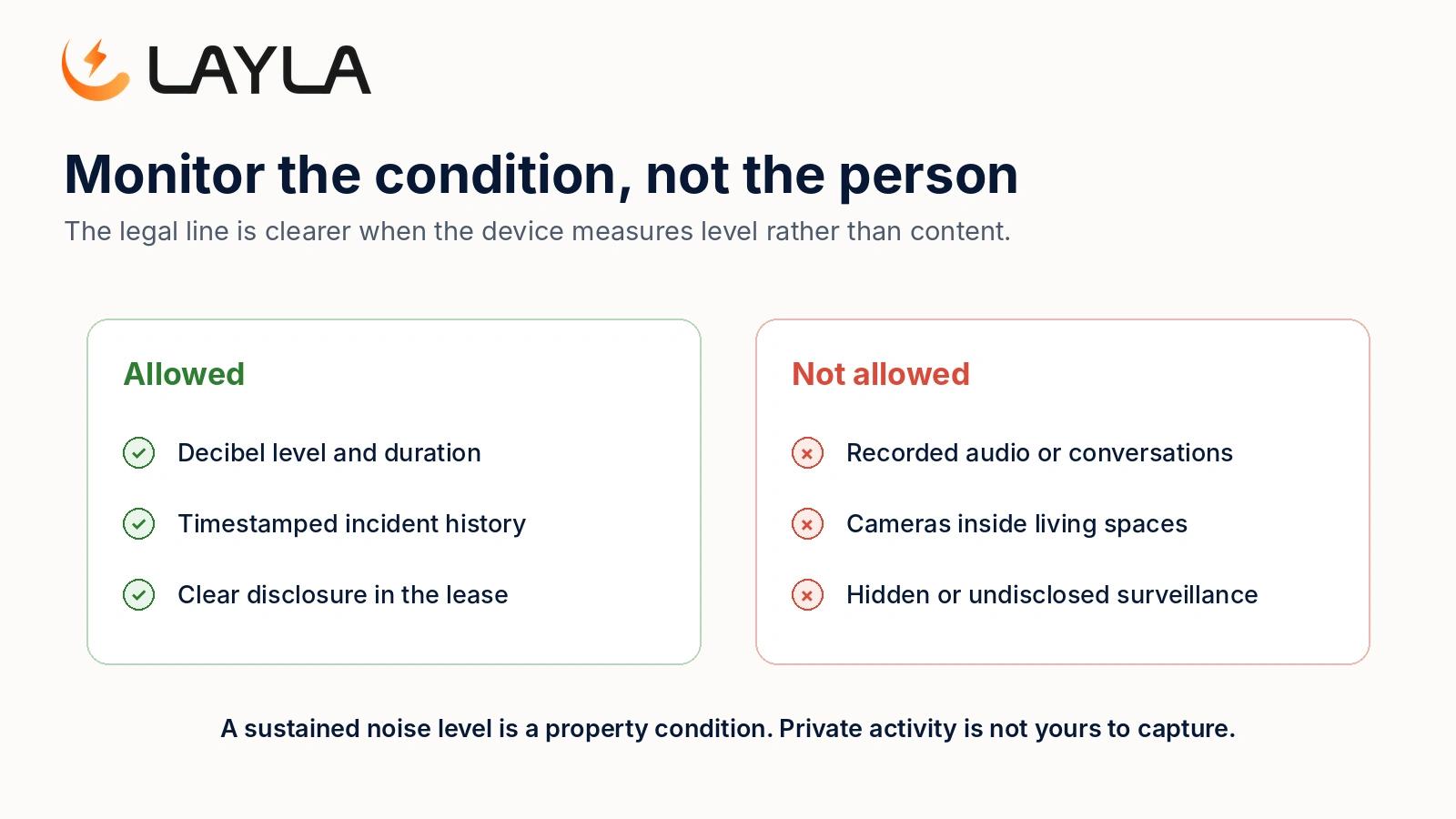
Start with the hard boundaries. You cannot record audio inside a tenant's home. You cannot place a camera in their living space. These are not judgment calls. A tenant's unit is their private residence, and surveillance of it breaches the very protections that make a tenancy lawful. Anything that captures conversation or activity inside the home is exposure no landlord should want.
Here is the part owners often miss. You are allowed to know whether a unit is producing sustained, disruptive noise, because that directly affects your other tenants and the condition of your property. The law draws its line between monitoring a person and monitoring a condition. A decibel level is a condition, in the same category as temperature or humidity. You may know that a unit was subjected to two hours of sustained disturbance. You may not know what was said during it. Keep everything you do on the condition side of that line and you stay protected. Cross it, and no amount of good intent will help you.
How privacy-safe noise monitoring works
A proper noise sensor reads the loudness curve in the unit and alerts you when it stays high long enough to matter. There is no microphone feed to replay, nothing stored beyond the fact that a unit was very loud between one and three in the morning. Layla does this through its noise and security sensor, a small device with no camera and no audio capture. It tracks sound level and occupancy patterns, never people.
For a landlord, that design is what counts, because it is the version you can put in writing. A clause in the lease and a line in the tenant handbook can spell out what the device does. It monitors sound levels, not conversations. There is nothing to conceal, so you do not have to. A tenant who reads the clause closely finds it means what it says, and that transparency protects the relationship as surely as the law protects you.
What to look for as a landlord
The landlord's checklist is a little different from a vacation-rental host's, because the priority is defensibility as much as detection. The device has to measure level only, so it stays on the lawful side of the line and reads cleanly in a lease clause. It should keep a solid history, so that when a dispute arises you can point to a record of when a unit was and was not disruptive. It should be unobtrusive, because a tenant's home is not a place for conspicuous hardware. And the cost model matters, since a landlord holds units for years, and a monthly fee per unit becomes a permanent charge against a fixed asset.
Those four priorities line up unevenly against the options.
NoiseAware, Minut, and Layla for rental property
Three systems come up most often. Each carries a different trade-off for a landlord specifically.
| NoiseAware | Minut | Layla | |
|---|---|---|---|
| Device (upfront) | Included in plan; $99 outdoor add-on | ~$100 per device | $179 / $299 (one-time) |
| Ongoing subscription | ~$180/yr per unit | $5–15/mo per unit | None |
| Noise history (for disputes) | Standard | 7 days to unlimited by tier | 180 days |
| Cost, 5 units / year | ~$900/yr | ~$300–900/yr | $0/yr (after ~$895 once) |
| Smoke & mold risk | No | Cigarette smoke | Cigarette/vape/cannabis + mold |
| Cameras / audio | None | None | None |
| Availability | US & Canada | Wider | Wider |
NoiseAware is a focused, noise-only monitor, sold as a subscription at around $180 per year for each property and available only in the United States and Canada. It does its one job well, but for a landlord it means an indefinite recurring fee per unit and no help with the smoke or moisture problems that quietly damage a rental. Its history and alerting are solid, the model underneath is simply a permanent line item.
Minut broadens the sensing to include occupancy, cigarette smoke, and climate, which is genuinely useful in a rental. The catch is the same recurring structure, roughly $5 to $15 per month for each home, with your data-retention window tied to the tier you pay for. A landlord who wants a long, dispute-ready history ends up on a higher plan, paying more every month, indefinitely.
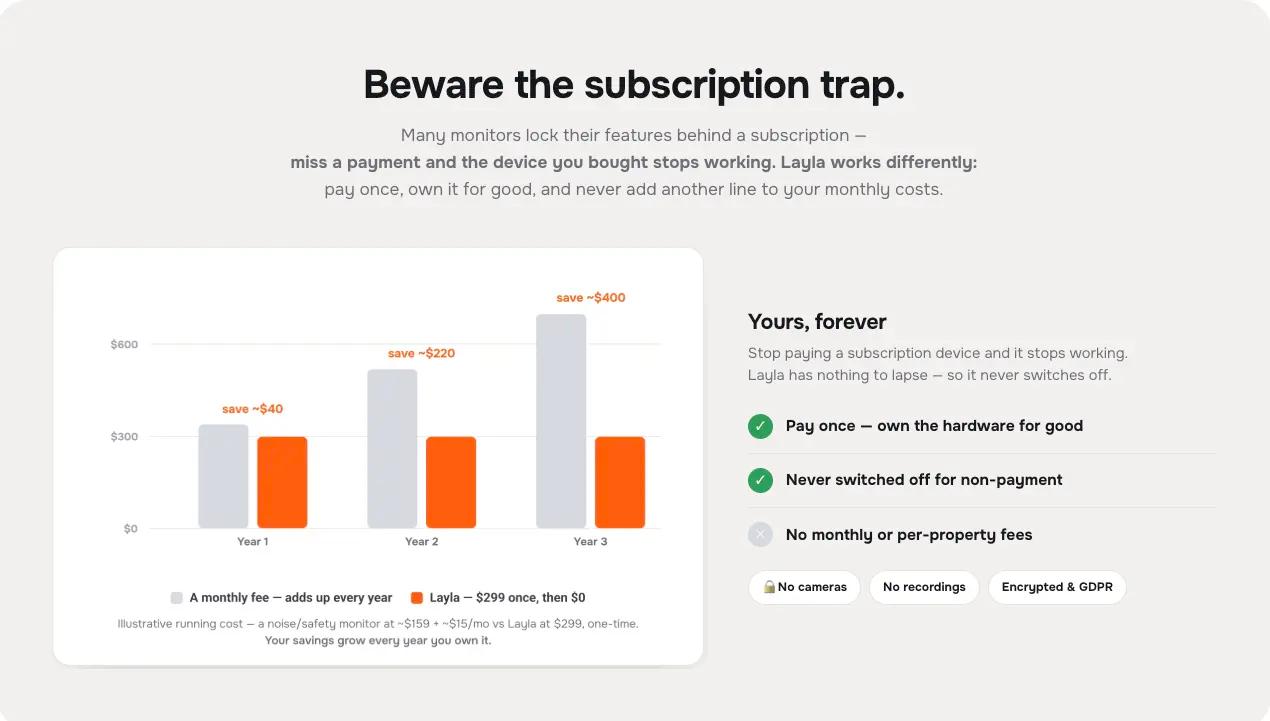
Layla takes the position that fits a property owner best. It is a one-time purchase. The Pro plan is $179 and includes real-time decibel monitoring, timestamped incident alerts, quiet-hours logic, occupancy estimation, and a 180-day noise history, all with no cameras and no audio. The All-In-One plan at $299 adds smoke and air quality. You buy it once, it keeps working, and there is no monthly fee eroding the return on a unit you may hold for a decade. Across a portfolio, that is the difference between a fixed cost you pay once and a subscription that scales with your door count forever.
Set the expectation, and the data does the rest
The landlords who handle noise well do not use monitoring to catch tenants. They use it to make quiet the default. A short, upfront clause explaining that sound levels are monitored (not recorded, not listened to) does most of the work before anyone signs. When a disturbance does occur, a neutral, timely message resolves it far more reliably than a confrontation, because most tenants genuinely underestimate how far sound travels in a building.
The alternative is the situation every landlord dreads. A neighbour complains, you have no independent way to confirm it, and you are mediating one tenant's word against another's with nothing solid in hand. Monitoring replaces that with a simple, defensible record of when a unit was and was not disruptive. It is not there to punish. It is there so you are not refereeing blind.
The damage that shows up at move-out
Once a sensor is in the unit, the same privacy-safe approach covers the two problems that cost landlords the most and announce themselves the least.
Smoking in a non-smoking unit is the classic one, invisible until the smell is in the walls at move-out and nearly impossible to prove after the fact. Layla detects smoke as it happens and distinguishes cigarette, vape, and cannabis, with intensity grading so an occasional lapse does not read like a daily habit. You address it during the tenancy, not during a deposit dispute you cannot substantiate.
Then there is the slow structural damage that air-quality monitoring surfaces early. Humidity climbing toward mold, chronic poor ventilation, the conditions that become repairs and habitability complaints if they run unchecked. A sensor reading them continuously turns the property into something that flags its own maintenance needs, before a tenant has grounds to. This is also where a noise-only device leaves a landlord exposed, because none of it registers as sound.
Subscription versus one-time across a portfolio
The math is where the decision usually resolves. Take five units. On a subscription at roughly $120 to $180 per unit per year, that is between $600 and $900 every year, recurring for as long as you own the buildings. Layla's Pro plan at $179 per unit is a one-time outlay of about $895, after which the ongoing cost is zero. Somewhere in the second year the subscription passes the one-time purchase, and from then on the gap only widens.
For a single unit and a landlord who prefers not to spend up front, a subscription can make sense. For anyone holding multiple units over multiple years, which describes most landlords, buying the hardware once is the cheaper and simpler path by a wide margin.
What landlords say
Whether any of this holds up comes down to the device working in a real unit. A verified Amazon reviewer using Layla for rental-property monitoring calls it "one of those rare products that just works," while another, Jennifer Bahr, describes it as "a game-changer for managing my space" that is "incredibly accurate at tracking sound levels in real time." Accuracy and reliability are what let a landlord trust the record enough to act on it, and to stand behind it if a dispute ever reaches a hearing.
Frequently asked questions
Can a landlord legally monitor noise in a rental unit?
Generally yes, when the device measures sound level only and records no audio or video. This monitors a condition of the property rather than the tenant, which keeps it distinct from surveillance. Recording conversations or installing cameras inside a unit is not permitted and breaches quiet-enjoyment protections.
Does a noise monitor violate a tenant's right to quiet enjoyment?
Not if it only measures decibel levels and is disclosed in the lease. Quiet enjoyment protects tenants from unreasonable disturbance and from surveillance of their private activity. A sensor that captures neither, documented openly, respects both.
Should noise monitoring be disclosed in the lease?
Yes. Best practice is a clear clause and a handbook note stating that sound levels are monitored but conversations are not recorded. Transparency is both a legal safeguard and the most effective way to make quiet the default expectation.
What is the best noise monitor for a landlord?
NoiseAware is a proven noise-only option in the US and Canada but is subscription-based and covers nothing beyond noise. Minut adds sensors but charges monthly, with data retention tied to the plan. Layla fits landlords best because it is a one-time purchase with a 180-day history and also detects smoke and mold-risk conditions.
Can the same device detect smoking or mold risk?
Yes. Layla detects smoke, distinguishing cigarette, vape, and cannabis with intensity grading, and monitors humidity and air-quality signals that indicate mold risk, catching both during the tenancy rather than at move-out.
Is there an ongoing cost?
No. Layla is a one-time hardware purchase with no subscription, which suits owners holding units long term far better than recurring per-unit monthly fees.
Related reading
- Noise Monitoring for Student Housing: Making Quiet the Default
- Noise Monitoring for Vacation Rentals: The Complete Guide for Remote Hosts
- The Best No-Subscription Noise Monitor for Airbnb (No Monthly Fees, 2026)
- Layla for property managers and multifamily portfolios
Protecting a rental and want to stay firmly on the right side of the line? See how Layla covers a unit — sound level only, no camera, no audio, bought once.

Best for: full property coverage
All-in-One
Noise monitoring, smoke detection and smart AC control for complete coverage.
Everything included
Everything in Noise & Security Pro
AI party detector, noise alerts, intruder & break-in, occupancy, 180-day history, indoor + outdoor climate
Everything in Smoke & Air Quality
Air quality index (IAQ), CO2, bVOC, mold & smoke — full indoor + outdoor climate
Everything in AC Control & Energy
Smart AC (150+ brands), Eco Mode, schedules, filter health
Plus exclusive
- Advanced reports & insights
- Priority support
- Priority support
No monthly fees. Ever.
One sensor. Full coverage
One sensor. Full coverage.* Layla 3.0 monitors noise, air quality, motion, occupancy, temperature, humidity, pressure, VOCs, CO2, and controls your AC - from a single device on your shelf.
No subscription means no surprise costs.
Pay once. Every feature unlocked. Forever. No monthly fees eating into your rental margins or household budget.
The smartest buy is the one you make once.
Other solutions charge per-feature monthly subscriptions that exceed the device cost within a year. Layla's all-in-one pays for itself compared to any subscription alternative.
30-day money back guarantee