BLOG
Best Noise Monitor for Airbnb in 2026: The Honest Category Roundup
 By Nangyal Khan··Updated
 14 min read

Best Noise Monitor for Airbnb in 2026: The Honest Category Roundup
Every host who buys a noise monitor is really after the same three things. An end to the 2 a.m. call from the neighbor. A party caught before it becomes a one-star review. A security deposit nobody has to fight over. On a product page, the devices that promise all this look nearly identical. That resemblance disappears once you've run them across real properties for a year or two.
Four monitors are worth taking seriously for short-term rentals in 2026. They separate along three questions that actually decide the purchase. Do you pay once or pay forever? Does the device only listen for noise, or does it cover the other things that go wrong in a rental? And is your noise problem inside the walls or out in the yard? Answer those and the right pick tends to choose itself. Below is the honest version of each.
TL;DR — The Best Noise Monitor for Airbnb by Situation
- Best overall: Layla. One-time from $149, no subscription ever, covering noise, indoor air quality, smoke detection, and AC automation in a single indoor device. The right default for most hosts.
- Best for outdoor noise (US): NoiseAware. $180/year per property and noise-only, but its weatherproof outdoor sensor is the one device here that reliably catches backyard and pool noise.
- Best-known name: Minut. A solid noise, smoke-risk, and occupancy sensor, though it's hardware plus an ongoing per-property subscription and stops at noise-adjacent monitoring.
- Best for European managed operations: Roomonitor. From €13/month, and the only option that puts a human response team behind the alert instead of just pinging your phone.
The Four Compared, at a Glance
| Monitor | Price | Subscription | What it monitors | Best for |
|---|---|---|---|---|
| Layla | From $149, one-time | None | Noise, air quality, smoke, AC automation | Best overall / value |
| NoiseAware | $180/yr + $99 outdoor add-on | Yes (annual) | Noise only (indoor + outdoor sensor) | Outdoor noise (US) |
| Minut | ~$100 device + $5–15/mo per property | Yes (required) | Noise, occupancy, smoke-risk | Single property, familiar name |
| Roomonitor | From €13/mo (device included) | Yes | Noise, smoke, air quality + human response team | European managed operations |
What Actually Separates These Devices
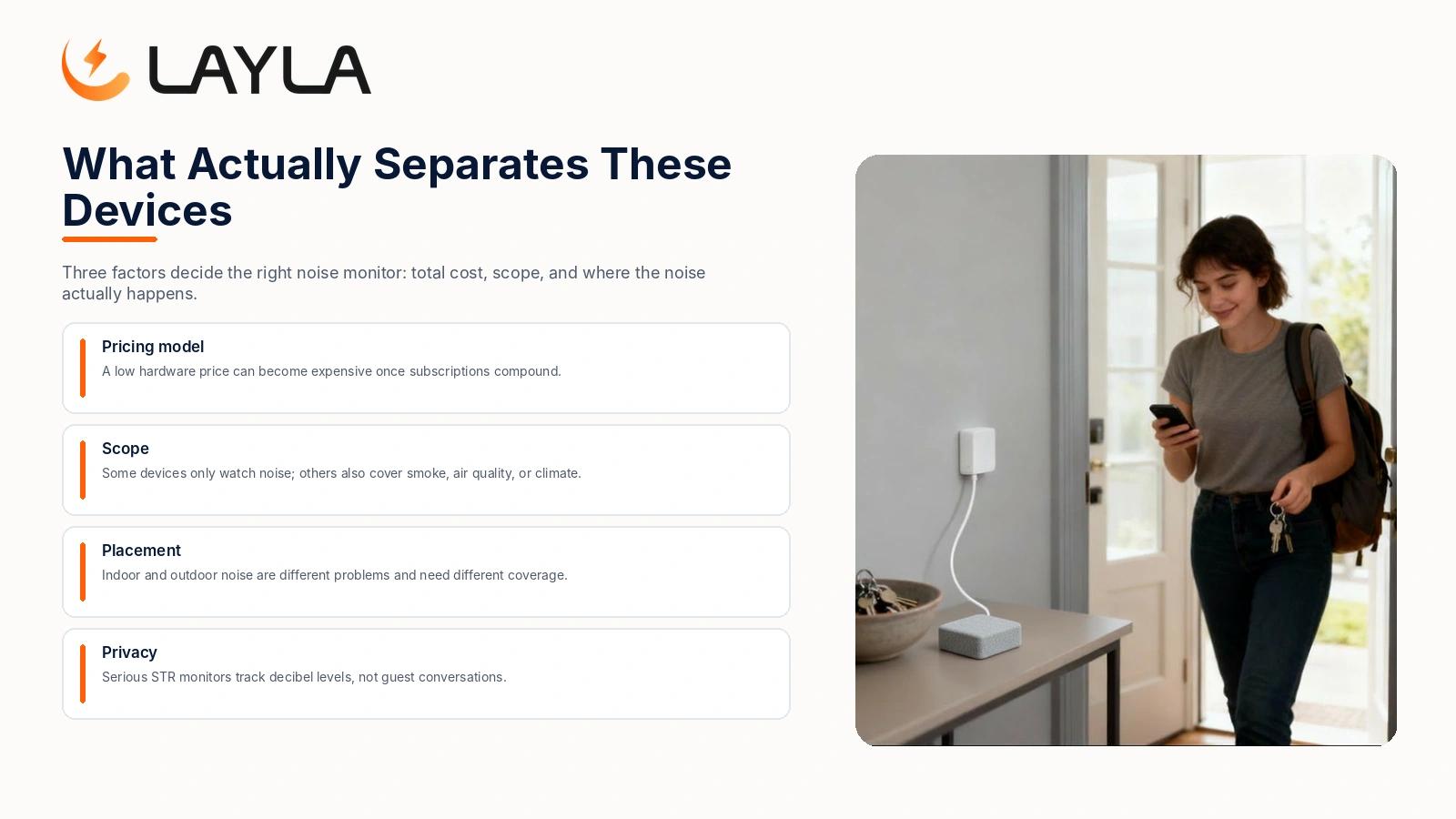
Start with privacy, because it's the first thing a nervous guest asks about and the fastest way to earn a one-star review if you get it wrong. None of the serious monitors record audio. They measure sound levels (decibels over time) and alert you when a threshold holds too long. That distinction is why they're legal to run in a rented space, and it's worth stating plainly in your listing. Any device that claims to let you "listen in" is one you should never put in a guest bedroom.
After that, three things decide it. First, the pricing model matters more than the sticker price. A $100 sensor with a $180-a-year subscription costs far more over three years than a $299 device you buy once, and the gap widens with every unit you add. Second is scope. A noise-only sensor solves one problem, while the same ceiling mount could also be watching for smoke, air quality, and wasted AC if you buy the right device. Placement comes last. An indoor sensor cannot hear a party that's moved out to the pool, and no amount of software fixes that.
With that settled, here is where each device lands.
1. Layla — Best Overall Noise Monitor for Airbnb
Best for: Hosts who want the noise problem solved and would rather not buy three separate devices, or pay a monthly fee per property, to cover everything else that goes wrong in a rental.
Layla earns the top spot for the same reason it frustrates a straight spec-sheet comparison. It does more than watch for noise. The noise monitoring itself is genuinely good, with real-time decibel alerts, occupancy and motion sensing, and the noise and security coverage most hosts buy the category for. The difference is what else the device is doing while it sits on your ceiling. It tracks indoor air quality, meaning VOCs, CO₂, and mold risk. It detects smoke. And it runs native AC automation that powers the climate down when a room sits empty, which is where hosts report cutting electricity costs by around 25%.
The pricing is the other half of the case. Layla is a one-time purchase. Plans run from $149 for the entry tier, $179 for Pro, up to $299 for the All-in-One that adds air quality, smoke detection, and AC automation. You own it outright. There's no renewal, no per-property fee, and no bill that grows when you add your sixth unit. Five All-in-Ones comes to $1,495, and that's the whole bill, not the bill for this year.
"It gives us a complete solution kit! It helps keep our properties quiet & safe, reduces energy costs dramatically, and helps keep my maintenance needs up to date."
— Fernando Delas, CEO-Founder, Hest Homes
"With Layla, we can monitor air quality, detect smoking events, mold, and ensure Airbnb guests are safe and comfortable."
— Matias Maradei, Director, Charco Inmobiliaria
One caveat worth naming. Layla is an indoor device, so if your recurring problem is guests taking the noise out to the backyard or pool after midnight, you'd pair it with a dedicated outdoor sensor for that spot. That's a narrow case. For the large majority of rentals, where the noise that gets you in trouble happens inside four walls, Layla covers it, along with air quality, smoke, and climate, in a single device.
Where it fits: Almost any host running one to fifty units who wants to stop stacking subscriptions and separate gadgets. It's especially strong in warm markets, where the AC automation pays for the device on its own.
Shop Layla — from $149, no subscription →
2. NoiseAware — Best for Outdoor Noise in the US
Best for: US hosts whose real problem is outside (patio, pool, backyard) and who don't need anything beyond noise.
NoiseAware is on this list for a single reason, and that's the outdoor sensor. It's weatherproof and connects to the indoor hub over a proprietary radio link rather than Wi-Fi, so it holds signal at the far end of a yard. If your complaints genuinely come from guests gathering outside late, that outdoor unit picks up the early build an indoor-only setup would miss. It's the one job NoiseAware does that Layla doesn't, and beyond that narrow use the device does very little for the money.
Pricing is $15/month per property ($180/year), with the indoor sensor included on the Starter plan for one to nine properties. The outdoor sensor is a separate $99 one-time add-on, and ten-plus properties move to custom Pro pricing. Beyond that outdoor use case, the picture narrows fast. There's no air quality monitoring, no smoke detection, and no climate control. It measures decibels and nothing else, and it ships to the US and Canada only.
Where it fits: US properties with pools, patios, or outdoor entertaining areas where outdoor noise is the problem. If your rentals are all indoor space, you're paying a subscription for a fraction of what a one-time device would cover.
3. Minut — The Established Name, With Strings Attached
Best for: Single-property hosts who want a recognized brand and only need noise, smoke-risk, and occupancy.
Minut is the device most hosts have heard of, and it does its core job well. A tidy ceiling sensor handles decibel monitoring, occupancy and crowd detection, temperature, humidity, and a smoke risk estimate. If you have one property and a familiar name gives you confidence, it's a reasonable buy.
The strings are the pricing model and the scope. Minut is hardware plus subscription. You pay roughly $100 for the M3 sensor, then a plan on top of it: $5/month flat on the single-property Starter, $10/month per home on Standard, or $15/month per home on Pro, billed annually. The sensor doesn't work without a plan. Across five properties on Standard, that's $500 in sensors plus $600 every year, so by the end of year three you've spent about $2,300. Layla's one-time bill for comparable coverage is $1,495, and it includes air quality and smoke. Scope is the other limit. Minut stops at noise-adjacent monitoring, with no full air quality data, smoke treated as a risk estimate rather than direct detection, and no native climate control, so anything more means bolting on extra hardware.
Where it fits: A single property, a host who wants the familiar name, and no need for the device to do anything past noise and occupancy. The math turns against it the moment you add units.
4. Roomonitor — Best for European Managed Operations
Best for: Property managers in Spain, Portugal, France, or the UK who want a human team to handle incidents rather than only send an alert to their phone.
Roomonitor is more than a device. It's hardware plus a 24/7 control centre. The sensor covers the usual ground (noise, smoke, temperature, humidity, air quality), but on the managed plans what you're really paying for is people. When an alert fires at 2 a.m., Roomonitor's team calls the guest instead of you. Plans run from €13/month for self-managed noise monitoring with the device included, up to €79.90/month for full guest-and-property services, with field agents in Barcelona, Madrid, Sevilla, Valencia, Lisbon, Paris, and Brussels.
That human layer is genuinely useful if you run twenty-plus units across cities and don't want to be personally on call. For a host with four or five properties who mainly wants to stop overpaying for monitoring, it's more service, and more cost, than the situation needs.
Where it fits: Larger portfolios in Iberia, France, or the UK that want incidents resolved rather than merely reported. The managed value only holds where the response team actually operates.
Subscription vs One-Time: What You Really Pay to Own It
A monthly fee is built to feel painless at checkout. Ten or fifteen dollars a month, per property, barely registers on its own. It's the three-year total that stings. A subscription monitor at around $180 a year per property is roughly $540 over three years for a single rental, before you add a second unit. Put five properties on the same plan and you pay that yearly fee five times over, for as long as you keep hosting. A one-time device flips the arithmetic: the price is set at purchase, no matter how many years you host or how many doors you add, and across several units over several years it usually comes out cheaper, often by half or more. For a worked example of how the monthly model piles up, see the full math on Minut's pricing.
The cost isn't the only catch. When your monitoring sits behind a subscription you never fully own it: a lapsed plan, a declined card, or a price hike you'd rather not accept, and the device you already paid for goes dark. The rate you signed up for is this year's rate, not a promise. And the model is hardest on the hosts doing well, since the bill scales up with every property you add. Own the device outright and none of that applies: nothing to lapse, nothing to reprice, no penalty for growing.
How to judge a "no-subscription" claim
Not every monitor that advertises itself as subscription-free actually is, so look past the headline before you buy:
- The alerts. Some devices are technically free of a subscription but tuck the real-time alerts, event history, or multi-property view behind an optional paid tier. If the noise alert only fires when you're on a plan, that's a subscription in disguise.
- The data history. A monitor is only useful if you can go back and show what happened and when, so make sure a usable history window is included rather than paywalled.
- The scope. A no-fee sensor that only listens for noise still leaves you shopping for separate smoke and air-quality hardware. The one-time buys that genuinely pay off cover several problems at once, so a single purchase does the work of three.
Layla lands on the right side of all three: the monitoring runs on the device you own, and that one purchase handles noise, occupancy, smoke, and air quality in the same unit, with no recurring fee at any portfolio size. The one-time tiers are on the Layla pricing page.
How to Choose
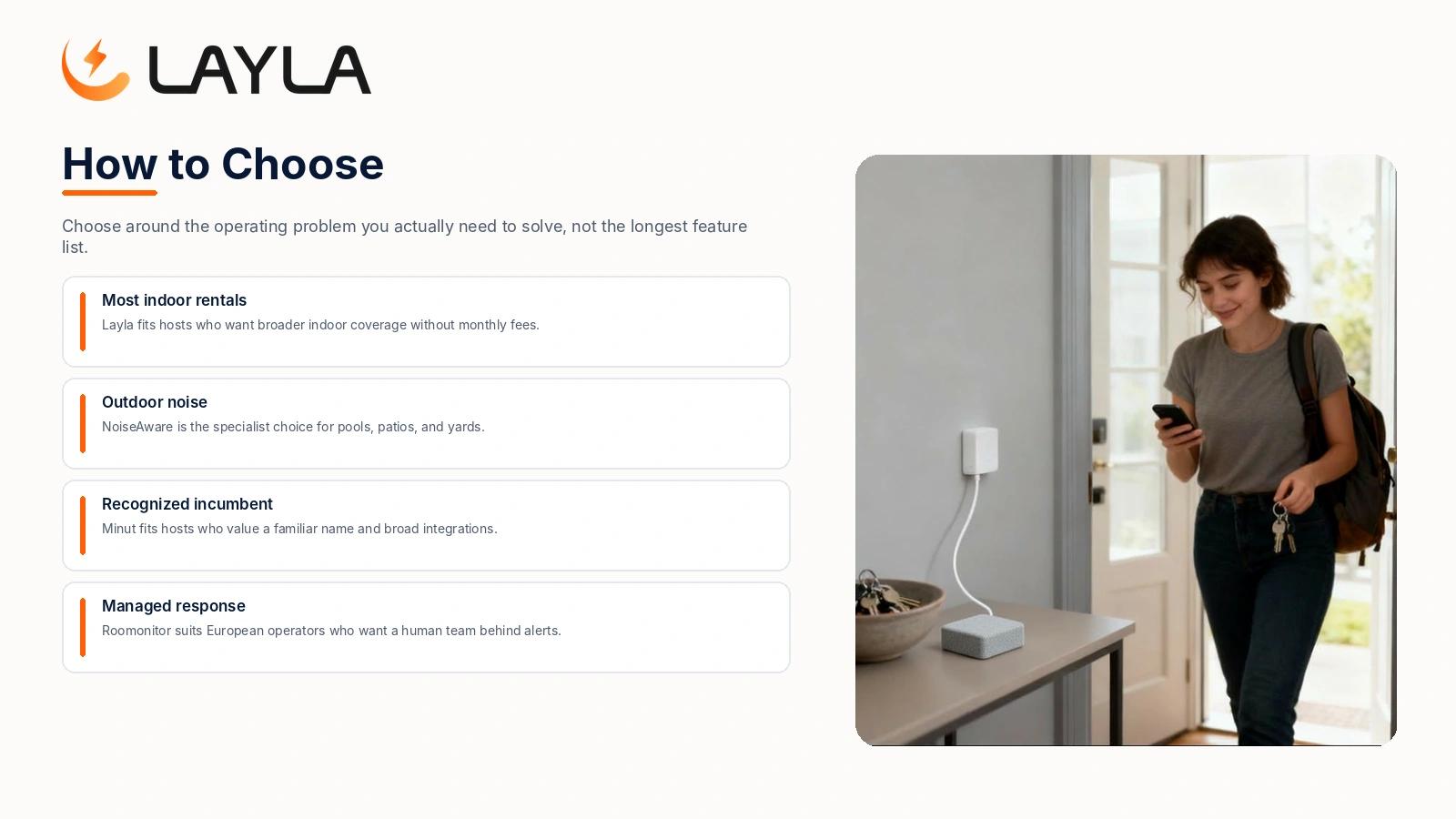
The decision comes down to the three questions from the top. If you're weighing cost across more than a property or two, the one-time model wins on arithmetic alone, and that points to Layla. The per-property subscription on every other option compounds indefinitely, while Layla's cost locks in at purchase. If your noise problem is specifically outdoors and US-based, NoiseAware's outdoor sensor covers that one job, though it does nothing else for the subscription. If you want a vendor to physically handle 2 a.m. incidents across a European portfolio, Roomonitor is the only one here that does it. And if you have a single unit and want the name everyone recognizes, Minut is a fair pick.
For most hosts in 2026, the straightforward answer is Layla. That covers anyone with a handful of rentals, anyone tired of separate bills for noise and climate, and anyone who'd rather the ceiling sensor earn its keep by watching air quality and trimming the power bill while it's at it.
Get Layla — One-Time From $149
See Layla pricing — buy once, own it permanently →
One indoor device covering noise monitoring, indoor air quality, smoke detection, and native AC automation. No monthly fees at any portfolio size. 30-day money-back guarantee.
Best Noise Monitor for Airbnb — FAQ
What is the best noise monitor for Airbnb?
For most hosts in 2026, Layla, because it solves the noise problem without a subscription and covers air quality, smoke detection, and AC automation in the same device, one-time from $149. NoiseAware is worth a look only if your problem is specifically outdoor noise on a US property and you need nothing else. Minut suits a single-property host who wants the familiar name, and Roomonitor fits European managers who want a team handling incidents in person.
Do Airbnb noise monitors record conversations?
No. Reputable noise monitors (Layla, NoiseAware, and Minut included) measure sound levels in decibels over time and never record or stream audio. That's exactly why they're acceptable to run in a rented space, and it's worth saying so in your listing to reassure guests. Avoid any device that markets the ability to listen in.
What's the best noise monitor for Airbnb without a subscription?
Layla. You pay once from $149, own the device outright, and there are no recurring fees no matter how many properties you run. Minut, NoiseAware, and Roomonitor all charge an ongoing subscription on top of the hardware. See the full one-time vs monthly breakdown in the "Subscription vs One-Time" section above.
Can a noise monitor detect an outdoor party?
Only if the sensor is built for outside. Most complaints actually start indoors, which is where Layla monitors, alongside air quality and smoke. For genuinely outdoor noise you'd add a dedicated outdoor sensor such as NoiseAware's, which is the one unit here made specifically for backyards, pools, and patios.
How much does an Airbnb noise monitor cost?
There are two models. One-time: Layla runs from $149 to $299 per device with nothing after that. Subscription: Minut is about $100 per sensor plus $5 to $15 per property per month, and NoiseAware is roughly $180 per property per year. Over three years across several properties, the one-time model is typically far cheaper, often by half or more.
Do I actually need a noise monitor for my rental?
If you have neighbors, an HOA, a local noise ordinance, or a party risk, then yes. One caught party pays for the device many times over in avoided fines, damage, and bad reviews. The bigger question is whether you want a device that only watches noise or one that also covers smoke, air quality, and energy for a similar outlay.
Keep Reading
- Best Minut Alternatives in 2026 — if Minut's the one you're moving on from
- Layla vs Minut: Full Head-to-Head — if you've narrowed it to those two
- Layla vs NoiseAware — noise-only versus all-in-one
- Minut vs NoiseAware — the two subscription incumbents, side by side
- Minut vs NoiseAware vs Layla — the three-way breakdown
- Minut Pricing Explained (2026) — the full subscription math
- Party Squasher Alternatives — if party detection is your main worry

Best for: full property coverage
All-in-One
Noise monitoring, smoke detection and smart AC control for complete coverage.
Everything included
Everything in Noise & Security Pro
AI party detector, noise alerts, intruder & break-in, occupancy, 180-day history, indoor + outdoor climate
Everything in Smoke & Air Quality
Air quality index (IAQ), CO2, bVOC, mold & smoke — full indoor + outdoor climate
Everything in AC Control & Energy
Smart AC (150+ brands), Eco Mode, schedules, filter health
Plus exclusive
- Advanced reports & insights
- Priority support
- Priority support
No monthly fees. Ever.
One sensor. Full coverage
One sensor. Full coverage.* Layla 3.0 monitors noise, air quality, motion, occupancy, temperature, humidity, pressure, VOCs, CO2, and controls your AC - from a single device on your shelf.
No subscription means no surprise costs.
Pay once. Every feature unlocked. Forever. No monthly fees eating into your rental margins or household budget.
The smartest buy is the one you make once.
Other solutions charge per-feature monthly subscriptions that exceed the device cost within a year. Layla's all-in-one pays for itself compared to any subscription alternative.
30-day money back guarantee