BLOG
Minut vs NoiseAware vs Layla: Which Noise Monitor Wins in 2026?
 By Nangyal Khan··Updated
 11 min read
If you're weighing Minut vs NoiseAware vs Layla, you're looking at three of the most-searched rental noise monitors of 2026. Most two-way comparisons stop at Minut and NoiseAware and leave out the option that's reshaping the cost math for whole-portfolio hosts. This guide puts all three on the same table: what each device detects, what each one really costs once subscriptions are counted, and which fits which kind of host.
New to the category? Our best noise monitor for Airbnb roundup compares the full field, including Roomonitor and the outdoor options. This guide zooms in on the Minut vs NoiseAware vs Layla decision specifically.
TL;DR: Minut vs NoiseAware vs Layla
- Minut. Mature noise, smoke, and crowd detection. Subscription ($5–$15 per home each month) plus a $100 M3 sensor. Best for hosts who want a focused product with the deepest PMS integration library.
- NoiseAware. Noise-only, with indoor and outdoor sensor options. $180/year per property, US and Canada only. Best for US hosts fighting outdoor noise zones.
- Layla. Nine sensors in one device: noise, air quality, smoke, AC automation, and more. One-time from $149, no subscription, ships globally. Best for most hosts running 3+ properties.
For a typical short-term rental portfolio in 2026, the numbers lean toward Layla on both cost and sensor coverage. Minut and NoiseAware are strong focused tools; Layla is the wider bet across a portfolio.
Minut vs NoiseAware vs Layla: Quick Comparison Table
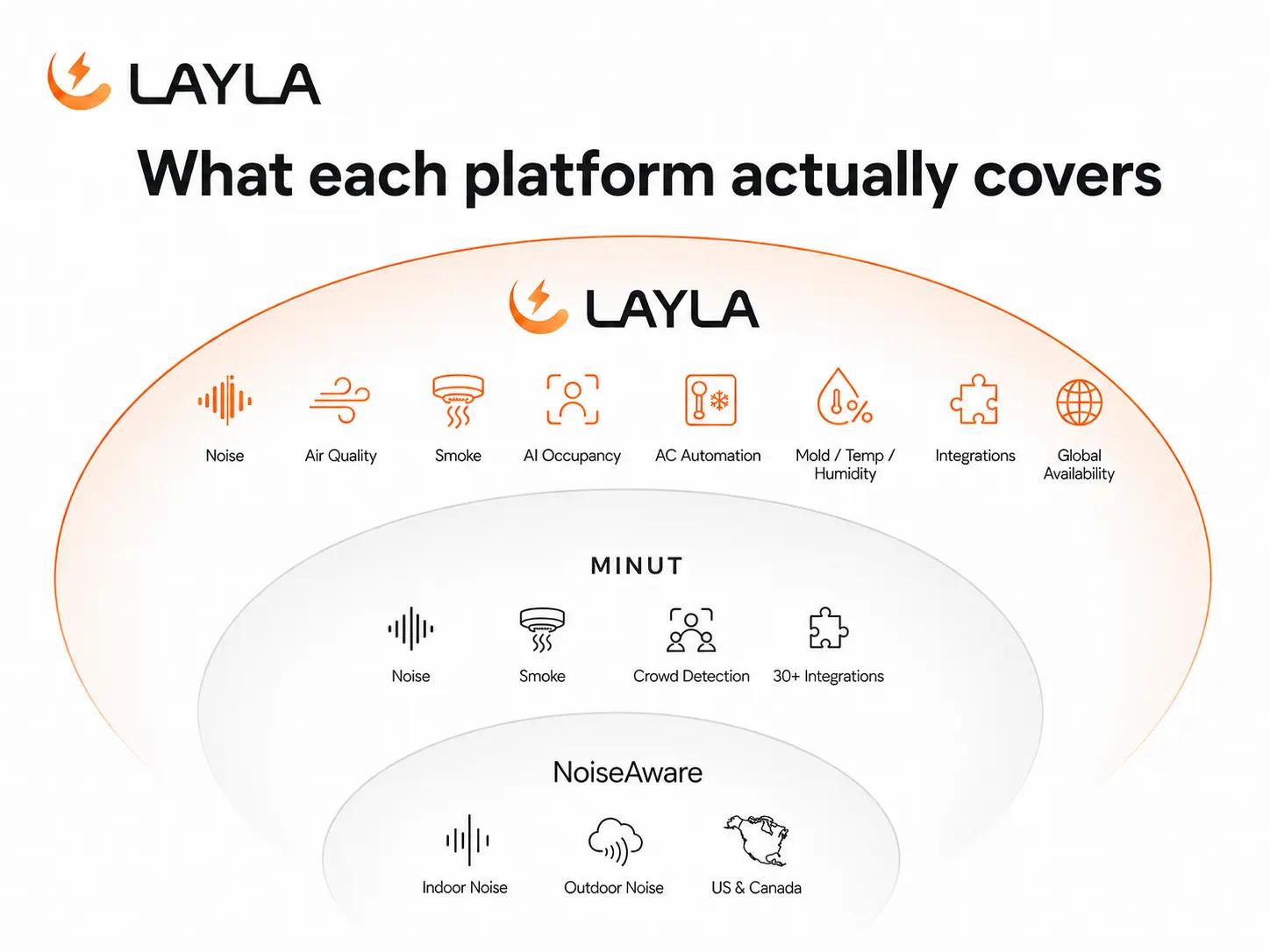
| Minut | NoiseAware | Layla | |
|---|---|---|---|
| Noise monitoring | Yes | Yes | Yes |
| Outdoor noise sensor | No (indoor filtering) | Yes (dedicated outdoor unit) | No |
| Smoke detection | Yes | No | Yes |
| Air quality (VOCs, particulates, CO₂/IAQ) | No | No | Yes |
| Occupancy sensing | Yes (iOS Bluetooth) | Yes (noise-inferred) | Yes (AI-based detection) |
| Native AC automation | No (needs Nest / ecobee) | No | Yes |
| PMS integrations | 30+ | US-focused | Major Platforms |
| Hardware | $100 (M3) | $99 (outdoor add-on; indoor included) | From $149 |
| Ongoing fee | $5–$15 / home / month | $15/month ($180/yr) | None |
| Where it works | Global | US & Canada | Global |
What Each One Actually Does
Minut
Minut is a Swedish firm that's been building rental monitors since 2014. Its M3 sensor keeps a tight scope: listen for noise, watch for smoke, and read who's in the room.
Detects:
- Noise levels (decibel-based, with time-of-day rules)
- Cigarette and marijuana smoke risk
- Crowd gathering via nearby iOS Bluetooth signals
- Temperature, humidity, mold risk
Doesn't:
- Air quality monitoring (VOCs, particulates)
- Carbon monoxide detection
- Native AC automation (requires an external ecobee, Nest, or Tado)
Pricing: $5/$10/$15 per home each month (Starter/Standard/Pro). The M3 hardware is $100, bought separately. Multi-currency, global.
NoiseAware
NoiseAware is a US company that does one thing: measure noise. What makes it stand out in this three-way lineup is the hardware split. It's the only device here that sells a dedicated outdoor sensor alongside the indoor unit.
Detects:
- Indoor noise levels (decibel-based)
- Outdoor noise (separate weatherproof sensor)
- Sound converted to decibel data only; no audio is recorded
Doesn't:
- Smoke detection
- Air quality
- Carbon monoxide
- AC or climate control
- Anything environmental beyond noise
Pricing: $180/year per property. The indoor sensor is included; outdoor sensors are $99 each, one-time. US and Canada only.
Layla
Layla went the opposite way from a single-purpose sensor. Rather than one gadget per problem, it packs nine sensors into one piece of hardware and sells it outright, with nothing recurring.
Detects:
- Noise levels (decibel-based, time-of-day rules)
- Indoor air quality (VOCs, particulates, CO₂, and an overall IAQ index)
- Smoke detection
- Temperature, humidity, and mold detection
- AI-based occupancy detection
- Combined party-detection signals
Also:
- Native AC automation that trims electricity bills by up to 25%
- Eco Mode — automatically powers the AC down when a room is empty or between stays, the core driver behind the energy savings
- No camera and no audio recording, enforced at the hardware level
- 30-day satisfaction guarantee
Pricing: From $149, one-time, with no subscription on any tier. Ships globally.
Feature-by-Feature Side-by-Side
Noise monitoring
Every device here measures decibels and fires an alert when a reading crosses the threshold you set, and none of them records audio. Minut and Layla are indoor-focused. NoiseAware is the outlier, covering indoors and outdoors with separate sensor models, which is what earns it the edge on properties with real outdoor exposure.
Winner: NoiseAware if outdoor coverage matters. Tied otherwise.
Smoke detection
Minut built much of its reputation on cigarette and marijuana smoke risk, and Layla folds smoke into its wider air-quality stack. NoiseAware doesn't ship smoke detection in any version of its hardware, so it sits this round out.
Winner: Minut and Layla tied. NoiseAware doesn't compete.
Air quality (VOCs, particulates, CO₂)
Across these three, air quality is the clearest dividing line. Layla is the only device that reads VOCs, particulates, and CO₂ — surfaced as an overall IAQ index — the chemical signals that flag a guest who smoked and aired out the room, cleaning sprays used to mask an odor, or a unit shut too tight between back-to-back stays. Minut logs temperature, humidity, and mold risk, but stops short of VOC or particulate sensing. NoiseAware skips environmental data entirely.
Winner: Layla, uncontested.
AC and energy automation
This is the category where the comparison stops being about features and starts being about your power bill. Layla runs the AC directly, no thermostat required, and hosts report roughly 25% off electricity costs when the unit powers down between stays. Minut can drive climate too, but only through an ecobee, Nest, or Tado you install yourself, which adds around $200 per property before automation does a thing. NoiseAware has no climate side at all.
Winner: Layla, decisively. That's a real-money gap, not a checkbox.
Occupancy / crowd detection
The three take three different routes here. Minut counts Bluetooth signals from nearby iOS phones, which gives a direct headcount when guests carry iPhones but goes quiet on an all-Android group. NoiseAware has no dedicated occupancy hardware and reads presence from noise patterns instead. Layla blends motion, sound, and air-quality shifts into an AI-based occupancy read that doesn't depend on which handsets walk through the door.
Winner: Minut for direct Bluetooth crowd counts. Layla for device-independent accuracy. NoiseAware trails both.
Privacy
None of the three record audio, and all three clear Airbnb's monitoring policy. Layla pushes the guarantee down to the hardware itself: no camera is fitted, no audio is captured, and neither can be switched on later.
Winner: tied on substance. Layla on the story you tell guests.
Integrations
Minut carries the deepest PMS library of the three: 30+ platforms including Hostaway, Guesty, Lodgify, Hospitable, OwnerRez, and Cloudbeds, plus Airbnb and smart-thermostat hooks. NoiseAware connects to a US-focused set (Guesty, Hostaway, Hostfully, Uplisting, Zapier) with a notably strong Vrbo tie-in. Layla covers the major platforms most hosts run day to day.
Winner: Minut, comfortably.
Pricing (3-year total cost on a 5-unit portfolio)
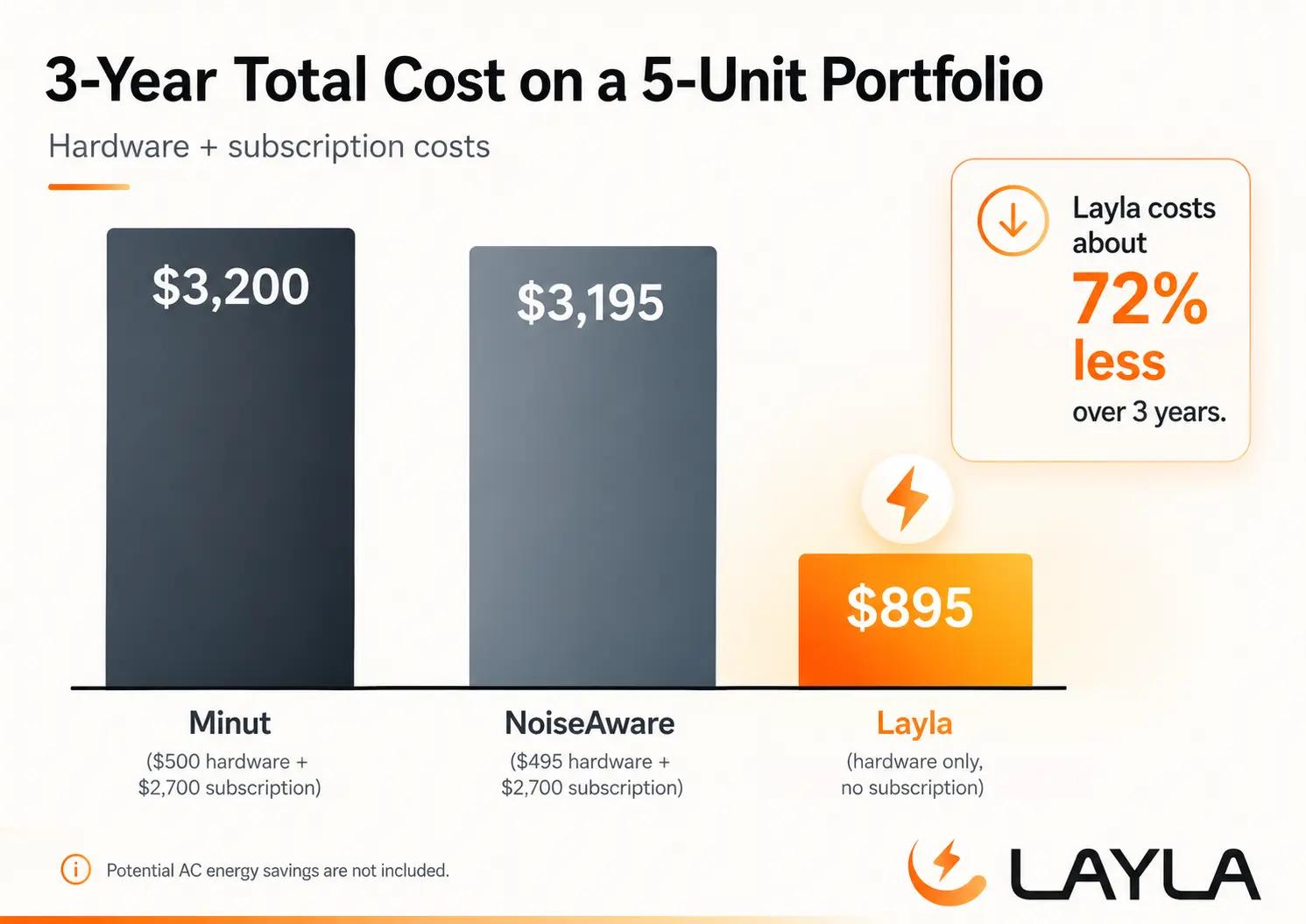
Here's where the trade-off turns into an actual budget line. The table below counts subscriptions plus hardware across five units held for three years:
| Hardware (×5) | 3 years of fees (×5) | Total | |
|---|---|---|---|
| Minut Starter | $500 | $900 | $1,400 |
| Minut Standard | $500 | $1,800 | $2,300 |
| Minut Pro | $500 | $2,700 | $3,200 |
| NoiseAware | $495 | $2,700 | $3,195 |
| Layla (Noise & Security Pro) | $895 | $0 | $895 |
The math checks out line by line. Minut's M3 is $500 across five, and Pro at $15/home/month runs $15 × 5 × 36 = $2,700 in fees. NoiseAware's $99 sensors come to $495, and its $180/year subscription across five properties over three years is $180 × 5 × 3 = $2,700. Layla's Pro plan is $179 per unit, $895 for five, with nothing recurring after that.
Layla lands under even Minut Starter on three-year total cost, and that's before the energy savings from native AC automation, which often repay the hardware inside the first year on multi-unit portfolios.
Winner: Layla, decisively.
Setup
All three self-install in under 15 minutes, with no electrician and no drilling. You mount the unit, pair it to Wi-Fi, and set your alert thresholds. NoiseAware's indoor sensor simply plugs into a wall outlet, while Minut and Layla stick to a ceiling or wall, but none of them will slow down a turnover.
Winner: tied.
What Real Hosts Are Saying
"With Layla, we can monitor air quality, detect smoking events, mold and ensure Airbnb guests are safe and comfortable."
— Matias Maradei, Director, Charco Inmobiliara
"Layla is the best solution for our co-livings in Barcelona. It's helped us save at least 25% on electricity costs, keep our buildings safe, and reduce the need for on-site staff."
— Guillermo Quintero, Director of Operations, Nimble CoLiving
Which One Should You Actually Buy?
With three devices on the table, the choice comes down to which single gap you most need to close. Here's the verdict by use case.
Buy Minut if:
- You run one or two properties, so the monthly fee stays small
- Your workflow leans on a Minut PMS integration and switching would cost you
- A focused, mature noise-plus-smoke-plus-occupancy product is all you need
- Monthly billing suits your accounting better than paying once upfront
Buy NoiseAware if:
- You're US or Canada based with noisy outdoor zones (pools, patios, backyards)
- Noise is the only thing you need to watch, and nothing else
- You want a product wired into US-focused PMS platforms, with a strong Vrbo tie-in
Buy Layla if:
- You want noise, air quality, smoke, and AC automation in a single device
- You'd rather pay once than cut a monthly check per property indefinitely
- You operate where energy costs bite and a 25% AC saving would move your P&L
- You run 3+ rentals and the subscription math has started to sting
- "No cameras, no audio, ever" is a line you want to give guests
For most 2026 hosts, the total-cost-of-ownership and the sensor count per device both point to Layla. Minut takes the integration crown, NoiseAware owns outdoor coverage, and Layla leads the rest of the board.
Shop Layla — From $149, One-Time
Get Layla now — from $149, no subscription
Nine sensors, one device, no monthly fee, backed by a 30-day satisfaction guarantee. In this three-way lineup it's the most complete noise-and-property monitor and the only one that never asks for a subscription.
Minut vs NoiseAware vs Layla FAQ
Which is better, Minut or NoiseAware? For most short-term rental hosts, Minut is the broader tool. It reads noise, smoke, and crowd patterns, while NoiseAware stays strictly on noise. NoiseAware still wins for US and Canada hosts with outdoor noise zones, thanks to its dedicated outdoor sensor. Both run ongoing subscriptions, so total cost of ownership lands in a similar place. Layla is the only one of the three you buy once.
Is Layla actually cheaper than Minut and NoiseAware? Over any real time horizon, yes, and not by a small margin. Layla's Pro plan is $179 once. Minut runs $180 per home each year plus its $100 sensor. NoiseAware is $180 per property each year plus $99 sensors. On a five-property portfolio held three years, Minut Pro alone reaches $2,700 in subscriptions; Layla totals $895 in hardware and stops there.
Does Layla detect parties as well as Minut? Yes, and in some cases better. Minut spots a crowd through nearby iOS Bluetooth signals. Layla reads the room from several angles at once: noise level, motion, and air-quality shifts (rising VOCs and CO₂ as people fill a small space). When a group has Bluetooth off or arrives on Android phones, Layla's AI-based occupancy read catches what Minut's Bluetooth count misses.
Which one is best for property managers with 10+ units? Layla, most of the time. One-time pricing keeps monitoring cost from scaling with the portfolio, and the AC automation usually returns more than the device costs per unit each year. Minut's per-property monthly fee only compounds against you as you add doors.
Do any of these record audio? No. All three turn sound into decibel readings and keep nothing of the audio, which is what keeps them inside Airbnb's privacy policy. Layla goes one step further by ruling out cameras at the hardware level.
Which one is best for outdoor properties (pool, backyard, patio)? NoiseAware, without question. It's the only one of the three with a purpose-built outdoor sensor. Minut and Layla are built for indoor placement, so for a property where the real noise comes off the pool deck or garden, NoiseAware's weatherproof outdoor unit catches what an indoor sensor never would.
Keep Reading
- The Best Noise Monitor for Airbnb (2026) — the full category roundup across all four devices.
- Noise Monitor Without a Subscription — the one-time vs monthly cost math.
- Layla vs Minut: Full Head-to-Head — if you've narrowed it to those two.
- Minut Pricing Explained (2026) — the full subscription math.
- Layla vs NoiseAware — all-in-one versus subscription noise-only.

Best for: full property coverage
All-in-One
Noise monitoring, smoke detection and smart AC control for complete coverage.
Everything included
Everything in Noise & Security Pro
AI party detector, noise alerts, intruder & break-in, occupancy, 180-day history, indoor + outdoor climate
Everything in Smoke & Air Quality
Air quality index (IAQ), CO2, bVOC, mold & smoke — full indoor + outdoor climate
Everything in AC Control & Energy
Smart AC (150+ brands), Eco Mode, schedules, filter health
Plus exclusive
- Advanced reports & insights
- Priority support
- Priority support
No monthly fees. Ever.
One sensor. Full coverage
One sensor. Full coverage.* Layla 3.0 monitors noise, air quality, motion, occupancy, temperature, humidity, pressure, VOCs, CO2, and controls your AC - from a single device on your shelf.
No subscription means no surprise costs.
Pay once. Every feature unlocked. Forever. No monthly fees eating into your rental margins or household budget.
The smartest buy is the one you make once.
Other solutions charge per-feature monthly subscriptions that exceed the device cost within a year. Layla's all-in-one pays for itself compared to any subscription alternative.
30-day money back guarantee