BLOG
Layla vs Minut: Which Noise Monitor Wins for Airbnb Hosts in 2026?
 By Nangyal Khan··Updated
 15 min read
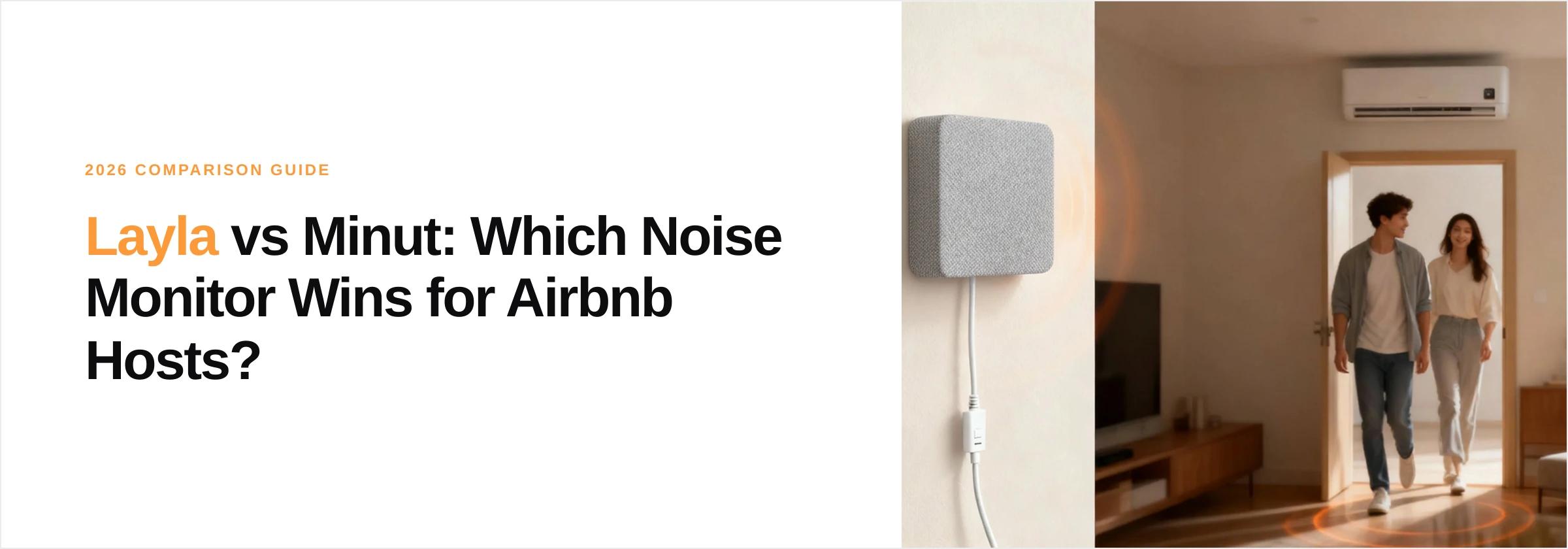
Two devices. One costs $100 for the hardware, then charges $5 to $15 per property every single month, indefinitely. The other starts at $149 once, with no subscription ever.
That's the headline difference between Layla and Minut when you're comparing noise monitors. For hosts who also want air quality monitoring, smoke detection, and AC automation under one roof, Layla's All-in-One plan comes in at $299, still cheaper than Minut over any two-year window once the monthly fees are counted.
The rest of this comparison gets into what each device actually monitors, where each one falls short, and how the two fit into a real rental operation. We'll cover noise detection, smoke and air quality, occupancy, integrations, privacy, setup, and total cost of ownership: the stuff that actually matters when you're making this call.
Quick Summary
Choose Minut if you only need noise, smoke, and occupancy monitoring, you're already deeply integrated into their platform connections, and a per-sensor hardware cost plus ongoing monthly subscription works for your budget. If you're an Airbnb host who qualifies for Minut's free sensor program (available in 60+ countries, up to 5 properties), that changes the math meaningfully for a smaller portfolio.
Choose Layla if you want one device that handles noise, indoor air quality, smoke, occupancy, and native AC automation, without paying monthly fees, ever. Layla starts at $149 as a one-time purchase, where Minut adds $5 to $15 per property every month on top of its $100 sensor. For the full feature set, the All-in-One at $299 still comes in below Minut on any subscription tier over two years.
What Is Minut?
Minut has been in this space since 2014, long enough that "Minut" has become almost a shorthand for "rental noise monitor" in some host communities. Their current flagship (the M3) is a small disc you mount on the ceiling. It tracks sound levels, cigarette and marijuana smoke risk, crowd-gathering signals, temperature, humidity, and mold risk, then pushes alerts to a phone app where you set thresholds per property and per time of day.
What Minut does well:
- Long track record and a genuinely mature feature set
- Cigarette and marijuana smoke risk detection built in
- Crowd-gathering detection using nearby iOS Bluetooth signals as a proxy for headcount
- Extensive integration library: Hostaway, Guesty, Lodgify, Airbnb, Hospitable, Hostfully, OwnerRez, Cloudbeds, and 30+ more
- Thermostat integrations with ecobee, Google Nest, and Tado for climate control
- Official Airbnb partner: eligible hosts in 60+ countries can claim a free M3 sensor plus 3 months of Pro or Standard subscription, up to 5 listings
Where it falls short:
- Tracks temperature and humidity but doesn't monitor indoor air quality in the broader sense (VOCs, particulates, CO2)
- Its smoke detection flags a cigarette-or-marijuana risk, but it doesn't identify the specific type of smoke or catch vape
- Doesn't natively automate AC: it integrates with thermostats you already own, which means you need a compatible ecobee, Nest, or Tado installed in every unit before climate automation is even possible
- Crowd Detect only works with iOS devices. Android phones don't broadcast Bluetooth passively the same way, so in markets where guests lean Android, this feature will undercount, sometimes significantly
- Every property requires both the one-time hardware purchase ($100 per sensor) and an ongoing monthly subscription
Minut is a focused, polished product. If noise and occupancy is all you need, it's a defensible choice.
What Is Layla?
Layla takes a different approach entirely. Instead of specializing in one or two categories and charging monthly, Layla sells a single device that covers noise, smoke, indoor air quality, temperature, humidity, mold, occupancy, and native AC automation, all managed from one app with no recurring fees attached.
Layla pricing: one-time plans, no subscriptions
| Plan | Price | What's included |
|---|---|---|
| Noise Basic | $149 | Noise alerts, AI occupancy, temperature and humidity, 7-day history |
| Noise and Security Pro | $179 | Noise Basic plus party detection, live alerts, and 180-day history |
| Smoke and Air Quality | $99 | CO2, VOCs, smoke and cigarette detection, mold risk, temperature and humidity |
| AC Control & Energy | $175 | Smart AC control, occupancy-based auto-off, energy insights |
| All-in-One | $299 | Everything above, plus Eco Mode and priority support |
For a noise monitor comparison, the entry point is Layla's Noise Basic plan at $149, one-time, with the Noise and Security Pro plan at $179 adding party detection, live alerts, and longer history. Either way there's no subscription. Hosts who want air quality monitoring, smoke detection, and native AC automation in the same device can step up to the All-in-One at $299, which is still cheaper than Minut on any multi-property portfolio over two years.
What makes Layla different:
No monthly subscription. You pay once. Features stay unlocked permanently, with no per-property recurring fees stacking up over time.
One device, many categories. You don't need to piece together separate vendors per unit to cover noise, air quality, and climate control.
Native AC automation. Layla controls compatible AC systems directly, cutting electricity costs by up to 25%, with no separate smart thermostat required per unit.
Privacy-first by design. No camera. No microphone. Sound is measured in decibels only and never stored as audio.
30-day money-back guarantee. If it doesn't work for your setup, you get a full refund. That's a meaningful safety net when you're buying hardware you've never tested.
Feature-by-Feature Comparison
Noise Monitoring
Both devices work well here. Both let you set custom decibel thresholds per property, schedule quieter limits overnight, and get instant alerts when readings spike past your set level. Neither records audio; sound is converted to decibel data only, keeping both compliant with Airbnb's monitoring policy.
The real difference is context. Minut treats the noise reading as the primary event. Layla treats it as one signal among several: a 92 dB spike at midnight that also coincides with rising VOC levels or an occupied-when-it-should-be-empty reading tells a different story than a TV left on too loud. Whether that matters to you depends on how granular you want your alerts to be.
For standalone noise detection, they're roughly on par. Where Layla starts to pull ahead is when noise is read alongside other environmental signals.
Smoke Detection
Both devices flag smoke, but not in the same way. Minut is strong at flagging elevated cigarette and marijuana smoke risk, having refined it as a core feature since the early days. What it doesn't do is name the specific type of smoke or catch vape.
Layla goes a step further. It identifies whether an event was cigarette, vape, or cannabis, grades the intensity as low, medium, or high, and cross-checks it against its VOC air-quality readings so a scented candle doesn't cry wolf. When a guest disputes a cleaning fee, "medium-intensity cannabis smoke at 11:40pm" is a far more defensible record than a generic smoke flag. On smoke, Layla does more than match Minut: it tells you what actually happened.
Neither device is a certified fire alarm, and neither detects carbon monoxide. For CO you still need a dedicated CO alarm, and for life safety you keep the code-required smoke detector on the ceiling. Treat both of these as enforcement and awareness tools, not replacements for safety hardware.
Air Quality
Layla monitors VOCs, CO2, particulates, temperature, and humidity, a full indoor environmental picture, and flags mold risk before it becomes a visible problem. Minut covers temperature, humidity, and mold risk, but stops short of the broader VOC and particulate data.
For properties in wildfire-prone areas, urban markets with outdoor air infiltration, or listings that attract health-conscious guests, Layla captures data Minut simply doesn't. If this matters to your guests or your listing positioning, it's worth knowing.
Occupancy and Crowd Detection
Minut's Crowd Detect counts how many iOS devices are within Bluetooth range of the sensor and alerts you when that number exceeds your threshold. It's a direct, well-understood approach, with one real limitation: it only detects iOS devices. Android phones don't broadcast Bluetooth passively the same way, so they aren't counted.
In markets where Android is dominant (most of Europe, large parts of Asia), Crowd Detect will consistently undercount guests. It's not a dealbreaker, but it's worth knowing before you rely on it.
Layla reads occupancy with AI-based radar, sensing physical presence in the room rather than pinging guest phones, with no camera, no microphone, and no Bluetooth involved. Because it doesn't depend on what devices guests carry, the reading stays consistent across different markets. For a direct device headcount in iPhone-heavy markets, Minut has an angle. For reliable presence detection regardless of guest phones, Layla's radar is the steadier signal.
AC Control and Energy Savings
This is probably the biggest functional gap between the two products.
Layla controls compatible AC systems natively, adjusting set-points based on occupancy and conditions to cut electricity costs by up to 25%. No additional hardware needed.
Minut doesn't control AC directly. It connects to ecobee, Google Nest, and Tado, which means you need a compatible smart thermostat already installed in every unit before climate automation is even possible. Smart thermostats typically run $130–$200 each. Add that per-unit cost to Minut's hardware and monthly subscription and the real cost per property climbs fast.
This isn't a minor feature difference. If energy costs are meaningful in your portfolio, Layla's native AC automation is a genuine financial advantage, not just a convenience.
Privacy
Both devices are camera-free and don't record audio. Both convert sound to decibel readings only. Both comply with Airbnb's monitoring disclosure policy.
The practical difference is mostly in how you communicate it to guests. Layla positions privacy as a hardware-level design decision: no camera, no microphone, full stop. That's a cleaner story to tell a guest who asks. Functionally, both devices can be disclosed to guests without issue.
Integrations
Minut's integration library is genuinely extensive, covering PMS platforms (Hostaway, Guesty, Lodgify, Cloudbeds, OwnerRez, Hospitable, Hostfully, and more), Airbnb natively, smart thermostats, smart locks, and Zapier. For hosts on niche PMS platforms or those with complex automation workflows already built around Minut, this depth is a real advantage.
Layla covers the major STR platforms most hosts are actually using. For a mainstream stack (Airbnb, the leading PMS names, standard smart home systems), coverage is solid. If you're on a less common platform, it's worth checking compatibility before purchasing.
For breadth of integrations, Minut leads. For the majority of hosts running standard setups, both products cover what's needed.
Pricing
Minut: two required costs per property
| Cost | Details |
|---|---|
| Hardware (one-time) | M3 Sensor: $100 per property |
| Subscription (annual) | Starter: $5/mo ($60/yr) · Standard: $10/mo ($120/yr) · Pro: $15/mo ($180/yr) |
Note for Airbnb hosts: Minut's Airbnb partnership lets eligible hosts in 60+ countries claim a free M3 sensor plus 3 months of Pro or Standard subscription, up to 5 listings. Standard subscription rates apply after the free period.
Layla: one-time purchase, no subscription
| Plan | Price |
|---|---|
| Noise Basic | $149 |
| Noise and Security Pro | $179 |
| Smoke and Air Quality | $99 |
| AC Control & Energy | $175 |
| All-in-One | $299 |
Three-year total cost, five properties:
| Hardware | 3-Year Subscription | Total | |
|---|---|---|---|
| Layla Noise and Security Pro | 5 × $179 = $895 | $0 | $895 |
| Layla All-in-One | 5 × $299 = $1,495 | $0 | $1,495 |
| Minut Starter | 5 × $100 = $500 | 5 × $60 × 3 = $900 | $1,400 |
| Minut Pro | 5 × $100 = $500 | 5 × $180 × 3 = $2,700 | $3,200 |
On a five-property portfolio over three years, Layla's Noise and Security Pro plan totals $895 and never renews. Minut Starter comes to $1,400 and Minut Pro to $3,200, with the subscription portion recurring for as long as you use it.
Even Layla's full All-in-One ($1,495 total for five properties) lands close to Minut Starter and well under Minut Pro over three years, while covering air quality, smoke, and AC automation that Minut doesn't. The math doesn't get better for Minut as your portfolio grows; it gets worse, because subscription fees are a fixed cost per property, per month, indefinitely.
Setup and Installation
Both devices self-install in under 15 minutes: mount the sensor, connect to Wi-Fi via the app, configure your thresholds. There's nothing complicated about either setup.
Layla's portable form factor is worth mentioning for anyone who can't drill into walls: renters, multifamily operators, or hosts who move devices between seasonal listings. If permanent installation isn't an option, Layla is the more flexible choice.
Customer Support
Minut offers email and chat support with faster response times on higher subscription tiers. Layla offers email support and a 30-day money-back guarantee, which in practice functions as a low-risk trial period rather than a leap of faith on new hardware.
If tiered support escalation matters to your operation, Minut has the edge. If you'd rather evaluate the hardware properly before committing, Layla's return window is more generous.
What Real Hosts Say
With Layla, we can monitor air quality, detect smoking events, mold, and ensure Airbnb guests are safe and comfortable.
— Matias Maradei, Director, Charco Inmobiliaria
Layla is the best solution for our co-livings in Barcelona. It's helped us save at least 25% on electricity costs, keep our buildings safe, and reduce the need for on-site staff.
— Guillermo Quintero, Director of Operations, Nimble CoLiving
Which One Should You Buy?
Minut makes sense if:
- You manage one or two properties and the hardware plus subscription fits your budget without friction
- You're already embedded in a PMS workflow built around Minut's integrations and the switching cost isn't worth it
- You only need noise, smoke, and occupancy monitoring, and climate automation is already handled elsewhere in your stack
- You prefer spreading costs as a monthly operating expense rather than a larger one-time purchase
- You're an Airbnb host who qualifies for the free sensor program (up to 5 listings, subscription applies after the 3-month free period)
Layla makes sense if:
- You want one device, one app, one purchase, not multiple vendors per property
- You'd rather pay once, from $149, for noise monitoring than $100 upfront plus $5–$15 per property every month going forward
- Your properties are in markets where energy costs are significant and the 25% AC savings translates to real dollars
- You manage three or more rentals and the per-property subscription cost is starting to add up
- Guest privacy and transparency matter to you: "no cameras, no audio recording" is something you want to be able to say clearly
For most hosts running three or more short-term rentals in 2026, Layla is the stronger choice, primarily because of the no-subscription model and native AC automation. Minut is a polished product with a real track record, but its cost structure works against you as your portfolio grows, and getting to the same feature coverage requires additional hardware investment per unit.
Frequently Asked Questions
Is Layla cheaper than Minut?
Over any real time horizon, yes. Layla starts at $149 as a one-time purchase, with the Noise and Security Pro plan at $179 and no subscription on any tier. Minut is $100 for the M3 sensor plus $5 to $15 per property every month, indefinitely. On a five-property portfolio over three years, Layla's Noise and Security Pro plan totals $895, while Minut ranges from $1,400 (Starter) to $3,200 (Pro). Airbnb hosts who qualify for the free sensor program can offset hardware costs for up to 5 properties, but subscription fees apply after the initial 3-month period.
Does Minut detect smoke?
Yes. Minut flags an elevated risk of cigarette and marijuana smoke, and confirmed detections have served as supporting evidence through Airbnb's resolution process. What it doesn't do is identify the specific type or catch vape. Layla goes further, naming whether an event was cigarette, vape, or cannabis and grading its intensity, alongside broader indoor air quality including VOCs and CO2.
Does Layla work with Airbnb?
Yes. Layla is built for short-term rental hosts across Airbnb, Vrbo, and Booking.com. It integrates with major PMS platforms and works as a standalone solution for hosts managing listings directly.
Can I switch from Minut to Layla mid-season?
Yes. Mount Layla in each unit, connect to Wi-Fi, and configure your thresholds, which takes about 15 minutes per property. You can run both devices in parallel for a week during the transition, then cancel Minut once you're confident in the setup. Layla's 30-day money-back guarantee gives you a fallback if anything doesn't work as expected.
Does Layla or Minut record audio?
Neither device records audio. Both convert sound to decibel readings only and don't store audio files. Both comply with Airbnb's monitoring policy. Layla makes this a hardware-level design decision rather than a software setting.
Which is better for property managers with 10 or more units?
Layla, in most cases. The no-subscription model means monitoring costs don't scale linearly with portfolio size. The AC automation can also recover more than the hardware cost per unit annually in larger portfolios. Minut's per-property monthly fee compounds as the portfolio grows.
Does Layla detect parties?
Yes. It reads noise levels alongside radar-based occupancy and air-quality changes, such as rising VOCs and CO2 from many people in an enclosed space, to identify developing situations earlier than a noise-only sensor typically would.
Related Articles
- Best Minut Alternatives for Short-Term Rental Hosts in 2026
- Layla vs NoiseAware: Which Sensor Fits Your Portfolio?
- Best Noise Monitor for Airbnb in 2026

Best for: serious hosts
Noise Pro
Compliant with Airbnb's rules and local noise laws worldwide. Advanced protection for serious hosts.
Included forever – no subscription
- AI party detector
- Instant noise alerts with timestamps
- Live data feed, no 5-minute delay
- 180-day data history
- Radar intruder & vacant-home alerts
- Property status dashboard
- Outdoor temperature & humidity
- Automatic AI accuracy updates
- Daily & weekly summary reports by email
No monthly fees. Ever.
Your indoor air is 2-5x more polluted than outdoor air.
The EPA confirms it, but most people have no idea. You spend 90% of your time indoors breathing air you've never measured.
CO2 builds up silently.
A bedroom with two people can hit 2,500 ppm overnight. Harvard research shows decision-making drops 50% at 1,400 ppm. That brain fog and morning fatigue? It might not be bad sleep - it's bad air.
VOCs are off-gassing in every room.
New furniture, carpets, paint, cleaning products indoor VOC levels run up to 10x higher than outdoors. Some, like formaldehyde and benzene, are classified carcinogens. You can't smell most of them.
Mold starts in 24 hours.
When humidity exceeds 60%, mold begins colonizing within a day. 47% of U.S. homes show visible mold. Average remediation cost: $2,368 severe cases hit $30,000. A sensor that warns you before mold starts is orders of magnitude cheaper than cleanup.
Standard smoke detectors only catch fires.
They don't detect cigarette, vape, or marijuana smoke at low levels. For landlords and hosts, unauthorized smoking causes damage that goes unnoticed for weeks.
Post-COVID, people want data.
66% of Americans are more cautious about indoor air since the pandemic. 61% say they'd trust a space more if it monitored air quality. The awareness shift is permanent.
30-day money back guarantee