BLOG
Noise Monitoring for Student Housing in 2026: Keeping the Peace at Building Scale
 By Nangyal Khan··Updated
 10 min read
Of all the places a noise problem can live, student housing is the hardest. The residents are young, social, and often on their own for the first time, and the entire appeal of the experience is that nobody is standing over them. That is how it should be. It is also why complaints, neighbour friction, and property wear run higher in student accommodation than in almost any other kind of rental.
The operators who manage it well have reached a conclusion that sounds backwards at first. The objective is not to catch students being loud. It is to make quiet the easy option, so that catching anyone almost never becomes necessary. What follows is how noise monitoring serves that goal: where the legal line falls for off-campus units, which systems fit a building rather than a single room, and why the pricing model matters more here than anywhere else.
The tools that don't fit here
You cannot post staff in every building overnight, and you would not want a residence that felt like it needed them. Cameras and audio recording are off the table entirely. These are tenants' homes, and off-campus residents hold the same right to quiet enjoyment as anyone else, plus privacy protections that make surveillance of their living space a genuine legal exposure. Writing quiet hours into a lease helps, but enforcement still hinges on someone being bothered enough to report, and in a building full of students that is a coin toss.
That leaves a real gap. You have a legitimate interest in whether a unit is generating disruptive noise, since it affects neighbours and tracks closely with the parties that damage the property. What operators have historically lacked is any privacy-respecting way to actually know. Noise monitoring is what closes that gap, provided it is the right kind.
Monitoring the sound, not the student
Privacy-safe noise monitoring measures one thing. How loud a unit is, and for how long. It sends an alert when noise stays high enough, long enough, to signal a genuine disturbance. It records no audio and carries no camera. It cannot overhear a conversation or observe a room. All it can report is that a unit has been loud. Layla does exactly this. A small, discreet noise and security sensor reads sound level and occupancy patterns, never the people inside.
This is what keeps an operator on firm ground. You are not monitoring students, you are monitoring a condition of the unit, no different in kind from tracking temperature or humidity. And because nothing is recorded or listened to, you can write it openly into the housing agreement and the resident handbook. Sound levels are monitored, conversations are not. Residents who understand precisely what the device does are far less inclined to read it as surveillance, because it is not one.
What student housing needs from a noise monitor
The requirements here are shaped by scale and by the resident. The device has to measure level only, both for the legal reasons above and to keep trust with students who will notice anything that feels invasive. It has to work across a whole building from one dashboard, not as a separate app per room that no one can realistically watch. It should catch vaping, because in student housing that is the single most common and best-hidden lease violation. And the cost has to scale sanely, because whatever you pay for one unit, you are about to pay for fifty or two hundred.
That last point is where the choice of system matters most.
NoiseAware, Minut, and Layla at building scale
Three names dominate, and at building scale their differences stop being academic.
| NoiseAware | Minut | Layla | |
|---|---|---|---|
| Device (upfront) | Included in plan; $99 outdoor add-on | ~$100 per device | $179 / $299 (one-time) |
| Ongoing subscription | ~$180/yr per unit | $5–15/mo per unit | None |
| Cost, 50 units / year | ~$9,000/yr | ~$3,000–9,000/yr | $0/yr (after ~$8,950 once) |
| Vaping detection | No | No (cigarette only) | Yes (cig / vape / cannabis) |
| Air quality (CO₂, mold) | No | Climate only | Yes |
| Cameras / audio | None | None | None |
| Availability | US & Canada | Wider | Wider |
NoiseAware is a capable noise-only monitor, sold on subscription at around $180 per year for each property and limited to the United States and Canada. For a single vacation rental that is fine. For a residence of many units it means a recurring annual fee multiplied across every room, and it does nothing about vaping or air quality, which in student housing are not side issues.
Minut adds occupancy, cigarette-smoke, and climate sensing on top of noise, and charges roughly $5 to $15 per month for each home, with data retention tied to the tier. Across a building, two costs compound at once. The monthly fee per unit, and the pressure to buy a higher tier just to keep a usable history. Both scale with your door count, every month, indefinitely.
Layla is the one-time-purchase option, which is exactly what changes the arithmetic at scale. The Pro plan is $179 per unit and covers real-time decibel monitoring, timestamped alerts, quiet-hours enforcement with automatic notifications, occupancy estimation, and a 180-day history, with no cameras and no audio. The All-In-One plan at $299 adds smoke and air quality, including the vaping detection that student housing needs. You buy each sensor once. There is no per-room monthly fee waiting to multiply across the building. For an operator fitting out a whole residence, that is the difference between a one-time capital cost and a software bill that grows with every unit and never ends.
Why the early nudge beats the crackdown
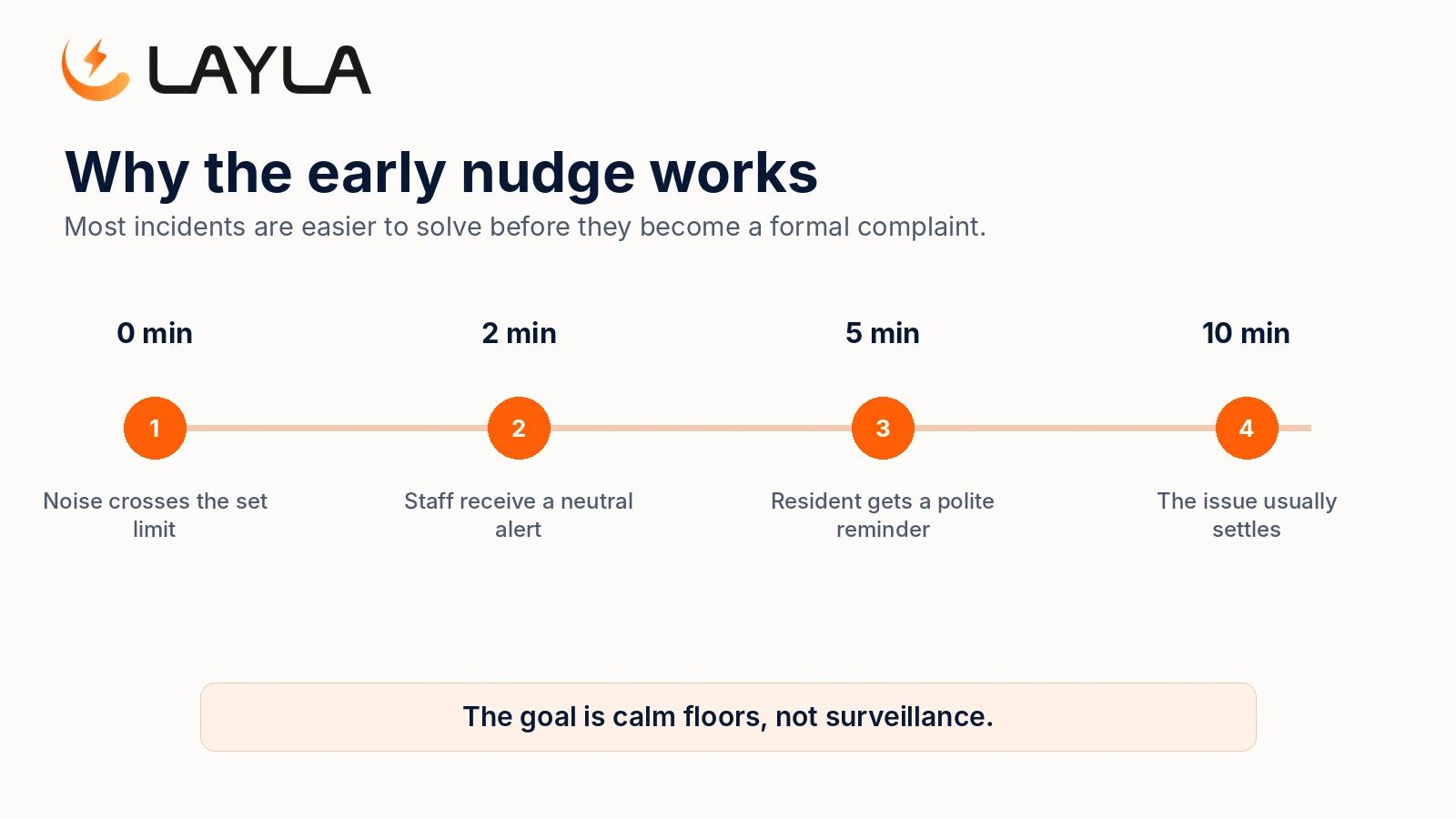
New operators are often surprised by this, but in most cases students do not know they are being loud. A dozen people in a shared unit on a Friday night simply lose track of the volume. A low-key message the moment noise crosses the line, something like "hey, noise levels are running high, please keep it down for your neighbours," settles the large majority of incidents with no escalation and no confrontation at anyone's door.
That nudge only exists if you know in the moment. The gap between a message at 11:15 tonight and a formal complaint filed tomorrow morning is the gap between a non-event and a disciplinary file. Monitoring is what puts you on the right side of it. Pair it with clear expectations set on move-in day, and noise management stops being a running battle and becomes a backstop you rarely have to use.
Vaping, and the damage you don't see
Students are hard on buildings, and the costs that sting most are the ones you do not see until turnover.
Vaping leads the list, precisely because it is easy to hide and nearly impossible to prove after the fact. A vape leaves no lingering smell the way a cigarette does, so without a sensor the first evidence is often a damaged unit and a resident who denies everything. Layla detects smoke as it happens and tells cigarette from vape from cannabis, grading the intensity so a faint trace reads differently from a unit that is being vaped in nightly. You handle it during the tenancy, with evidence, instead of absorbing the deep-clean at move-out.
The slower damage matters just as much. Shared units get crowded, under-ventilated, and damp. CO₂ climbs in a closed room full of people, and humidity drifts toward mold in a bathroom that is never idle. The same sensor's air-quality monitoring reads these conditions continuously, so the building surfaces what needs attention before it becomes a habitability complaint or a repair invoice. A noise-only system sees none of it.
Why per-room subscription punishes buildings
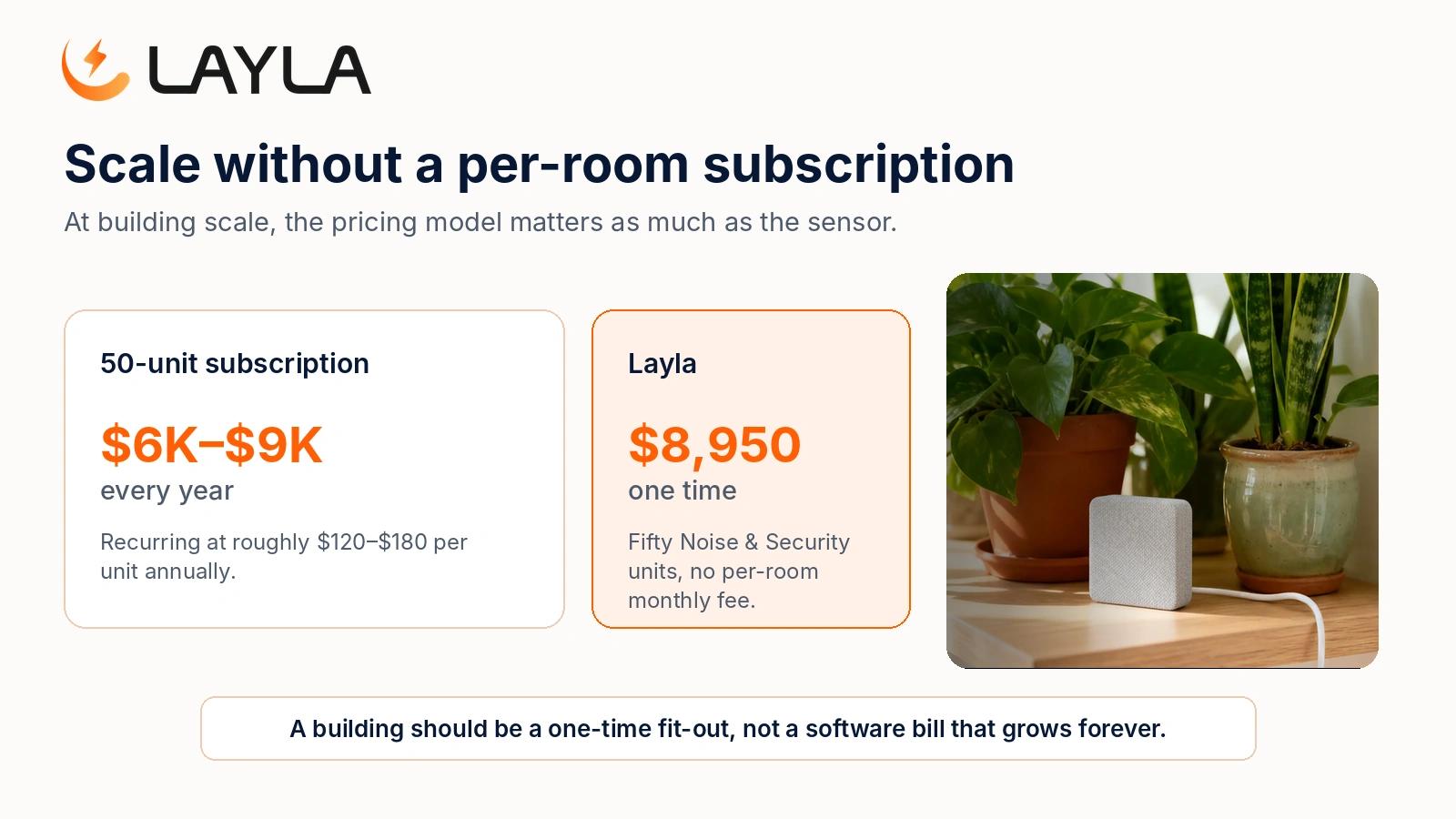
The economics are the clearest argument of all. Take a fifty-unit residence. On a subscription at roughly $120 to $180 per unit per year, that is between $6,000 and $9,000 every year, recurring for as long as you operate, and climbing if you want longer data retention. Layla's Pro plan at $179 per unit is a one-time outlay of about $8,950, after which the ongoing cost is nothing. The subscription passes the one-time purchase inside the first year or two, and every year after that the difference compounds in your favour.
A recurring per-unit fee is designed for someone with one or two properties. Applied to a building, it becomes a permanent, scaling drain. Operators fitting out whole residences tend to reach the same conclusion and buy the hardware once.
What operators say
The case rests on the device working in a real building. A verified Amazon reviewer using Layla for rental-property monitoring calls it "one of those rare products that just works," and another, Aaron, notes how much functionality is packed into one unit and how simply it set up and integrated with existing smart-home systems. For an operator deploying across many rooms, a device that installs in minutes and runs reliably is not a nicety. It is the only kind that survives contact with a real residence.
Frequently asked questions
Is noise monitoring in student housing legal?
Yes, when it measures sound levels only and is disclosed to residents. It monitors a condition of the unit rather than the students, which distinguishes it from surveillance. Recording audio or installing cameras inside residents' units is not permitted and breaches their right to quiet enjoyment.
Do students have to be told about the monitoring?
Yes, and it works better when they are. Best practice is to state clearly in the housing agreement and handbook that sound levels are monitored but conversations are never recorded. Transparency reduces friction and helps make quiet the expected norm.
Can it detect vaping or smoking in student units?
Yes. Layla detects smoke and distinguishes cigarette, vape, and cannabis, with intensity grading. This is especially useful in student housing, where vaping is common, easy to conceal, and otherwise only discovered at move-out.
What is the best noise monitor for student housing?
For a building, the one-time model wins. NoiseAware and Minut are both subscription-based and multiply their fees across every unit, and NoiseAware covers noise only. Layla is a one-time purchase per unit with no monthly fee and adds vaping detection and air quality, which fits multi-unit residences best.
How does monitoring reduce noise complaints without confrontation?
It alerts staff the moment sustained noise begins, allowing a quick, neutral reminder before neighbours escalate. Since most students do not realize they are being loud, an early nudge resolves the majority of incidents without any formal process.
What does it cost across a whole building?
Layla is a one-time hardware purchase with no per-room subscription, which suits multi-unit student accommodation far better than recurring monthly fees. Full-building rollouts, staged installation, and volume pricing are handled directly.
Related reading

Best for: full property coverage
All-in-One
Noise monitoring, smoke detection and smart AC control for complete coverage.
Everything included
Everything in Noise & Security Pro
AI party detector, noise alerts, intruder & break-in, occupancy, 180-day history, indoor + outdoor climate
Everything in Smoke & Air Quality
Air quality index (IAQ), CO2, bVOC, mold & smoke — full indoor + outdoor climate
Everything in AC Control & Energy
Smart AC (150+ brands), Eco Mode, schedules, filter health
Plus exclusive
- Advanced reports & insights
- Priority support
- Priority support
No monthly fees. Ever.
One sensor. Full coverage
One sensor. Full coverage.* Layla 3.0 monitors noise, air quality, motion, occupancy, temperature, humidity, pressure, VOCs, CO2, and controls your AC - from a single device on your shelf.
No subscription means no surprise costs.
Pay once. Every feature unlocked. Forever. No monthly fees eating into your rental margins or household budget.
The smartest buy is the one you make once.
Other solutions charge per-feature monthly subscriptions that exceed the device cost within a year. Layla's all-in-one pays for itself compared to any subscription alternative.
30-day money back guarantee