BLOG
Hotel Noise Monitoring in 2026: How to Stop Complaints Before They Reach Your Reviews
 By Nangyal Khan··Updated
 12 min read
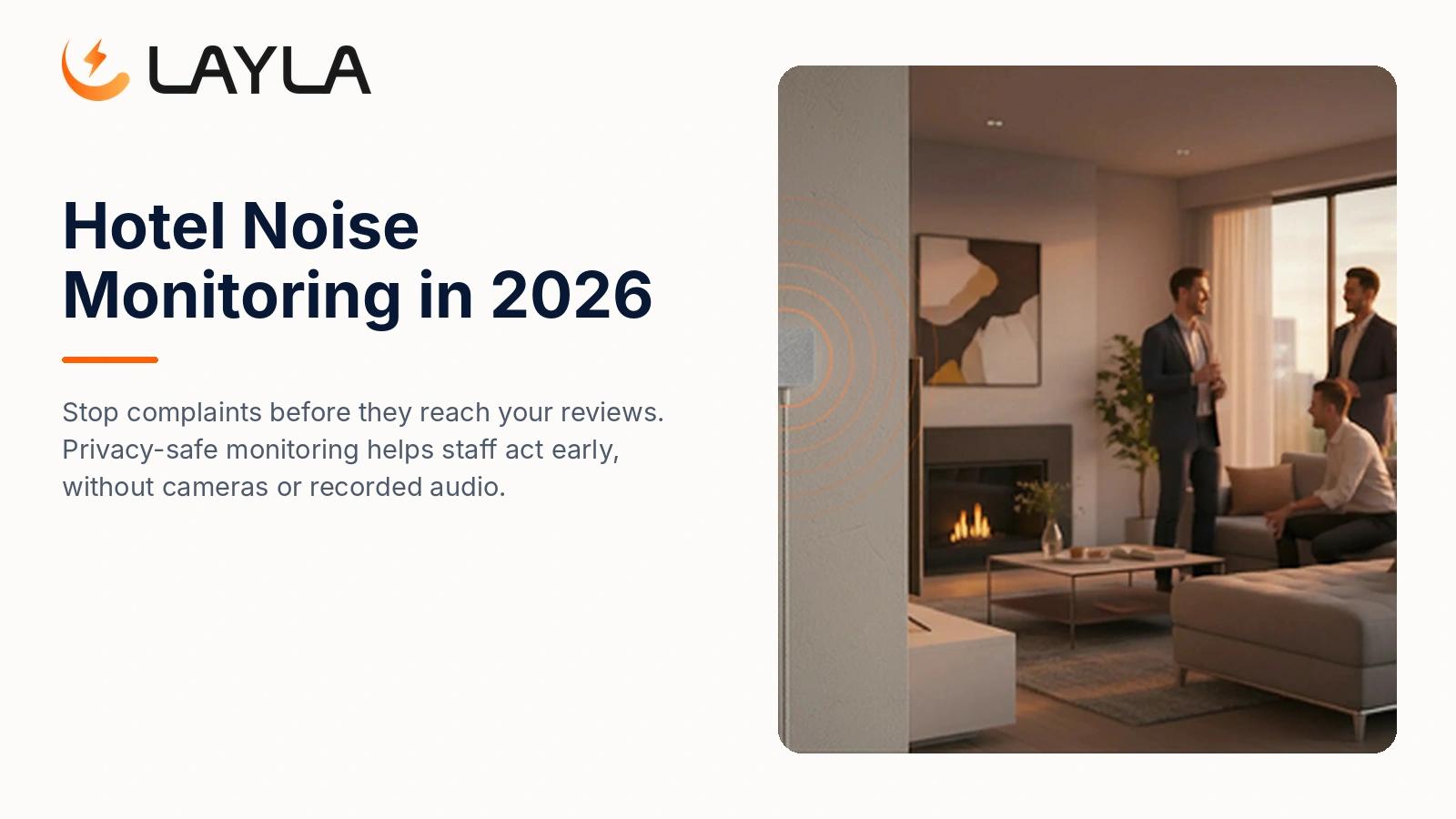
Here is a number that should bother any hotelier. In J.D. Power's North America Hotel Guest Satisfaction Index, noise came out as the single most commonly experienced problem guests reported, ahead of both cleanliness and service. And of the guests who ran into it, fewer than half, roughly 43 percent, actually told the hotel. The rest said nothing at the desk. Worse, among the minority who did complain, only about a third felt the problem was resolved.
Put those three facts together and you get the real shape of the noise problem. Most disturbances are never reported, most reports never get fixed, and the guest who was kept awake checks out in the morning and writes the review from the airport. You never lose that argument at the front desk. You lose it a week later, on your ratings page, in front of every traveller deciding whether to book.
Closing that gap is the whole job of noise monitoring, and getting it right in a hotel comes down to a few practical questions. What the technology does in a guest room, how the leading systems differ, where the privacy line sits, and how to fit a property without locking yourself into a fee that climbs every year.
The complaint you never hear is the one that costs you
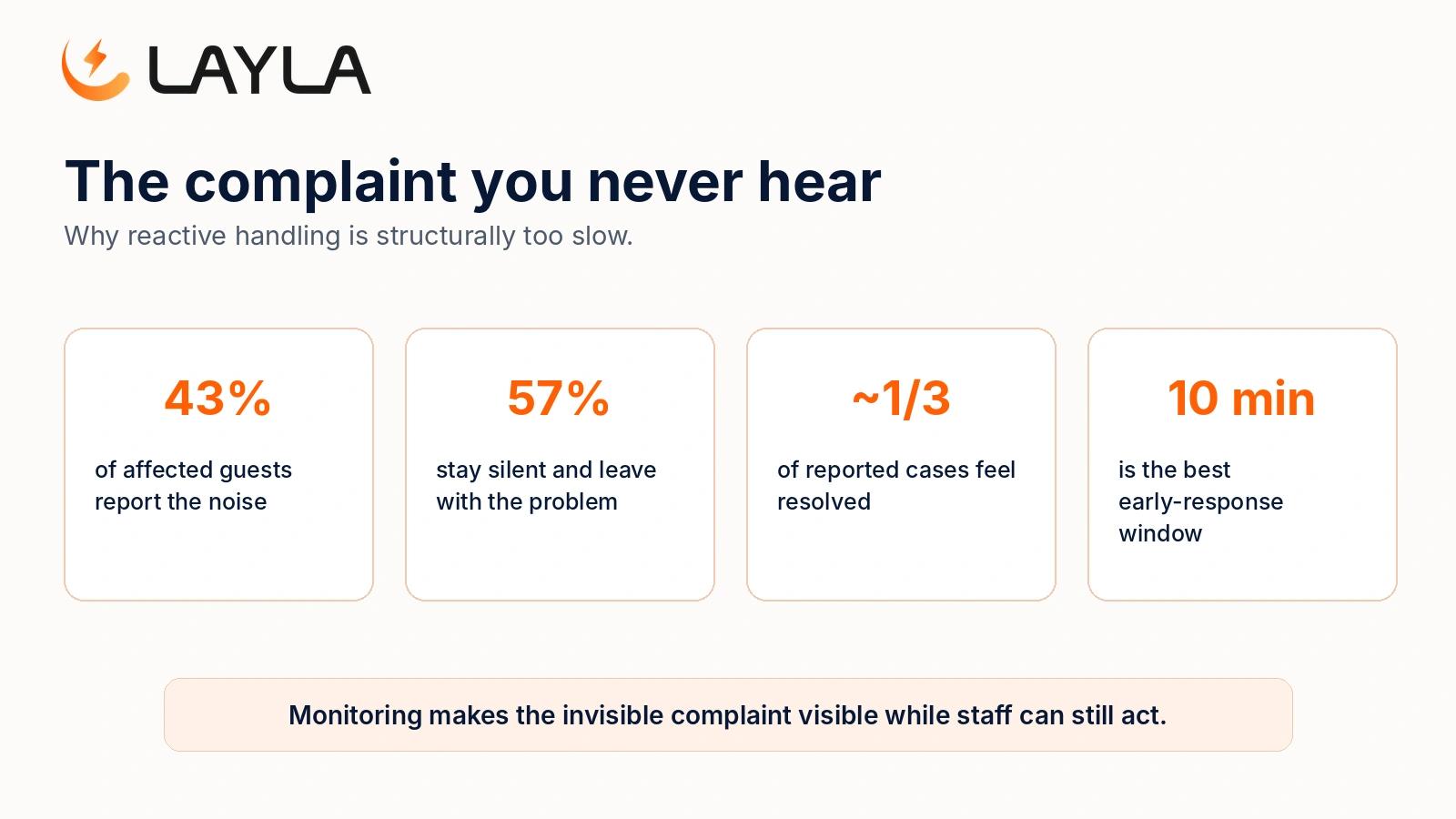
A guest who complains is a gift. They have handed you a chance to move a room, send up a bottle of wine, and turn a bad night into a loyal customer. The dangerous guest is the silent one. They lie awake, decide it isn't worth the phone call, and convert their frustration into a public, permanent, searchable one-star review that mentions "paper-thin walls."
That is why the 43 percent figure matters more than it looks. The reported complaints are the ones you already handle. It is the invisible 57 percent, the guests who never say a word, that quietly erode your rating and your occupancy. Noise monitoring exists to make those silent disturbances visible while there is still time to act on them.
Why the front desk always finds out too late
The traditional model is reactive by design, and every step in it burns minutes you don't have. A guest has to be bothered enough to call. Someone at the desk has to be free to take it. Staff have to walk up, knock, and defuse the situation. By the time all of that happens, a party two doors down has been running for an hour and the neighbouring guests have already given up on sleep.
Monitoring changes the trigger. Instead of waiting for a call that usually never comes, the property registers a sustained rise in decibel level the moment it starts, and your duty manager can send a quiet message to the room before it becomes a corridor-wide problem. Most disturbances are loudest and easiest to defuse in the first ten minutes. That opening window is exactly what a complaint-based system is structurally guaranteed to miss.
What a hotel needs from a noise monitor
Before comparing brands, it helps to know what separates a noise monitoring system built for a spare-bedroom rental from one that works across a whole hotel. Four things matter.
It has to measure sound level rather than record sound, because anything that captures audio inside a guest room is a privacy and legal problem you do not want. It has to report into one dashboard a duty manager can scan across every floor, not a separate app per room. It has to scale in your favour rather than against you, which rules out any model that charges a monthly fee for every room forever. And ideally it catches more than noise, because the same socket that watches decibels can just as easily watch for smoking and air quality, the two other issues that quietly drain housekeeping budgets.
Hold those four criteria in mind, because they are where the popular options diverge.
How the main options compare
Three names come up most often when a property starts shopping for a noise monitoring system: NoiseAware, Minut, and Layla. They solve the same surface problem in genuinely different ways.
| NoiseAware | Minut | Layla | |
|---|---|---|---|
| Device (upfront) | Included in plan; $99 outdoor add-on | ~$100 per device | $179 / $299 (one-time) |
| Ongoing subscription | ~$180/yr per room | $5–15/mo per room | None |
| Annual cost, 60 rooms | ~$10,800/yr | ~$3,600–10,800/yr | $0/yr (after ~$10,700 once) |
| Smoke & vape detection | No | Cigarette smoke | Cigarette, vape, cannabis |
| Air quality (CO₂, mold) | No | Climate only | Yes |
| Cameras / audio in room | None | None | None |
| Availability | US & Canada | Wider | Wider |
NoiseAware is the most established name in short-term-rental noise, and it does one thing: decibel monitoring, indoors, with an outdoor sensor available as an add-on. It is sold as a subscription, priced around $180 per year per property, and it is available only in the United States and Canada. For a pure noise problem in a US property it is a safe, proven choice. The catch for a hotel is the model. It is noise-only, so it does nothing about smoking or air quality, and the per-property annual fee never ends. When you multiply a recurring subscription across dozens of rooms, the yearly total becomes a permanent fixture of your operating budget.
Minut is the more sensor-rich competitor. Its device tracks noise and occupancy and adds cigarette-smoke and climate sensing, which makes it a real step up from noise-only hardware. But it too runs on a subscription, roughly $5 to $15 per month for each home depending on the tier, and that tier is also what decides how long your noise history is kept, from as little as seven days on the entry plan up to unlimited on the top one. So the more rooms you cover and the more history you want to keep, the more the monthly bill climbs, month after month, for as long as you own the property.
Layla takes the opposite position on the one variable that matters most at scale: it is a one-time purchase with no subscription at all. The Pro plan is $179 and covers real-time decibel monitoring, timestamped alerts, quiet-hours enforcement with automatic guest notifications, occupancy estimation, and a 180-day noise history, all with no cameras and no audio recording. The All-In-One plan at $299 adds the full air-quality and smoke picture on top. You buy the hardware once and it keeps working, with nothing recurring stacked on top of it. For a single spare room that is merely convenient. Across a hotel, where the alternative is paying a monthly fee per room indefinitely, it changes the entire economics of the decision.
The privacy line, stated plainly
Every hotelier's first reaction to in-room technology is suspicion, and it should be. So here is the exact distinction that makes noise monitoring defensible.
A proper noise sensor measures level, not content. It reads how loud a room is and how long it stays that way, and it stores none of the sound itself. There is no microphone feed to listen back to, nothing recorded, nothing anyone could ever replay. The device can tell your team that room 412 has been loud for twenty straight minutes. It cannot tell them a single word that was said inside it. That distinction between level and content is what keeps the technology compatible with privacy law and easy to state plainly in your house policy. Layla's noise and security monitoring is built on exactly that principle, with no camera and no audio capture anywhere in the device.
Noise is rarely the only problem in the room
Decibels are the reason you install a sensor. They are not the only return, and for a hotel the other two problems are where a multi-sensor device earns its place.
Smoking is the first. A guest who lights up in a non-smoking room hands you a deep-clean, a night of lost inventory, and a billing argument you usually can't win, because housekeeping only discovers it the next morning. Layla detects smoke as it happens and distinguishes cigarette from vape from cannabis, grading the intensity so a faint trace by a cracked window reads differently from a room that has clearly been smoked in. You know that evening, while the charge is still enforceable and the room can still be aired before the next check-in.
Air quality is the second, and it is the quiet one. CO₂ climbing in a room with poor airflow, humidity creeping toward the mold line in a bathroom that never fully dries. Nobody complains about these until they have already become "the room smelled musty" in a review. Reading them continuously means maintenance fixes the room before a guest ever forms the impression. This is also the clearest gap between the options above. A noise-only system like NoiseAware simply cannot see any of it.
Rolling it out across a property
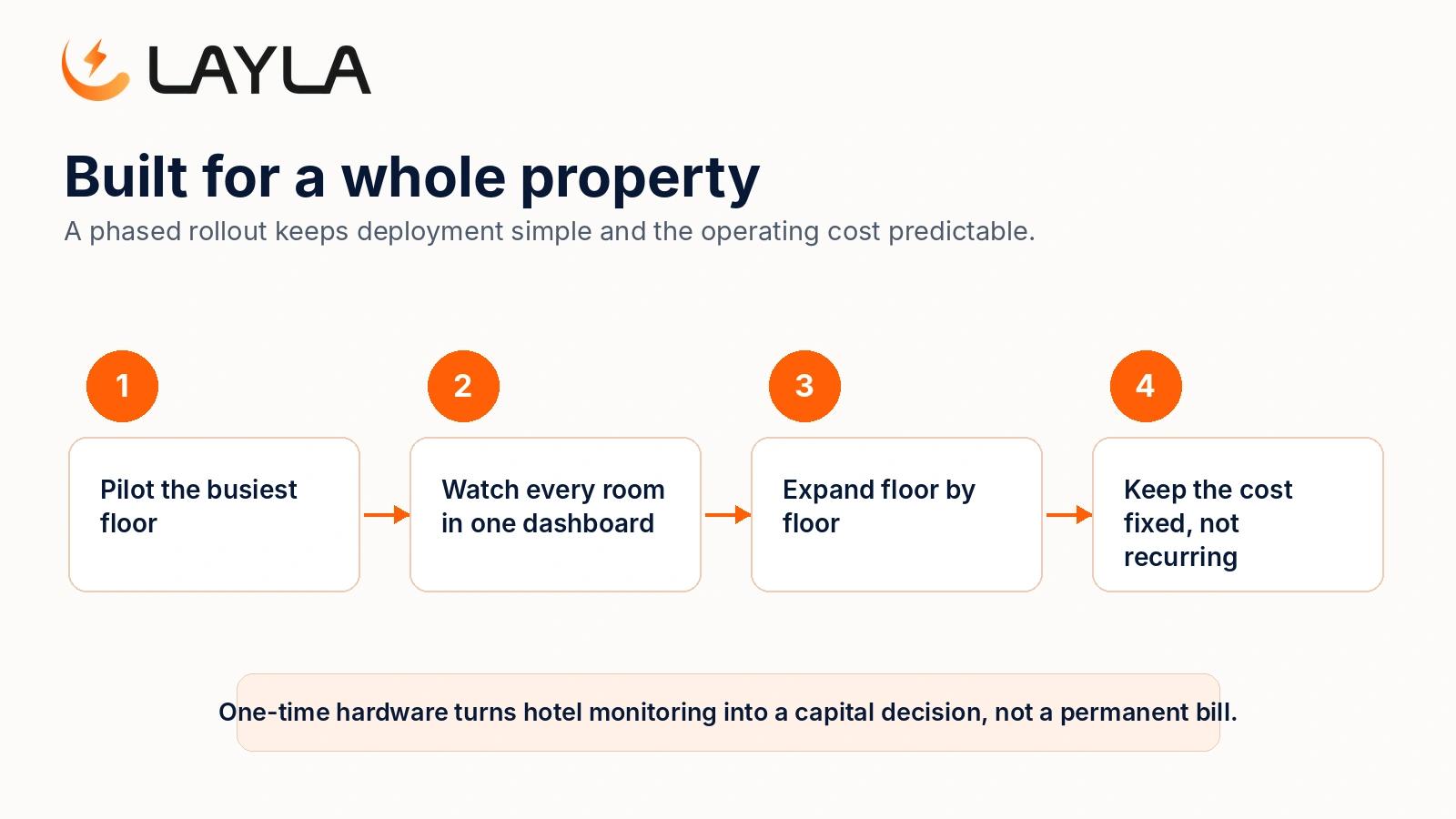
A single rental needs one device. A hotel needs fifty, or five hundred, each sitting quietly on a wall or shelf, connecting to the property Wi-Fi, and reporting into one view a duty manager can watch across every floor. Properties are increasingly rolling out noise monitoring one floor at a time, and the pattern is simple. Start with the rooms that generate the most complaints, watch how the alerts change the way the front desk responds, then extend to the rest of the building.
A sensible rollout tends to run in four steps. Start with the rooms that generate the most complaints, usually those near elevators, ice machines, and event space. Set quiet hours and alert thresholds to match your house policy. Brief the front desk on the one workflow that matters, which is sending a courteous message to the room at the first sustained alert rather than waiting for a neighbour to call. Then expand floor by floor once the team trusts the signal. None of this needs a technician per room, and because there is no subscription, extending coverage later costs only the hardware.
The math that decides it
For most properties the decision comes down to one calculation, and it is worth doing with real numbers.
Take a sixty-room property. On a subscription model at a representative $10 per room per month, that is $600 a month, or $7,200 every year, recurring for as long as you operate, and climbing if you want longer data retention. Layla's Pro plan at $179 per room is a one-time outlay of about $10,740, after which the ongoing cost is zero. The subscription overtakes the one-time purchase in well under two years, and every year after that the gap widens in your favour. The All-In-One plan at $299 per room costs more up front but folds in smoke and air quality, which for a hotel usually pays for itself the first time it catches a smoking violation or a developing mold problem before a guest does.
Subscription pricing can make sense for a host with one or two units and no appetite for capital outlay. At the scale of a hotel it works the other way. A recurring per-room fee is a cost that never leaves the P&L, while buying the hardware once is a decision you make a single time. It is why properties fitting out whole floors tend to land on the one-time model.
What operators say
The credibility of any of this rests on whether the device actually works in a real property, so it is worth reading the people using it. "This noise monitoring device has been a game-changer for managing my space," writes verified Amazon reviewer Jennifer Bahr. "It's incredibly accurate at tracking sound levels in real time, which helps." Another verified reviewer using it for rental-property monitoring calls it "one of those rare products that just works." Accuracy and set-and-forget reliability are exactly what a busy front desk needs, because a monitor that cries wolf gets ignored, and an ignored monitor protects nothing.
Frequently asked questions
Do hotel noise sensors record audio or conversations?
No. A properly designed hotel noise sensor measures decibel level and duration only. It has no microphone feed to listen to and stores no audio, so it can register that a room is loud without ever capturing what is said. Layla's sensor also has no camera.
Is noise monitoring in hotel rooms legal?
Measuring sound levels is generally permissible, because it monitors a condition of the room rather than the people in it, and most properties disclose it in their house policy. Recording audio or video inside a guest room is a different matter and carries real legal risk. The distinction is level versus content.
What is the best noise monitor for a hotel?
It depends on scale. NoiseAware is a proven noise-only option in the US and Canada but is subscription-based and sees nothing beyond noise. Minut adds more sensors but still charges a monthly per-home fee, with data retention tied to the tier. Layla is the strongest fit for multi-room properties because it is a one-time purchase with no subscription and also covers smoke and air quality.
How much does hotel noise monitoring cost?
Subscription systems typically run around $60 to $180 per year for each room or property and never stop. Layla is a one-time purchase, $179 per room for Pro or $299 for the All-In-One plan, with no recurring fee, which usually costs less than a subscription within about two years across a property.
Can one sensor cover more than noise?
Yes. Layla's All-In-One sensor detects smoking, distinguishing cigarette, vape, and cannabis, and monitors air-quality signals such as CO₂ and humidity, flagging both policy violations and maintenance issues from the same device that watches noise.
How is it priced and deployed for a whole hotel?
As a one-time hardware purchase with no per-room monthly fee, which suits multi-room deployment far better than subscription models. Full-property rollouts, staged installation, and volume pricing are handled directly rather than through a standard checkout.
Related reading
- The Best No-Subscription Noise Monitor for Airbnb (No Monthly Fees, 2026) — the one-time versus subscription argument in full
- Airbnb Anti-Party Technology: What Actually Works in 2026
- Noise Monitoring for Vacation Rentals
- Explore Layla for property managers and multifamily buildings

Best for: full property coverage
All-in-One
Noise monitoring, smoke detection and smart AC control for complete coverage.
Everything included
Everything in Noise & Security Pro
AI party detector, noise alerts, intruder & break-in, occupancy, 180-day history, indoor + outdoor climate
Everything in Smoke & Air Quality
Air quality index (IAQ), CO2, bVOC, mold & smoke — full indoor + outdoor climate
Everything in AC Control & Energy
Smart AC (150+ brands), Eco Mode, schedules, filter health
Plus exclusive
- Advanced reports & insights
- Priority support
- Priority support
No monthly fees. Ever.
One sensor. Full coverage
One sensor. Full coverage.* Layla 3.0 monitors noise, air quality, motion, occupancy, temperature, humidity, pressure, VOCs, CO2, and controls your AC - from a single device on your shelf.
No subscription means no surprise costs.
Pay once. Every feature unlocked. Forever. No monthly fees eating into your rental margins or household budget.
The smartest buy is the one you make once.
Other solutions charge per-feature monthly subscriptions that exceed the device cost within a year. Layla's all-in-one pays for itself compared to any subscription alternative.
30-day money back guarantee