BLOG
Best Cigarette, Vape & Cannabis Smoke Detectors for Rentals in 2026
 By Nangyal Khan··Updated
 10 min read
Smoking is the violation that hides. A party is loud and someone calls. Smoking happens quietly, and you find out three days later, when the cleaner opens the door and the smell arrives before the light switch. By then the guest is gone, the deposit is closed, and the unit is off the calendar while you throw the windows open. That's why more hosts now run a dedicated smoke sensor, one that catches cigarette, vape, or cannabis while the guest is still in the building and there's still something to be done about it.
The market has more real options than it did a year ago, and they aren't interchangeable. Some are smoke specialists. Some are noise monitors that bolted on smoke. One is enterprise security hardware that happens to detect vaping. Prices run from a one-time purchase to a subscription to a sales-desk quote. This guide breaks down the serious contenders for 2026, who each one suits, and where the trade-offs bite.
What actually matters when you're choosing
Before the picks, the questions that separate them:
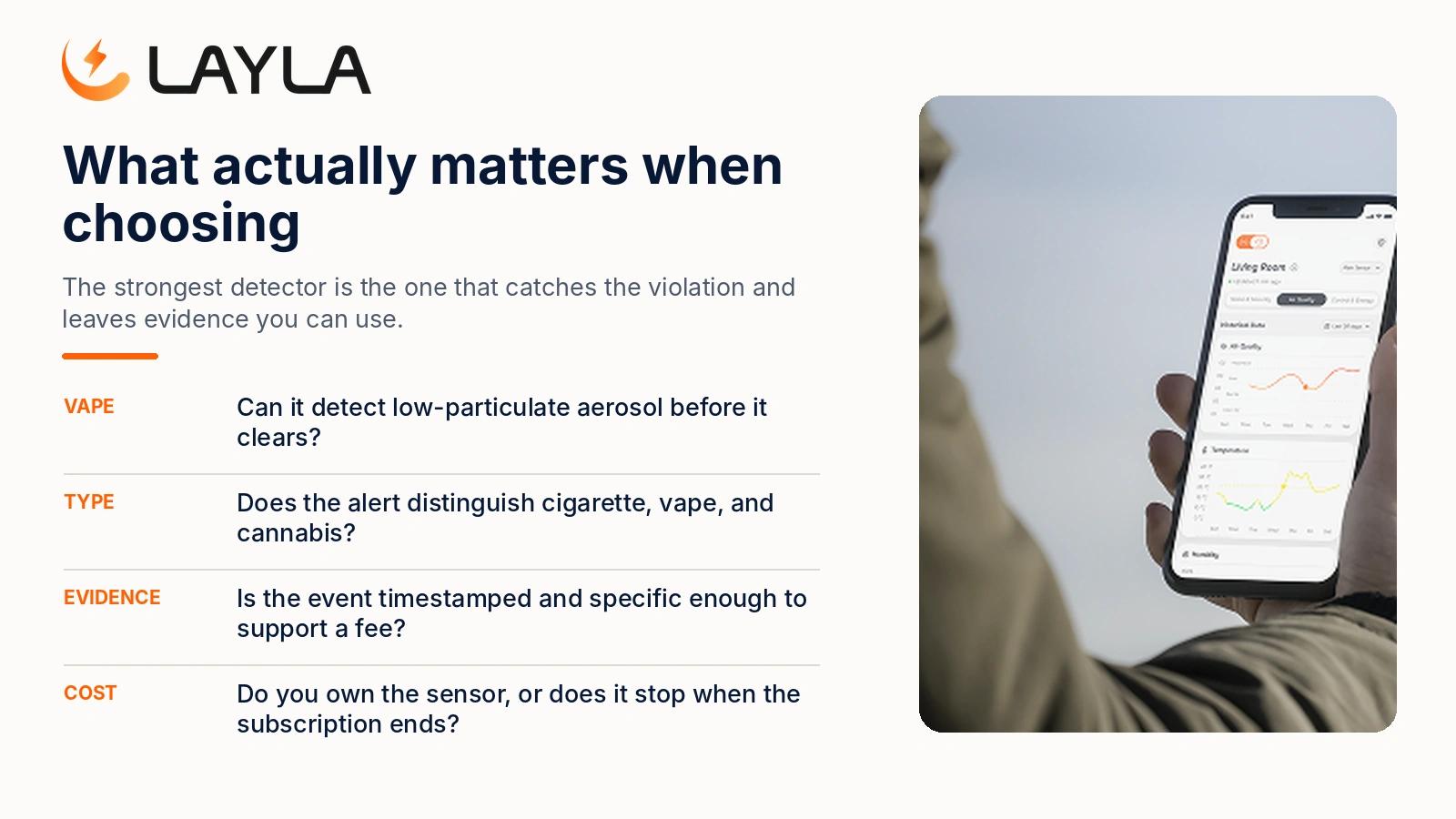
- Does it catch vaping? Vape carries far less particulate than cigarette smoke and clears fast, so it's the hardest thing on this list to detect. A sensor tuned only to cigarette particles is weakest exactly where guests push hardest.
- Does the alert name the smoke type? Cannabis in a strict no-smoking unit is a different breach, and sometimes a different legal matter, than a vape. Some devices tell you which; others just say "smoke."
- What's the evidence like? A timestamped, specific record is what turns a smoking fee you can enforce into one you write off.
- One-time or subscription? Some devices are bought once. Others only work while you keep paying, and go dark the day you stop.
- Privacy and compliance. Airbnb makes you disclose monitoring devices and bans cameras and microphones in interior spaces. Every sensor worth buying here uses neither.
- Does it do anything else? A smoke-only device solves one problem. An all-in-one watches air quality, noise, and energy from the same spot on the ceiling.
The best smoke and vape detectors for rentals
1. Layla — best all-in-one for hosts
Layla reads cigarette, vape, and cannabis, names which one, and grades each event low, medium, or high, updating live as the smoke builds or clears. You set the alert threshold, and each alert lands tagged by type and strength, which gives you a record you can actually enforce a fee on. It's built to catch vaping, not just cigarettes, and its VOC air-quality sensor adds a second angle that picks up the chemical trace a guest leaves behind even after they've aired the room out.
What sets it apart here is that smoke is one job of several. The same sensor tracks air quality (CO₂, VOCs, particulates, humidity, mould risk), monitors noise as a decibel level, reads occupancy through AI radar, and uses that to automate AC and appliances so an empty unit stops cooling itself flat-out between stays. No camera, no microphone. It self-installs on Wi-Fi in minutes. Layla's Air Quality tier that adds smoke detection is a one-time $99, no subscription.
Best for: hosts and small portfolios who want smoking caught, vape included, and want the device to earn its keep on air quality, noise, and energy too.
The trade-off: it's a monitoring sensor, not a certified fire alarm, and there's no outdoor unit for pool or garden noise.
2. Wynd Sentry — best dedicated smoke-and-noise specialist
Wynd Sentry led with smoke instead of noise, and it's quick: it picks up cigarette, cigar, marijuana, and vape from about twenty feet within a minute, across a room up to 400 square feet. Its standout is SmokeSignal reporting, timestamped and location-tagged records built to support cleaning fees and evictions, and hosts trust them. It handles noise too, and it has earned real hospitality accounts.
Two catches. First, per Wynd's own FAQ, a Sentry alert tells you recreational smoke is present but not whether it was a cigarette, a joint, or a vape. Second, the model: the device is included, but only with a subscription of $180 a year, with a one-year minimum after the 30-day trial, and the sensor stops working if you stop paying. It also does smoke and noise only.
Best for: hosts who want a smoke specialist with strong dispute reporting and don't mind a permanent subscription.
Full breakdown: Layla vs Wynd Sentry →
3. Minut — best if you want the Airbnb integration
Minut is the noise monitor most hosts already know, and its machine-learning cigarette detection is a genuine strength, trained to tell cigarette smoke from burnt toast, with confirmed alerts standing up in Airbnb's resolution centre. Its official Airbnb partnership slots smoke and noise warnings into the platform hosts already use. It also covers occupancy, temperature, humidity, and mould.
The limits are specific to smoke. Detection is particle-based and points to roughly twenty to thirty minutes of exposure for a reliable read, so brief smoking by an open window can slip under it. There's no intensity grading. And vaping, with its far lower particulate, is the soft spot: Minut is built for cigarette and marijuana smoke, not vapor. It runs on a subscription of $5 to $15 per property per month.
Best for: hosts focused on cigarettes who value the Airbnb integration and already run Minut for noise.
Full breakdown: Minut smoke detection vs Layla →
4. FreshAir Sensor — best molecular precision for hotels and schools
FreshAir uses patented polymer sensors that bind only to the molecules in tobacco, marijuana, and vape, ignoring steam, dust, candles, and perfume, with a dedicated vaping sensor developed largely for schools. That molecular approach gives it outstanding false-alarm resistance, which is why casinos, hotels, and school districts rely on it where a wrong alert carries real cost. The polymer self-resets, so it runs 24/7 without upkeep.
It's an institutional product, though. Each device covers up to about 500 square feet and connects to a building network and FreshAir's managed monitoring platform, sold on a subscription with a sales-led rollout rather than a one-time host purchase. And it does smoke and vape only, no air quality, noise, or occupancy.
Best for: hotels, casinos, and schools that want the most selective molecular detection, wired into a managed system.
Full breakdown: Layla vs FreshAir Sensor →
5. HALO Smart Sensor — best for schools and large venues
The HALO Smart Sensor (made by IPVideo, sold via Pelco) is the most capable device here, stacking a dozen-plus sensors to read vape, THC, cigarette smoke, and air quality, plus aggression and keyword detection, all with no camera or microphone so it works in bathrooms. It integrates with video management systems, logs events for a year, and the 3C-PC model adds occupancy and people counting.
That power comes at enterprise cost and complexity: a wired PoE install, a network or VMS to plug into, and quote-based pricing. For a single rental, it's the wrong size.
Best for: schools, hospitals, casinos, and large hotels with security teams and network infrastructure.
Full breakdown: Layla vs HALO Smart Sensor →
6. Alertify and managed monitoring services — best hands-off option
Some operators would rather outsource the watching entirely. Services such as Alertify package real-time tobacco, cannabis, and vape detection with managed monitoring and alerting for short-term rentals and multi-unit properties. It fits if you want a provider handling the alert flow instead of a device you run yourself, though that usually means an ongoing service relationship and cost.
Best for: portfolios that prefer managed monitoring over self-run hardware.
A note on noise-only devices
NoiseAware is a well-known name in this space, but be clear on what it is: a noise monitor, not a smoke detector. If smoking enforcement is on your list, a noise-only device won't cover it, and you'd be pairing it with one of the sensors above. Layla, Wynd, and Minut all handle noise and smoke on a single unit.
Quick comparison
| Device | Vape | Names type | Intensity | Beyond smoke | Cost |
|---|---|---|---|---|---|
| Layla | ✅ | ✅ | ✅ live | Air quality, noise, occupancy, AC | $99 one-time |
| Wynd Sentry | ✅ | ❌ | ❌ | Noise, SmokeSignal reports | $180/yr, 1-yr min |
| Minut | Not built for it | Cigarette-focused | ❌ | Noise, occupancy, Airbnb integration | $100 + $5–15/mo |
| FreshAir | ✅ (molecular) | ✅ | ❌ | Managed monitoring | Subscription |
| HALO | ✅ | ✅ | Events | Air quality, security, people counting | Quote (enterprise) |
How to pick the right one
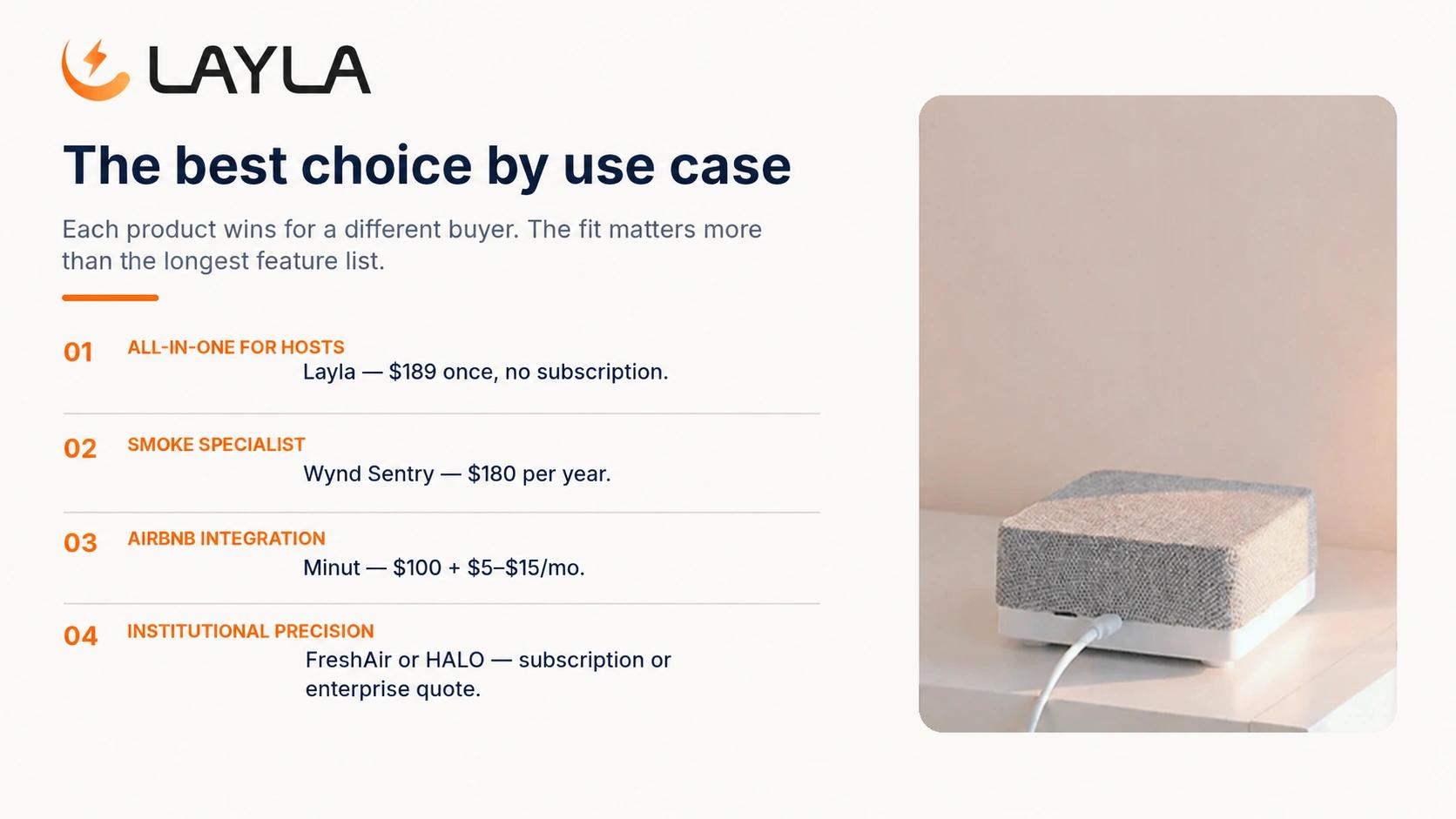
Run a handful of short-term rentals and want smoking caught without a subscription, plus air quality and energy watched from the same device? Layla is the most complete single-purchase option. Want a smoke specialist with strong dispute reporting and don't mind paying monthly? Wynd Sentry is the pick. Already on Minut and mostly worried about cigarettes? Its detection may be enough, as long as you know vaping is its blind spot. Running a hotel, casino, or school? FreshAir's molecular precision or HALO's enterprise depth matches the scale and the way those buyers procure.
Whatever you land on, one rule covers all of them: disclose it. Airbnb and the other platforms require you to note monitoring devices in your listing, and they ban cameras and microphones in interior spaces. Every device worth buying here uses neither, which makes that disclosure easy, and it doubles as your best deterrent. A guest who knows you'll know is far less likely to light up in the first place.
Frequently asked questions
What's the best smoke detector for an Airbnb in 2026?
For most hosts, an all-in-one like Layla, because it catches cigarette, vape, and cannabis, names the type, grades intensity, and adds air-quality, noise, and occupancy monitoring, all for a one-time $99 with no subscription. Wynd Sentry is the strongest dedicated smoke specialist if you prefer a subscription with detailed dispute reports, and Minut suits hosts who want the official Airbnb integration.
Can a smoke detector catch vaping?
Some can, but not all. Vape aerosol carries far less particulate than cigarette smoke and disperses quickly, so sensors tuned only to cigarette particles struggle with it. Layla and Wynd Sentry are built to detect vaping, and FreshAir uses a dedicated molecular vape sensor. Minut, by contrast, is designed for cigarette and marijuana smoke rather than vapor.
Are smoke detectors allowed in short-term rentals?
Yes, as long as you disclose them. Airbnb permits air-quality and smoke monitoring when it's noted in the listing, and it prohibits cameras and microphones in interior spaces. The sensors in this guide use neither, so they stay compliant when disclosed.
Do these devices record audio or video?
No. The smoke and noise sensors here have no cameras and don't store audio. Noise is read as a decibel figure only. That's what keeps them within platform monitoring rules.
One-time purchase or subscription, which is cheaper?
Over any multi-year stretch, a one-time device wins. Layla is $99 once. Wynd runs $180 a year with a one-year minimum, Minut adds $5 to $15 per property per month to its $100 sensor, and FreshAir and HALO are subscription or enterprise-quote based. Across several properties and a few years, the recurring totals climb well past a one-time purchase.
Is a smoke sensor a replacement for a fire alarm?
No. These are monitoring sensors that flag smoking as an air-quality signal. They are not certified fire or smoke alarms and don't replace the life-safety devices your property is legally required to have. Keep those in place and let the monitoring sensor handle policy enforcement.
Related reading
- Cigarette, Vape, and Cannabis: How Layla's Smoke Detection Actually Works
- Layla vs Wynd Sentry: Which Catches Smoking in Your Rental?
- Minut Smoke Detection vs Layla: What Each One Catches
Catch smoking while there's still time to act. See how Layla covers your rental: cigarette, vape, and cannabis detection with air quality, noise, and occupancy, from one sensor, bought once.

Best for: health-conscious homes
Smoke & Air Quality
Air quality, mold and smoke monitoring for healthy homes and smoke-free rentals.
Included forever — no subscription
- Mold-risk early warning
- Smoke & cigarette detection
- Air quality score (IAQ) with alerts
- CO₂ & bVOC monitoring
- AI air insights & recommendations
- Allergy-comfort monitoring
No monthly fees. Ever.
30-day money back guarantee