BLOG
Layla vs FreshAir Sensor: Which Smoke Detection Fits Your Rental?
 By Nangyal Khan··Updated
 8 min read
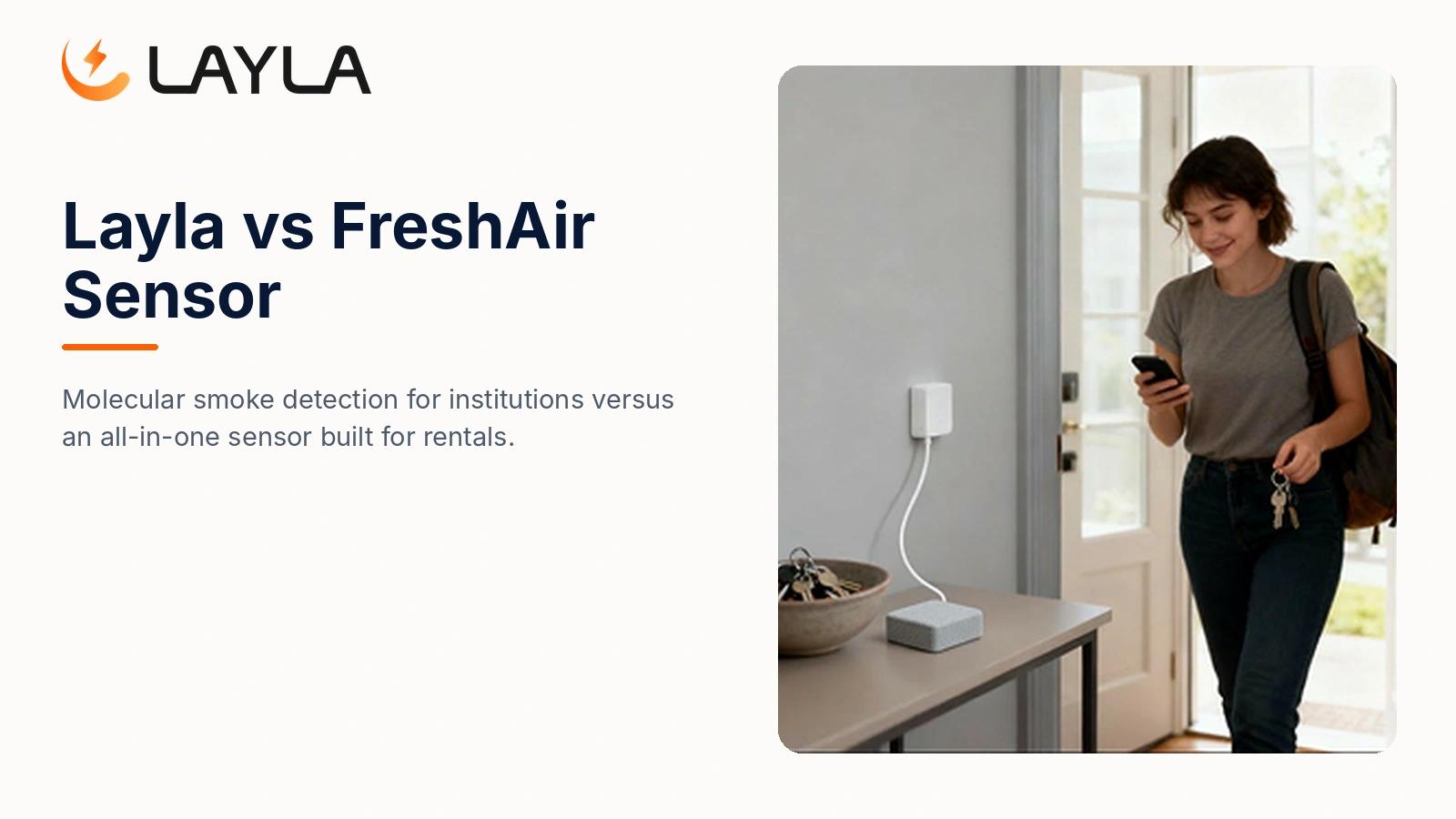
FreshAir Sensor is built on a genuinely clever idea. Instead of counting particles like an ordinary smoke detector, its patented PolySens polymer binds to the specific molecules in tobacco, marijuana, and vape, and shrugs off everything else: steam, dust, a lit candle, a cloud of perfume. That's why casinos and schools trust it in rooms where a false alarm means a comped night or a furious parent. On the narrow question of "was that really smoke," it rarely cries wolf.
But FreshAir is an institutional product. It's sold to hotels, casinos, apartment operators, and school districts, wired into a building network and watched through a managed monitoring platform. Layla is a sensor a single host puts up themselves and pays for once. Both catch smokers, and both catch vaping. They're built for different buyers, and they cover the room very differently. Here's the honest read.
Layla vs FreshAir Sensor at a glance
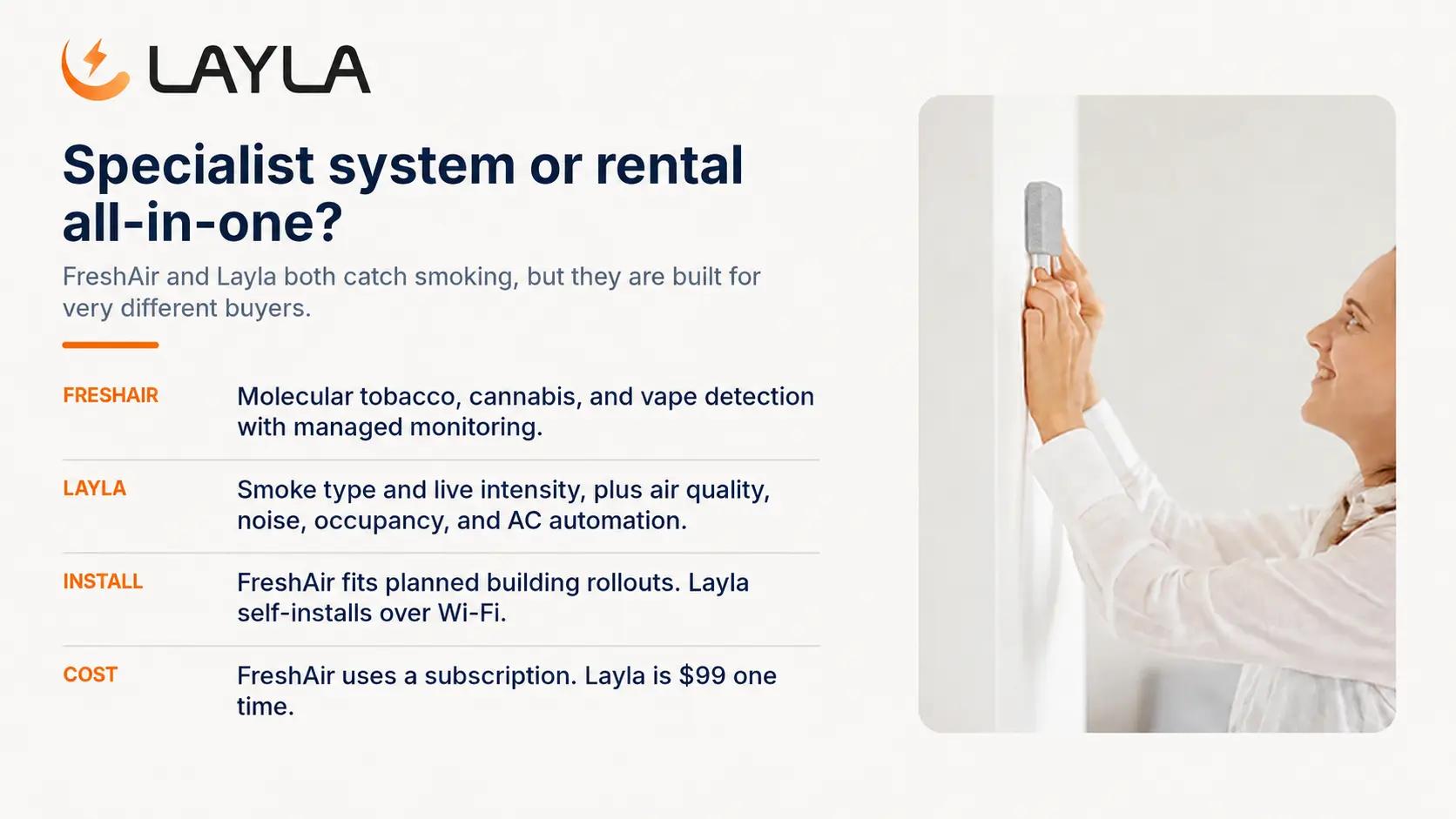
| FreshAir Sensor | Layla | |
|---|---|---|
| Tobacco / cigarette detection | ✅ (molecular) | ✅ |
| Marijuana / cannabis detection | ✅ (molecular) | ✅ |
| Vape / e-cigarette detection | ✅ (dedicated molecular sensor) | ✅ |
| Smoke intensity grading | ❌ (detection events) | ✅ (low / medium / high, live) |
| Air quality (CO₂, VOCs, particulates) | ❌ | ✅ |
| Noise monitoring | ❌ | ✅ |
| Occupancy detection | ❌ | ✅ (AI radar) |
| AC / appliance automation | ❌ | ✅ |
| Install | Plug-in, network-connected | Self-install, Wi-Fi |
| Built for | Hotels, casinos, schools, managed buildings | Rentals, small portfolios |
| Cost model | Subscription + managed monitoring | $99 (one-time) |
What FreshAir Sensor does
The science behind it is genuinely clever. Seventeen years of research, some of it NIH-funded, went into a molecularly imprinted polymer that reacts only to the compounds in tobacco and marijuana smoke, with a separate sensor tuned the same way for vaping. That's a different world from the light-scattering detectors that fire at any airborne speck. The payoff is strong false-alarm resistance. Run a hot shower, burn a candle, spray cologne, and it stays quiet, because none of that carries the molecules it's watching for. When it does alert, staff can trust someone actually lit up or vaped. The polymer resets itself after each detection, so it keeps monitoring around the clock without anyone servicing it.
Everything else about the design follows from its market. The units are Wi-Fi, plug in fast, and are built tamper-proof for rooms full of strangers. Each one covers up to about 500 square feet of open space and talks continuously to FreshAir's monitoring platform, which pushes an alert to a phone, an email, or the front desk the moment unauthorised smoking shows up. That's exactly the setup a hotel, casino, or school wants: a specialist that does one thing very well, wired into a system a facilities team already runs.
Where it fits a short-term rental host less neatly comes down to scope and how you buy it. FreshAir detects smoke and vape, and that's the entire remit. It doesn't read general air quality, it doesn't monitor noise, it has no occupancy sensing, and it won't touch your AC. Coverage also depends on matching the right molecular sensor to the substance you're worried about, which is a natural fit for a planned building rollout and more friction for one apartment. And it's sold the way institutional hardware is sold: through a subscription, a managed monitoring relationship, and usually a conversation with sales, not a one-time click a solo host makes on a Tuesday night. For a 200-room hotel that's the right way to procure. For someone running three Airbnbs, it's a lot of system.
What Layla does
Layla is aimed squarely at the buyer FreshAir isn't chasing: the operator running a handful of units who wants smoking caught without standing up an enterprise deployment to do it.
Smoke it reads by type and by strength
Layla detects cigarette, vape, and cannabis and names which one, all from a single sensor rather than a matched set. The alert that reaches you already says what rule was broken, which is the part that settles a guest conversation. It grades intensity too, low, medium, or high, and keeps updating as the smoke thickens or clears, so a furtive pull by the window reads differently from a room being run as a lounge. You set the threshold that pulls you in.
The two are tuned for different goals, and it's worth being clear about which one a rental needs. FreshAir's molecular sensor is built to stay silent unless it meets its exact target molecules, which keeps false alarms low. Layla is built to catch a faint trace early, tell you whether it was a cigarette, a vape, or cannabis, and grade how strong it got, with a host-set threshold to keep nuisance pings down. For a host trying to enforce a rule, knowing what happened and how heavy it was is worth more than selectivity alone.
Everything a rental needs that a smoke specialist skips
This is where the gap opens. Layla runs air quality as a core function: CO₂, VOCs, particulates, temperature, humidity, and mould risk, rolled into one indoor reading. That catches the stale, stuffy room a guest would otherwise mention in a review, and there's a fuller breakdown on the air-quality monitoring page. It watches noise as a decibel level for parties, with no audio ever stored. And it reads occupancy through AI radar, which powers native AC and appliance automation. When a unit sits empty, the cooling backs off on its own instead of running through the hours between checkout and check-in. FreshAir does none of that, and was never meant to.
Guillermo Quintero, Director of Operations at Nimble CoLiving in Barcelona:
"Layla is the best solution for our co-livings in Barcelona. It's helped us save at least 25% on electricity costs, keep our buildings safe, and reduce the need for on-site staff."
Setup and price finish the contrast. Layla goes up on Wi-Fi in minutes and runs off its own app. Its Air Quality tier that catches smoke is a one-time $99, with no subscription and no sales call. The honest limits still hold: it's a monitoring sensor, not a certified fire or smoke alarm, and there's no outdoor unit.
So which one is worth it?
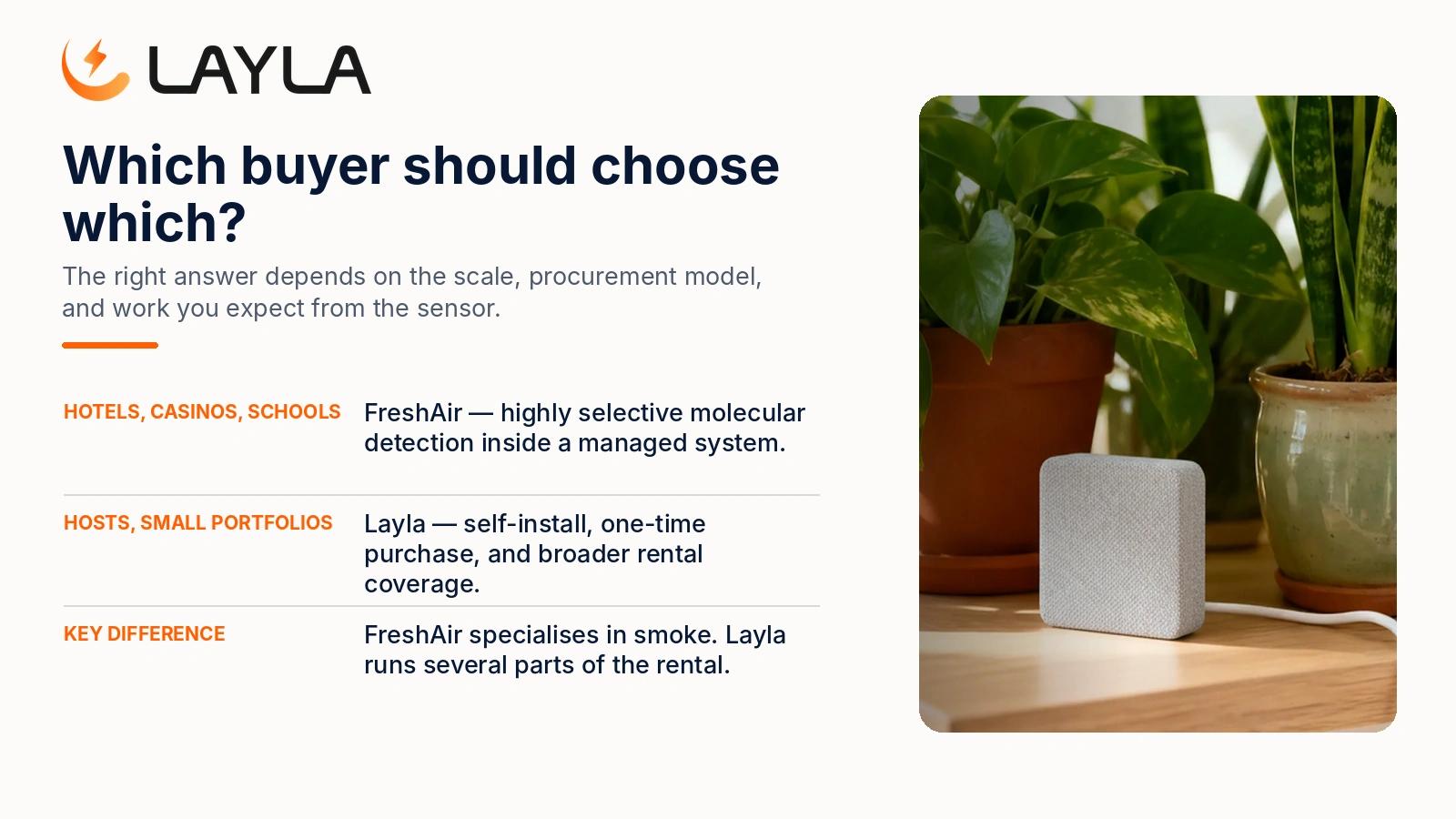
Pick FreshAir Sensor if you run a hotel, casino, school, or professionally managed building where a single false alarm carries real cost, and you want highly selective molecular detection backed by a monitoring platform your team can plug into. At that scale, the subscription and the sales-led rollout are simply how you'd buy this kind of hardware.
Pick Layla if you're a host or small operator who wants smoking caught, vape included, from a device you install yourself and buy once. Alongside smoke it watches air quality, noise, and energy, and it names the smoke type and grades it without a managed service behind it. FreshAir does one thing, very selectively. Layla does the several things a rental actually runs on, for a single price.
Frequently asked questions
Does FreshAir Sensor detect vaping?
Yes. Alongside its tobacco and marijuana detection, FreshAir makes a dedicated molecular sensor for vaping, developed largely for schools. Its strength is selectivity: it reacts only to the target molecules, which keeps false alarms very low. Layla also detects vape, and pairs it with cigarette and cannabis detection in a single sensor that names the type.
How is FreshAir different from a normal smoke detector?
It uses molecular sensors (PolySens) that respond only to the specific compounds in tobacco, marijuana, or vape, so it ignores steam, dust, candles, and perfume. That keeps its false alarms low. The trade-off is scope and setup: it detects smoke and vape only, and it's sold to managed properties on a subscription with a monitoring platform.
Is Layla or FreshAir better for an Airbnb?
For most short-term rental hosts, Layla, because it's a one-time purchase you install yourself, and the same sensor adds air quality, noise, occupancy, and AC automation on top of smoke. FreshAir suits hotels, casinos, and schools that want specialist molecular detection wired into a managed system.
Does FreshAir need a subscription?
Yes. FreshAir is sold to managed properties on a subscription with ongoing monitoring, rather than as a one-time consumer purchase. Layla is a single $99 payment with no recurring fee.
Does Layla monitor more than smoke?
Yes. Beyond cigarette, vape, and cannabis detection, Layla tracks air quality (CO₂, VOCs, particulates, humidity, mould risk), noise as a decibel level, and occupancy via AI radar, and it uses occupancy to automate AC and appliances. FreshAir focuses on smoke and vape detection only.
Related reading
- Cigarette, Vape, and Cannabis: How Layla's Smoke Detection Actually Works
- Best Cigarette, Vape & Cannabis Smoke Detectors for Rentals in 2026
- Layla vs Wynd Sentry: Which Catches Smoking in Your Rental?
That kind of molecular selectivity is built for hotels. See how Layla covers your rental: smoke, air quality, noise, and occupancy from one sensor, bought once, no subscription.

Best for: health-conscious homes
Smoke & Air Quality
Air quality, mold and smoke monitoring for healthy homes and smoke-free rentals.
Included forever — no subscription
- Mold-risk early warning
- Smoke & cigarette detection
- Air quality score (IAQ) with alerts
- CO₂ & bVOC monitoring
- AI air insights & recommendations
- Allergy-comfort monitoring
No monthly fees. Ever.
30-day money back guarantee