BLOG
Layla vs the HALO Smart Sensor: Enterprise Power or Host-Sized Sense?
 By Nangyal Khan··Updated
 8 min read
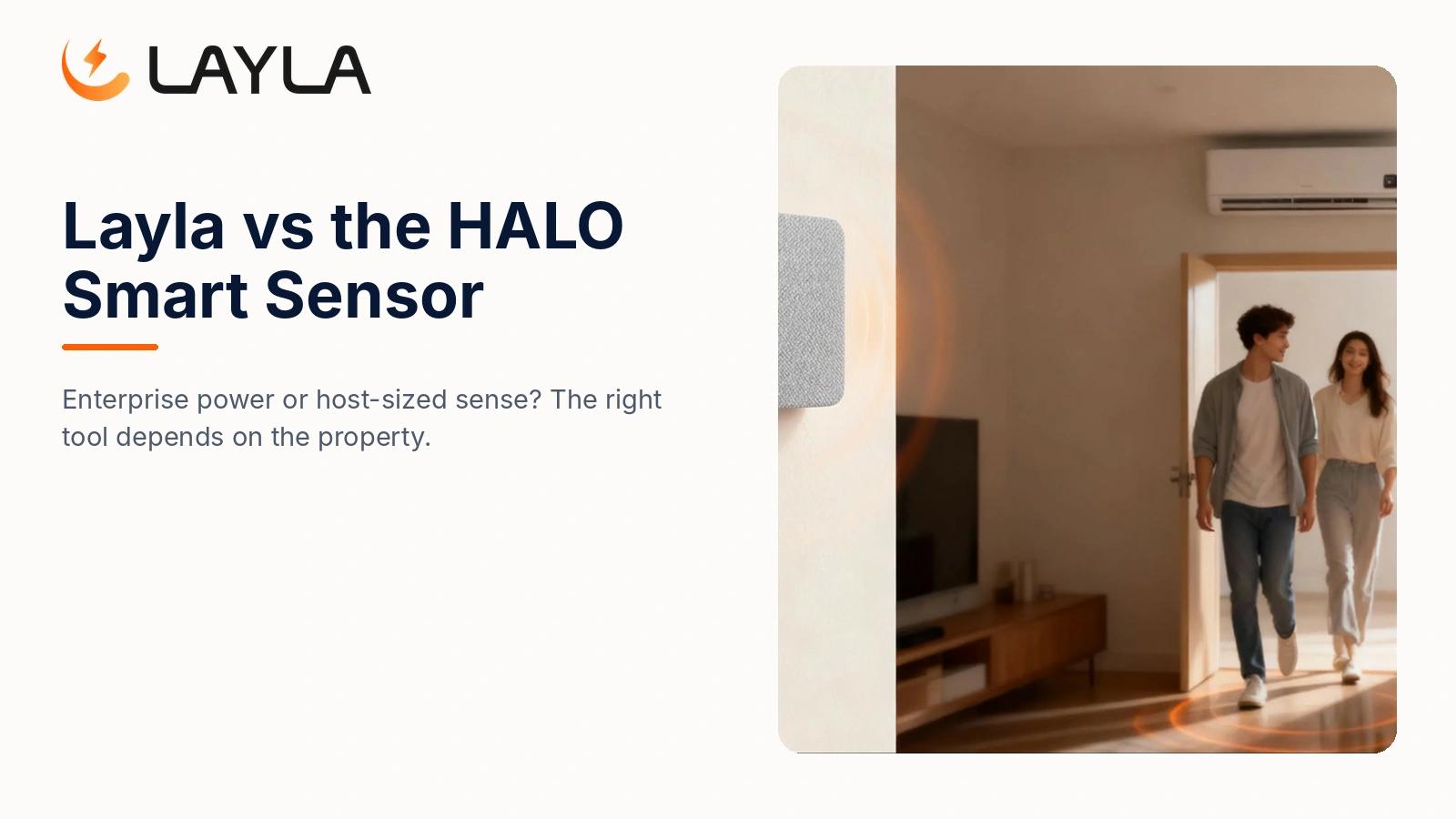
The HALO Smart Sensor is a serious piece of hardware. Made by IPVideo, sold through Pelco and other security channels, it packs more than a dozen sensors into one ceiling unit and reads vape, THC vapor, tobacco smoke, CO₂, VOCs, and air quality, then throws in aggression detection and keyword recognition on top. Schools put it in bathrooms where a camera can't go. Hospitals and large hotels wire it into their security systems. By most measures it's one of the most capable detection sensors a building can buy.
It's also the wrong tool for nearly every short-term rental, and that isn't a knock on the device. HALO was built for institutions with a network closet, a security team, and a procurement process. Layla was built for the host running a few units who wants smoking caught without becoming a systems integrator to get there. This comparison is really about matching the tool to the property.
Layla vs HALO Smart Sensor at a glance
| HALO Smart Sensor | Layla | |
|---|---|---|
| Vape / THC / cigarette detection | ✅ | ✅ |
| Names the smoke type | ✅ | ✅ (cigarette / vape / cannabis) |
| Smoke intensity grading | Threshold events | ✅ (low / medium / high, live) |
| Air quality (VOCs, CO₂, particulates) | ✅ (extensive) | ✅ |
| Sound / security detection | ✅ (aggression, keywords) | Noise (decibel level) |
| Occupancy detection | ✅ (3C-PC variant, people counting) | ✅ (AI radar) |
| AC / appliance automation | ❌ | ✅ (All-in-One) |
| Camera or microphone recording | None | None |
| Install | Wired (PoE); network, optional VMS | Self-install, Wi-Fi |
| Built for | Schools, hospitals, large venues | Rentals, small portfolios |
| Cost model | Quote-based (enterprise) | From $99 (one-time, by tier) |
| Ongoing cost | Optional cloud / VMS licensing | None |

What the HALO Smart Sensor does
Take HALO seriously, because within its world it earns its reputation. The device stacks a dozen-plus sensors into one housing and uses them together: laser scattering to see smoke and vape aerosol, chemical sensing for tobacco compounds and THC, and air-quality sensors reading CO₂, VOCs, humidity, and gases like NO₂. That combination is what lets it separate cigarette from vape from cannabis while keeping false positives down. On top of detection it listens for abnormal sound, shouting, aggression, spoken keywords like "help," which is exactly why schools and hospitals mount it in the private spaces a camera legally can't cover. The 3C-PC model adds occupancy and people counting to the mix.
The management side is built for organisations. HALO can run standalone through its own cloud dashboard and app, and it also integrates with video management systems where a building already runs one. It logs events for up to a year and lets an administrator write detailed rules by event type and time window. For a security team watching hundreds of rooms across a campus, that depth is the point. Alerts route through the app, email, or a connected VMS, and because nothing is recorded as audio or video, the sensor stays usable in sensitive areas.
Now the honest part. All of that assumes the environment HALO was designed for, and a single rental isn't it. The sensor is powered over Ethernet and expects a wired network to plug into — and, in most rollouts, a VMS behind it — so installation is a wiring-and-configuration job, not a stick-it-on-the-ceiling one. Pricing is quote-based and lands where enterprise security hardware lands, which makes sense per classroom in a district rollout and very little sense for one Airbnb. And most of what makes HALO special — aggression analytics, keyword spotting, VMS event routing, people counting across a building — is aimed at institutional security a host running three rentals will never touch. You'd be buying a commercial platform to solve a problem that doesn't need one.
What Layla does
Layla starts from the other end of the question: what does one host, running a few units they rarely visit, actually need? The answer turns out to be most of what matters in HALO, minus the parts only an institution uses, in a device you put up yourself in minutes.
Smoke detection sized for a rental
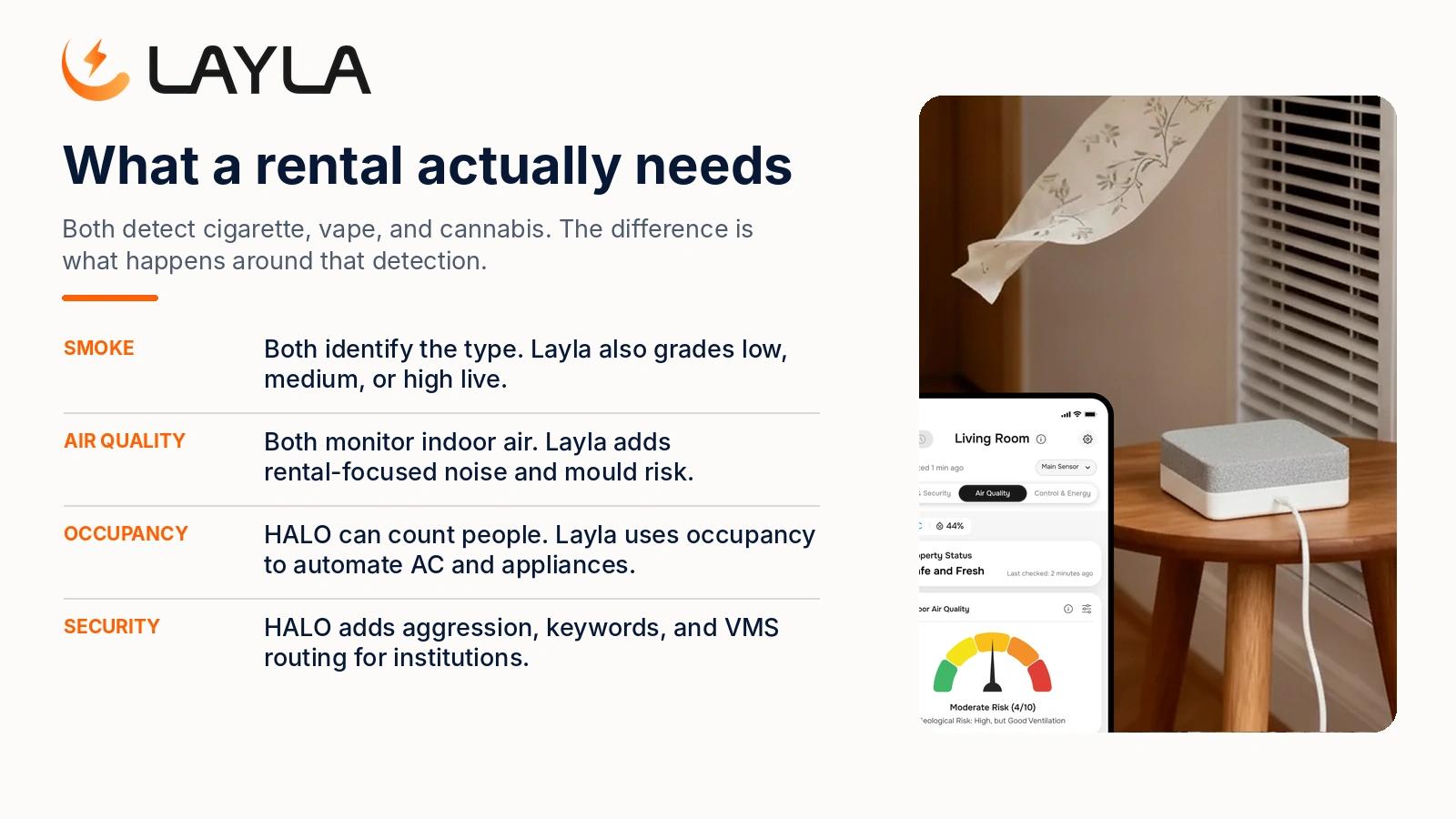
Layla reads cigarette, vape, and cannabis and names which one, so the alert already tells you what rule was broken. It grades each event low, medium, or high and keeps updating as the smoke builds or clears, so a single nervous pull by the window doesn't read like a room run as a lounge. You set the threshold that pulls you in, the alert lands live, and you're left with a timestamped record you can enforce a fee on. No VMS to route it through, no administrator to configure the rules — the enforcement outcome most hosts are actually after, reached by a much shorter road.
Everything else a rental runs on
HALO's air-quality sensing is excellent, and Layla holds its own on the readings a host actually uses: CO₂, VOCs, particulates, temperature, humidity, and mould risk in one indoor picture, laid out on the air-quality monitoring page. The real divergence is what happens with occupancy. Both devices can tell when a room is occupied, but only Layla turns that into action. Its AI-radar read feeds native AC and appliance automation, so an empty unit's cooling eases off on its own instead of running flat-out through the dead hours before the next arrival. HALO counts people; it doesn't manage your energy bill, because that was never in its brief.
Guillermo Quintero, Director of Operations at Nimble CoLiving in Barcelona:
"Layla is the best solution for our co-livings in Barcelona. It's helped us save at least 25% on electricity costs, keep our buildings safe, and reduce the need for on-site staff."
Setup is the quiet dividing line. Layla mounts on the ceiling and comes online over your existing Wi-Fi in minutes. No PoE run, no network configuration, no platform to license. The Air Quality tier that adds smoke detection is a one-time $99; the native AC and appliance automation sits on the All-in-One tier. Either way it's a one-time price, not a quote and not a recurring cloud fee.
The fair limits: Layla is a monitoring sensor, not a certified fire or smoke alarm, and it has no outdoor unit. It also won't do the institutional-security work, keyword spotting, aggression analytics, VMS integration, that HALO is genuinely built for. If you need those, HALO is the right buy.
So which one is worth it?
Pick the HALO Smart Sensor if you're outfitting a school, hospital, casino, or large hotel that already has a security team and network in place. Its sensor depth, VMS integration, and security features are built for exactly that scale, and the quote-based cost and wired install come with the territory. For that buyer, none of this is a criticism.
Pick Layla if you run short-term rentals or a small portfolio and want smoking caught, air quality watched, and energy managed without standing up an enterprise deployment to do it. You install it yourself, you pay once, and you skip the network setup, the licensing, and the quote. For a host, that isn't a downgrade from HALO. It's the right size.
Frequently asked questions
Is the HALO Smart Sensor good for Airbnb rentals?
It's an excellent device, but it's built for institutions, schools, hospitals, large hotels, with network infrastructure and often a video management system. For a single rental or small portfolio it's usually overkill: quote-based enterprise pricing, a wired PoE install, and a feature set aimed at commercial security. Layla covers the smoke and air-quality needs a host actually has, self-installed and paid for once.
How much does the HALO Smart Sensor cost?
Pricing is quote-based rather than public, and sits in the enterprise bracket typical of commercial security hardware, which fits an institutional rollout more than a single property. Layla is a one-time $99 with no ongoing fee.
Does Layla detect vaping and THC like HALO?
Yes. Layla reads cigarette, vape, and cannabis, names the type, and grades each event low, medium, or high with live updates. HALO uses more sensors and adds institutional security features, but for the everyday job of catching and documenting smoking in a rental, Layla gives a host what they need — a typed, timestamped record to enforce a fee on.
Do I need special installation or a network for Layla?
No. Layla mounts on the ceiling and comes online over your existing Wi-Fi in minutes, with no PoE wiring, no network configuration, and no platform to license. HALO generally requires a wired install and a network or VMS to plug into.
Does either device record audio or video?
No. Neither HALO nor Layla records audio or video, which is why both can be used in sensitive areas. HALO listens for aggression and keywords as sound events; Layla reads noise as a decibel figure only.
Related reading
- Cigarette, Vape, and Cannabis: How Layla's Smoke Detection Actually Works
- Best Cigarette, Vape & Cannabis Smoke Detectors for Rentals in 2026
- Layla vs Wynd Sentry: Which Catches Smoking in Your Rental?
Enterprise power is great when you're an enterprise. See how Layla covers your rental: smoke, air quality, noise, and occupancy from one self-installed sensor, bought once.

Best for: health-conscious homes
Smoke & Air Quality
Air quality, mold and smoke monitoring for healthy homes and smoke-free rentals.
Included forever — no subscription
- Mold-risk early warning
- Smoke & cigarette detection
- Air quality score (IAQ) with alerts
- CO₂ & bVOC monitoring
- AI air insights & recommendations
- Allergy-comfort monitoring
No monthly fees. Ever.
30-day money back guarantee