BLOG
Minut Smoke Detection vs Layla: What Each One Actually Catches
 By Nangyal Khan··Updated
 7 min read
Minut is the noise monitor most Airbnb hosts already know, and a few years back it added cigarette smoke detection to the same little disc. One device, two of the biggest house-rule problems. For anyone already running Minut for parties, that was an easy upgrade. The question worth asking is how far that smoke feature really reaches, and where a wider-purpose sensor like Layla pulls ahead. Vaping is where the answer gets interesting, because it's the violation guests attempt most and the one that's hardest to catch.
This is the smoke-specific comparison. If you want the full noise, pricing, and occupancy breakdown, that's in the complete Layla vs Minut guide. Here we're staying on smoke.
Minut vs Layla on smoke, at a glance
| Minut | Layla | |
|---|---|---|
| Cigarette detection | ✅ (ML, particulate) | ✅ |
| Cannabis detection | ✅ | ✅ |
| Vape / e-cigarette detection | Not designed for it | ✅ |
| Names the smoke type | Cigarette-focused | ✅ (cigarette / vape / cannabis) |
| Intensity grading | ❌ | ✅ (low / medium / high, live) |
| Time to register | ~20–30 min of exposure | Faint traces, live updates |
| VOC air-quality cross-check | ❌ | ✅ |
| Airbnb official integration | ✅ | ❌ |
| Ongoing fee | $5–$15 / month | None ($99 one-time) |
How Minut's smoke detection works
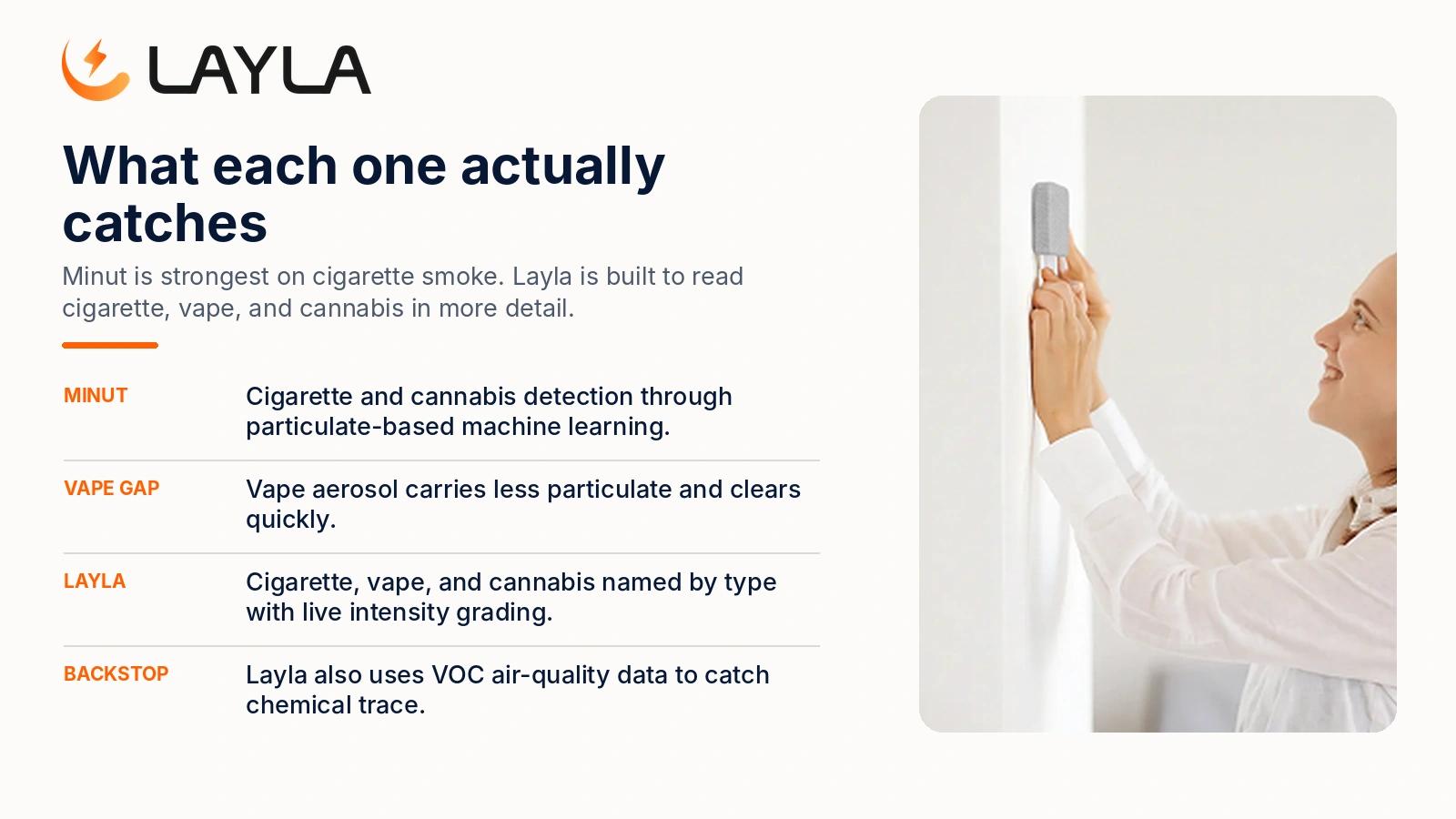
Minut catches cigarette smoke with machine learning rather than a chemical sensor. The M3 reads particulate matter in the air, and its model has been trained to tell cigarette smoke from something harmless like burnt toast. That's a smarter approach than a plain particle counter, and most of the time it does the job. You switch the feature on in the app, the sensor runs a short calibration, and from then on it flags likely cigarette and marijuana smoke. Confirmed detections have held up as supporting evidence inside Airbnb's resolution centre, and because Minut has an official Airbnb partnership, those alerts sit alongside the noise warnings the platform already trusts. For a host who mostly worries about cigarettes and already leans on Minut for noise, that's a solid, familiar package.
The limits come straight from the method, and they're worth knowing before you rely on it. Particle detection needs enough smoke to reach the sensor and linger there. Minut's own guidance points to roughly twenty to thirty minutes of exposure for a reliable read, which is fine for a guest who settles in and chain-smokes, and less useful against someone who cracks a window, takes a few pulls, and airs the room out. Read a Minut smoke alert as a strong paper trail, not an ironclad one. There's no intensity grading either, so you learn that smoke was likely, not whether it was one cigarette or a two-hour session.
Vaping is the real soft spot, and the physics explain why. A vape cloud carries far less particulate matter than a cigarette, by some measures up to ten times less, and it disperses fast. A detector trained and tuned around cigarette particles is working against the grain there. Minut is built for cigarette and marijuana smoke, not for vapor, which matters because vaping is exactly what a guest reaches for when they assume nothing will notice.
How Layla approaches the same problem
Layla treats smoke as a signal to read in detail, not a single yes-or-no flag, and it's built to cover the case Minut is weakest on.
Type, strength, and the vape gap
Layla reads cigarette, vape, and cannabis and names which one, so you know what rule was broken before you send a message. Vape coverage is the headline difference. Where a cigarette-tuned model struggles with low-particulate aerosol, Layla is designed to catch it, and that's the violation guests attempt most because they bank on getting away with it.
Then there's strength. Layla grades each event low, medium, or high and keeps updating as things move, so a faint trace by the balcony door reads differently from a room filling with haze. It doesn't ping once and go dark. It tracks the situation as it develops. You set the threshold that pulls you in, low to hear about the faintest whiff, higher so only a sustained session reaches you. Every alert arrives live, tagged by type and graded by strength, which leaves you a record that says what happened, not just that something did.
A second angle on what particles miss
Layla's air-quality sensing adds a backstop Minut doesn't have. Its VOC reading picks up the chemical trace smoke leaves behind, so a guest who airs the room to keep direct particle readings down can still surface in the VOC log. Two ways of catching the same event are harder to slip past than one. That air-quality layer pays off the rest of the time too, flagging the stuffy, stale room a guest would otherwise leave in a review. There's more on the air-quality page.
The honest trade: Minut has the official Airbnb integration and Layla doesn't, so if pushing warnings straight through Airbnb's messaging is central to how you run things, that's a genuine point in Minut's favour. Both devices are camera-free and audio-free, and neither is a certified fire or smoke alarm, so keep your required safety devices in place.
So which should a host use for smoke?
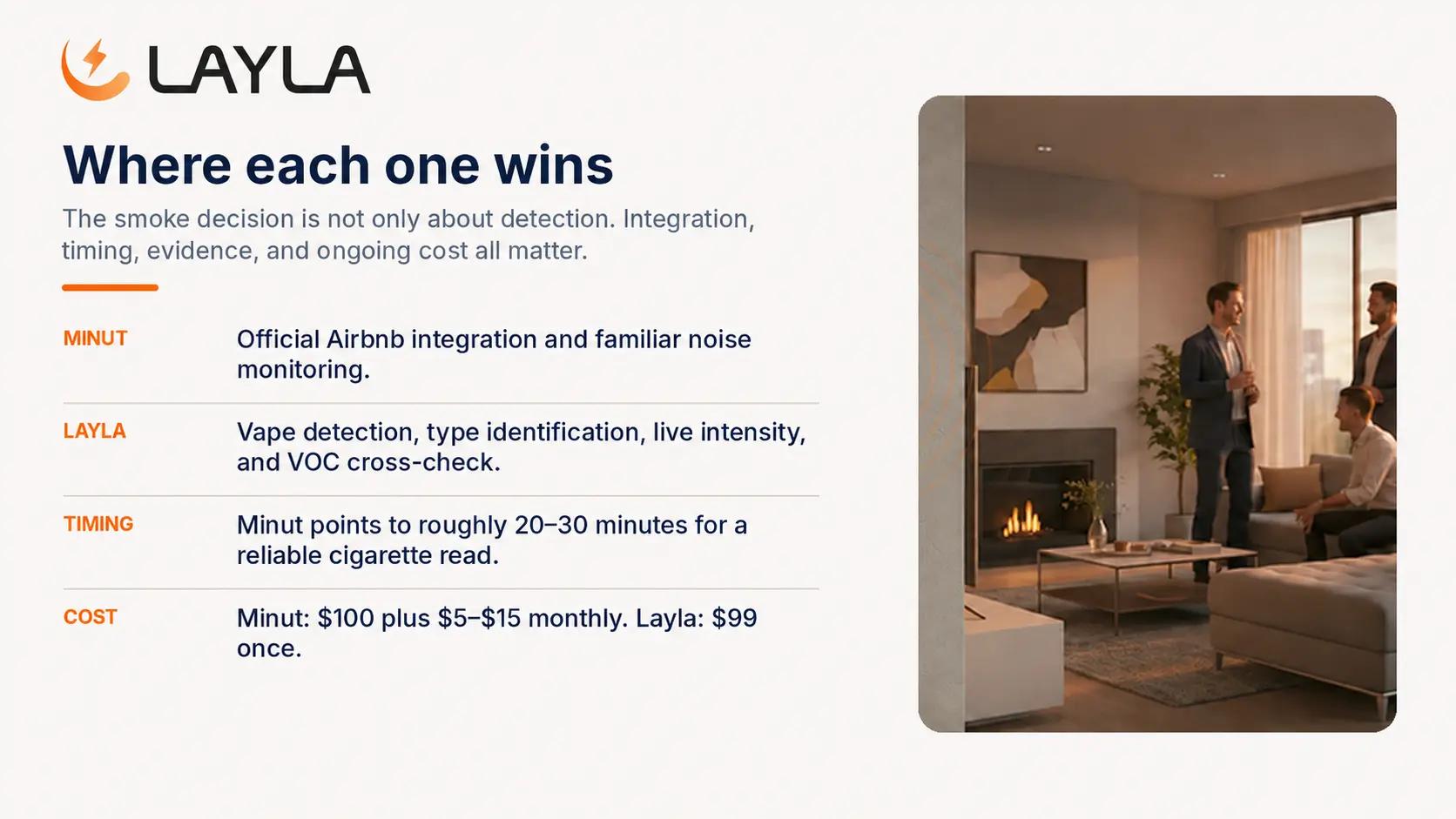
Stick with Minut if cigarettes are your main worry, you already run it for noise, and the Airbnb integration is doing real work in your setup. Its detection is good, its evidence has stood up in disputes, and there's convenience in one familiar device.
Choose Layla if vaping is on your list, if you want to know how heavy a session was rather than just that one happened, and if you'd rather pay once than carry a monthly fee. The cigarette, vape, and cannabis split, the intensity grading, and the VOC cross-check make it the more thorough smoke catcher, and it handles the air-quality and energy work Minut's smoke feature was never meant to touch. For everything beyond smoke, see the complete Layla vs Minut comparison.
Frequently asked questions
Does Minut detect vaping?
Minut's smoke detection is built around cigarette smoke, and it flags marijuana too, using machine learning on airborne particles. Vape aerosol carries far less particulate and disperses quickly, so it's the weakest case for a cigarette-trained detector. Layla is designed to detect vape alongside cigarette and cannabis smoke.
How long does Minut take to detect smoke?
Minut points to roughly twenty to thirty minutes of exposure for a reliable read, because particle detection needs enough smoke to build up and hold near the sensor. A guest who smokes briefly by an open window can stay under that. Layla is built to pick up fainter traces and updates the reading live as the smoke changes.
How accurate is Minut's cigarette detection?
It's good for a particle-based method, and confirmed alerts have supported host claims in Airbnb's resolution centre. The limit is physics: brief smoking, an open window, or a running extractor can thin the smoke before enough reaches the sensor. Treat it as strong supporting evidence rather than proof on its own.
What does Layla's smoke detection add over Minut's?
Three things. It names the smoke as cigarette, vape, or cannabis. It grades intensity low, medium, or high and updates live. And its VOC air-quality sensor cross-checks smoke by chemical trace, catching cases a particle reading alone can miss. Minut's edge is the official Airbnb integration.
Is Layla cheaper than Minut for smoke detection?
Minut's smoke feature runs on its subscription, $5 to $15 per property each month on top of the $100 sensor. Layla's Air Quality tier that catches smoke is a one-time $99 with no monthly fee, so over any multi-year stretch it costs less. The full cost breakdown is in the complete Layla vs Minut comparison.
Related reading
- Cigarette, Vape, and Cannabis: How Layla's Smoke Detection Actually Works
- Layla vs Minut: Which Noise Monitor Wins for Airbnb Hosts?
- Best Cigarette, Vape & Cannabis Smoke Detectors for Rentals in 2026
Vaping is the one most sensors miss. See how Layla covers your rental: cigarette, vape, and cannabis detection with air quality and noise, from one sensor, bought once.

Best for: health-conscious homes
Smoke & Air Quality
Air quality, mold and smoke monitoring for healthy homes and smoke-free rentals.
Included forever — no subscription
- Mold-risk early warning
- Smoke & cigarette detection
- Air quality score (IAQ) with alerts
- CO₂ & bVOC monitoring
- AI air insights & recommendations
- Allergy-comfort monitoring
No monthly fees. Ever.
30-day money back guarantee