BLOG
How to prevent Airbnb noise complaints before a neighbor calls
 By Nangyal Khan·
9 min read
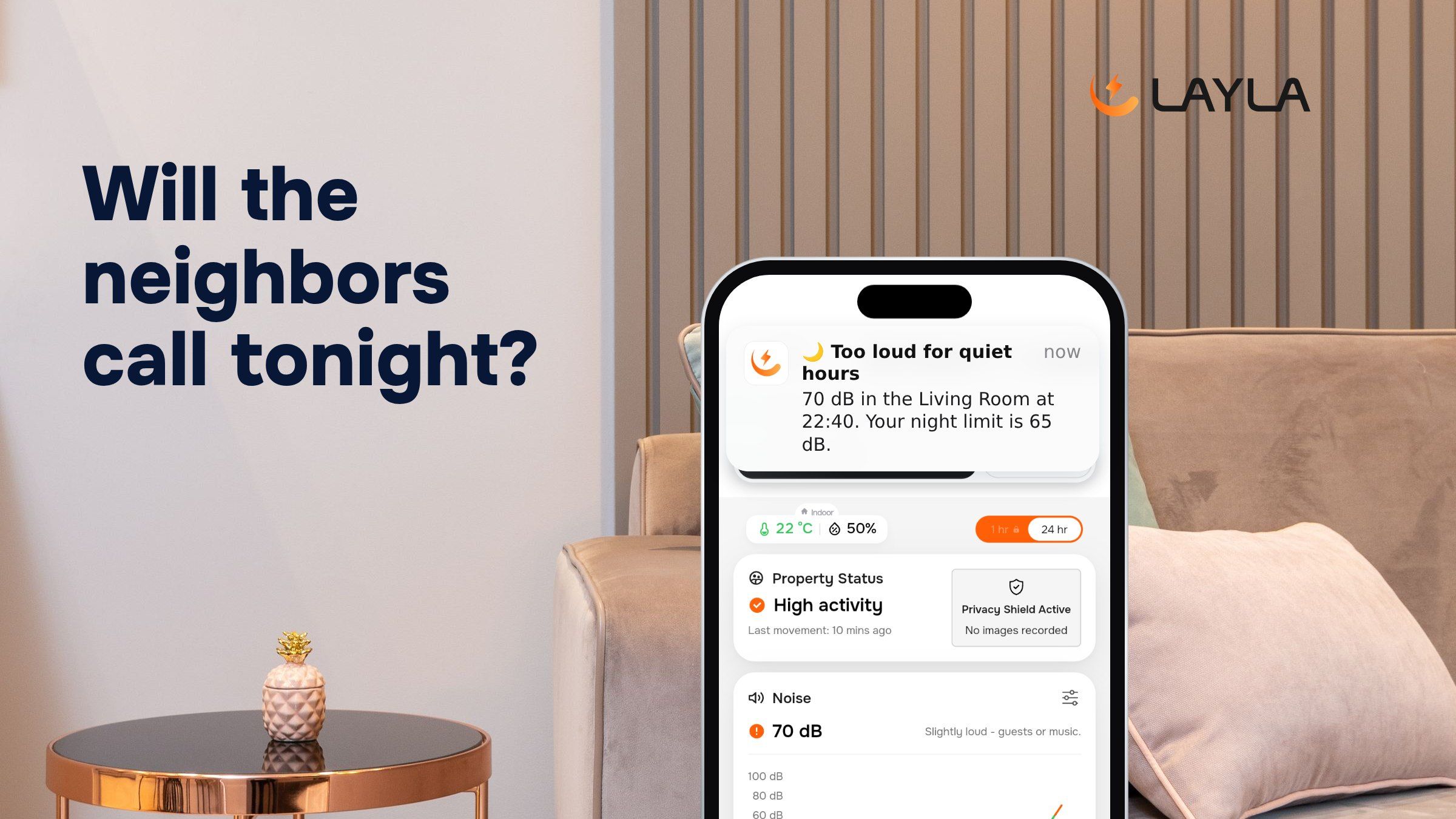
Most Airbnb noise complaints start the same way. Guests get loud late in the evening, a neighbor puts up with it for an hour, and the host finds out when the phone rings. You prevent them with three things: quiet hours guests read before they book and again when they arrive, neighbors who can reach you first, and a noise monitor that alerts you the moment it gets too loud, so you message the guest before anyone else has to. Layla measures how loud it gets in decibels, with no camera, and no audio is recorded, so it fits a rental where guests expect privacy.
Below are the steps, in the order to set them up. If a complaint has already come in, start with what to do about an Airbnb noise complaint from a neighbor.
Why do Airbnb noise complaints happen?
A complaint rarely comes from one loud laugh. It comes from noise that ran on for a while with nobody stepping in. The usual causes:
- Noise after quiet hours. Music or talk on a balcony at 23:00 bothers people far more than the same noise at 15:00, because the neighbors are trying to sleep.
- More guests than booked. A booking for four that turns into nine is louder in every room. Here is how to catch extra guests without cameras.
- Shared walls and floors. In an apartment or a duplex, ordinary voices carry to the people next door.
- A host who finds out last. When you are miles away or asleep, you learn about it from the neighbor's call, a bad review or a letter from the city.
Rules cut down the first three. The last one is the gap a noise monitor closes, and it is the one that turns a loud evening into a complaint.
What quiet hours should you set, and where should guests see them?
A common window is 22:00 to 07:00 (10 p.m. to 7 a.m.). If your city or building sets its own quiet hours, use those when they are stricter. Our guide to quiet hours for vacation rentals covers the usual windows and the wording in more detail.
Guests follow a rule they have read more than once, so put your quiet hours in four places:
- The listing, so guests know before they book.
- Your house rules. Our vacation rental house rules template has a quiet hours rule you can copy.
- The check-in message, sent the day they arrive.
- A card in the living room, where the group gathers.
Tell guests about the noise monitor in the same places. Airbnb allows noise monitors that measure decibels when you disclose them in the listing. Disclosing it also sets the tone: guests know the noise is being measured, and most keep it down. Clear quiet hours and a disclosed monitor also help you follow local noise rules. A line you can copy:
Quiet hours are 22:00 to 07:00. This home has a noise monitor in the living room. It measures noise levels in decibels only: there is no camera and no audio is recorded. If it stays loud during quiet hours, we will message you.
What noise level should trigger an alert?
Quiet hours only work if you know when they are broken, so turn them into a number. In the Layla app you choose one of three alert settings for each property:
| Setting | Alerts you when | Suits |
|---|---|---|
| Strict | 70 dB for 1 minute | Thin walls, shared buildings |
| Balanced | 70 dB for 5 minutes | Most homes |
| Relaxed | 85 dB for 10 minutes | Detached houses |
On top of that, you set a night limit for quiet hours, from 65 to 75 dB. The lower the limit, the earlier you hear about it. Take Elm House, a two-bedroom apartment in a shared building: Balanced for the day, and quiet hours from 22:00 with a night limit of 65 dB. A conversation that turns into a loud gathering after 22:00 alerts the host long before it wakes the floor above. A detached house with no close neighbors can use a night limit nearer 75 dB. For what each level means in a real room, see acceptable decibel levels in a rental.
You set it once for each property, in the noise settings, and it applies every night.
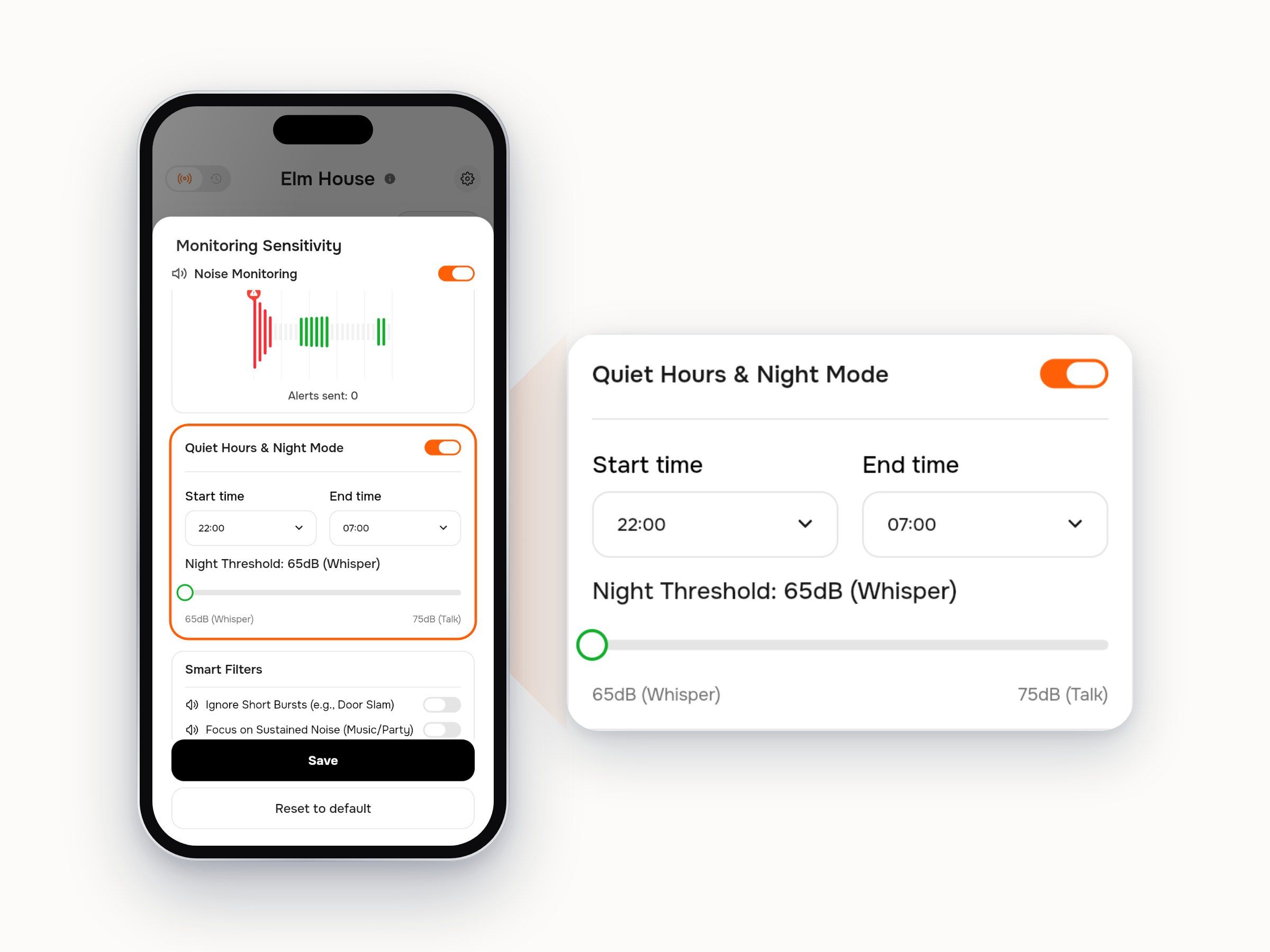
Elm House's noise settings in the Layla app: quiet hours from 22:00 and a 65 dB night limit
What do you do the moment the alert comes?
Act straight away, while it is still a small problem. Here is how an evening at Elm House goes. Three guests are staying, within the guest limit of 4. From 22:20 the living room gets louder. At 22:40 it reaches 70 dB, over the 65 dB night limit, and Layla sends the host a phone notification: "70 dB in the Living Room at 22:40. Your night limit is 65 dB." Alerts come as a phone notification or an email, the moment something needs you.
The host sends one friendly message. By about 22:55 the living room is back under 65 dB, and no neighbor had a reason to call.
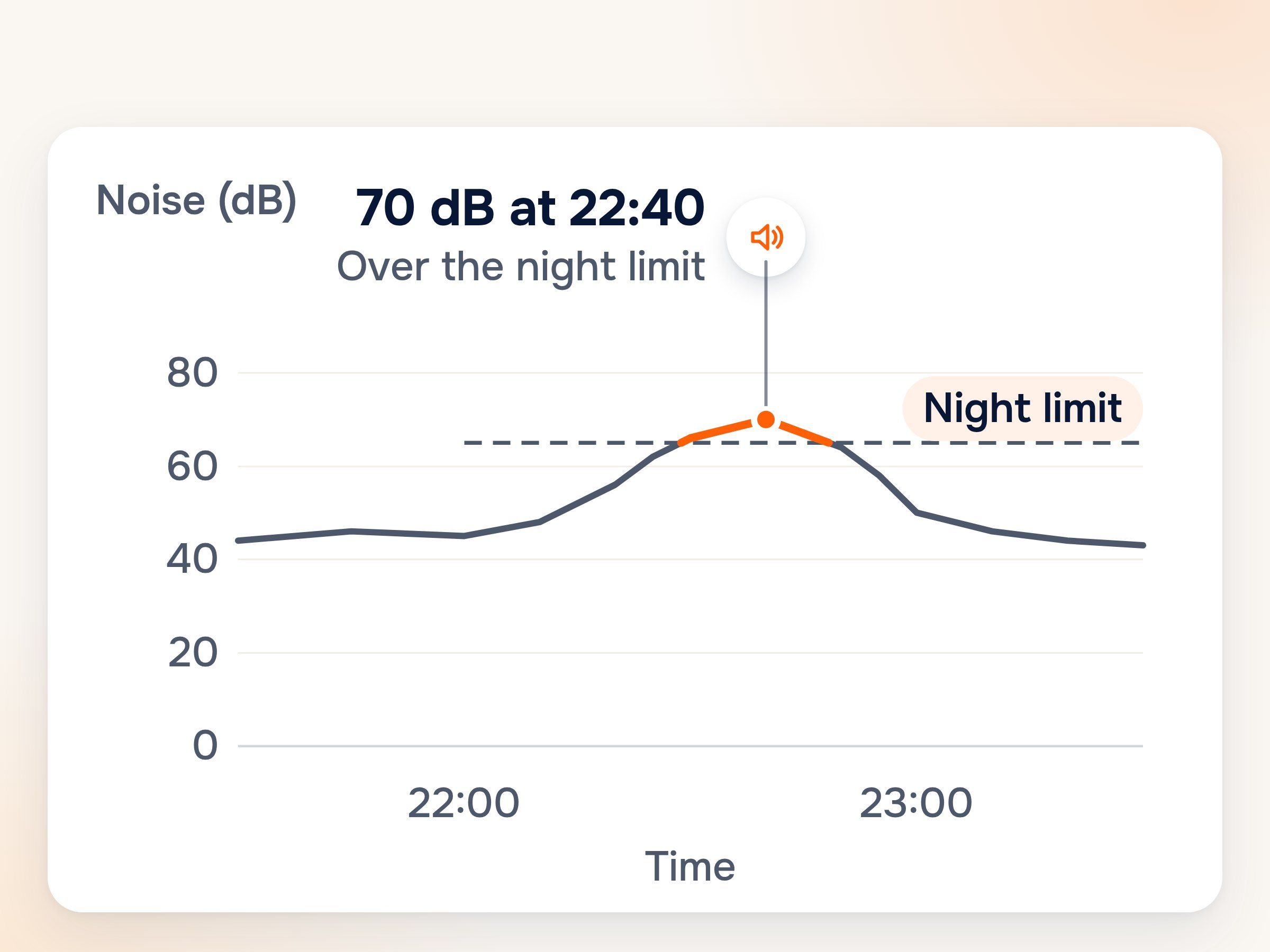
One evening at Elm House: 70 dB over the night limit at 22:40, quiet again within minutes
What to do when the alert comes:
- Message the guest within minutes. The sooner you write, the smaller the ask.
- Keep it friendly. Most guests have no idea how far noise carries, and a kind note works better than a warning.
- Check that it worked. On Noise & Security Pro, readings are live, so the graph shows within minutes whether the noise came down. Noise Basic alerts in real time and updates its readings every 5 minutes.
- Follow up if it stays loud. Call the guest, then take the steps your house rules set out.
A message you can copy:
Hi, hope you're enjoying the stay! Our noise monitor shows it's getting loud, and quiet hours started at 22:00. The neighbors are close, so could you keep it down from here? Thanks so much.
How do you stop a party before it starts?
Parties cause the most serious complaints, so stop them at three points.
At booking. Screening catches many party bookings before anyone arrives: one-night weekend stays, a new account, a vague reason for the trip. Our guide to Airbnb guest screening for party bookings lists the signs.
When extra people arrive. Tell Layla how many guests each property allows. Layla tells you how many people are inside, and it alerts you when there are more than that. The count is anonymous: nobody is identified. Crowd alerts come with Noise Basic and Noise & Security Pro.
When a party builds. On Noise & Security Pro, the AI Party Detector alerts you when noise and a crowd build at the same time. It is on by default, and the alert says how loud it is and about how many people are inside. Say Elm House, booked for 4, fills up on a Saturday from 23:00. By 23:15 the host gets a party alert: 78 dB and about 9 people in the Living Room. That is a party the host can stop now with a call to the guest, not one they read about in the morning. Layla alerts you, and you decide what to do.
The next morning, Party & guest watch shows yesterday's status, such as Party, with about how many people were inside and the hour noise went over your limit. That gives you what you need for the conversation with the guest. For the wider picture of what Airbnb does about parties and what is left to you, read Airbnb party prevention without cameras.
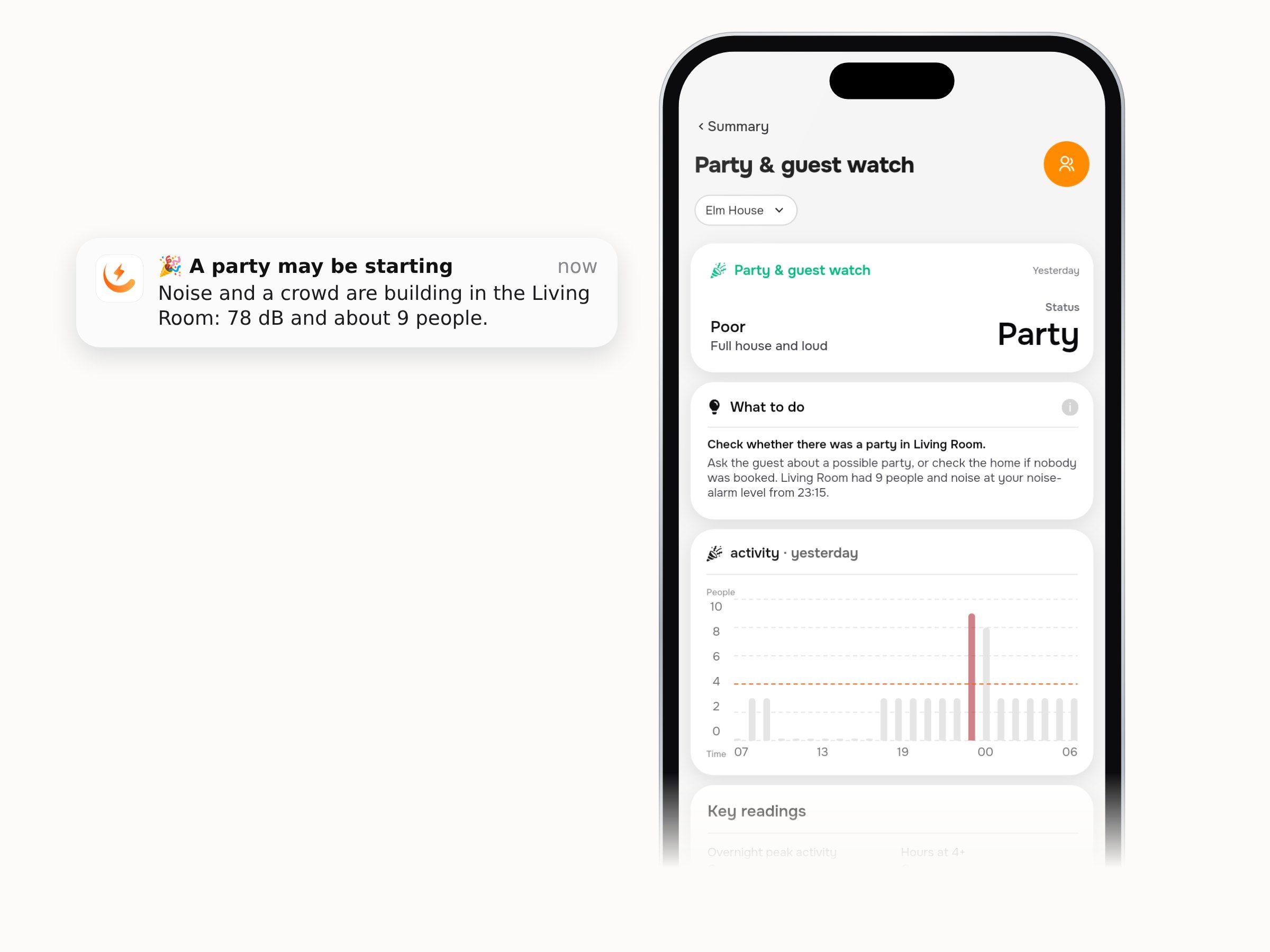
Layla's party alert at Elm House: 78 dB and about 9 people at a home with a limit of 4
What should you tell your neighbors?
A neighbor who can reach you is far less likely to go to Airbnb or the city first. Make them your early warning too. Give the neighbors closest to the rental a short note, with your number, your quiet hours and a line about the noise monitor:
Hi, I'm the host of the apartment next door. If my guests are ever too loud, please text or call me first at [your number], day or night, and I'll sort it out. Quiet hours are 22:00 to 07:00, and the home has a noise monitor that alerts me when it gets loud. It measures decibels only: there is no camera and no audio is recorded.
Thank them when they do call, and tell them what you did. A neighbor who sees a problem fixed within minutes keeps calling you, not the city.
If a complaint comes anyway, our step-by-step guide to an Airbnb noise complaint from a neighbor covers what to say and what to do next.
Which Layla plan keeps the noise in check?
Both noise plans give you the early warning this guide is built on. The difference is how much they tell you about a party.
| What you get | Noise Basic (new) | Noise & Security Pro |
|---|---|---|
| Price | $149 once | $179 once |
| Noise alerts and quiet hours | Yes | Yes |
| Crowd alerts | Yes | Yes |
| AI Party Detector | No | Yes |
| Readings | Every 5 minutes | Live |
| History | 7 days | 30-day charts |
The new Noise Basic, at $149 once, is the start for a host who needs noise alerts, quiet hours and crowd alerts. Noise & Security Pro, at $179 once, adds the two things that catch a party early: the AI Party Detector, which tells you how loud it is and about how many people are inside, and live readings, which show within minutes whether your message worked. It also adds Party & guest watch the morning after, radar security for when the home should be empty, and incident reports for the last six months. For a host who is often away from the rental, that is $30 well spent.
Either way, you pay once, with no subscription. Setup takes about 2 minutes: plug the sensor in, find it in the Layla app, connect it to Wi-Fi and activate it. For noise and how many people are inside, one sensor covers most small apartments. See every plan on the pricing page, or compare Layla with other monitors in our guide to the best noise monitor for Airbnb.

Best for: serious hosts
Noise Pro
Compliant with Airbnb's rules and local noise laws worldwide. Advanced protection for serious hosts.
Included forever – no subscription
- AI party detector
- Instant noise alerts with timestamps
- Live data feed, no 5-minute delay
- 180-day data history
- Radar intruder & vacant-home alerts
- Property status dashboard
- Outdoor temperature & humidity
- Automatic AI accuracy updates
- Daily & weekly summary reports by email
No monthly fees. Ever.
Your indoor air is 2-5x more polluted than outdoor air.
The EPA confirms it, but most people have no idea. You spend 90% of your time indoors breathing air you've never measured.
CO2 builds up silently.
A bedroom with two people can hit 2,500 ppm overnight. Harvard research shows decision-making drops 50% at 1,400 ppm. That brain fog and morning fatigue? It might not be bad sleep - it's bad air.
VOCs are off-gassing in every room.
New furniture, carpets, paint, cleaning products indoor VOC levels run up to 10x higher than outdoors. Some, like formaldehyde and benzene, are classified carcinogens. You can't smell most of them.
Mold starts in 24 hours.
When humidity exceeds 60%, mold begins colonizing within a day. 47% of U.S. homes show visible mold. Average remediation cost: $2,368 severe cases hit $30,000. A sensor that warns you before mold starts is orders of magnitude cheaper than cleanup.
Standard smoke detectors only catch fires.
They don't detect cigarette, vape, or marijuana smoke at low levels. For landlords and hosts, unauthorized smoking causes damage that goes unnoticed for weeks.
Post-COVID, people want data.
66% of Americans are more cautious about indoor air since the pandemic. 61% say they'd trust a space more if it monitored air quality. The awareness shift is permanent.
30-day money back guarantee