BLOG
How to Catch Extra Guests at Your Short-Term Rental (Without Cameras, 2026)
 By Nangyal Khan··Updated
 8 min read
A party is loud and obvious, and it's over by morning. The occupancy problem that slowly eats into your business is much quieter. It's the two-person booking that turns up as five and settles in for the week, or the "just me and my partner" reservation that becomes a family of seven. No broken glass, no call at 2 a.m., just more people in the house than you agreed to, night after night, and a host who never finds out.
It's easy to shrug off because nothing dramatic happens, and that's exactly why it costs you. Extra guests are where the slow damage hides: wear you aren't being paid for, insurance you might have just voided, safety limits you set for good reasons, and sometimes an unauthorized sublet running quietly in the background. Here's how to catch it, legally, without turning your rental into a surveillance operation and without pointing a single camera at your guests.
Why Extra Guests Cost More Than You'd Think
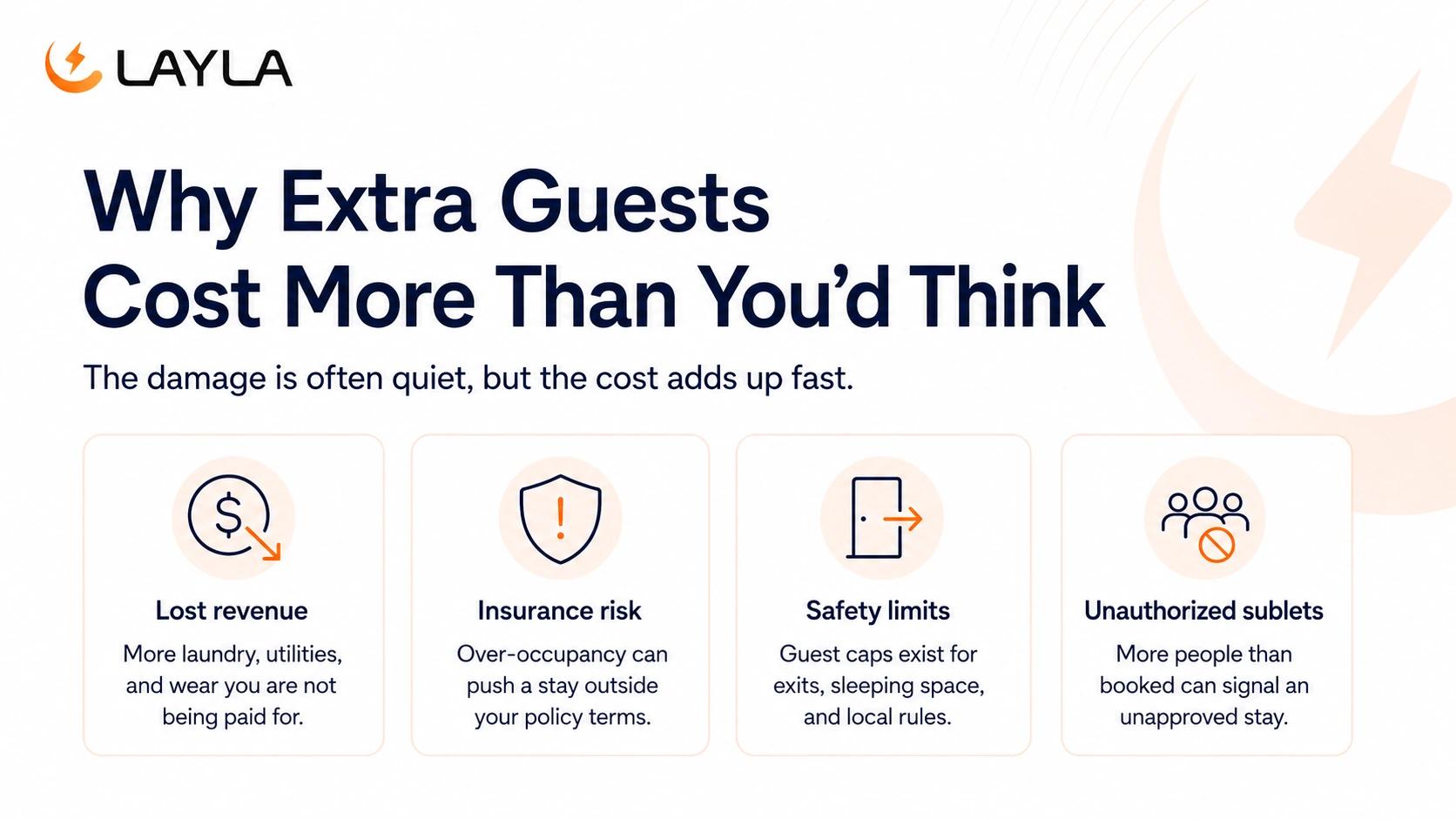
Put the noise to one side and look at what over-occupancy actually does to a rental.
Start with the money you're leaving on the table. Extra-guest fees exist because more people means more wear: more laundry, more water, more strain on everything from the AC to the septic tank. When guests slip past the count you agreed on, they get that usage for free and leave you holding the maintenance bill.
Then there's the part that can really sting, which is insurance and liability. Most short-term rental policies, and the protections your platform offers, assume the occupancy you listed. Pack in more people than the home is rated for and you may be operating outside your coverage at the worst possible moment. An injury in an overcrowded house is not when you want to learn there's an occupancy clause in your policy.
Occupancy caps aren't pulled from thin air, either. They tie back to the safety of the space: exits, sleeping arrangements, sometimes a local ordinance or an HOA limit. A home set up for four doesn't quietly become safe for nine because nobody asked first. And in the worst cases, the extra guests aren't guests at all. They're a sublet, or someone re-listing your place under your nose. Every one of those situations begins the same way, with more people in the home than the booking allowed.
What ties it all together is that none of it announces itself, which is why you need a way to actually see occupancy rather than trust that guests will be upfront about it.
Why the Usual Methods Fall Short
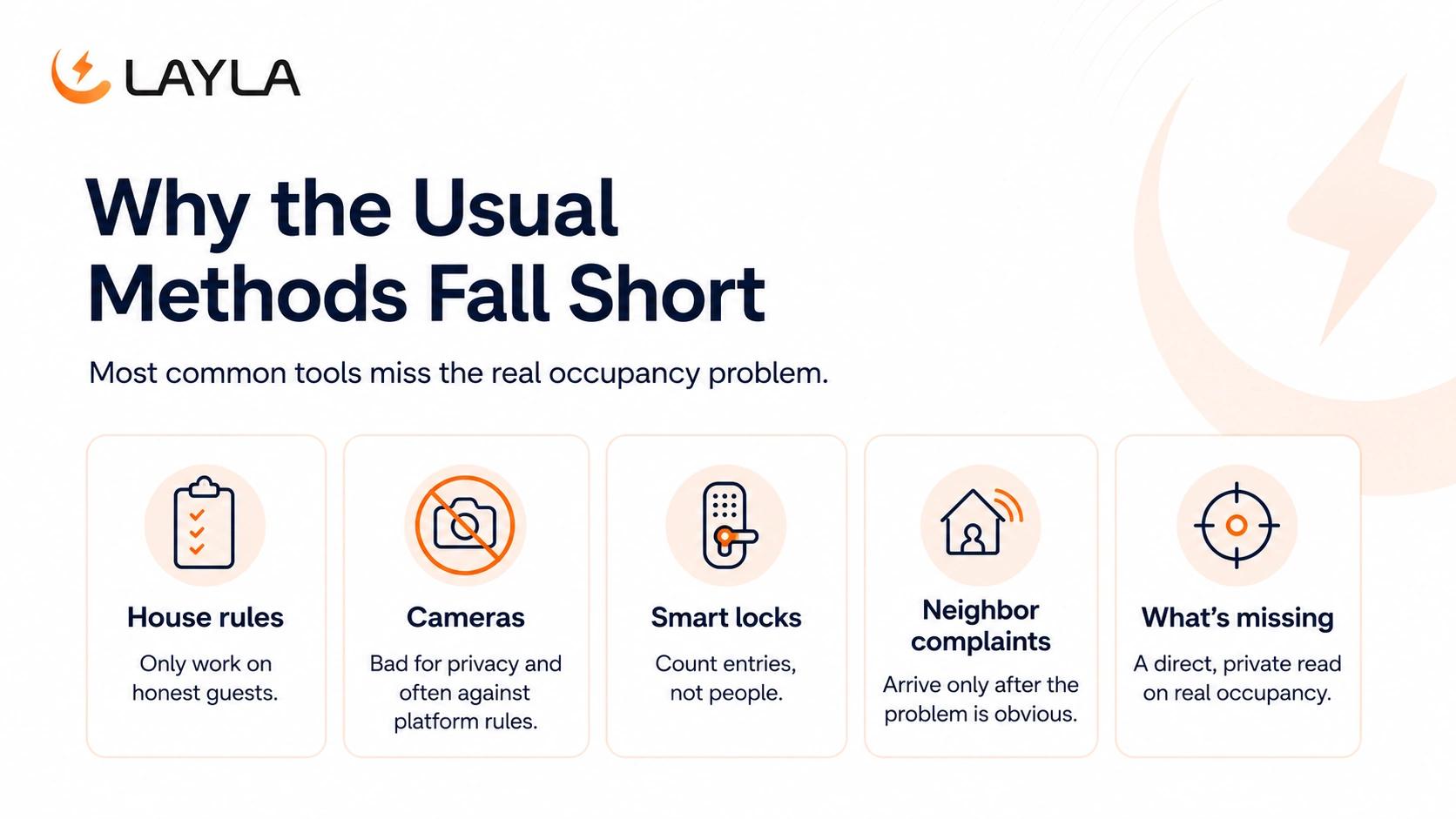
Most hosts try to manage occupancy with whatever they already have on hand, and most of it misses.
House rules and the honor system are the starting point, and they only work on honest guests. Anyone planning to bring extra people has already decided your limit doesn't apply to them. A number in the listing does nothing to change what happens once they're inside.
Cameras feel like the natural fix, and they're the wrong one. Interior cameras in a rental are a fast route to a one-star review, a platform violation, and in plenty of places a legal problem, because guests have a reasonable expectation of privacy inside the home. Even outdoor cameras only watch the front door, not how many people are really living in the space.
Smart locks help a little, but they count entries, not people. A door that opens twice tells you nothing about whether two guests walked in or two guests held it open for a dozen more. Neighbor complaints, the last line of defense, only reach you once things are already bad enough for someone else to notice.
What every one of these misses is a direct, private read on how many people are in the home, one that respects a guest's privacy and still tells you the truth.
How to Catch Extra Guests the Right Way, With Occupancy Detection
This is the gap Layla is built to fill.
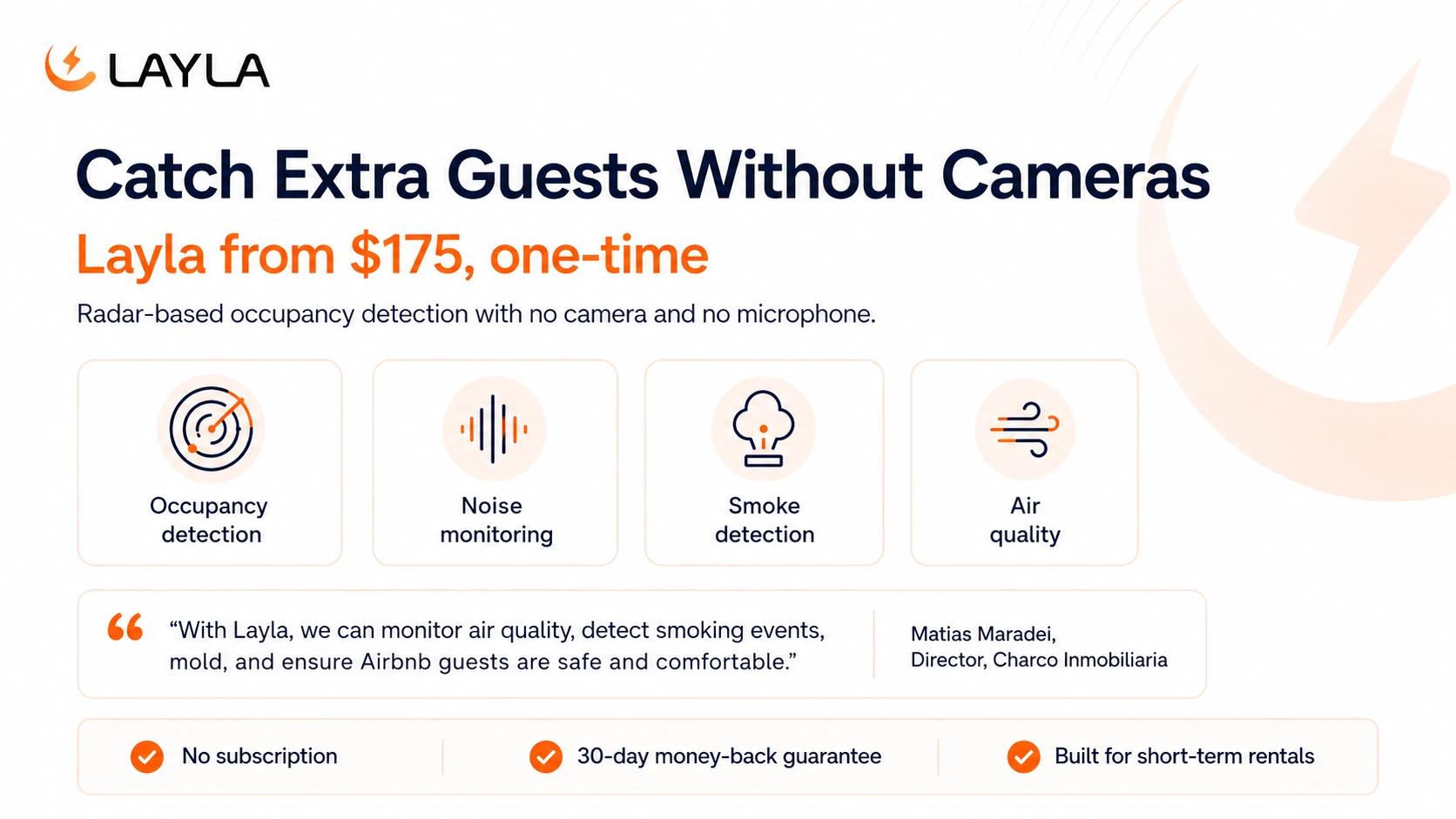
Layla runs on AI-based occupancy detection using radar presence sensing: no camera, no microphone. Radar picks up the presence and number of people in a space by sensing movement and position, so it can flag a home holding far more occupants than the booking allowed without ever seeing or hearing anyone. In a rental, that distinction carries real weight. You get an honest read on occupancy, and you can tell guests, truthfully, that there's no camera and no audio recording anywhere in the unit.
Because it watches continuously, it catches the thing the honor system can't. Not a single count at the door, but the real, ongoing number of people living in the space across a stay. If a two-guest booking is quietly housing six, it shows. You find out early, while a polite message about the occupancy limit and the extra-guest fee can still fix it, instead of piecing it together later from the wear, the utility bill, or a neighbor's text.
And since it's one device, that same sensor is handling the rest of what tends to go sideways in a rental. Real-time noise monitoring based on decibels, again with no audio recorded. Smoke detection that covers the vape-in-a-non-smoking-unit habit extra guests often bring. And indoor air-quality tracking for VOCs, CO₂, particulates, and mold. Occupancy is the headline, but you're not paying for a one-trick gadget to get it.
"With Layla, we can monitor air quality, detect smoking events, mold, and ensure Airbnb guests are safe and comfortable."
>
— Matias Maradei, Director, Charco Inmobiliaria
The pricing keeps things simple. Layla is a one-time purchase from $149, up to $299 for the All-in-One, with no subscription at any number of properties. You own the device, and there's no monthly fee piling up per unit.
Shop Layla — catch extra guests without cameras, from $149 →
What to Do When You Catch It
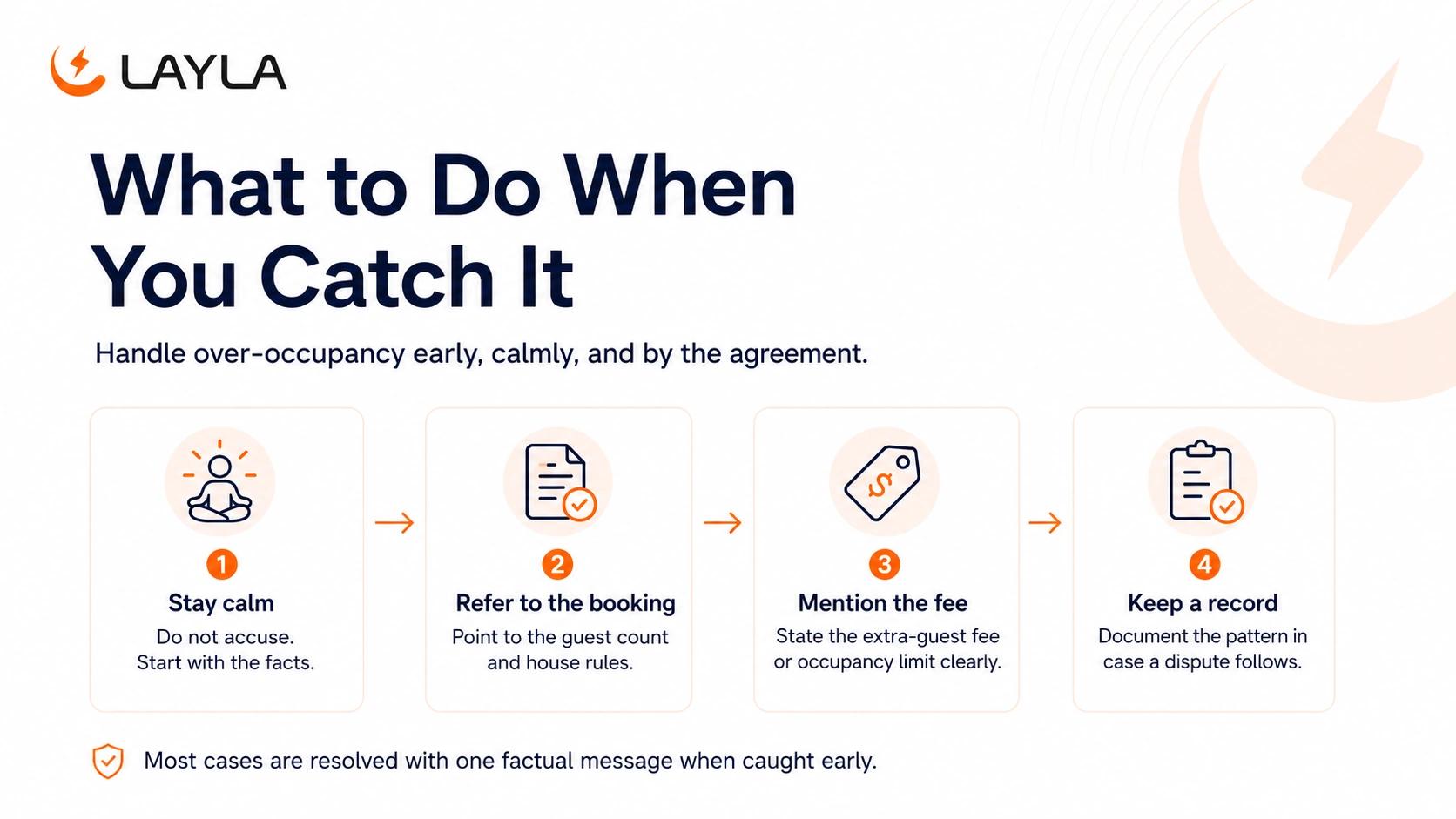
Detection is only half the job. The response is what protects both the property and the relationship, so keep it calm and factual.
Lead with the agreement rather than an accusation. A short note works well: "Our records show more guests than the booking. The home is set up and insured for four, and there's a fee of X for additional visitors." That gives the guest a clean way to put it right, and most will, because they know they're over the line. Tie everything back to your listed occupancy limit and your posted fee, so the conversation stays about the terms they accepted and not your read on their character. Keep a record of the pattern too, so if it ever turns into a platform dispute you've got a clear, privacy-respecting account of what happened.
Handled early and evenly, most over-occupancy gets sorted with a single message. The hosts who end up stuck are the ones who never knew in time to send it.
Get Layla — One-Time From $149
See Layla pricing — buy once, own it permanently →
One indoor device that reads occupancy by radar, with no camera and no microphone, plus decibel-based noise monitoring, smoke detection, and indoor air quality. No monthly fees at any portfolio size, and a 30-day money-back guarantee.
How to Catch Extra Guests at Your Airbnb — FAQ
How can I tell if guests brought extra people?
The dependable way is occupancy detection. Layla uses radar presence sensing to read how many people are actually in the home over a stay, with no camera and no audio, so a two-guest booking housing six shows up while you can still do something about it. House rules and smart locks won't tell you this: one leans on honesty, the other counts door openings rather than people.
Can I put a camera inside my Airbnb to check occupancy?
No. Interior cameras break guests' reasonable expectation of privacy, violate most platforms' policies, and are illegal in many places. Use privacy-safe occupancy detection instead. Radar sensing like Layla's counts presence without seeing or hearing anyone, which is what makes it appropriate inside a rented home.
Why do extra guests matter if they're not throwing a party?
Because the damage is quieter than a party and often more expensive: unpaid wear, higher utility bills, and, most seriously, insurance and liability exposure, since most policies assume your listed occupancy. Over-occupancy can also break safety and exit limits, and at the extreme it points to an unauthorized sublet.
How do I enforce my occupancy limit without being confrontational?
Catch it early, then anchor the conversation to the agreement. A short, factual message that references your listed limit and your posted extra-guest fee gives the guest a clean way to correct course, and most take it. The key is spotting it early enough to send that message instead of finding out afterward.
Does occupancy monitoring record audio or video?
No. Layla detects occupancy by radar and measures noise as sound levels in decibels, with no microphone, no camera, and no recording. You can say so plainly in your listing, which reassures honest guests while still giving you an accurate occupancy read.
Keep Reading
- Airbnb Anti-Party Technology: What Actually Works — when the problem is a gathering, not just extra guests
- Got a Neighbor Complaint About Your Airbnb? — handling the fallout when occupancy spills over
- The Best Noise Monitor for Airbnb (2026) — the full category roundup

Best for: full property coverage
All-in-One
Noise monitoring, smoke detection and smart AC control for complete coverage.
Everything included
Everything in Noise & Security Pro
AI party detector, noise alerts, intruder & break-in, occupancy, 180-day history, indoor + outdoor climate
Everything in Smoke & Air Quality
Air quality index (IAQ), CO2, bVOC, mold & smoke — full indoor + outdoor climate
Everything in AC Control & Energy
Smart AC (150+ brands), Eco Mode, schedules, filter health
Plus exclusive
- Advanced reports & insights
- Priority support
- Priority support
No monthly fees. Ever.
One sensor. Full coverage
One sensor. Full coverage.* Layla 3.0 monitors noise, air quality, motion, occupancy, temperature, humidity, pressure, VOCs, CO2, and controls your AC - from a single device on your shelf.
No subscription means no surprise costs.
Pay once. Every feature unlocked. Forever. No monthly fees eating into your rental margins or household budget.
The smartest buy is the one you make once.
Other solutions charge per-feature monthly subscriptions that exceed the device cost within a year. Layla's all-in-one pays for itself compared to any subscription alternative.
30-day money back guarantee