BLOG
The best commercial vape detectors in 2026
 By Nangyal Khan··Updated
 10 min read

Commercial vape detectors exist because vaping moved into the rooms a camera can't go: school bathrooms, locker rooms, hotel floors, office restrooms. They're sensors that catch vape and smoke in the air and alert someone in seconds, without recording anyone. Most of the serious ones are built for institutions, which means enterprise hardware, professional wiring and an annual subscription per device. That's the right shape for a school district with hundreds of restrooms. It's overkill for a landlord with one rental.
So this guide does two things. It ranks the genuine commercial systems for the buyer they're built for, a school or a large facility, and it's honest about where each wins. And it names the right-sized option for the other buyer, the host or small-venue owner who found these systems and balked at the price. If you're the institution, read the top of the list. If you're protecting a property, skip to the bottom.
How to choose a commercial vape detector
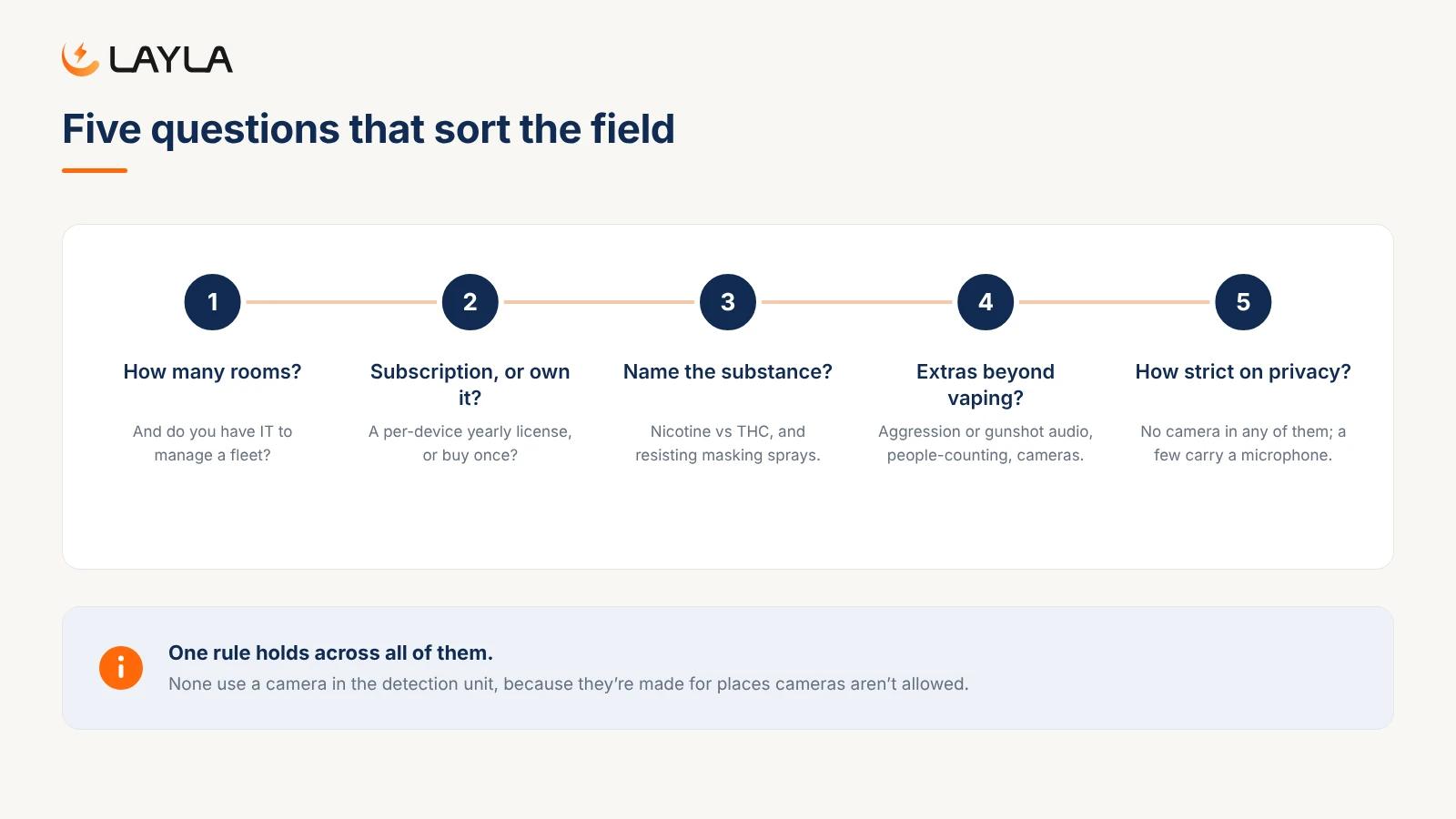
A few questions sort the field fast. How many rooms are you covering, and do you have IT to manage a fleet? Are you willing to pay a per-device annual subscription, or do you want to own the hardware outright? Do you need the detector to name the substance (nicotine versus THC) and resist masking sprays? Do you need extras beyond vaping, aggression or gunshot audio, people-counting, camera integration? And how strict are you on privacy, most of these use no camera, but a few carry a microphone for audio features.
One rule holds across all of them: none use a camera in the detection unit, because they're made for places cameras aren't allowed. The differences are in substance detection, extras, install, and whether you're renting the software forever or buying the device once.
1. Triton — best all-in-one for schools and facilities
Triton, a Hanwha Vision brand, is about the most capable sensor in the category. It names nicotine vape, THC and smoke and resists masking agents, reads a full air-quality stack, counts people and flags loitering with radar, and on its ULTRA model adds audio detections like aggression, gunshot and spoken keywords, then slews your security cameras to the alert. Hardware runs roughly $899 to $1,495 per sensor with an optional per-sensor cloud license, installed over PoE.
For a campus that wants the whole safety stack wired into existing security, it's the strongest pick. The caveats are the obvious ones: enterprise price, professional install, and a microphone on the ULTRA (audio-disabled versions are sold). See the full breakdown in Layla vs Triton.
2. HALO Smart Sensor — best for enterprise security integration
The HALO Smart Sensor, made by IPVideo and now part of Motorola's Avigilon line, is the one most likely to already live inside a large security estate. The current hardware is the HALO 3C and 3C-PC, with a newer HALO 4 for Avigilon-integrated deployments (HALO 4 is sold in the US and Canada only). It picks up vape, THC and cigarette smoke, flags masking attempts, reads a broad air-quality stack (CO2, CO, NO2, VOCs, particulates), and listens for aggression, gunshot and spoken keywords. The PC variants add occupancy and people-counting. There's no camera, and the audio side analyses sound without recording it. It wires over PoE and feeds a video management system. Pricing is quote-based, so there's no public number.
If you run facilities security and want vape detection inside the same platform as your cameras and access control, HALO is the natural fit. It's firmly an institutional product. More in Layla vs HALO.
3. Verkada — best if you already run Verkada
If your building already runs Verkada's cloud security platform, its vape sensor is the path of least resistance: one vendor, one dashboard, one login. The model that scores vaping is the SV23 (the SV25 does too; the cheaper SV21 is environmental-only and has no vape detection). It rates vaping with a "Vape Index" and alongside it reads full air quality, noise and occupancy. No camera. The sensor lives inside Verkada Command next to the cameras and door controllers.
Hardware runs around $999 and up, but the real commitment is the Verkada Command license, which is required, not optional. It's billed per device on a recurring basis, roughly $249 a year or close to $999 for five years. Worth it if you're already standardised on Verkada; a lot to buy into if you're not. We cover the options in Best Verkada vape-detector alternatives.
4. Zeptive — best for flexible and wireless deployments
Zeptive is the flexible one. It offers wired PoE units and genuinely wireless battery models, including cellular ones that work where the network doesn't reach, and it installs DIY with tamper-resistant screws. It names nicotine versus THC, catches smoke, flags masking agents, and manages a fleet from a web console and app. Hardware is around $995 to $1,195 per unit with an annual cloud license per device.
For a school or multi-site operator that needs sensors in awkward spots without running cable everywhere, Zeptive's wireless and cellular options are a real advantage. See Layla vs Zeptive.
5. Soter FlySense — best for vape plus aggression in schools
FlySense, from Soter Technologies, pairs vape and smoke detection with a sound channel tuned to catch aggression, shouting and fighting, which is exactly the combination a K-12 school wants in a bathroom. It's PoE-wired, backed by predictive analytics and a long deployment history, and it carries a required annual platform subscription plus, for schools, a setup fee.
If your priority is vaping and bullying together, FlySense is purpose-built for it. More in Layla vs Soter FlySense.
6. FreshAir — best for the fewest false alarms
FreshAir takes a different technical route. Its patented molecular sensor (PolySens) detects tobacco and marijuana at a chemical level, and vape is handled by a separate dedicated add-on sensor rather than coming standard in every unit. That molecular selectivity is the standout: it ignores steam, dust, candles and perfume, which earns it a reputation for near-zero false alarms and makes it a favourite in hotels and casinos where a nuisance alert is costly. The sensor resets itself, uses no camera or microphone, and runs on a managed subscription platform. FreshAir leans hospitality-first but also serves schools and dorms.
If false-alarm tolerance is near zero and the setting is a hotel or casino, FreshAir is the specialist pick. Price is quote-based, and like the rest of the field it's a subscription product. The comparison is in Layla vs FreshAir.
7. Layla — best for rentals, small venues and homes
This is the option the enterprise systems overshoot. Layla is a home and rental sensor that catches cigarette, vape and cannabis smoke, tells you which one it is, and grades the event as low, medium or high, updating live as the intensity climbs or fades. For a host, that turns into a dated log of exactly what happened and when, the kind of evidence a damage claim or a guest dispute tends to hinge on. There's no camera and no microphone. It goes up over Wi-Fi in a few minutes, and because it watches air and noise as well, a single unit covers smoke, air quality, humidity that signals mould risk, and loudness for the whole property. You can see what it tracks on the air quality page.
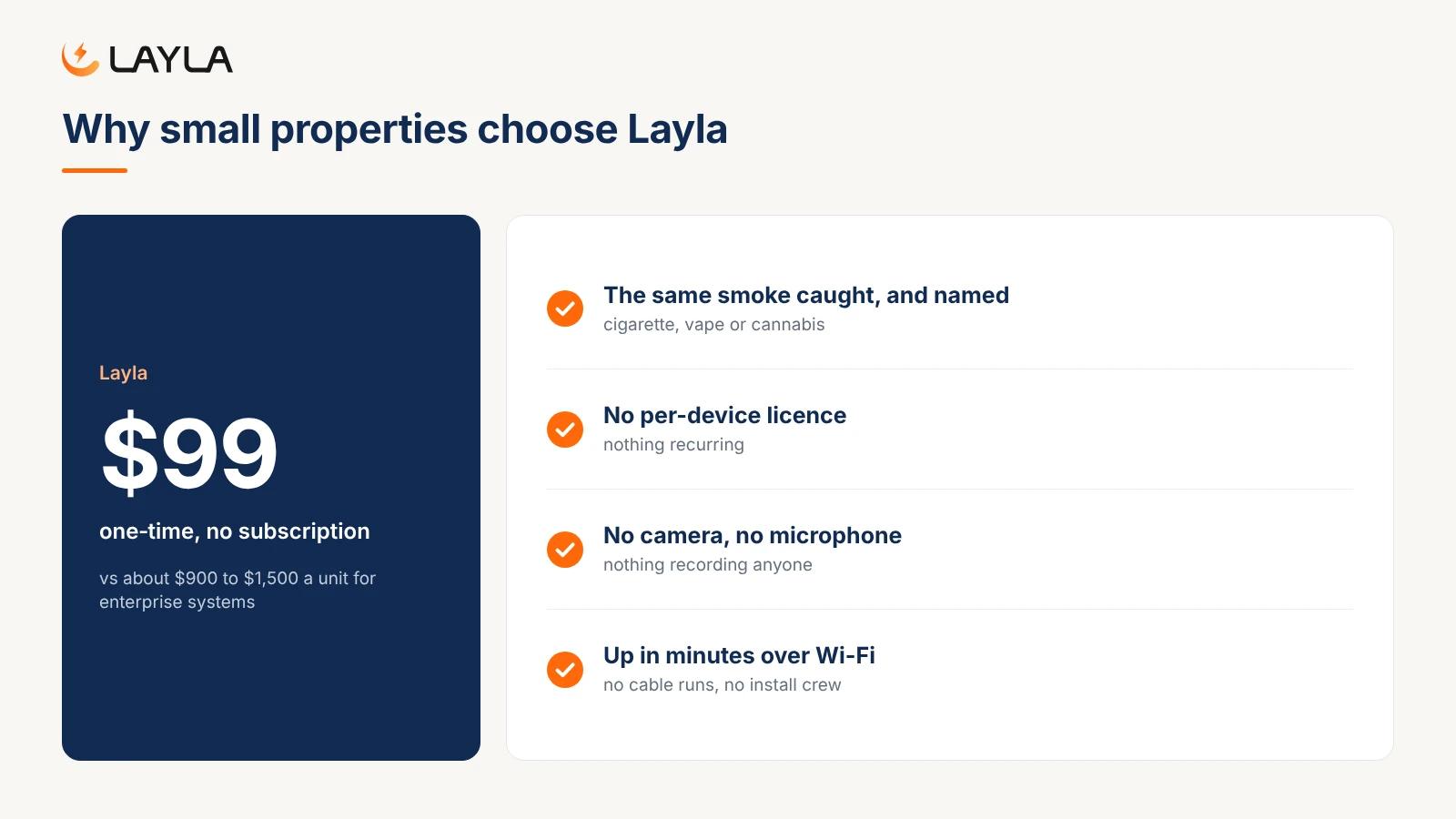
The real split is ownership. Layla's Smoke & Air Quality tier costs $99, the All-in-One is $299, and both are one-time with nothing recurring, where the enterprise systems run roughly $900 to $1,500 a unit on top of an annual license. Layla won't count crowds, listen for gunshots or plug into a VMS, and it isn't meant to cover a school district. But for a rental, a hotel room, a small office or a home, it does the job without the enterprise tax. The tiers are on pricing.
At a glance
| Detector | Best for | Subscription | Install | Price |
|---|---|---|---|---|
| Triton | All-in-one for schools/facilities | Optional per-sensor cloud | PoE, pro | ~$899–$1,495/unit |
| HALO | Enterprise security / VMS estates | Quote-based enterprise | PoE, pro | Quote-based |
| Verkada | Buildings already on Verkada | Command license required, per device | PoE, pro | ~$999+/unit |
| Zeptive | Flexible / wireless / cellular | Annual cloud license, per device | DIY mount | ~$995–$1,195/unit |
| Soter FlySense | Vape + aggression in schools | Annual platform fee (+ setup) | PoE, pro | ~$650–$1,300/unit |
| FreshAir | Fewest false alarms (hospitality) | Managed subscription | Pro | Quote-based |
| Layla | Rentals, small venues, homes | None | DIY, Wi-Fi | $99 one-time |
Which commercial vape detector should you buy?
Work from the building. A school district or a large facility should pick by need: Triton for the fullest all-in-one, HALO or Verkada if you want vape detection inside an existing security platform, Zeptive for flexible wireless and cellular placements, Soter FlySense if aggression detection matters as much as vaping, FreshAir where false alarms must be near zero. Any of them is a reasonable institutional buy, and the subscription pays for the fleet management a campus actually uses.
A host, landlord or small-venue owner should think twice before buying an enterprise system to cover a room or two. Layla picks up the same cigarette, vape and cannabis smoke, tells you which it is, logs each event with its intensity, and keeps an eye on air and noise, for a one-time $99 with no subscription, no cable runs and no microphone. If you came looking for a commercial vape detector to protect a single property, a campus platform is far more than you need, and this is where a home-grade sensor earns its place.
Get Layla — from $99, no subscription
See Layla pricing — own it once →
One self-installed device that spots cigarette, vape and cannabis smoke, tells you which it is and how strong, and keeps an eye on air quality and noise, with no microphone and nothing to subscribe to. Pay once, get free shipping, a one-year warranty and 30 days to change your mind.
Frequently asked questions
What is the best commercial vape detector in 2026?
For a school or large facility, Triton is the most capable all-in-one, with HALO and Verkada strong if you want vape detection inside an existing security platform. For a rental, small venue or home, Layla is the best-fit option: it catches cigarette, vape and cannabis, names the type, and costs a one-time $99 with no subscription.
Which commercial vape detector has no subscription?
Most enterprise systems (Triton, HALO, Verkada, Zeptive, Soter FlySense, FreshAir) carry an annual per-device subscription for their management platform. Layla is the exception: a one-time $99 for the Smoke & Air Quality tier, with nothing recurring, aimed at small properties rather than fleets.
Do commercial vape detectors use cameras or microphones?
None of them use a camera in the detection unit, since they're made for bathrooms and other camera-free spaces. A few carry a microphone for audio features like aggression or keyword detection (analysing, not recording), and some sell audio-disabled versions. Layla has no camera and no microphone at all.
Do vape detectors tell nicotine from THC?
Several do. Triton and Zeptive differentiate nicotine from THC, and Layla distinguishes cigarette, vape and cannabis with intensity grading. Others flag that vaping or smoking happened without always naming the substance, so check the spec if substance-level detail matters to you.
What's the best vape detector for a single rental or small business?
Layla, for most. The enterprise systems are priced and built for campuses, with per-device subscriptions and professional installs. For one property, Layla catches and names the smoke, logs it for disputes, watches the air and noise, and costs $99 one-time with no recurring fee.
Keep reading
- Layla vs Zeptive · Layla vs Soter FlySense · Layla vs Triton
- Best Verkada vape-detector alternatives — the enterprise-ecosystem angle
- Best smoke & vape detectors for rentals — the host-focused roundup

Best for: health-conscious homes
Smoke & Air Quality
Air quality, mold and smoke monitoring for healthy homes and smoke-free rentals.
Included forever — no subscription
- Mold-risk early warning
- Smoke & cigarette detection
- Air quality score (IAQ) with alerts
- CO₂ & bVOC monitoring
- AI air insights & recommendations
- Allergy-comfort monitoring
No monthly fees. Ever.
30-day money back guarantee