BLOG
Layla vs Soter FlySense: which vape detector should you choose?
 By Nangyal Khan·
8 min read
Compare layla vs soter flysense and you've found two devices that both watch for vaping, yet were designed for very different rooms. FlySense, made by Soter Technologies, is a school sensor. It detects vape and smoke and, more distinctively, listens for the sound of aggression and bullying, all wired in over PoE and run from a cloud portal with a subscription behind it. Layla is a home and rental sensor that names the type of smoke it catches and keeps an eye on the air and the noise too, for a one-time price with nothing recurring. Your pick turns on one thing: are you protecting a school restroom or a property?
Credit where it's due. For a K-12 school, pairing vape detection with aggression sensing is a smart idea, and Soter has built real depth around it. Tens of thousands of units in the field, predictive analytics that flag where incidents are likely, tamper alerts for unsupervised bathrooms, a five-year warranty. If your problem is vaping and fights in school bathrooms where a camera isn't allowed, FlySense is a serious, proven answer, and nothing here changes that.
What does Soter FlySense do?
FlySense, in its current FS300 generation, is a ceiling or wall sensor built for schools and institutions. It detects vape and smoke particles through VOC and particulate sensing, and its signature second channel listens to sound, analysing decibel level and frequency patterns to flag shouting, fighting and aggression. That bullying-detection angle is what sets it apart from a plain vape sensor, and it's the reason schools buy it. It adds tamper detection, real-time email and SMS alerts, device-health diagnostics and a cloud portal with role-based access.
What it is not is a consumer product. FlySense wires in over PoE, so it needs Cat5e or Cat6 cabling and a professional install, not a plug-in-and-go setup. It's sold through security resellers and integrators rather than a shop, usually quote or purchase-order based. Hardware runs roughly $650 to $1,300 a unit depending on model and reseller, there's a required annual platform subscription per device, and school deployments often carry a setup fee on top. For a district, that's a managed rollout. For one property, it's a project.
One honest note on detection: Soter's own FS300 materials describe catching "smoke and vape particles," and some resellers go further and claim it tells THC from nicotine. That substance-level differentiation is a reseller claim rather than something Soter spells out itself, so it's fair to say FlySense reliably flags that vaping or smoking happened, while being careful about how precisely it names what.
What does Layla do that FlySense doesn't?
Layla comes at the same vaping problem as a single self-installed sensor that names what it catches and does more than one job.
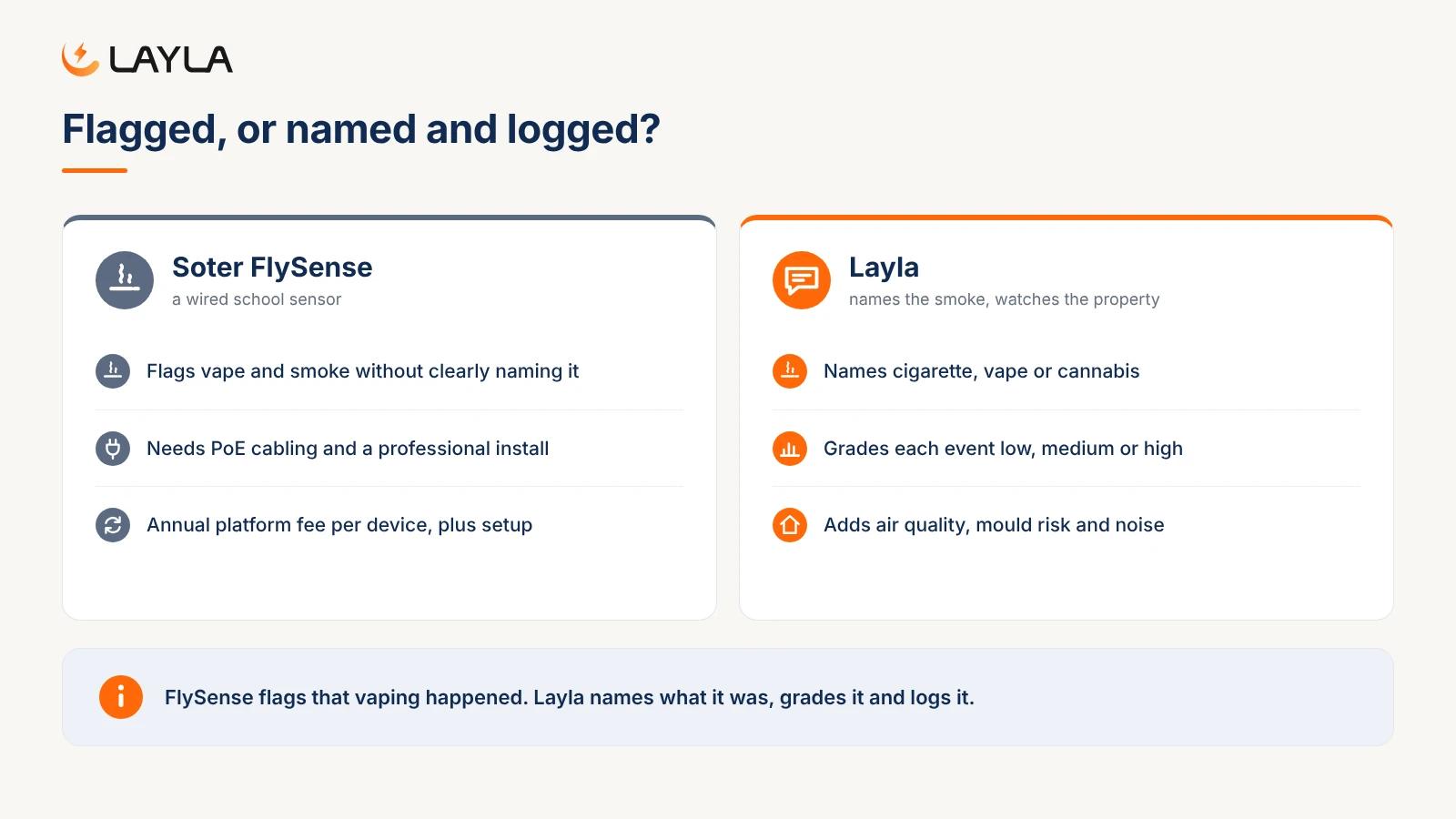
Start with detection, because this is where Layla has a real edge for a property. It tells cigarette, vape and cannabis apart, grades each event low, medium or high, and keeps updating as the intensity changes rather than firing once. Faint traces register in real time, and you set your own alert threshold. Where FlySense tells a school that vaping is happening in a bathroom, Layla hands a host a logged event that names the substance, stamps the time and grades how strong it was, and that's precisely what a damage claim or a guest dispute turns on. The air quality page lays out the full capability.
Then there's scope. FlySense pairs vape detection with aggression and noise, a combination aimed squarely at schools. Layla pairs smoke detection with the things a property owner actually tracks: air quality, CO2, VOCs and the humidity that breeds mould, plus noise monitoring and radar occupancy on the higher tiers, all in one device. Its noise sensing is tuned to loudness and quiet-hours for a rental rather than detecting fights, which is the honest difference. If aggression detection is your reason to buy, that's FlySense's lane, not Layla's.
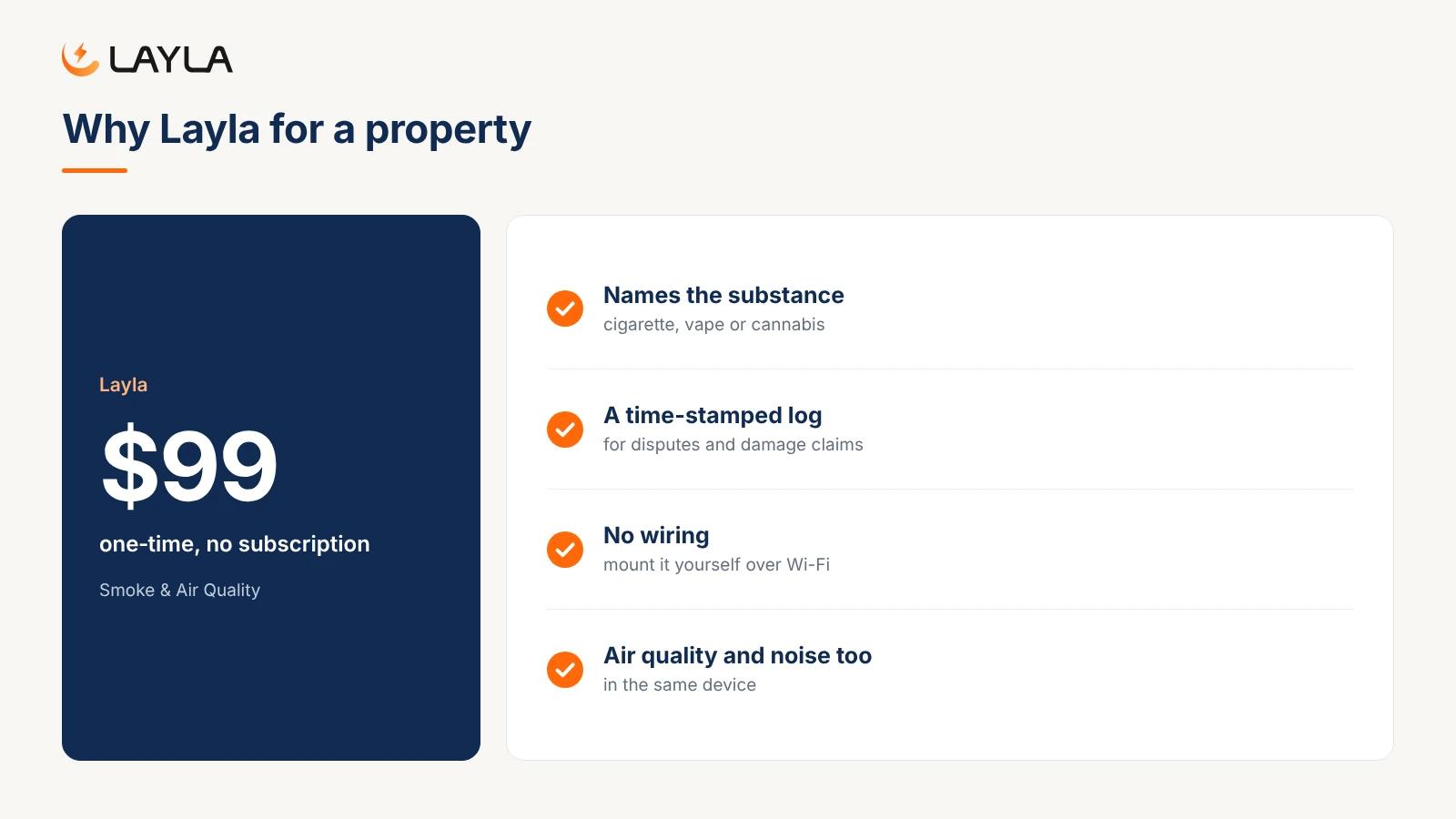
And it's bought once. Layla's Smoke & Air Quality tier is $99, the All-in-One is $299, with no subscription and no professional install, you mount it yourself over Wi-Fi. Against FlySense's PoE hardware plus an annual per-device platform fee plus a setup charge, the running cost isn't comparable. The tiers are on pricing.
Where layla vs soter flysense really differ: fit and cost
Both were priced and built for different customers, so fit is the comparison that matters. FlySense's cost structure, the professional wiring, the per-device subscription, the setup fee, buys a school something it genuinely needs: a managed, wired fleet across many restrooms, with aggression detection and the compliance reporting administrators lean on. The ongoing fee pays for the platform that runs it all.
Layla carries no platform fee, because a host isn't running a managed fleet. They're watching a property, or a few, from an app, and they want vaping and smoking caught, named and logged without a yearly bill. The sums fall out easily. A single Layla at $99 catches cigarette, vape and cannabis events, grades them, never charges again, and covers air and noise in the same unit. Five rooms on Layla run $495 in total. Five FlySense units run into thousands in hardware, plus a subscription that renews, plus the cabling to install them.
The fair summary: FlySense is the right tool for a school that needs vape-and-aggression detection wired across its bathrooms. Layla is the right tool for a rental, hotel or small venue that needs smoke and vape caught and named, cheaply, with no recurring fee.
At a glance
| Layla (Smoke & Air Quality) | Soter FlySense | |
|---|---|---|
| Built for | Rentals, small venues, hotels, homes | K-12 schools and institutions |
| Vape / smoke | Cigarette, vape, cannabis (type-ID + intensity) | Vape and smoke particles |
| Signature extra | Air quality, mould, noise, occupancy, AC | Aggression / noise (bullying) detection |
| Install | DIY, Wi-Fi, self-serve | Professional, PoE wired |
| Privacy | No camera, no mic (radar occupancy) | No camera, sound-level sensor (no recording) |
| Subscription | None | Annual platform fee, per device (+ setup) |
| Price | $99 one-time ($299 All-in-One) | ~$650–$1,300/unit + subscription |
Which one should you buy?
The room you're protecting decides this one.
Run a school where the problem is vaping and fights in bathrooms a camera can't go into, and FlySense is the buy. Vape-plus-aggression sensing, predictive analytics and wired fleet management are built for exactly that, and the subscription pays for the platform a district relies on. Layla doesn't do aggression detection, and you shouldn't point a school to it for that.
Protect a rental, a hotel room, a small office or a home, and Layla is the buy. You catch cigarette, vape and cannabis with the substance named and the intensity graded, get air quality and noise in the same device, mount it yourself, and never pay a subscription. For anyone who looked at a school system and realised they needed one property covered rather than a wired campus, it's the stronger flysense alternative.
It comes down to this: FlySense protects a school, Layla protects a property. Buy for the building you actually have.
Get Layla — from $99, no subscription
See Layla pricing — own it once →
Mount one sensor yourself and it flags cigarette, vape and cannabis smoke by name, rates how strong each event is, and tracks air quality and noise in the same box. One payment, free shipping, a one-year warranty, and 30 days to change your mind.
Frequently asked questions
Is Layla a good Soter FlySense alternative?
For rentals, small venues and homes, yes. Layla detects cigarette, vape and cannabis, names the type and grades the intensity, and alerts you in real time, for a one-time $99 with no subscription or wiring. FlySense is the stronger choice for a school that specifically needs vape-and-aggression detection wired across its bathrooms.
Does Soter FlySense need a subscription?
Yes. FlySense carries a required annual platform subscription per device, on top of roughly $650 to $1,300 in hardware and, for schools, a setup fee. Layla's Smoke & Air Quality tier is a one-time $99 with nothing recurring.
Does FlySense detect aggression or bullying?
Yes, that's its signature feature. FlySense analyses decibel level and frequency patterns to flag shouting, fighting and aggression alongside vape detection, which is why schools choose it. Layla doesn't detect aggression; its noise monitoring tracks loudness and quiet hours for rentals.
Does Layla name the type of smoke?
Yes. Layla distinguishes cigarette, vape and cannabis, grading each event low, medium or high. Since the log names the substance and stamps the time, it backs up a guest dispute or a damage claim. FlySense flags that vaping or smoking happened without clearly naming the substance.
Do either use a camera or microphone?
Neither records you. FlySense uses no camera and a sound-level sensor that analyses patterns rather than recording audio. Layla has no camera and no microphone; its occupancy sensing on higher tiers uses radar.
Keep reading
- Layla vs Zeptive — the flexible institutional vape detector
- Layla vs Triton — the all-in-one enterprise sensor
- Best commercial vape detectors — the full category, ranked

Best for: health-conscious homes
Smoke & Air Quality
Air quality, mold and smoke monitoring for healthy homes and smoke-free rentals.
Included forever — no subscription
- Mold-risk early warning
- Smoke & cigarette detection
- Air quality score (IAQ) with alerts
- CO₂ & bVOC monitoring
- AI air insights & recommendations
- Allergy-comfort monitoring
No monthly fees. Ever.
30-day money back guarantee