BLOG
Layla vs Triton: which vape and safety sensor fits your property?
 By Nangyal Khan·
9 min read
If you're comparing layla vs triton, it helps to know going in that these are not the same class of product. Triton, a Hanwha Vision brand, makes an enterprise safety sensor: vape, THC and smoke detection bundled with full air-quality readings, radar people-counting, and, on its top model, audio events like aggression and gunshot, all wired in and tied into a building's camera system. Layla is a home and rental sensor that catches and names smoke and watches the air and noise too, for a one-time price with nothing recurring. One is built for a campus; the other for a property.
Triton deserves real credit, so let's be direct about it. For a school or a large facility, it's about the most capable all-in-one sensor on the market. It tells vape from THC and resists the sprays people use to mask it, it reads CO2, particulates and the rest of the air, it counts people and flags loitering with radar, it can listen for fights, gunshots and spoken keywords, and it slews a facility's security cameras to an alert. If you're protecting an institution, that depth is genuinely impressive and this article won't talk you out of it.
What does Triton do?
Triton sells a short ladder of sensors, the VD at around $899, the PRO near $1,195, and the flagship ULTRA at about $1,495, each covering roughly 160 square feet and installed over PoE by an integrator. The headline on the ULTRA is "20-plus health, safety and security features," and that's not far off.
On substances it genuinely differentiates, naming nicotine vape, THC and cigarette smoke with on-device AI and engineering to resist masking agents like deodorant and aerosols. It layers in a full air-quality stack, temperature, humidity, CO2, TVOCs and particulates, and it uses radar to count people, measure dwell time and flag loitering without a camera. On the ULTRA it adds audio-based detections: aggression, glass-break, gunshot and customizable keyword or safeword alerts in several languages. Alerts go out in about five seconds over SMS, email, Teams, Slack and more, and the sensor integrates with the major video management systems so a nearby camera turns to the event.
Two things shape whether it fits you. First, it's an institutional purchase, professional PoE install, sold through security integrators, with an optional per-sensor cloud license for the analytics layer. Second, privacy is mostly camera-free by design, radar handles presence and there's no video, but the standard ULTRA carries a microphone for its audio detections. Triton says it analyses sound on-device without recording, and it sells audio-disabled versions for buyers who want no microphone at all, which is the honest way to put it: camera-free always, microphone-free only if you choose that model.
What does Layla do that Triton doesn't?
On a raw feature count Triton carries more than a rental will ever use, and it's worth saying so plainly. What Layla does is deliver the part a property owner actually needs, in a device they own outright and install themselves.
For a rental, the detection holds up where it counts. Layla tells cigarette, vape and cannabis apart, grades each event low, medium or high, keeps updating as the intensity shifts, catches faint traces in real time, and lets you set your own alert threshold. A host gets a log that says what was smoked, when, and how heavily. That's the thing you attach to a damage claim or put in front of a guest who swears they didn't. The full capability is on the air quality page. Triton identifies substances too, so this isn't a dig at Triton. What Layla adds is the intensity grade and the live updating, and it hands a property that record without the enterprise rig bolted around it.
Where Layla pulls ahead for its buyer is fit, not features. It installs over Wi-Fi in minutes with no integrator, no PoE cabling and no camera system to tie into. It carries no microphone at all, so the privacy question never comes up. And it folds the things a rental tracks, air quality, mould-risk humidity, noise and radar occupancy, into one unit that also runs the AC on the higher tiers. Triton's gunshot detection, keyword alerts, people-counting analytics and VMS integration are real and valuable in a school; in a two-bedroom rental they're features you'll never open.
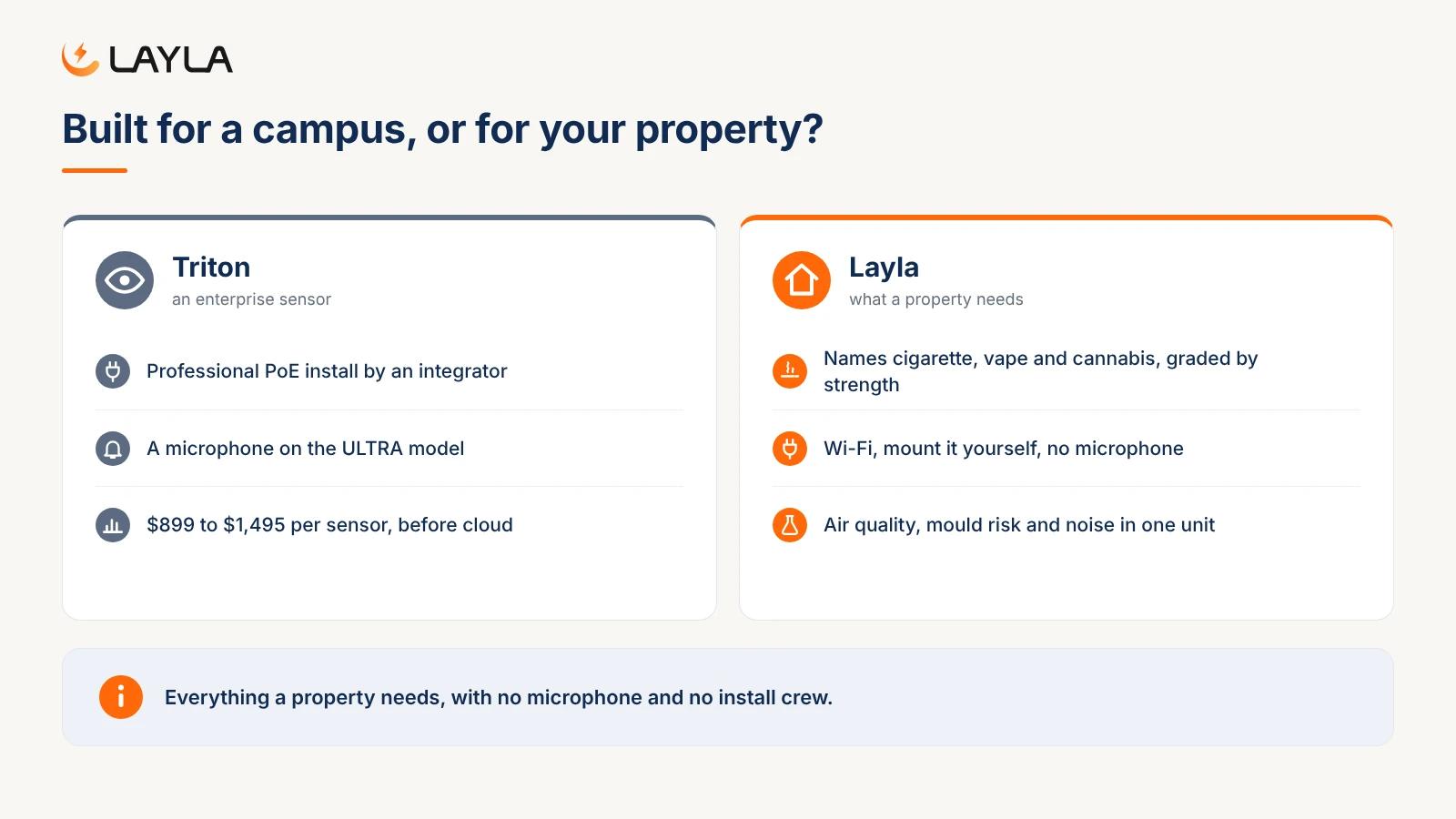
Then there's the cost, which is the clearest line of all. Layla's Smoke & Air Quality tier is $99 and the All-in-One is $299, one-time, no subscription. Triton runs roughly $899 to $1,495 per sensor before any cloud license, installed by a pro, at about 160 square feet of coverage each. The tiers are on pricing.
How layla vs triton compares on fit and cost
The honest comparison here isn't feature-for-feature, because Triton would win that on paper and then cost ten times as much. It's about what each is for. Triton's price, its PoE install, its optional per-sensor cloud fee and its VMS hooks all make sense for a facility: you're covering many rooms, you want people-counting and audio safety events, and you want it wired into existing security. The spend buys capability an institution uses.
Layla has none of that overhead because a host isn't running a campus. One sensor, bought once, self-installed, watching a property from an app, catching and naming the smoke and keeping an eye on the air and noise. Five rooms on Layla is $495 total, forever. Five Triton ULTRA sensors is roughly $7,500 in hardware before cloud licenses and installation. For the buyer who wanted one room protected, that's not a close call.
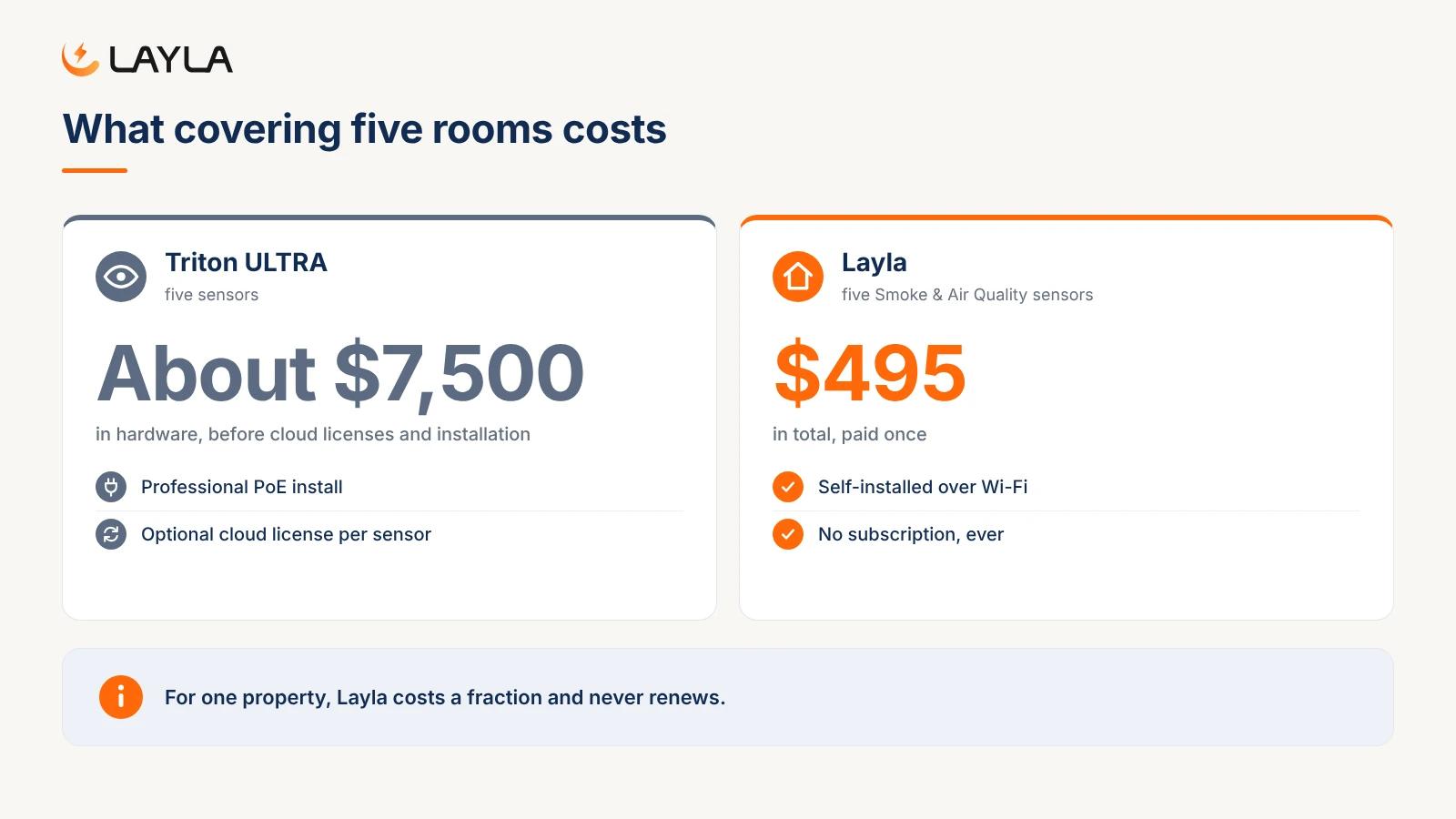
The fair summary: Triton is the better sensor for a school or large facility that needs the full safety stack wired in. Layla is the better sensor for a rental, hotel or small venue that needs smoke and vape caught and named, plus air and noise, with no subscription and no install crew.
At a glance
| Layla (Smoke & Air Quality) | Triton | |
|---|---|---|
| Built for | Rentals, small venues, hotels, homes | Schools, large facilities, campuses |
| Vape / smoke | Cigarette, vape, cannabis (type-ID + intensity) | Nicotine, THC, smoke (masking-resistant) |
| Also does | Air quality, mould, noise, occupancy, AC | Full IAQ, radar people-counting, audio safety events, VMS |
| Install | DIY, Wi-Fi, self-serve | Professional, PoE, integrator |
| Privacy | No camera, no microphone | No camera; microphone on ULTRA (audio-free SKUs sold) |
| Subscription | None | Optional per-sensor cloud license |
| Price | $99 one-time ($299 All-in-One) | ~$899–$1,495/unit (before cloud) |
Which one should you buy?
It comes down to the size of what you're protecting.
If you run a school or a large facility and you want vape, air quality, people-counting and audio safety events wired into your camera system, buy Triton. It's the most complete sensor in the category and the enterprise features earn their place in that setting. Layla doesn't count crowds or listen for gunshots, and I wouldn't send an institution to it expecting that.
If you're protecting a rental, a hotel room, a small office or a home, buy Layla. It identifies cigarette, vape and cannabis, grades how strong the event is, bundles air quality and noise into the same unit, goes up over Wi-Fi yourself, carries no microphone, and asks for no subscription. For anyone who priced an enterprise system and realised they needed one property covered rather than a wired campus, it's the natural triton sensors alternative.
Put plainly: Triton is the enterprise safety sensor, Layla is the one-time detector scaled to a single property. Buy for the building you have, not the one in the brochure.
Get Layla — from $99, no subscription
See Layla pricing — own it once →
One self-installed device that identifies cigarette, vape and cannabis smoke, grades how heavy each event is, and keeps an eye on air quality and noise, with no microphone and nothing recurring. One payment, free shipping, a one-year warranty, and 30 days to change your mind.
Frequently asked questions
Is Layla a good Triton alternative?
For rentals, small venues and homes, yes. Layla catches cigarette, vape and cannabis, tells them apart and rates how strong each event is, and adds air quality and noise, for a one-time $99 with no subscription, no wiring and no microphone. Triton is the stronger choice for a school or large facility that needs people-counting, audio safety events and camera-system integration.
Does Triton need a subscription?
Triton's hardware runs about $899 to $1,495 per sensor, and its full analytics layer uses an optional per-sensor cloud license. Layla's Smoke & Air Quality tier is a one-time $99 with nothing recurring.
Does Triton use a microphone?
Triton uses radar rather than a camera for presence, but its top ULTRA model carries a microphone for audio detections like aggression and keyword alerts; it says it analyses sound without recording, and it sells audio-disabled versions. Layla has no microphone and no camera at all.
Does Layla detect the type of smoke like Triton?
Yes. Both name substances. Layla separates cigarette, vape and cannabis and grades each event low, medium or high, so a host can see exactly what was smoked and when for a dispute or claim. What differs is scope and price, not whether the smoke gets identified.
Which is better value for a single rental?
Layla, clearly. One Layla at $99 covers smoke, vape, air and noise for a property with no recurring cost, while a single Triton sensor starts near $899 before a cloud license and needs a professional PoE install. Triton's value shows up across a campus, not in one room.
Keep reading
- Layla vs Zeptive — the flexible institutional vape detector
- Layla vs Soter (FlySense) — the school vape-plus-aggression sensor
- Best commercial vape detectors — the full category, ranked

Best for: health-conscious homes
Smoke & Air Quality
Air quality, mold and smoke monitoring for healthy homes and smoke-free rentals.
Included forever — no subscription
- Mold-risk early warning
- Smoke & cigarette detection
- Air quality score (IAQ) with alerts
- CO₂ & bVOC monitoring
- AI air insights & recommendations
- Allergy-comfort monitoring
No monthly fees. Ever.
30-day money back guarantee