BLOG
Layla vs Zeptive: which vape detector is right for you?
 By Nangyal Khan··Updated
 8 min read
Anyone weighing layla vs zeptive should settle one thing first: these two devices were built for different buyers. Zeptive is an institutional vape-detection system, hardware plus an annual per-device subscription, deployed across schools, offices, hotels and public buildings and managed in bulk from a central console. Layla is a home and rental sensor that catches smoke and vape as one of several jobs it handles, for a one-time price with nothing recurring. So the real question isn't which device wins. It's whether you're kitting out a building full of restrooms, or watching over a single rental, a small venue or a home.
Zeptive earns some credit up front. For a school district, or any large institution with dozens or hundreds of rooms to cover, it's a serious, purpose-built answer. It separates nicotine vape from THC, shrugs off the sprays people use to mask vaping, and manages a whole fleet from one console. When that's the job in front of you, Zeptive is a strong tool, and this piece won't pretend otherwise.
What does Zeptive do?
Zeptive makes wired and wireless vape detectors for institutions. The wired units run on PoE or USB with Wi-Fi; the wireless ones run on battery with Wi-Fi or genuine cellular, so they work in a restroom where the network doesn't reach. Each sensor covers roughly a 12-by-12-foot room, and the whole fleet reports into a web console and mobile app with real-time alerts over SMS, email and push.
On detection it does more than ping "something happened." It distinguishes nicotine vape from THC, catches cigarette smoke at the same time, and flags masking agents like cologne and spray. It also reads temperature, humidity and sound abnormalities as context, and it raises a tamper or removal alert if someone interferes with the unit. There's no camera and no audio recording, which is the standard that lets these go in bathrooms at all. For enforcement in a school, that package is genuinely well thought out.
The part that shapes ownership is the cost structure. Hardware lists around $995 for a wired unit and $1,195 for wireless, and every device needs an annual Zeptive Cloud license on top, billed separately, per device. Zeptive's own pricing is quote-based, but independent resellers and school budgets put the subscription in the region of $120 to $150 per device per year. For a campus buying in volume with an IT team to run it, that's a normal institutional line item. For one rental, it's a lot of money that keeps coming.
What does Layla do that Zeptive doesn't?
Layla approaches the same smoke-and-vape problem from the opposite end: a single self-installed sensor that a host or owner buys once and owns.
On detection, Layla separates one type of smoke from another, much as Zeptive separates substances. It distinguishes cigarette, vape and cannabis, grades each event low, medium or high, and keeps updating as the intensity shifts instead of firing once and going quiet. Faint traces register in real time, and you choose the threshold at which it alerts you. That detail earns its keep in a rental, because a log that records what was detected and how strong it was, with a timestamp, is exactly what you reach for in a damage claim or a dispute. The air quality page shows the full capability.
Where the two really diverge is scope and cost. Zeptive detects vape and smoke and little else. Layla's Smoke & Air Quality sensor also reads the room's air, CO2, VOCs and the humidity that leads to mould, and the higher tiers add noise monitoring, radar-based occupancy and even AC automation, all in one device with no camera or microphone. So instead of a single-purpose vape detector plus a separate noise sensor plus an air monitor, a rental gets one unit covering the lot.
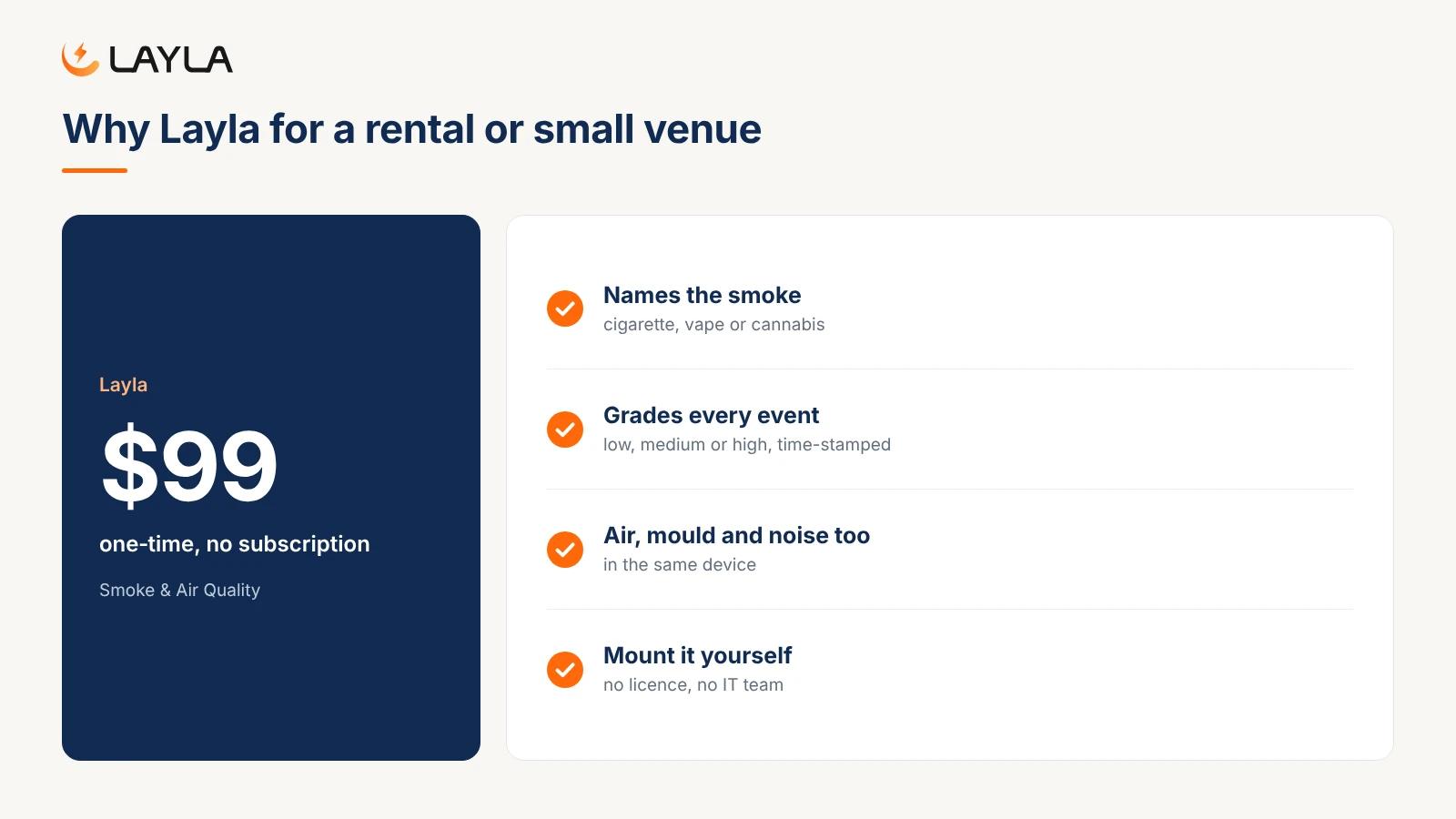
And it's a one-time purchase. Layla's Smoke & Air Quality tier is $99, the All-in-One is $299, and there's no subscription, ever. Against Zeptive's roughly $1,000 to $1,200 per unit plus a yearly per-device license, the gap over a few years isn't close. You can see how the tiers line up on pricing.
What layla vs zeptive really costs to run
Here the choice gets concrete, because the two priced themselves for different customers. Zeptive's model is hardware plus recurring SaaS, which makes sense when you're managing a fleet. The subscription pays for the central console, the compliance reporting and the fleet-wide analytics a school actually uses. That ongoing fee is the point, not a tax.
Layla's model is buy-it-once. There's no console to subscribe to, because a host isn't running a hundred sensors across a district. They're watching one property, or a handful, from an app. For that buyer the maths comes out plain. A single Layla at $99 catches the same vape and cigarette events, names the type, grades the intensity, and never sends another invoice. Put five rooms on Layla and you've spent $495 in total. Five rooms on Zeptive means five units near $1,000 each, plus five annual licenses that keep renewing.
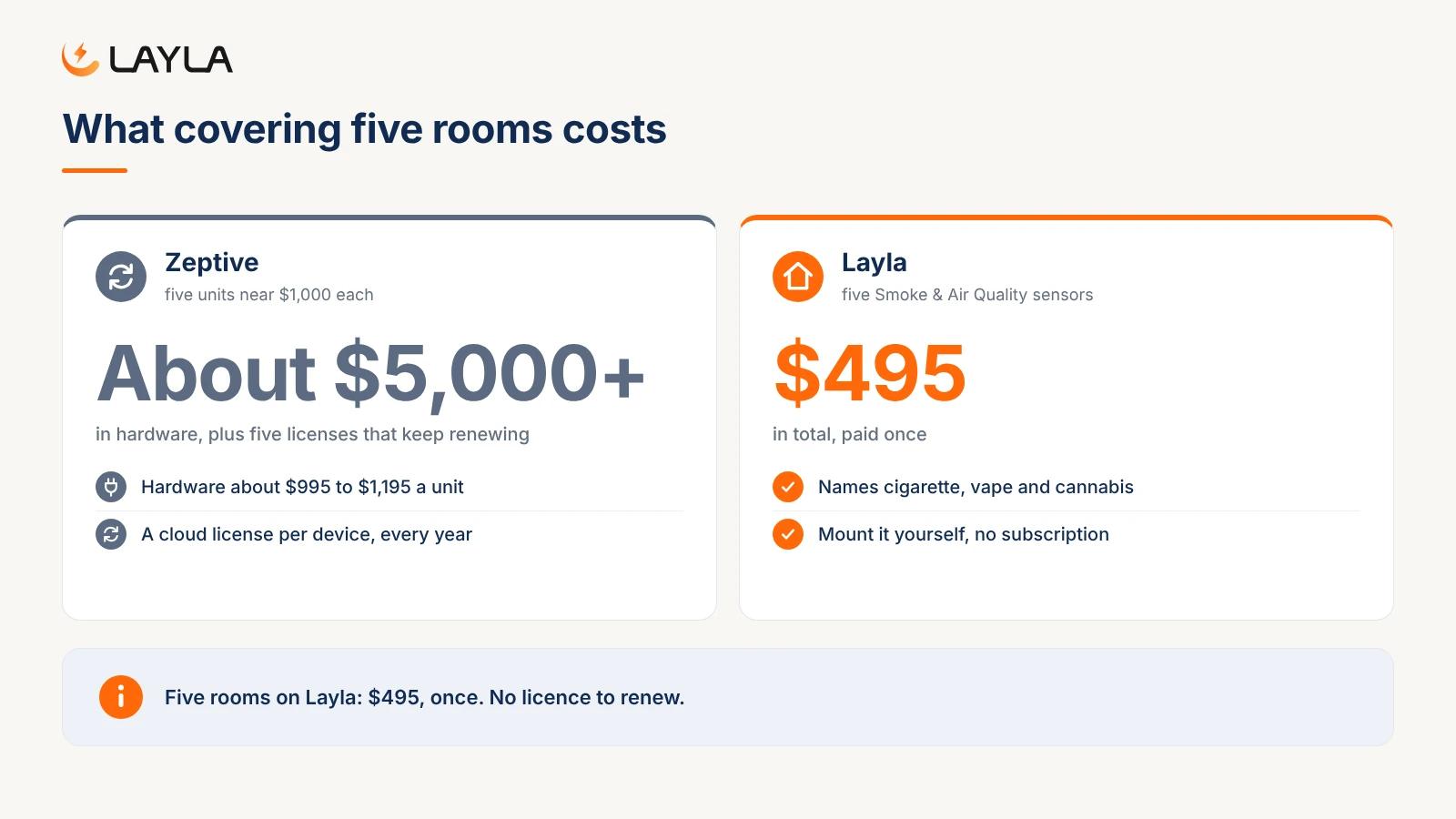
The honest line: if you need district-wide fleet management, tamper-at-scale and masking-agent detection across many restrooms, Zeptive's subscription buys you things Layla doesn't try to offer. If you're covering a rental or a small venue, you're paying enterprise prices for enterprise features you'll never open.
At a glance
| Layla (Smoke & Air Quality) | Zeptive | |
|---|---|---|
| Built for | Rentals, small venues, hotels, homes | Schools, large institutions, fleets |
| Detects | Cigarette, vape, cannabis (type-ID + intensity) | Nicotine vape, THC, smoke, masking agents |
| Also monitors | Air quality, mould, noise, occupancy, AC | Temp, humidity, sound abnormality, tamper |
| Install | DIY, self-serve | DIY mount; fleet console |
| Privacy | No camera, no mic (radar occupancy) | No camera, no audio recording |
| Subscription | None | Annual cloud license, per device |
| Price | $99 one-time ($299 All-in-One) | ~$995–$1,195/unit + ~$120–$150/device/yr |
Which one should you buy?
There are really two buyers here, and most people know which one they are the moment they see the price.
One runs a school, a campus or a building with many restrooms to cover and a team to manage them. They need substance differentiation, masking-agent detection, tamper alerts on every unit, and one console to see it all. They'll lean on the compliance reporting the subscription pays for. Zeptive is the right tool for that buyer, and the recurring fee buys real capability. You wouldn't send a school district to a $99 sensor.
The other is protecting a rental, a hotel room, a small office or a home. They want to know whether someone vaped, smoked a cigarette or lit cannabis. They want the type named and the intensity graded in case of a dispute, and they'd rather not pay a per-device license forever to get it. Layla fits that buyer better: a one-time $99, self-installed, watching the air and the noise as well. It's the stronger zeptive alternative for anyone who priced out an enterprise system and realised they needed one room covered, not a fleet.
In the end it comes down to scale. Zeptive is built for the institution, Layla for the property. Match the device to the one you're actually buying for.
Get Layla — from $99, no subscription
See Layla pricing — own it once →
One sensor you mount yourself logs cigarette, vape and cannabis smoke by name, grades how strong each event was, and watches air quality and noise alongside it. One payment, free shipping, a one-year warranty, and 30 days to change your mind.
Frequently asked questions
Is Layla a good Zeptive alternative?
For rentals, small venues and homes, yes. Layla detects cigarette, vape and cannabis smoke, names the type and grades the intensity, and alerts you in real time, for a one-time $99 with no subscription. Zeptive is the stronger choice for a school or large institution that needs fleet management and masking-agent detection across many rooms.
Does Zeptive need a subscription?
Yes. Every Zeptive device requires an annual Zeptive Cloud license, billed separately, per device, on top of roughly $995 to $1,195 in hardware. Layla's Smoke & Air Quality tier is a one-time $99 with nothing recurring.
Does Layla tell the difference between vape and cigarette smoke?
Yes. Layla distinguishes cigarette, vape and cannabis, grading each event low, medium or high and updating as the intensity changes. Because the log names the type and stamps the time, it holds up when you need to back a damage claim or a guest dispute.
Do either use a camera or microphone?
Neither records you. Zeptive uses no camera and no audio recording, and flags sound abnormalities as an event rather than capturing audio. Layla also has no camera and no microphone; its occupancy sensing on higher tiers uses radar.
Can Layla do more than detect vaping?
Yes, and that's a big part of the case for a rental. The same device reads air quality, CO2, VOCs and mould-risk humidity, and the higher tiers add noise monitoring, radar occupancy and AC automation. Zeptive is focused on vape and smoke detection.
Keep reading
- Layla vs Soter (FlySense) — the school vape-plus-noise sensor
- Layla vs Triton — the all-in-one enterprise sensor
- Best commercial vape detectors — the full category, ranked

Best for: health-conscious homes
Smoke & Air Quality
Air quality, mold and smoke monitoring for healthy homes and smoke-free rentals.
Included forever — no subscription
- Mold-risk early warning
- Smoke & cigarette detection
- Air quality score (IAQ) with alerts
- CO₂ & bVOC monitoring
- AI air insights & recommendations
- Allergy-comfort monitoring
No monthly fees. Ever.
30-day money back guarantee