BLOG
The best smart AC controllers in 2026
 By Nangyal Khan·
8 min read
A smart AC controller is the cheapest way to make a "dumb" air conditioner behave like a modern one. If your mini-split, window or portable unit runs off a handheld remote, one of these little infrared devices sits nearby, learns that remote's signals, and hands control to your phone: schedules, temperature triggers, voice, and switching the AC off when you've left it running. No wiring, no electrician, usually under ten minutes to set up.
The category has quietly split into two kinds of product, though, and knowing which you want saves money. Most are pure controllers that switch the AC and little else. One of them, Layla, is a home monitor that controls the AC as one of several things it does. Below are the best smart AC controllers in 2026, what each is genuinely best at, and where each falls short, so you can match the device to your home.
How to choose a smart AC controller
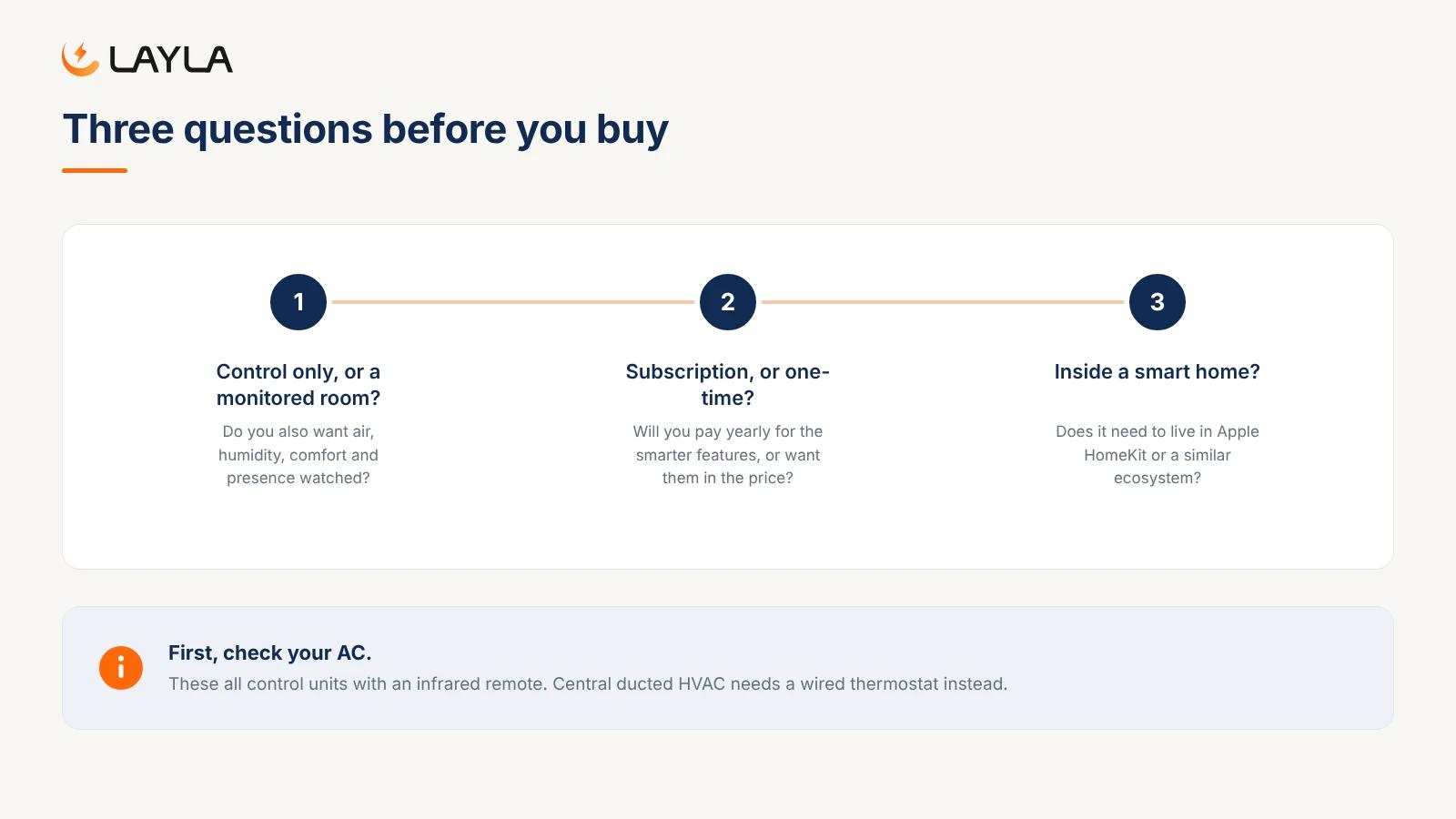
Three questions settle most of it. First, do you only want to control the AC, or do you also want the room monitored for air, humidity, comfort and presence? Second, are you willing to pay a subscription for the smarter features, or do you want everything in the one-time price? Third, does it need to live inside a smart-home ecosystem like Apple HomeKit? Hold those three in mind and the right pick falls out quickly.
One note before the list: all of these control air conditioners that use an infrared remote. If you have central ducted heating and cooling instead, you don't want an AC controller at all. You want a wired thermostat like a Nest or an ecobee. That's the single most common mismatch in this category.
1. Layla — best overall, and best if you want the room monitored
Layla is the pick if you want more than a remote. It controls heat pumps and AC units across 150+ brands over infrared like the others, but it's built as a home monitor first. Layla 4.0 reads the room and turns it into a Comfort score, a Sleep score and an Air quality score, each paired with a plain-language line that says what the reading means and what you can do about it. On top of control it measures CO2, VOCs and humidity, warns on mould risk before damp sets in, and identifies smoke type. The full set is on the air quality page.
Energy is where it pulls ahead. Eco Mode cuts the AC once radar presence sensing confirms the room has actually cleared out, rather than guessing from a schedule or your phone's location, and it does that without a camera or microphone. There's no subscription either; the features sit in the one-time price, from $89 for AC Control & Energy, $99 with air and mould, $299 for the All-in-One. The one honest trade is that Layla isn't a smart-home node, so you won't get HomeKit or SmartThings. If you want the room understood and the AC run intelligently, it's the best of the group. The full tiers are on pricing.
2. Sensibo — best for smart-home ecosystems
Sensibo is the most mature controller here and the one to buy if you want the AC inside a smart home. Its ecosystem coverage is the widest in the category, spanning Alexa, Google, Apple HomeKit, SmartThings, IFTTT, Home Assistant and an open API, and its free Climate React feature, which fires the AC on temperature or humidity thresholds, is genuinely good. Hardware starts near $89 on sale for the Sky.
The catch is the subscription. Basic control, Climate React and geofencing are free, but the AI energy optimisation, the detailed analytics and the anti-mould control renew at $30 a year. Like most controllers, it also monitors little beyond temperature and humidity, with CO2 and VOC sensing only on the pricier Air Pro. For smart-home integration it's the leader; for fee-free monitoring it isn't. The Layla vs Sensibo comparison digs in.
3. Cielo Breez — best value, no subscription
If control is all you want and the budget is tight, Cielo Breez is the value champion. It's a straightforward infrared controller covering a huge brand list, with Comfy mode, scheduling, geofencing and energy history all free for the life of the device, no subscription ever. Models run from the $60s to about $130.
It won't monitor the room beyond temperature and humidity, and it has no native Apple HomeKit (only Siri Shortcuts), so it's neither a monitor nor an ecosystem pick. But for cheap, honest, fee-free AC control, nothing here beats it on price. More in Layla vs Cielo Breez.
4. tado Smart AC Control — best if you also heat a European home
tado's Smart AC Control is a capable infrared controller, but tado's real strength is heating. Its boiler thermostats and radiator valves are excellent for European homes, and the AC Control is the cooling piece of that ecosystem. If you want one brand across heating and cooling and you're in Europe or the UK, that's the reason to pick it.
Two things to weigh: tado's best automations sit behind its Auto-Assist subscription at around €30 a year, and in the US only the AC Control is sold, not the heating side. As a standalone AC controller it's fine; as part of a whole-home heating setup it's where tado shines. See Layla vs tado.
5. Mysa for Mini-Split — best if it's a heat pump you also heat with
Mysa's mini-split controller is worth knowing about if your ductless unit is a heat pump you rely on for heating as well as cooling. Mysa is a heating specialist at heart (its baseboard and in-floor thermostats are best-in-class for electric heat), and its mini-split model brings that energy-reporting, no-subscription approach to a heat-pump head. At $139 it's priced above the budget controllers, and it won't monitor the room, but for a heating-led household it's a sensible fit. The Layla vs Mysa piece covers the split.
A note on Ambi Climate
If you've seen Ambi Climate recommended in older roundups, skip it. Ambi Labs shut down its servers in March 2024, and because the devices were fully cloud-dependent, they stopped working entirely. It can't be bought and used today. If its AI-comfort idea is what appealed to you, our Ambi Climate alternative guide covers what to buy instead.
At a glance
| Controller | Best for | Subscription | Monitors the room? | From |
|---|---|---|---|---|
| Layla | Control + a monitored, scored room | None | Yes — air, mould, smoke, presence | $89 |
| Sensibo | Smart-home ecosystems | $30/yr for advanced | Air only, on Air Pro | ~$89 |
| Cielo Breez | Cheapest fee-free control | None | No | ~$63 |
| tado AC Control | Also heating a European home | Auto-Assist for key features | No | ~€94 |
| Mysa Mini-Split | Heat-pump homes that also heat | None | No | $139 |
Which smart AC controller should you buy?
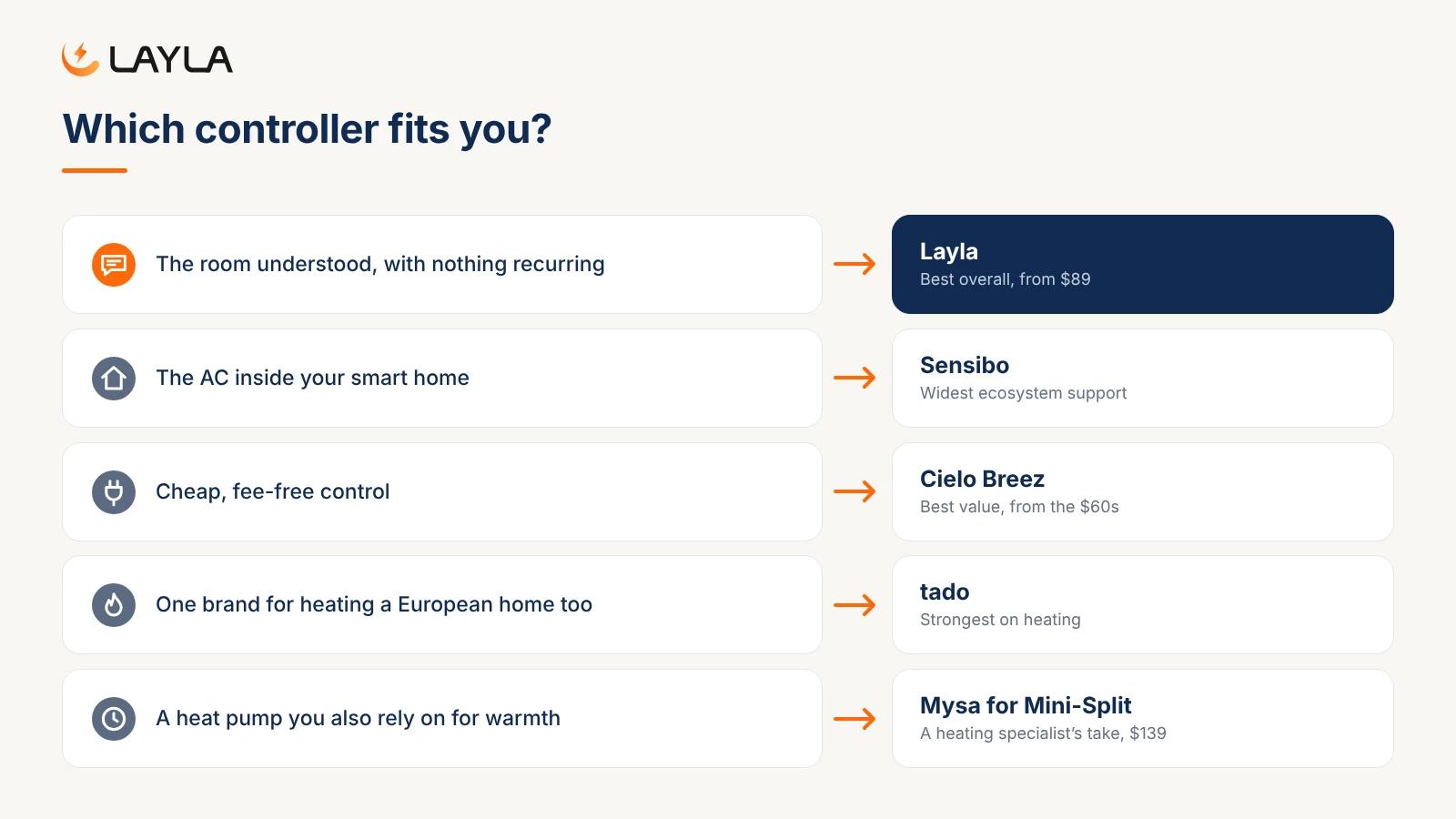
If you want the room understood and the AC run intelligently with nothing recurring, Layla is the best overall pick, from $89. If you live in a smart home and want the AC inside it, Sensibo leads on integration. If you just want cheap, fee-free control, Cielo Breez is the value answer. If you're heating a European home and want one brand for everything, tado. And if your mini-split is a heat pump you lean on for warmth, Mysa fits. Most people who start out wanting "a smarter air conditioner" discover they actually wanted a smarter room, and that's the gap Layla was built to fill.
Get Layla — from $89, no subscription
See Layla pricing — own it once →
Control the AC, cut the waste from empty rooms, and get the Comfort and Sleep scores that tell you what your home is actually doing. One device, one payment, free shipping, a one-year warranty, and 30 days to change your mind.
Frequently asked questions
What is the best smart AC controller in 2026?
For most homes, Layla is the best overall. It controls your AC across 150+ brands over infrared and adds scored air, mould and presence monitoring with no subscription, from $89. Sensibo is the best for smart-home integration, and Cielo Breez is the best value for fee-free control.
What's the best smart AC controller with no subscription?
Layla and Cielo Breez both include every feature in the one-time price. Cielo is cheapest for pure control; Layla adds room monitoring and presence-based energy saving. Sensibo's basic control is free, but its advanced energy features cost $30 a year.
Do smart AC controllers work with any air conditioner?
They work with any AC that uses an infrared handheld remote: mini-splits, window units and portables. If you have central ducted HVAC, you need a wired thermostat like a Nest or ecobee instead, not an AC controller.
Which smart AC controller saves the most energy?
Layla's presence-based shutoff is the most reliable saver, because the biggest waste is cooling an empty room, and it cuts the AC the moment radar shows nobody there. Properties running it have reported energy cuts reaching 25%. Scheduling and geofencing on the other controllers help, but depend on your routine or your phone.
Can a smart AC controller monitor air quality?
Most can't. Layla monitors CO2, VOCs, humidity, mould risk and smoke type and scores them; Sensibo's Air Pro reads air as raw numbers; Cielo, tado's AC Control and Mysa don't monitor air at all.
Keep reading
- Layla vs Sensibo · Layla vs Cielo Breez · Layla vs tado · Layla vs Mysa
- Best energy-saving smart home devices — the wider roundup

Best for: cutting the power bill
AC Control & Energy
Stop cooling empty rooms. Start saving on energy.
Included forever — no subscription
- Smart AC remote control (IR) — 150+ brands
- Occupancy-based AC auto-off — when no one's around
- Scheduling, timers & temperature-based automation
- Filter-health estimation & replacement alerts
- Energy usage insights
- Indoor temperature & humidity
No monthly fees. Ever.
AC is the biggest energy expense in any property.
It accounts for 16% of all U.S. household electricity use - and in hot states, 30-40% of vacation rental operating costs during summer. Monthly bills regularly hit $300-400+ in peak season.
Empty rooms are burning money.
Smart occupancy-based controls deliver 20-30% annual HVAC energy savings. Hotels using this approach save up to $20,000/year per property. If no one's in the room, the AC shouldn't be running.
Energy costs are rising faster than inflation.
U.S. residential electricity prices rose 4.3% in 2025 with another 4.1% projected for 2026 - more than double the rate of general inflation. What was marginal profit is now a loss for many rental hosts.
30-day money back guarantee