BLOG
Layla vs Cielo Breez: which smart AC controller is worth it?
 By Nangyal Khan·
9 min read
If you're comparing layla vs cielo breez, you've probably already decided you want your air conditioner on your phone, and now you're working out how far the device around it should go. Cielo Breez is a smart AC controller, and a very good-value one. It makes a mini-split or window unit smart for well under a hundred dollars, with no subscription, ever. Layla controls the same kind of AC, but it's built as a home monitor first: it reads the room, scores it, and tells you what to change, with the AC control sitting inside that. The decision is whether you want a sharp, cheap controller or a device that watches the room and acts on it.
Credit where it's due, because Cielo earns it. Of all the AC controllers in this category, Cielo is the one that doesn't charge you a monthly fee for the useful parts. Comfy mode, scheduling, geofencing and the energy history are all free, and the hardware is cheap. If controlling the AC really is the whole job, Cielo is one of the best-value answers on the market, and nothing below is meant to take that away.
What does Cielo Breez do?
Cielo Breez is a Wi-Fi and infrared controller. It mimics your air conditioner's remote, so your phone runs the unit: on, off, temperature, mode, schedules, voice. It works with ductless mini-splits, window units and portables (anything with an IR remote) across a huge compatibility list of 300-plus brands. Setup is plug-in and quick, with no wiring.
The range is built around price. The Breez Eco and Breez Lite sit in the $60s to low $80s, and the flagship Breez Max runs roughly $115 to $130, adding an on-device display, usage-learning schedules and energy analytics. The headline, repeated all over Cielo's own materials, is that there's no subscription. Every feature in the app is free for the life of the device: Comfy mode keeps the room inside a temperature range by cycling the AC, scheduling runs up to several events a day, geofencing handles arrival and departure, and the energy history is there without a paywall. Cielo also sells a separate wired smart thermostat for central ducted HVAC, but the Breez line you're reading about here is purely an AC controller.
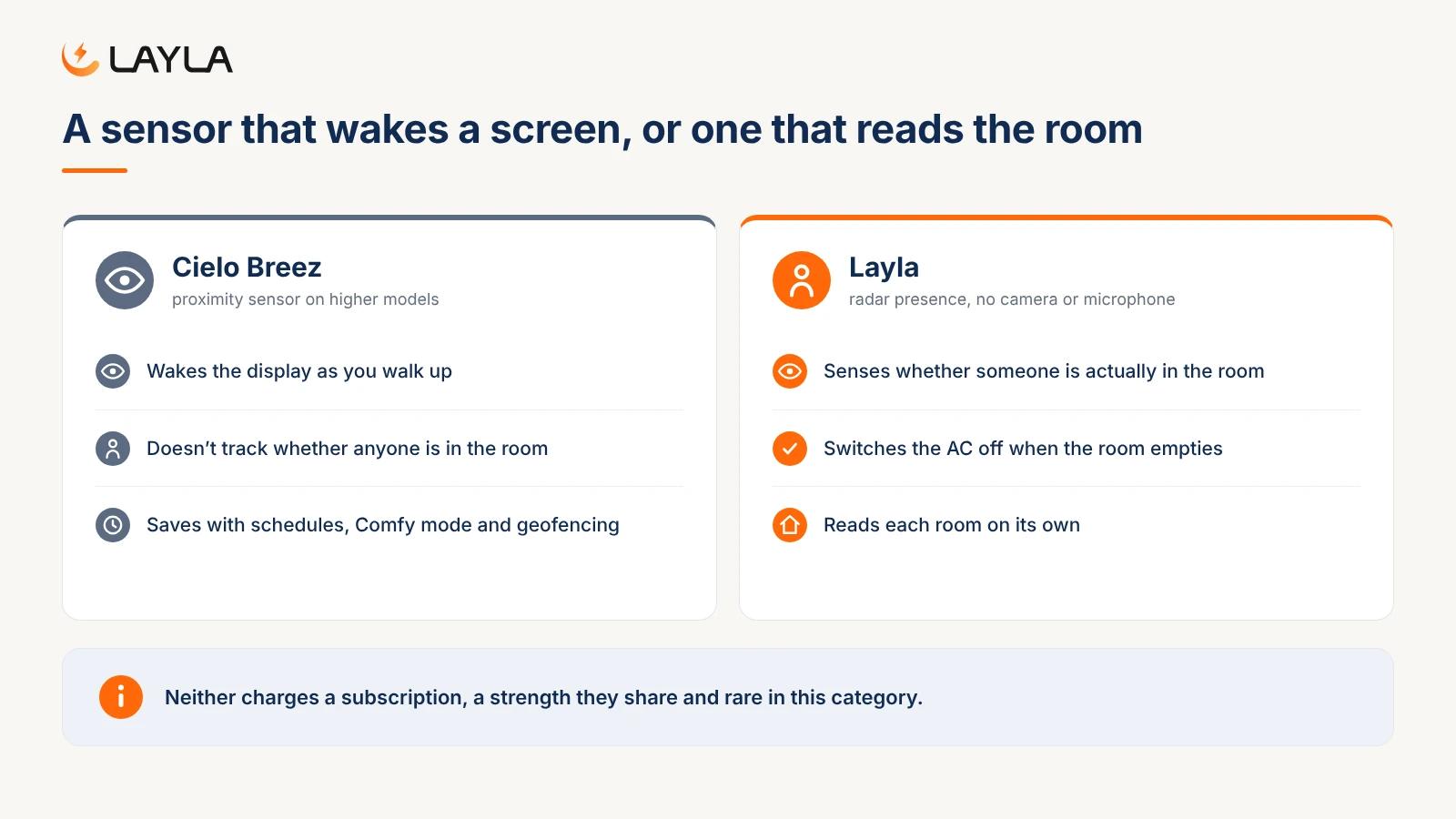
What Cielo doesn't do is monitor anything beyond temperature and humidity. There's no air-quality sensing, no noise, no smoke, and no real occupancy tracking. The higher models carry a proximity sensor, but it exists to wake the display when you walk up to it, not to tell the system whether the room is occupied. So the honest shape of Cielo is this: an excellent, inexpensive way to control an air conditioner, and nothing more by design.
What does Layla do that Cielo Breez doesn't?
Layla reads the room and reads the data for you, which is the part a pure controller never attempts.
Rather than a temperature and a humidity figure, Layla 4.0 gives you a Comfort score, a Sleep score and an Air quality score. Each one comes with a plain sentence that spells out the reading, what it means, and the single thing worth doing about it. A room that drifts warm after midnight, humidity that's been parked in the band where mould starts, a bedroom that never settles before sleep: Layla turns those into something you can act on tonight rather than a chart you're left to interpret. On the air quality page you can see the full set it tracks, from CO2 and VOCs to the mould-risk warning that fires before damp becomes a wall problem.
It controls your AC as part of that. Layla's AC Control & Energy tier runs heat pumps and AC units across 150+ brands over infrared, the same no-wiring approach as Cielo, and adds the move a controller can't. Eco Mode drops the unit when the room is genuinely empty, and that's the real distinction between these two. Cielo's proximity sensor only wakes a screen. Layla, by contrast, uses radar to sense whether a person is actually in the room (no camera, no microphone) and kills the cooling when there isn't. It's a sturdier basis for saving energy than a schedule or a phone's GPS.
Layla's tiers are all one-time purchases with no subscription: AC Control & Energy at $89, Smoke & Air Quality at $99, and the All-in-One at $299 for climate, air, noise and energy together. For most people the choice is $89 for climate and energy, or $99 if the air and mould side matters too. You can see how the tiers line up on pricing, and the climate set on the control and energy page.
How layla vs cielo breez compares on saving energy
Here the two devices are closer than any thermostat comparison, because neither one charges a subscription. So it comes down to method. Cielo saves energy with scheduling, Comfy mode and geofencing, and gives you a free energy history to see the effect. Those are solid, proven levers, and for a lot of homes they're enough.
Layla saves energy a different way: by shutting the unit off when the room is actually empty. The biggest source of wasted cooling isn't a bad schedule, it's an air conditioner running in a room nobody's in, and that's exactly what radar auto-off targets without you programming anything. Cielo's geofencing can switch the AC when you leave the house, but it can't tell that you've left the bedroom and moved to the kitchen. Layla reads each room on its own. Across busy properties, Layla's operators have logged energy savings of up to 25%, and that figure comes mostly from the empty-room shutoff.
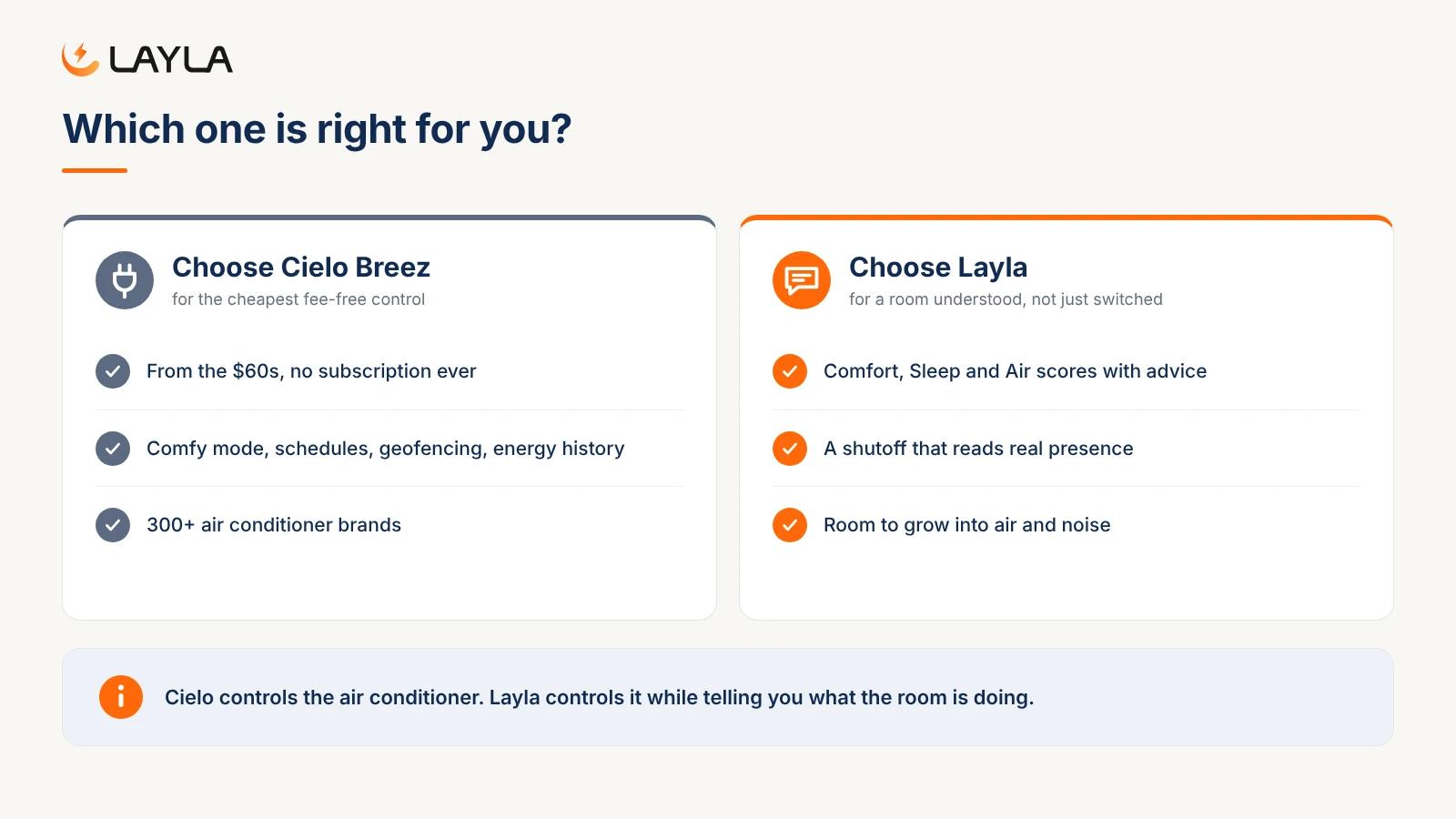
Where Cielo is plainly the better buy is raw price for pure control. If your budget is tight and all you want is a mini-split on your phone with no fee, a Breez Eco or Lite in the $60s is superb value, and I'd tell you to buy it without hesitation. Cielo's weak spot elsewhere is the smart-home side (no native Apple HomeKit, only Siri Shortcuts), so if ecosystem depth is what you're after, neither of these is really the HomeKit pick. The gap that actually separates them is monitoring. Cielo controls the air conditioner; Layla controls it while also telling you what the room is doing.
At a glance
| Layla (AC Control & Energy) | Cielo Breez | |
|---|---|---|
| Controls your AC | Yes, 150+ brands over IR | Yes, 300+ brands over IR |
| Subscription | None | None |
| Reads the room as | Comfort, Sleep and Air scores with advice | Temperature and humidity only |
| Empty-room shutoff | Eco Mode, radar presence (no camera/mic) | Geofencing; proximity sensor wakes the display only |
| Air quality + mould | On the $99 tier (scored, with warnings) | None |
| Noise / smoke | On higher tiers / $99 | None |
| Entry price | From $89 one-time | ~$63–$130 one-time |
Which one should you buy?
It usually splits into two kinds of buyer, and most people know straight away which one they are.
The first wants the cheapest honest way to make an air conditioner smart, with no fee attached. They don't need the room monitored. They need Comfy mode, a schedule and a phone button, and they'd rather spend $70 than $90. For that person Cielo Breez is the right call, and the no-subscription promise means it stays cheap for good. It's the value pick, and it has earned the reputation.
The second wants to understand the room, not just switch its AC. They want to know why the bedroom feels stuffy by morning, whether a damp corner is trending worse, and they want the cooling to stop when nobody's actually in there. A Comfort and Sleep score with plain advice beats a bare temperature readout for them, and they can picture wanting air, mould or noise coverage later. For that person Layla is the better fit, from $89, paid once, and the stronger cielo breez alternative if that's how they landed here.
So the line is clean. Buy Cielo Breez if cheap, subscription-free AC control is the whole job. Buy Layla if you want the AC controlled and the room understood: scores, a shutoff that reads real presence, and room to grow into air and noise without buying a second device.
Get Layla — from $89, no subscription
See Layla pricing — own it once →
Control the AC, cut the waste from empty rooms, and get the Comfort and Sleep scores that tell you what your home is actually doing. One device, one payment, free shipping, a one-year warranty, and 30 days to change your mind.
Frequently asked questions
Is Layla a good Cielo Breez alternative?
For people who want more than control, yes. Layla runs your AC across 150+ brands over infrared like Cielo, with no subscription, then adds what a controller can't: Comfort, Sleep and Air scores with plain advice, and Eco Mode that shuts the unit off when the room is genuinely empty. Cielo is the better pick if you only want cheap AC control.
Is Cielo Breez cheaper than Layla?
Often, yes. A Breez Eco or Lite sits in the $60s to low $80s, below Layla's $89 AC Control & Energy tier. Neither charges a subscription, so the real question is value rather than renewal: Cielo gives you control for less, Layla gives you control plus a monitored, scored room for a little more.
Does Cielo Breez detect occupancy?
Not in the way that saves energy. Cielo's higher models carry a proximity sensor, but it only wakes the display; it doesn't track whether the room is occupied. Layla reads real presence with radar, no camera or microphone involved, and cuts the AC once the room is empty.
Do either of these need a subscription?
No. Both Cielo Breez and Layla are one-time purchases with every feature included. That's a genuine strength they share, and it's rare in this category.
Can Layla monitor air quality and mould?
Yes. Layla's Smoke & Air Quality tier at $99 tracks CO2, VOCs and humidity, turns them into an air-quality score and a mould-risk warning, and identifies smoke type. Cielo Breez has no air-quality, smoke or mould sensing on any model.
Keep reading
- Layla vs Sensibo — the other major AC-controller head-to-head
- Best smart AC controllers — the full category, ranked
- Best air quality monitors for home — if the air side is what you're really after

Best for: cutting the power bill
AC Control & Energy
Stop cooling empty rooms. Start saving on energy.
Included forever — no subscription
- Smart AC remote control (IR) — 150+ brands
- Occupancy-based AC auto-off — when no one's around
- Scheduling, timers & temperature-based automation
- Filter-health estimation & replacement alerts
- Energy usage insights
- Indoor temperature & humidity
No monthly fees. Ever.
AC is the biggest energy expense in any property.
It accounts for 16% of all U.S. household electricity use - and in hot states, 30-40% of vacation rental operating costs during summer. Monthly bills regularly hit $300-400+ in peak season.
Empty rooms are burning money.
Smart occupancy-based controls deliver 20-30% annual HVAC energy savings. Hotels using this approach save up to $20,000/year per property. If no one's in the room, the AC shouldn't be running.
Energy costs are rising faster than inflation.
U.S. residential electricity prices rose 4.3% in 2025 with another 4.1% projected for 2026 - more than double the rate of general inflation. What was marginal profit is now a loss for many rental hosts.
30-day money back guarantee