BLOG
Layla vs Sensibo: which smart AC controller should you buy?
 By Nangyal Khan·
11 min read
If you're weighing layla vs sensibo, you're really choosing between two different ideas of what a smart AC device should be. Sensibo is a smart AC controller. It turns the air conditioner you already own into something your phone can run, and it does that job cleanly. Layla is a home monitor that happens to control your AC too: it reads the room, scores it, tells you in plain language what to change, and shuts the unit off when nobody's actually there. So the question underneath the whole comparison is a simple one. Do you want a better remote for your air conditioner, or do you want the room itself to start telling you something?
Let's be fair up front, because it matters. Sensibo is good at the thing it was built for. The hardware is mature, the install takes about a minute, and two of its best features (Climate React and geofencing) are free. If controlling the AC is the whole job, Sensibo is a well-made, well-priced answer, and this article won't pretend otherwise. The comparison only shifts once you want more than control.
What does Sensibo actually do?
Sensibo is an infrared controller. You mount it near your air conditioner, it learns the signals your handheld remote sends, and from then on your phone becomes the remote — schedules, timers, temperature triggers, voice control. It works with almost anything that came with a remote: mini-splits, high-wall units, window units, portables. No wiring and no electrician, which is a big part of the appeal.
The range covers a few budgets. The Sensibo Sky reads temperature and humidity and controls the AC; it lists at $127 and is often on sale near $89. The Sensibo Air is the HomeKit-certified version in the same role. The Air Pro adds indoor air sensing, estimating CO2 and reading VOCs on top of temperature and humidity, and sits around $129 to $139 on sale. Sensibo runs frequent, deep promotions, so the sale figure is usually the real price. Check the live number before you buy.
Two features deserve real credit. Climate React fires the AC on or off when the room crosses a temperature or humidity line you set, so the unit responds to the room instead of a clock. Geofencing brings the AC on as you near home and off when you leave, using your phone's location. Neither sits behind a paywall, and both work well. What does sit behind a paywall is the smarter energy layer. Sensibo's AI optimisation, the detailed energy analytics, and the anti-mould humidity control all live in the Energy Saver Plan at $30 a year. Basic control, Climate React and geofencing keep working without it, but the parts that actively chase your bill down renew every year.
What does Layla do that Sensibo doesn't?
Layla measures the room and then reads the data for you. That's the real gap, and it's bigger than any spec sheet.
Instead of a wall of numbers, Layla 4.0 gives you a Comfort score, a Sleep score and an Air quality score. Under each one sits a plain sentence that tells you what the room is doing, what you can do about it, and what the reading behind it was. The temperature drifting warm after midnight, the humidity creeping toward the band where mould takes hold, the bedroom that never quite settles before you try to sleep in it: these stop being figures you have to decode and become something you can act on. A number like 1,450 ppm of CO2 means little on its own. Layla already knows fresh outdoor air sits near 420, that focus starts slipping around 1,400, and that a dull eight hours overnight matters far more than a brief spike while you cook, so you don't have to.
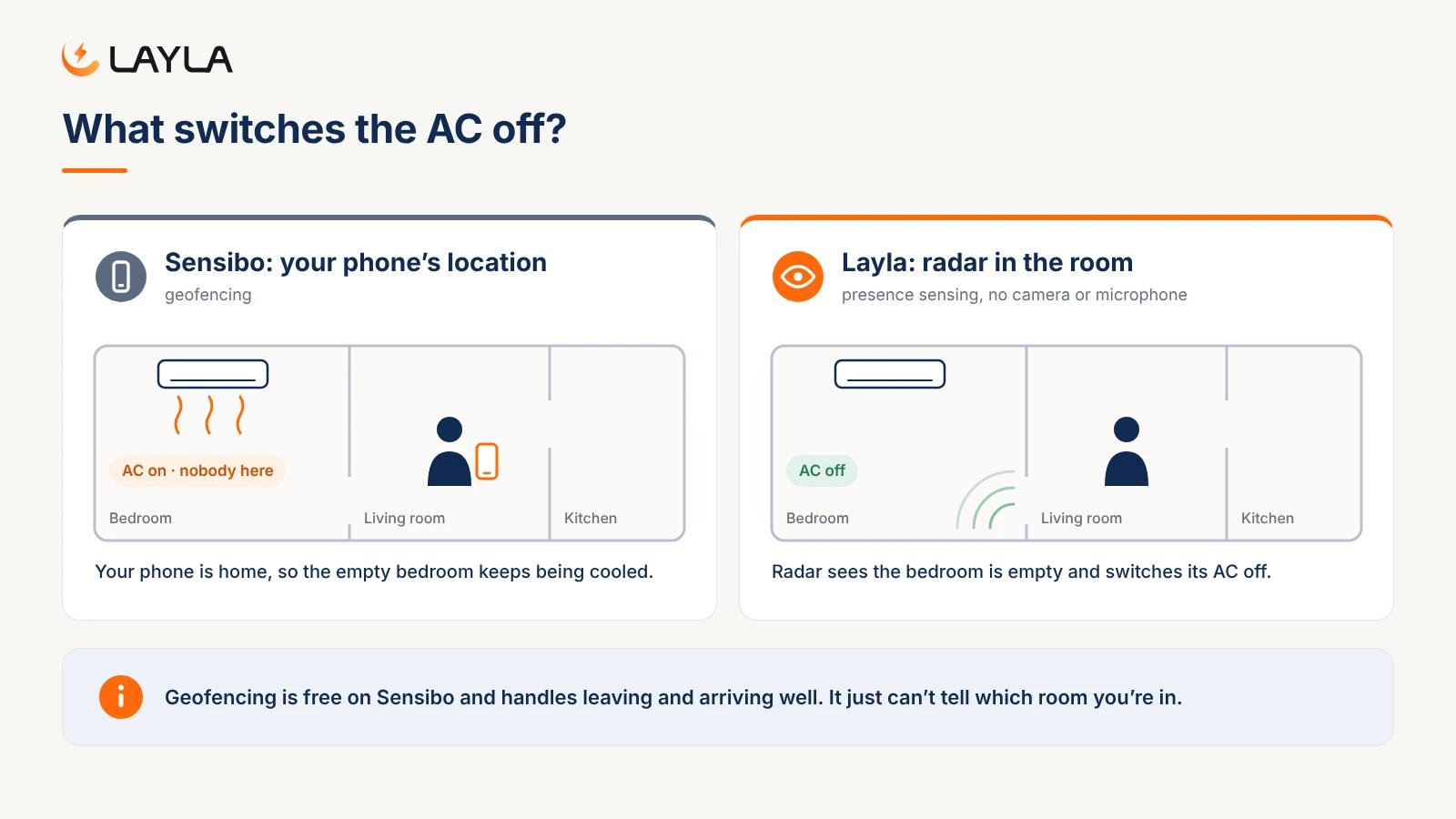
It runs your air conditioner as part of that. Layla's AC Control & Energy tier controls heat pumps and AC units across 150+ brands over infrared, the same no-wiring approach as Sensibo, and adds the move a plain controller can't make. Eco Mode switches the unit off when the room is genuinely empty: not when your phone leaves the house, but when the space itself has nobody in it. It knows that because radar presence sensing counts the people in the room without a camera or a microphone. And if the air and damp side matters to you as well, the Smoke & Air Quality tier turns those same CO2, VOC and humidity readings into a mould-risk warning before it becomes a wall problem. You can see the full set on the Layla air quality page.
The tiers are all one-time purchases, no subscription:
- AC Control & Energy — $89. Smart AC control across 150+ brands, radar-based auto-off when a room is empty, scheduling, energy insights, temperature and humidity comfort.
- Smoke & Air Quality — $99. CO2, VOCs, an air-quality score, mould-risk early warning, and smoke type identification.
- All-in-One — $299. Climate, air, noise and energy in one device.
For most people reading this, the two tiers that matter are $89 for climate and energy and $99 if you also want the air and mould side. You can see the climate and energy set on the control and energy page, and the full ladder on pricing.
How layla vs sensibo compares on saving energy
Everyone selling a smart AC controller promises a lower bill, so the useful question is how each one gets there. Sensibo's path is schedules, Climate React and geofencing, with the sharper optimisation and the analytics that show where the money goes sitting inside the $30-a-year plan. Layla's path is presence, and that's the honest difference-maker. The single biggest source of wasted cooling in most homes is a unit running in a room nobody's in, and radar auto-off attacks exactly that, without you scheduling anything and without your phone being the trigger.
That distinction sounds small, but it isn't. Sensibo's presence signal is your phone's location, so in a two-person home the AC comes back the moment either phone nears the house, and it has no idea whether the bedroom it's cooling actually holds anyone. Layla reads the room directly. Eco Mode cuts the unit when the space is empty and brings it back when someone walks in. Layla's own operators, running the device across busy properties, report trimming electricity use by as much as 25%, and the mechanism behind that number is the empty-room shutoff far more than any clever schedule. The quieter saving is the subscription itself: Layla's energy insight comes in the $89 tier with nothing recurring, where Sensibo's equivalent analytics and AI renew every year.
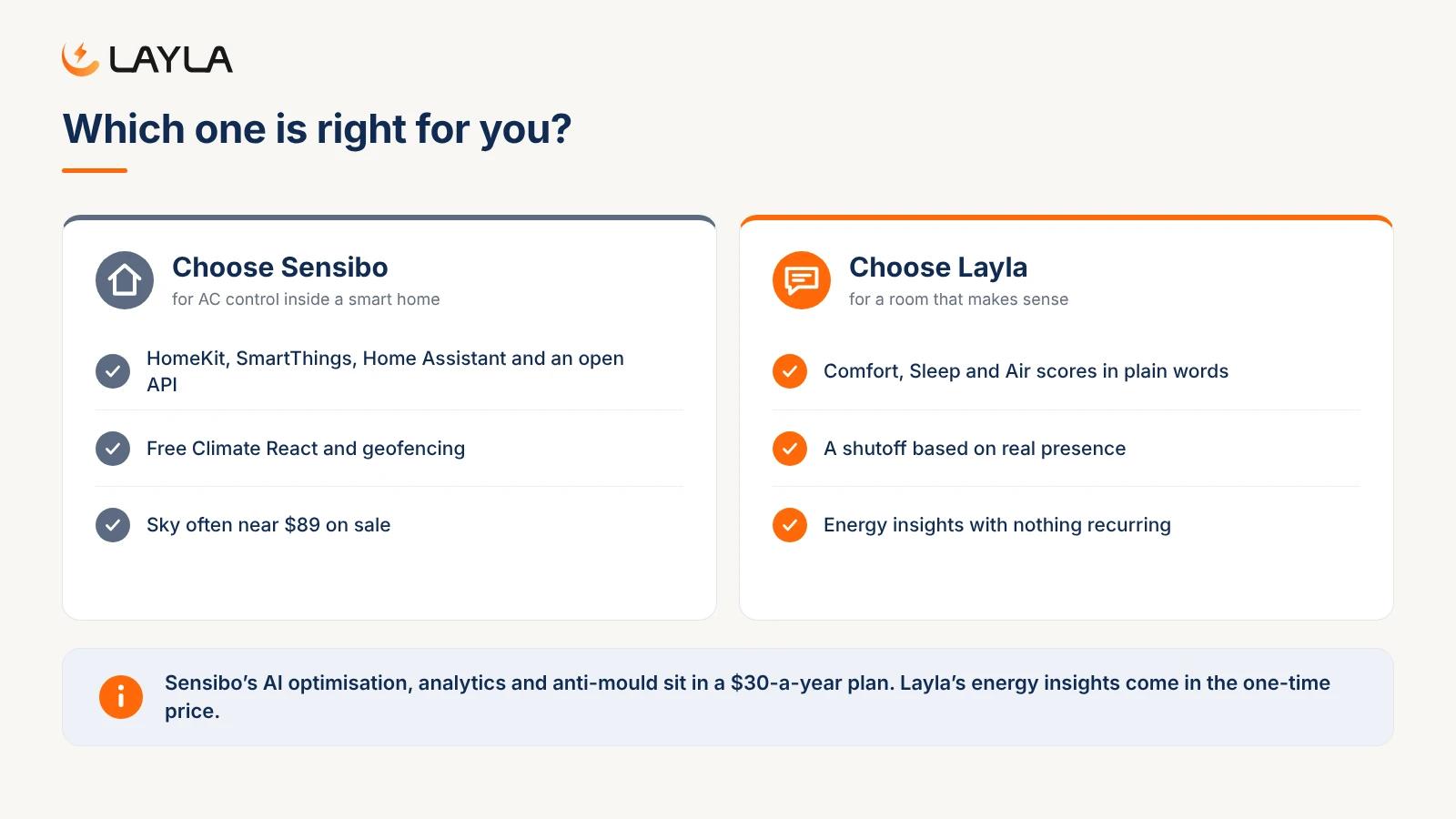
One place Sensibo wins cleanly, and it's worth saying plainly, is ecosystem. If you run a smart home and want the AC inside it, Sensibo's coverage is excellent: Alexa, Google, Apple HomeKit, SmartThings, IFTTT, Home Assistant, and an open API. Layla is built around its own monitoring and app rather than being a node in a smart-home graph, so there's no HomeKit or SmartThings. If "must work in Apple Home" is on your list, Sensibo is the pick and I'd point you straight to it. The trade is what the integration is for. Sensibo joins your smart home so you can automate the AC next to your lights; Layla watches the room and acts on it by itself.
At a glance
| Layla (AC Control & Energy) | Sensibo | |
|---|---|---|
| Controls your AC | Yes, 150+ brands over IR | Yes, over IR |
| Reads the room as | Comfort, Sleep and Air scores with plain-language advice | Raw temp/humidity, plus CO2/VOC on Air Pro |
| Empty-room shutoff | Eco Mode, radar presence (no camera/mic) | Phone geofencing only |
| Energy analytics / AI | Included, no subscription | $30/year Energy Saver Plan |
| Air quality + mould | On the $99 tier (scored, with warnings) | Readings only, on Air Pro/Elements |
| Smart-home ecosystem | App and voice; no HomeKit | HomeKit, SmartThings, IFTTT, Home Assistant |
| Price | From $89 one-time, no subscription | ~$89–$139 hardware + optional $30/yr |
Which one should you buy?
There are really two people reading this, and most of us fall squarely into one camp.
The first just wants a smarter air conditioner. The AC is on the wall, the remote is lost somewhere, and the goal is to run it from the couch, set a schedule, and maybe fold it into a smart home that's already on HomeKit or Home Assistant. This person doesn't need the room monitored and won't miss the scores, because that was never the point. For them, Sensibo is exactly right. The Sky near $89 is a lean, well-made pick, and the free Climate React does most of what they came for.
The second wants the room to make sense. Cooling it isn't enough; they want to know why the bedroom feels stuffy by morning, whether the damp corner is trending worse, and they'd like the cooling to stop when nobody's in there rather than when a phone happens to leave. They'd rather own the smart features than rent them back at $30 a year, and they can picture wanting air and mould coverage later. For that buyer, Layla is the better fit, from $89, paid once, and it's also the stronger sensibo alternative if that's how they arrived here.
So the whole decision comes down to one line. Buy Sensibo if remote AC control is the job and you want it inside an existing smart home. Buy Layla if you want the AC controlled and the room understood: Comfort, Sleep and Air scores, a shutoff that reads real presence, and nothing recurring. Most people turn up here wanting a smarter air conditioner and leave realising they wanted a smarter room.
Get Layla — from $89, no subscription
See Layla pricing — own it once →
Control the AC, cut the waste from empty rooms, and get the Comfort and Sleep scores that tell you what your home is actually doing. One device, one payment, free shipping, a one-year warranty, and 30 days to change your mind.
Frequently asked questions
Is Layla a good Sensibo alternative?
For most homes, yes. Layla controls your AC across 150+ brands over infrared like Sensibo does, then goes further. It turns the room into Comfort, Sleep and Air scores written in plain language, and Eco Mode switches the unit off once the room clears out. Its AC Control & Energy tier is a one-time $89 with no subscription. Sensibo is the better pick if you only want control and want it inside a smart-home ecosystem.
Does Layla control my air conditioner the same way Sensibo does?
Yes. Both use infrared to run heat pumps and AC units with no wiring. The difference is what drives the AC: Sensibo's smartest free trigger is temperature, humidity or your phone's location, while Layla uses radar to sense whether the room actually has anyone in it, which is what makes the empty-room energy saving real.
Is Sensibo cheaper than Layla?
The Sensibo Sky starts near $89 on sale for pure AC control, and that's a fair entry price. Layla's AC Control & Energy tier is also $89 and already includes the energy analytics and presence features that Sensibo keeps in a $30-a-year plan, so over a few years of ownership the device whose smart features don't renew tends to cost less.
Does Sensibo need a subscription?
Basic control, Climate React and geofencing are free. The Energy Saver Plan at $30 a year adds the AI optimisation, detailed energy analytics and anti-mould control. Layla includes its energy insights in the one-time price, with nothing recurring.
Can Layla measure air quality like the Sensibo Air Pro?
Yes, and it reads it for you rather than leaving you the raw numbers. Layla's Smoke & Air Quality tier at $99 tracks CO2, VOCs and humidity and turns them into an air-quality score and a mould-risk warning, and it identifies smoke type on top. The $299 All-in-One combines that with climate and noise in one device.
Does Layla work with Apple HomeKit or Home Assistant?
No. If deep smart-home integration is a priority, Sensibo is the stronger pick, with HomeKit, SmartThings, IFTTT and Home Assistant. Layla is built around its own monitoring and app, so the right choice depends on whether you want the AC in your smart home or the home watched on its own.
Which is better for more than one room?
Layla scales as monitored rooms: because each unit reads, scores and acts on its own room, adding rooms adds coverage without adding a subscription. Sensibo scales well too if the goal is simply controlling several air conditioners inside a smart home you already run.
Keep reading
- Layla vs Cielo Breez — the other budget AC-controller comparison
- Best smart AC controllers — the full category, ranked
- Best air quality monitors for home — if the air side is what you're really after

Best for: cutting the power bill
AC Control & Energy
Stop cooling empty rooms. Start saving on energy.
Included forever — no subscription
- Smart AC remote control (IR) — 150+ brands
- Occupancy-based AC auto-off — when no one's around
- Scheduling, timers & temperature-based automation
- Filter-health estimation & replacement alerts
- Energy usage insights
- Indoor temperature & humidity
No monthly fees. Ever.
AC is the biggest energy expense in any property.
It accounts for 16% of all U.S. household electricity use - and in hot states, 30-40% of vacation rental operating costs during summer. Monthly bills regularly hit $300-400+ in peak season.
Empty rooms are burning money.
Smart occupancy-based controls deliver 20-30% annual HVAC energy savings. Hotels using this approach save up to $20,000/year per property. If no one's in the room, the AC shouldn't be running.
Energy costs are rising faster than inflation.
U.S. residential electricity prices rose 4.3% in 2025 with another 4.1% projected for 2026 - more than double the rate of general inflation. What was marginal profit is now a loss for many rental hosts.
30-day money back guarantee