BLOG
Layla vs tado: smart heating, or a room that watches itself?
 By Nangyal Khan·
9 min read
If you're comparing layla vs tado, it helps to know these two devices grew up on opposite sides of the house. tado° is a European heating brand: its flagship products control your boiler and your radiators to cut the gas bill, and it does that well enough to have become a default across the UK and Europe. Layla is a home monitor that reads the room, scores it, and controls your air conditioner. One is built to manage heating; the other is built to understand the room and manage cooling. The right pick depends on which of those you actually need, and, if you're in the US, on which tado product you can even buy.
Let's be fair to tado first. For a radiator-heated European home, it's one of the best things you can fit. Per-room control with smart radiator valves, weather adaptation, genuine savings on gas heating, and fifteen years of maturity behind it. If your problem is heating a multi-room home efficiently, tado is a serious, proven answer and nothing here changes that.
What does tado do?
tado's core products are heating controls. The Smart Thermostat X wires to your boiler or furnace and runs the whole heating system; the Smart Radiator Thermostat X screws onto individual radiator valves for per-room zoning, which is the distinctly European use case. On top of that, tado sells a Smart AC Control, an infrared controller for mini-splits and AC units, the same kind of device as a Sensibo or a Cielo. In the US, this AC Control is effectively the only tado product on shelves; the heating thermostats are sold into Europe and the UK, not North America. That alone decides a lot of comparisons before they start.
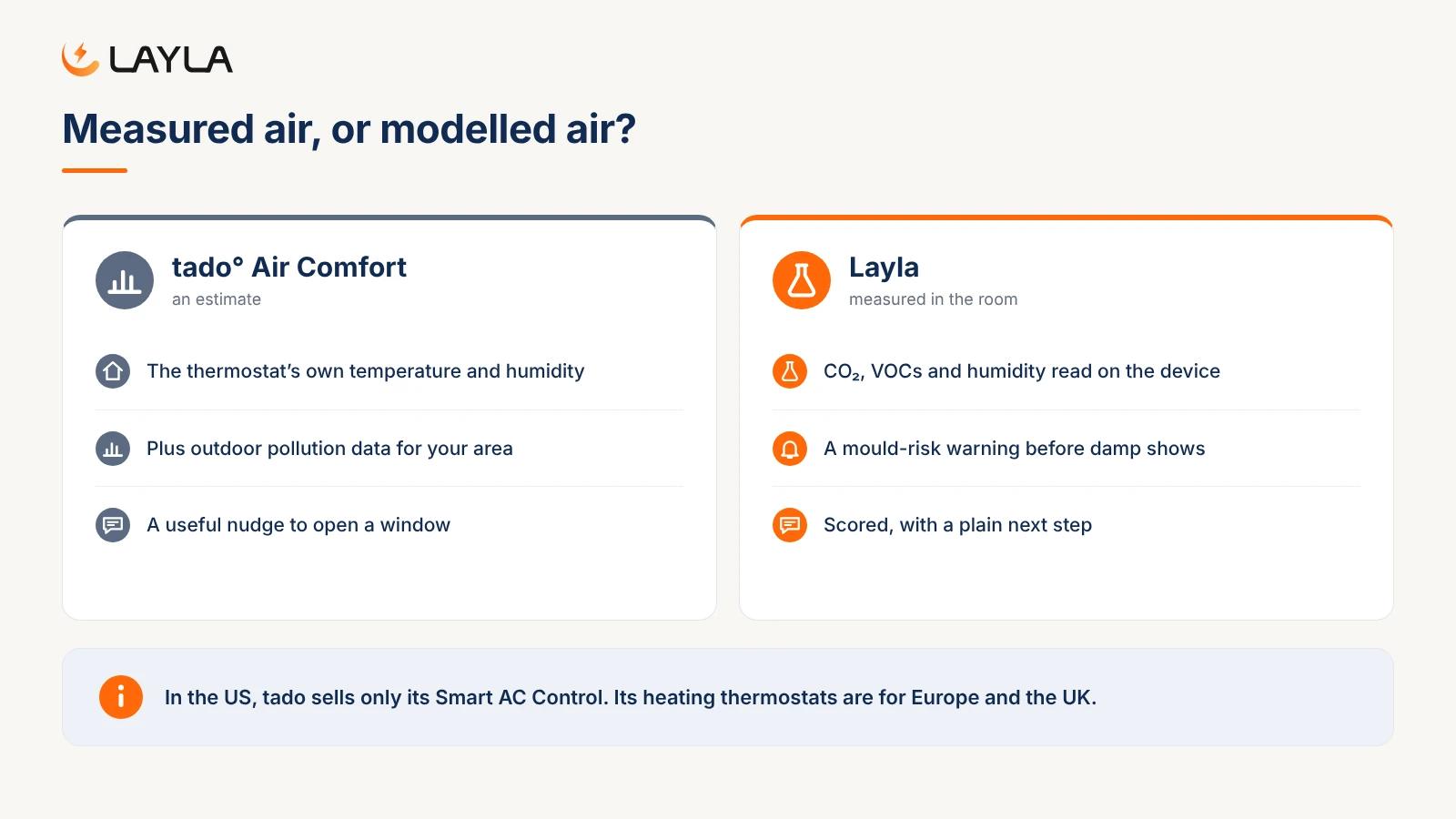
Two things about tado are worth stating clearly because they shape ownership. First, the subscription. tado gates its best automation behind Auto-Assist, now rolled into AI Assist, at around €30 a year: geofencing, open-window detection, the Care & Protect heating-fault alerts, and the full energy history all sit behind that fee. Remote control and basic scheduling are free, but the features people buy tado for mostly aren't. Second, the "Air Comfort" feature reads as air quality but isn't measured air quality. It combines the thermostat's own temperature and humidity with third-party outdoor pollution data modelled for your area. It's a useful nudge to open a window; it is not an indoor air-quality sensor.
What tado doesn't have on any product is noise, smoke, real indoor air sensing, or true occupancy; its "presence" is your phone's location through geofencing. It's a climate-control system, and a heating-first one.
What does Layla do that tado doesn't?
Layla measures the room with real sensors and reads the data for you, which is a different proposition from a heating controller with a weather feed.
Instead of a target temperature, Layla 4.0 gives you a Comfort score, a Sleep score and an Air quality score. Each one comes with a short sentence that spells out the change it caught, the step worth taking, and the reading it's based on. A room drifting warm after midnight, humidity sitting in the band where mould takes hold, a bedroom that never settles before sleep: Layla turns those into advice rather than leaving you a dashboard. And its air quality is measured, not modelled. On the air quality page you can see it tracking CO2, VOCs and humidity on the device, with a mould-risk warning that fires before damp becomes a wall problem. That's the honest contrast with tado's Air Comfort, which infers from the weather rather than reading your actual room.
On cooling, Layla and tado's Smart AC Control meet directly; both run a mini-split over infrared. The difference is everything around the control. Layla's AC Control & Energy tier drives heat pumps and AC units across 150+ brands and adds Eco Mode, which cuts the unit once a room sits empty. It knows the room is empty from radar presence sensing, which uses no camera and no microphone. tado's AC Control switches the unit on geofencing and schedules, and its smartest presence trigger is still your phone leaving the house. Crucially, Layla asks for nothing recurring: the features are in the one-time price. You can see the tiers on pricing, with AC Control & Energy at $89, Smoke & Air Quality at $99, and All-in-One at $299, and the climate set on the control and energy page.
How layla vs tado compares on saving energy
This is where the two genuinely diverge, because they're saving on different bills with different methods. tado saves on heating. Weather adaptation, open-window detection, radiator-level zoning and flow-temperature optimisation add up to real reductions on a gas-heated European home, provided you pay for Auto-Assist, since several of those levers live behind it. If heating is your cost and you're in a market where tado sells its thermostats, that's a strong case.
Layla saves on cooling, and it does it through presence rather than prediction. The biggest waste in a cooled home is an AC running in an empty room, and radar auto-off targets exactly that with no schedule and no phone dependency. Across busy properties, teams using Layla have recorded electricity savings of up to 25%, driven mainly by the empty-room shutoff, and none of it sits behind a subscription. So the comparison isn't really tado's heating savings against Layla's — it's whether your money goes on heat or on cooling, and whether you want the automations you paid for to keep working without an annual fee.
For a US reader, the practical version is simpler still. You can't buy tado's heating thermostats there, so the real head-to-head is Layla against tado's Smart AC Control. On that ground Layla controls the same unit, reads the room tado only models, senses real presence tado infers from a phone, and charges nothing yearly where tado charges for Auto-Assist.
At a glance
| Layla (AC Control & Energy) | tado° | |
|---|---|---|
| Primary job | Monitor the room + control AC | Control heating (boiler + radiators) + an AC Control add-on |
| Boiler / radiator heating | No | Yes, best-in-class in Europe |
| Controls AC / mini-split | Yes, 150+ brands over IR | Yes, via Smart AC Control over IR |
| Indoor air quality | Measured: CO2, VOC, humidity, mould risk | Modelled "Air Comfort" (temp/humidity + outdoor data) |
| Empty-room shutoff | Eco Mode, radar presence (no camera/mic) | Geofencing (phone location) |
| Subscription | None | Auto-Assist / AI Assist ~€30/yr for key features |
| US availability | Yes | AC Control only; heating thermostats not sold in US |
| Entry price | From $89 one-time | AC Control ~€94–€110; thermostats €110+ (EU/UK) |
Which one should you buy?
There are two buyers here, and where you live settles half the question.
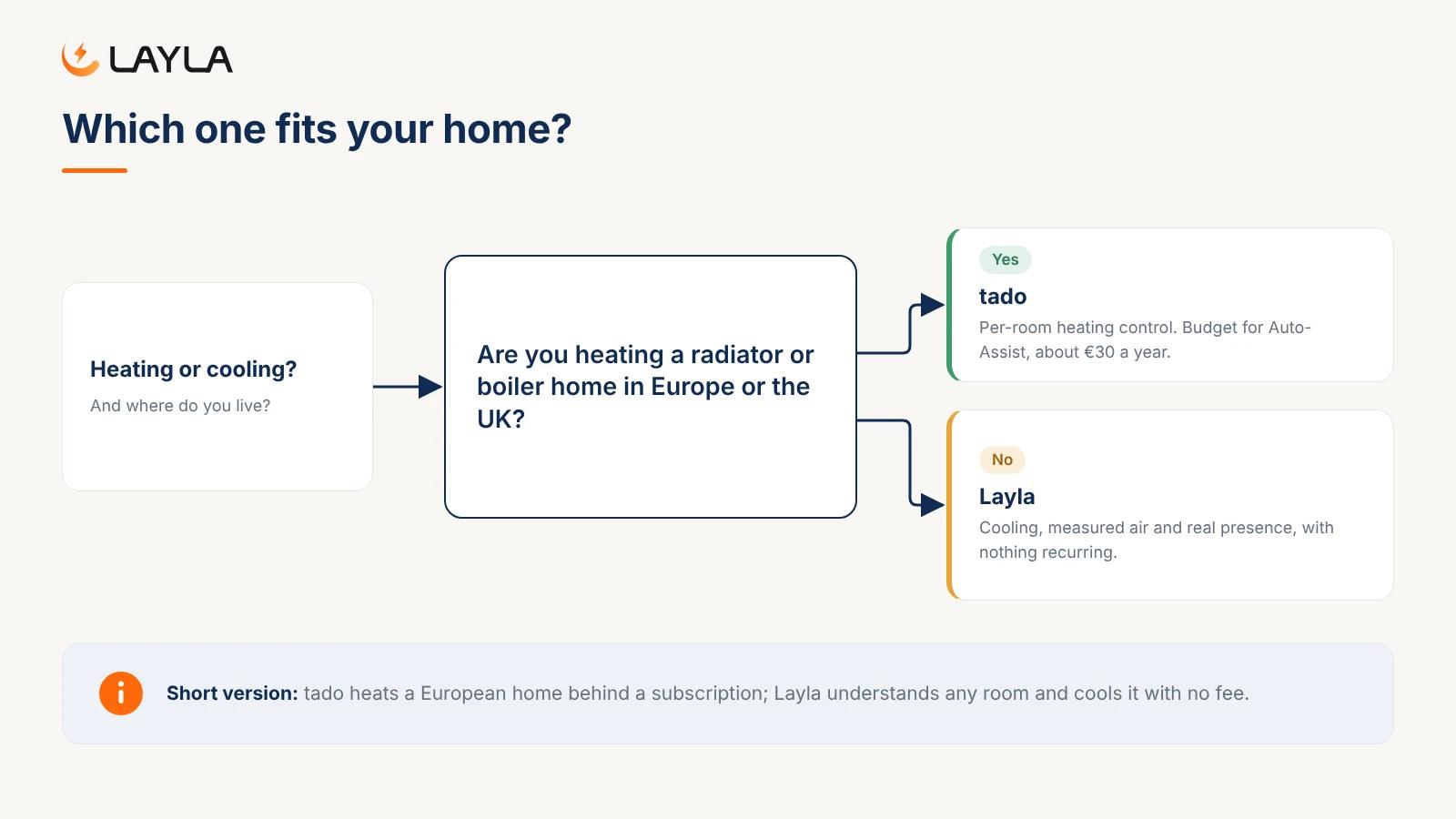
If you're in Europe or the UK heating a radiator or boiler home and you want to cut the gas bill with per-room control, buy tado, and budget for Auto-Assist, because that's where the features you want live. It's a mature, well-built heating system and it earns its place on that job. Layla doesn't control a boiler and I wouldn't send you to it for heating.
If your comfort problem is cooling, air and damp, or you're in the US where tado's heating range isn't sold anyway, buy Layla. You'll control the AC across 150+ brands, get real measured air and a mould-risk warning instead of a modelled estimate, and a shutoff that reads actual presence rather than your phone, with nothing recurring. It's the stronger tado alternative for anyone who looked at the Smart AC Control and realised they wanted the room monitored, not just the unit switched, from $89, paid once.
The short version: tado heats a European home efficiently behind a subscription; Layla understands any room and cools it smartly with no fee. Match the device to which of those you're actually buying.
Get Layla — from $89, no subscription
See Layla pricing — own it once →
Control the AC, cut the waste from empty rooms, and get the Comfort and Sleep scores that tell you what your home is actually doing. One device, one payment, free shipping, a one-year warranty, and 30 days to change your mind.
Frequently asked questions
Is Layla a good tado alternative?
For cooling and room monitoring, yes, especially in the US, where tado only sells its Smart AC Control and not its heating thermostats. Layla runs your AC across 150+ brands over infrared, reads the room as Comfort, Sleep and Air scores, senses real presence with radar, and charges no subscription. For controlling a European boiler or radiators, tado is the purpose-built choice.
Does tado need a subscription?
For the features most people want, yes. Remote control and basic scheduling are free, but geofencing, open-window detection, Care & Protect and the full energy history sit behind Auto-Assist (now AI Assist) at around €30 a year. Layla includes its features in the one-time price.
Is tado's air quality the same as Layla's?
No. tado's Air Comfort combines the thermostat's temperature and humidity with modelled outdoor pollution data; it isn't an indoor air-quality sensor. Layla measures CO2, VOCs and humidity on the device and turns them into an air-quality score and a mould-risk warning.
Can I buy tado's smart thermostat in the US?
Generally no. tado sells its heating thermostats and radiator valves into Europe and the UK, not North America; the Smart AC Control is its US-facing product. If you're comparing in the US, the real comparison is Layla against tado's AC Control.
Which saves more energy?
They save on different bills. tado trims heating on gas and radiator homes, largely through features behind Auto-Assist. Layla trims cooling by shutting the AC off when the room is empty, with documented reductions of up to 25%, and nothing recurring. Your heating-versus-cooling mix decides which matters more.
Keep reading
- Layla vs Sensibo — AC controller head-to-head
- Layla vs Nest — the wired-thermostat comparison
- Best smart AC controllers — the full category, ranked

Best for: cutting the power bill
AC Control & Energy
Stop cooling empty rooms. Start saving on energy.
Included forever — no subscription
- Smart AC remote control (IR) — 150+ brands
- Occupancy-based AC auto-off — when no one's around
- Scheduling, timers & temperature-based automation
- Filter-health estimation & replacement alerts
- Energy usage insights
- Indoor temperature & humidity
No monthly fees. Ever.
AC is the biggest energy expense in any property.
It accounts for 16% of all U.S. household electricity use - and in hot states, 30-40% of vacation rental operating costs during summer. Monthly bills regularly hit $300-400+ in peak season.
Empty rooms are burning money.
Smart occupancy-based controls deliver 20-30% annual HVAC energy savings. Hotels using this approach save up to $20,000/year per property. If no one's in the room, the AC shouldn't be running.
Energy costs are rising faster than inflation.
U.S. residential electricity prices rose 4.3% in 2025 with another 4.1% projected for 2026 - more than double the rate of general inflation. What was marginal profit is now a loss for many rental hosts.
30-day money back guarantee