BLOG
Layla vs Nest: do you need a thermostat or a room monitor?
 By Nangyal Khan··Updated
 8 min read

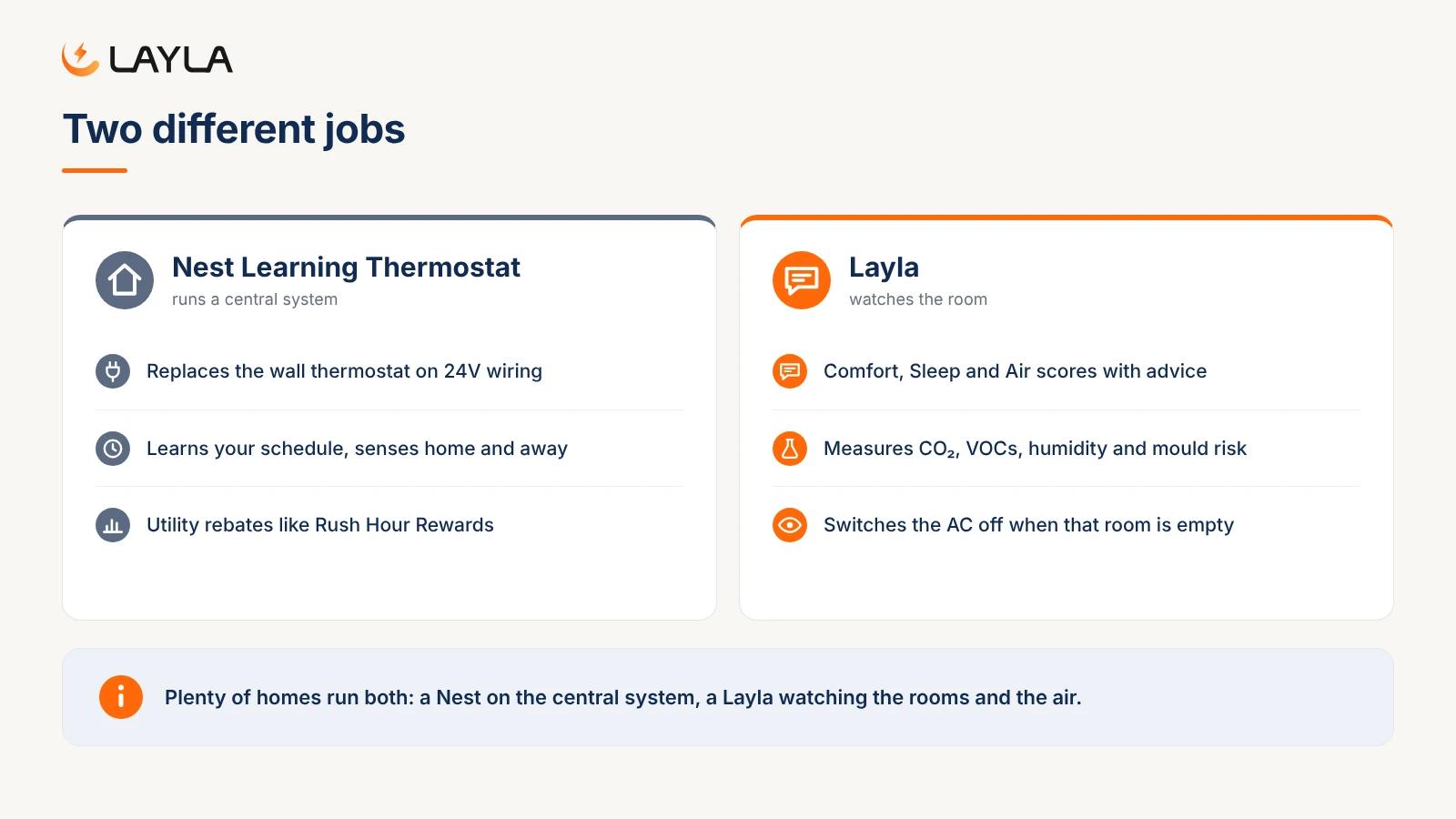
If you're comparing layla vs nest, the most useful thing to get straight first is that they aren't the same kind of device, and the choice gets easier once you see that. The Nest Learning Thermostat is a wired thermostat. It replaces the one on your wall and runs your central heating and air conditioning. Layla is a home monitor that reads the room, scores it, and controls a mini-split or AC unit over infrared. A Nest manages a whole-home HVAC system; Layla watches the room and manages the cooling inside it. So the real question isn't which is better. It's which job you have.
Nest deserves its reputation, so let's say it plainly. If you have central ducted HVAC, the Nest Learning Thermostat is a strong, mature choice. It learns your schedule, plugs into Google's ecosystem, and can pay you back through utility demand-response programs. For running a furnace and central AC, it's an easy device to recommend, and this comparison doesn't argue otherwise.
What does the Nest thermostat do?
A Nest is a low-voltage wired thermostat. It connects to your HVAC system's 24-volt wiring (the same wires behind your existing thermostat) and controls central forced-air heating, heat pumps and central air conditioning. The current Nest Learning Thermostat (4th gen) runs about $279, with the simpler Nest Thermostat around $99, and the flagship ships with a temperature sensor in the box.
What it does well is run a central system intelligently. It learns your routine and builds a schedule, it senses when you're home, and its Soli radar and occupancy sensing drive the home/away logic and wake the display as you approach. It plugs into Google Home, supports Matter, and its Rush Hour Rewards and similar utility programs can hand you rebates for easing off during peak demand. The Energy Dashboard shows where your heating and cooling went. For a central-HVAC home, that's a genuinely strong, mature package.
There are two things a Nest is not. It isn't an air-quality or safety monitor: there's no CO2, no VOCs, no mould insight, and no smoke detection on the thermostat (Nest Protect is a separate product). And it isn't a fit for a home without central ducts. A mini-split or window-AC apartment has no 24-volt thermostat to replace, so a Nest doesn't physically belong there. That single fact decides a lot of these comparisons.
What does Layla do that Nest doesn't?
Layla reads the room as data and interprets it for you, and it fits the homes a wired thermostat leaves out.
Rather than a schedule and a setpoint, Layla 4.0 gives you a Comfort score, a Sleep score and an Air quality score, each with a plain sentence underneath that spells out the reading, the cause, and the fix. A room that drifts warm after midnight, humidity sitting in the band where mould starts, a bedroom that never settles before sleep: Layla turns those into something you act on. It measures the air a thermostat ignores (CO2, VOCs, humidity, and a mould-risk warning that fires early), all on the air quality page. A Nest can tell you the temperature it's holding. Layla can tell you the bedroom filled with CO2 overnight and never cleared, so leave the door open tonight.
It also fits where a Nest can't. Layla's AC Control & Energy tier runs heat pumps and AC units across 150+ brands over infrared, with no wiring and no C-wire, so it works in the mini-split and window-AC homes (apartments, rentals, additions, older houses) that a central thermostat simply doesn't serve. And it saves energy on a different basis. Eco Mode switches the unit off once the room has emptied out, sensed by radar presence alone, with no camera and no microphone in the loop. Nest's occupancy drives a whole-home home/away mode; Layla reads the actual room and cuts the cooling there.
Layla's tiers are one-time, no subscription: AC Control & Energy at $89, Smoke & Air Quality at $99, All-in-One at $299. See pricing for the ladder and the control and energy page for the climate set.
How layla vs nest compares on saving energy
Both save energy; they just attack different systems. Nest's savings come from running a central HVAC system smartly: a learned schedule, home/away sensing, Sunblock adjustment, and the utility demand-response credits that can be worth real money over a year. On a home with ducted heating and cooling, those levers add up, and the rebate programs are a genuine Nest advantage Layla has no equivalent for.
Layla's savings come from presence in the individual room. The biggest waste in a cooled space is an AC running where nobody is, and radar auto-off targets exactly that. Not a whole-home mode, but the specific room, shut off when it's empty and back on when someone returns. Across busy properties, operators running Layla have logged electricity reductions of as much as 25%. The honest way to read it: on central ducted HVAC, Nest's scheduling and rebates are the stronger energy play; on mini-splits and room units, Layla's presence-based shutoff is the one that fits, and it monitors the air while it does it.
At a glance
| Layla (AC Control & Energy) | Nest Learning Thermostat | |
|---|---|---|
| Device type | Room monitor + IR AC controller | Wired central-HVAC thermostat |
| Fits mini-split / window-AC homes | Yes, no wiring | No; needs central ducts + 24V wiring |
| Controls central furnace / ducted AC | No | Yes |
| Reads the room as | Comfort, Sleep and Air scores with advice | Temperature, humidity, occupancy for home/away |
| Air quality + mould | Measured: CO2, VOC, humidity, mould risk | None |
| Empty-room shutoff | Eco Mode, radar presence, per room | Whole-home home/away sensing |
| Utility rebates / demand-response | No | Yes (Rush Hour Rewards and similar) |
| Price | From $89 one-time, no subscription | ~$99–$279, no subscription |
Which one should you buy?
Let the wall decide, because that's what really separates these two.
If you have central ducted heating and cooling and want to run it smartly, buy a Nest. It learns your schedule, ties into Google Home, and the utility rebates can offset its price. For a whole-home ducted system, it's the better climate controller, and Layla isn't trying to replace it.
If you cool with mini-splits or window units, or you want the room itself monitored (comfort, air, damp, real presence), buy Layla. It fits the homes a wired thermostat can't, controls the AC across 150+ brands with no wiring, measures the air a Nest ignores, and shuts cooling off when the specific room is empty, from $89 with nothing recurring. It's also the sensible nest alternative for a renter or apartment dweller who looked at a Nest and realised their home has no thermostat wire to replace.
Plenty of homes run both without conflict: a Nest on the central system, a Layla watching the rooms and the air. But if you're buying one device, the kind of HVAC you have makes the call for you.

Get Layla — from $89, no subscription
See Layla pricing — own it once →
Control the AC, cut the waste from empty rooms, and get the Comfort and Sleep scores that tell you what your home is actually doing. One device, one payment, free shipping, a one-year warranty, and 30 days to change your mind.
Frequently asked questions
Is Layla a good Nest alternative?
For mini-split and window-AC homes, and for anyone who wants the room's air monitored, yes. Layla controls the AC over infrared with no wiring and reads the room as Comfort, Sleep and Air scores, which a Nest doesn't do. For a central ducted HVAC system, a Nest is the better fit; the two suit different homes.
Can a Nest control a mini-split?
Not really. A Nest is a 24-volt wired thermostat for central HVAC; a ductless mini-split has no thermostat wire to connect it to, so it needs an infrared controller instead. Layla controls mini-splits and AC units over infrared, which is why it fits homes a Nest can't.
Does the Nest thermostat monitor air quality?
No. The Nest thermostat measures temperature, humidity and occupancy, but it has no CO2, VOC, mould or smoke monitoring. Layla measures CO2, VOCs and humidity and turns them into an air-quality score and a mould-risk warning.
Which saves more energy?
On central ducted HVAC, a Nest's learned schedule and utility demand-response rebates are the stronger play. On mini-splits and room units, Layla's presence-based shutoff fits better, cutting cooling when the room is empty, with documented reductions of up to 25%. It comes down to your HVAC type.
Do either need a subscription?
No. Both the Nest thermostat and Layla work fully without a subscription. (Nest Aware is for Nest cameras, not the thermostat.)
Keep reading
- Layla vs Ecobee — the thermostat with the most onboard sensing
- Layla vs Sensibo — AC controller head-to-head
- Best air quality monitors for home — if the air side is the point

Best for: cutting the power bill
AC Control & Energy
Stop cooling empty rooms. Start saving on energy.
Included forever — no subscription
- Smart AC remote control (IR) — 150+ brands
- Occupancy-based AC auto-off — when no one's around
- Scheduling, timers & temperature-based automation
- Filter-health estimation & replacement alerts
- Energy usage insights
- Indoor temperature & humidity
No monthly fees. Ever.
AC is the biggest energy expense in any property.
It accounts for 16% of all U.S. household electricity use - and in hot states, 30-40% of vacation rental operating costs during summer. Monthly bills regularly hit $300-400+ in peak season.
Empty rooms are burning money.
Smart occupancy-based controls deliver 20-30% annual HVAC energy savings. Hotels using this approach save up to $20,000/year per property. If no one's in the room, the AC shouldn't be running.
Energy costs are rising faster than inflation.
U.S. residential electricity prices rose 4.3% in 2025 with another 4.1% projected for 2026 - more than double the rate of general inflation. What was marginal profit is now a loss for many rental hosts.
30-day money back guarantee