BLOG
Layla vs ecobee: the thermostat that senses vs the room monitor
 By Nangyal Khan··Updated
 9 min read
If you're comparing layla vs ecobee, you've landed on the toughest matchup to call, because ecobee is the one smart thermostat that genuinely senses more than temperature. The ecobee Smart Thermostat Premium carries an onboard air-quality readout and radar occupancy, and it ships with a room sensor. That's real, and I'm not going to pretend ecobee is a bare thermostat; it plainly isn't. But it's still a wired thermostat built to run central HVAC, while Layla is a room monitor built to read the whole room and control a mini-split. The comparison is closer than the others here, and it rewards being precise.
Give ecobee its credit cleanly. On a central-HVAC home it's excellent. Room SmartSensors balance hot and cold spots, there's a built-in VOC and CO2 readout most thermostats don't attempt, Alexa is built into the Premium, and it supports HomeKit. If you have ducted heating and cooling and want the smartest thermostat on the wall, ecobee has a strong claim, and nothing below takes that away.
What does ecobee do?
ecobee makes wired thermostats that replace the one on your wall and control central HVAC over 24-volt wiring; the Power Extender Kit in the box handles homes without a C-wire. The lineup runs from the Smart Thermostat Essential at about $139, through the Enhanced at $199, to the Smart Thermostat Premium at $259. The Premium is the one worth focusing on, because it's where ecobee's sensing lives.
The Premium does more than hold a temperature. It has a built-in air-quality monitor that reads VOCs and CO2 and shows a simple index with alerts, an onboard radar occupancy sensor, a SmartSensor for reading and prioritising other rooms, and a built-in Alexa speaker and microphone. Its eco+ optimisation (smart home-and-away, time-of-use shifting, schedule assistance) is all free, and utility rebates often cut the real price. For a thermostat, that's an unusually rich sensing package, and it's the honest reason ecobee stands apart from Nest and Honeywell here.
The limits deserve the same accuracy, because they matter. ecobee's air quality is a basic VOC and CO2 index: no PM2.5, and not a lab-grade reading. It tells you the trend, not a precise figure. There's no noise-event monitoring, no smoke detection on the thermostat, and no mould-risk modelling. It's a wired central-HVAC device, so like any thermostat it does nothing for a mini-split or window-AC home with no wiring to replace. And at the moment it doesn't support Matter. None of that makes ecobee weak; it just marks where a thermostat with sensors stops and a dedicated monitor begins.
What does Layla do that ecobee doesn't?
Layla reads the room more completely and, more to the point, reads it for you, and it fits the homes a wired thermostat can't.
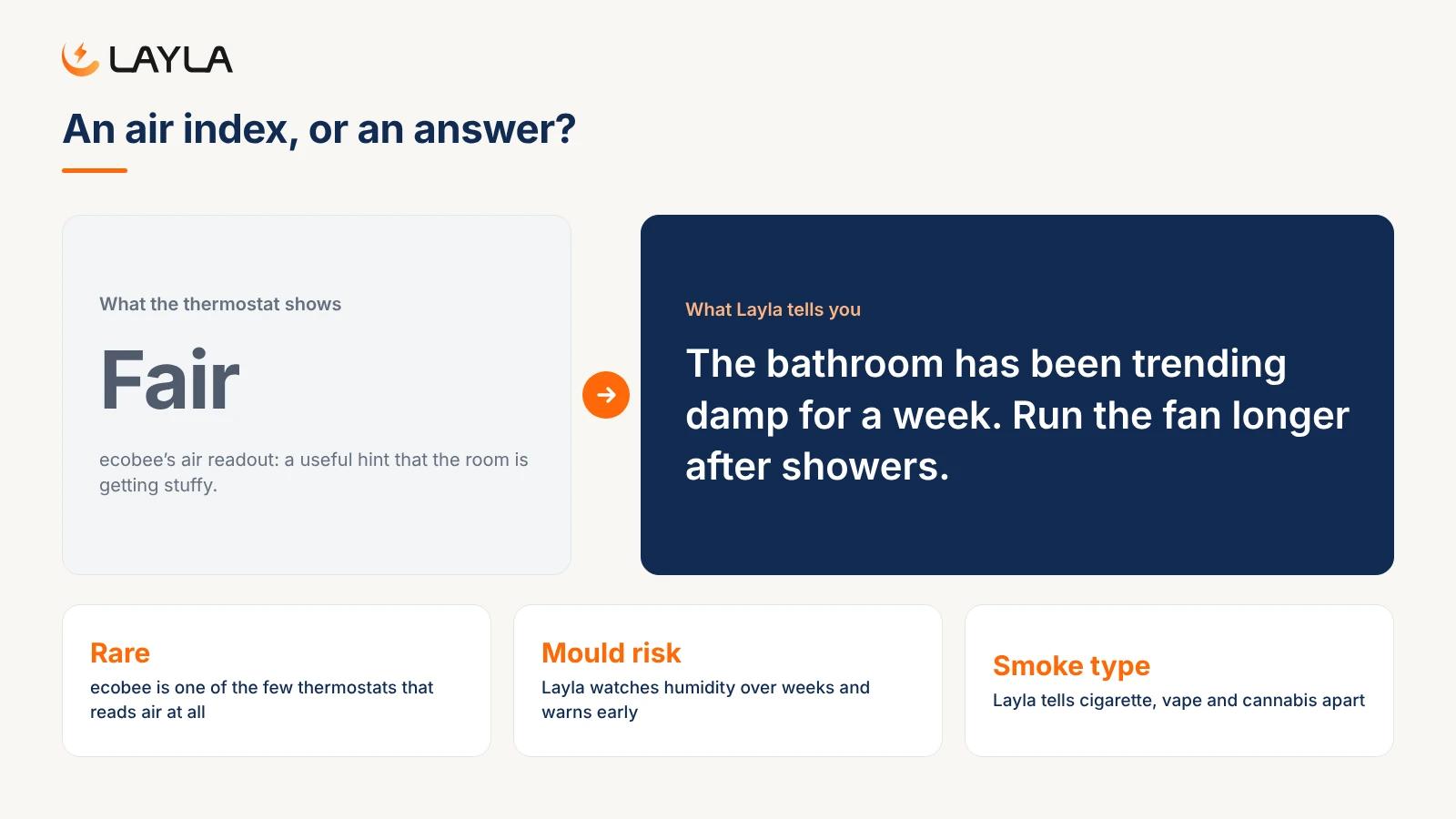
ecobee shows you an air-quality index; Layla turns the same kind of signals into a verdict. Layla 4.0 gives you a Comfort score, a Sleep score and an Air quality score, each paired with a plain sentence that names the reading, explains it, and tells you the move to make. On the air side it goes past ecobee's VOC-and-CO2 index to a mould-risk warning that watches humidity over time and flags before damp becomes a wall problem, plus smoke type identification that can tell a cigarette from a vape from cannabis. You can see the full set on the air quality page. ecobee tells you the air is "fair." Layla tells you the bathroom has been trending damp for a week and is drifting into the humidity band where mould takes hold, so run the fan longer after showers.
And it fits where ecobee physically can't. Layla's AC Control & Energy tier controls heat pumps and AC units across 150+ brands over infrared, with no wiring, so it serves the mini-split, window-AC and ductless homes that have no 24-volt thermostat for an ecobee to replace. Its energy saving runs on the same radar presence it uses to sense the room. Eco Mode drops the unit to standby once the space clears out, with no camera and no microphone involved. ecobee's radar drives home-and-away for a central system; Layla reads the specific room and acts on it.
Layla's tiers are one-time, no subscription: AC Control & Energy at $89, Smoke & Air Quality at $99, All-in-One at $299. The ladder is on pricing, the climate set on the control and energy page.
How layla vs ecobee compares on air and energy
This is the matchup where ecobee actually competes on air, so it's worth being exact. ecobee reads VOCs and CO2 as an index on the thermostat, which is more than almost any rival thermostat offers, and for a lot of homes that's a useful nudge. Layla reads CO2, VOCs and humidity too, but it converts them into scores and warnings (a mould-risk flag, a Sleep score built from the overnight air, smoke type on top) rather than an index you interpret yourself. If you just want a hint that the room's stuffy, ecobee's readout does it. If you want to understand and act on the air, Layla's interpreted version goes further, and it adds coverage like smoke identification that ecobee's VOC-and-CO2 sensor doesn't attempt.
On energy, ecobee's eco+ and utility rebates are a strong, proven play for a central-HVAC home, and its room sensors genuinely help by heating and cooling the rooms you're actually in. Layla's energy case is the presence-based shutoff on room units: cut the AC when the specific room is empty, with documented reductions of up to 25% on busy properties, and nothing recurring. Neither charges a subscription for its core job, which keeps the comparison about fit rather than fees. ecobee is the smarter thermostat for ducted HVAC; Layla is the more complete monitor and the one that fits ductless homes.
At a glance
| Layla (AC Control & Energy / Air Quality) | ecobee Smart Thermostat Premium | |
|---|---|---|
| Device type | Room monitor + IR AC controller | Wired central-HVAC thermostat |
| Fits mini-split / window-AC homes | Yes, no wiring | No; needs central HVAC + C-wire (PEK included) |
| Air quality | Scored: CO2, VOC, humidity, mould risk, smoke type | Onboard VOC + CO2 index (no PM2.5, not lab-grade) |
| Occupancy | Radar, per room, drives AC shutoff | Radar, drives home/away + room balancing |
| Noise / smoke / mould | Yes (across tiers) | No |
| Ecosystem | App and voice; no HomeKit | HomeKit, Alexa built-in, Google, SmartThings (no Matter) |
| Subscription | None | None for climate |
| Price | From $89 (climate) / $99 (air) one-time | $139–$259 |
Which one should you buy?
There are two buyers here, and the honest version gives each a real win.
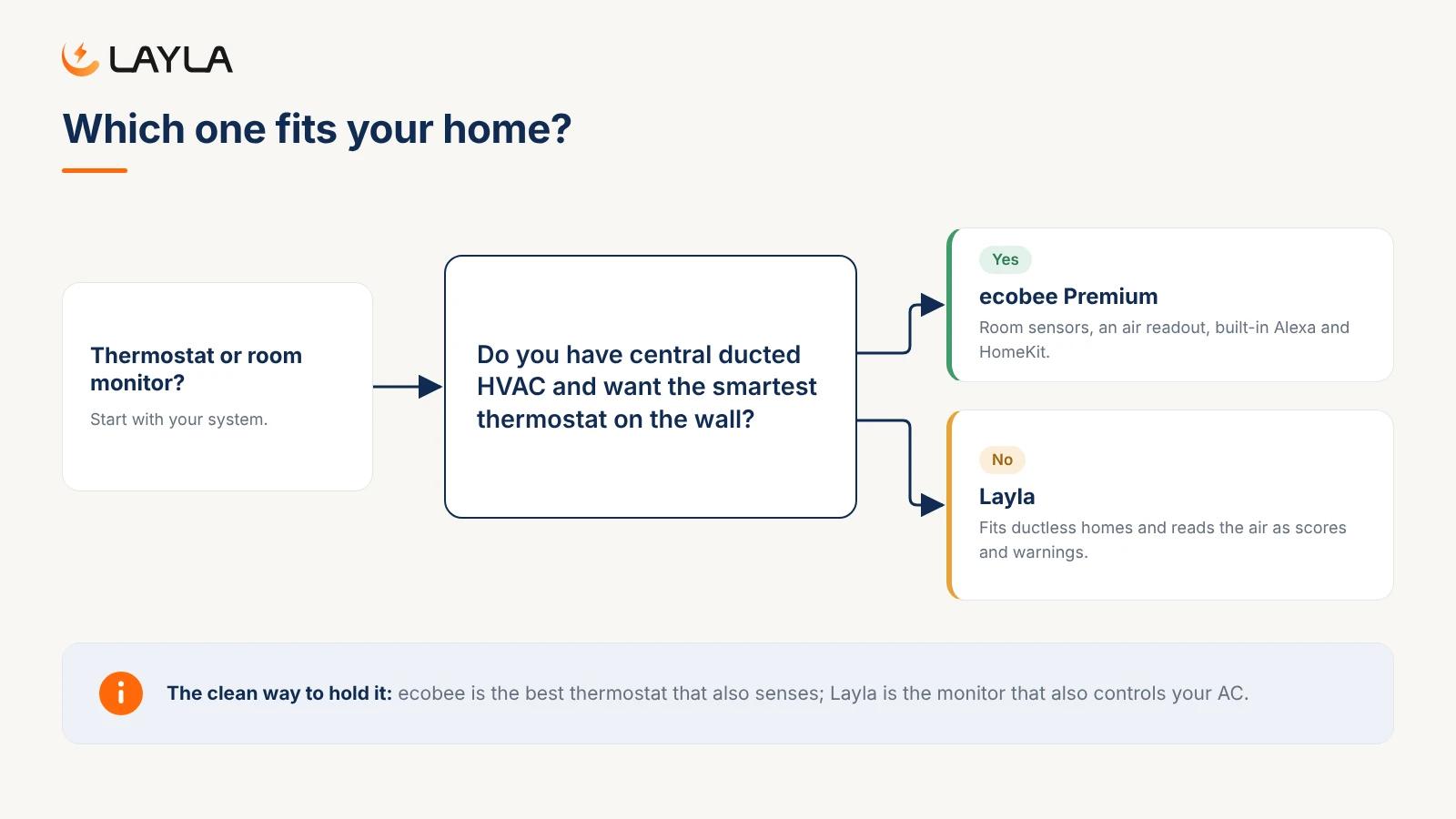
If you have central ducted HVAC and want the smartest thermostat on the wall (room balancing, an air-quality readout, built-in Alexa, HomeKit), buy the ecobee Premium. The room sensors earn their keep, and on a ducted home it's a better climate controller than Layla. I'd point a central-HVAC owner straight to it.
If you want the room genuinely monitored, with air read as scores, mould and smoke watched, comfort and sleep explained, or you live in a mini-split or window-AC home with no thermostat wire to replace, buy Layla. It fits where an ecobee can't, reads the air more completely and tells you what to do about it, and shuts cooling off when the specific room is empty, from $89 with nothing recurring. It's the natural ecobee alternative for anyone whose home is ductless or whose real interest is the air, not the thermostat.
The clean way to hold it: ecobee is the best thermostat that also senses; Layla is the monitor that also controls your AC. If the thermostat is the point, ecobee. If the room is the point, Layla.
Get Layla — from $89, no subscription
See Layla pricing — own it once →
Control the AC, cut the waste from empty rooms, and get the Comfort, Sleep and Air scores that tell you what your home is actually doing. One device, one payment, free shipping, a one-year warranty, and 30 days to change your mind.
Frequently asked questions
Is Layla a good ecobee alternative?
For ductless homes and for anyone whose main interest is the air, yes. Layla fits mini-split and window-AC homes an ecobee can't wire into, and it reads air as a scored Air quality signal with mould-risk and smoke identification rather than a VOC-and-CO2 index. For a central-HVAC home that wants the smartest thermostat, the ecobee Premium is the stronger pick.
Does the ecobee Premium really monitor air quality?
Yes, and it's fair to say so: it has a built-in VOC and CO2 readout, which is more than most thermostats. The limits are that it's a basic index with no PM2.5 and isn't lab-grade, and it has no mould or smoke insight. Layla measures CO2, VOCs and humidity and turns them into a score with a mould-risk warning and smoke type identification.
Can an ecobee control a mini-split?
No. The ecobee is a wired thermostat for central HVAC and needs a 24-volt system to connect to. A mini-split has no thermostat wire, so it needs an infrared controller, which is what Layla uses.
Which has better occupancy sensing?
Both use radar, which is the good kind — no camera, no microphone. The difference is what it drives: ecobee's radar runs whole-home home/away and room balancing on a central system, while Layla's reads the specific room and shuts its AC off when it's empty.
Do either need a subscription?
No. ecobee's climate features and Layla are both one-time with no subscription. (ecobee sells an optional security plan, which is unrelated to the thermostat.)
Keep reading
- Layla vs Nest — the other major wired-thermostat comparison
- Layla vs Sensibo — AC controller head-to-head
- Best air quality monitors for home — if the air side is the point

Best for: cutting the power bill
AC Control & Energy
Stop cooling empty rooms. Start saving on energy.
Included forever — no subscription
- Smart AC remote control (IR) — 150+ brands
- Occupancy-based AC auto-off — when no one's around
- Scheduling, timers & temperature-based automation
- Filter-health estimation & replacement alerts
- Energy usage insights
- Indoor temperature & humidity
No monthly fees. Ever.
AC is the biggest energy expense in any property.
It accounts for 16% of all U.S. household electricity use - and in hot states, 30-40% of vacation rental operating costs during summer. Monthly bills regularly hit $300-400+ in peak season.
Empty rooms are burning money.
Smart occupancy-based controls deliver 20-30% annual HVAC energy savings. Hotels using this approach save up to $20,000/year per property. If no one's in the room, the AC shouldn't be running.
Energy costs are rising faster than inflation.
U.S. residential electricity prices rose 4.3% in 2025 with another 4.1% projected for 2026 - more than double the rate of general inflation. What was marginal profit is now a loss for many rental hosts.
30-day money back guarantee